PUBLISHER: Mordor Intelligence | PRODUCT CODE: 2113427

PUBLISHER: Mordor Intelligence | PRODUCT CODE: 2113427
United States Veterinary Healthcare - Market Share Analysis, Industry Trends & Statistics, Growth Forecasts (2026 - 2031)
According to Mordor Intelligence, the United States veterinary healthcare market size is projected to expand from USD 21.21 billion in 2025 and USD 22.34 billion in 2026 to USD 28.98 billion by 2031, registering a CAGR of 5.34% between 2026 to 2031.
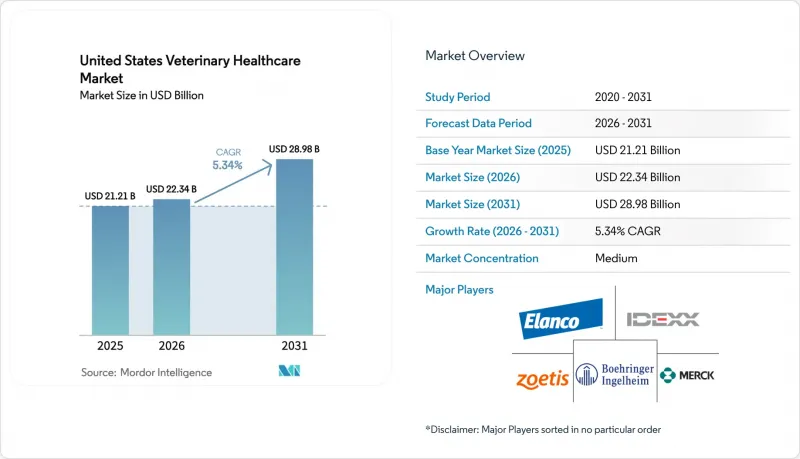
This report is Segmented by Product (Therapeutics, Diagnostics), Animal Type (Dogs and Cats, Horses, Ruminants, Swine, Poultry, Other Animals), and End User (Veterinary Clinics, Hospitals, Reference Laboratories, Livestock Producers, Home-care/Tele-veterinary Users, Others). Market Forecasts are Provided in Value (USD).
United States Veterinary Healthcare Market Trends and Insights
Rising Pet Ownership & Expenditure
American households owned 89.7 million dogs and 73.8 million cats in 2024, spending USD 598 and USD 529 per household respectively on veterinary care, a pattern that normalizes preventive plans and chronic-disease protocols. Limited pet-insurance penetration below 5% leaves most owners paying out of pocket, yet millennials and Gen Z increasingly regard pets as family members, sustaining demand for oncology, cardiology, and orthopedic services. Digital-first engagement preferences fuel telemedicine sign-ups and at-home monitoring adoption, broadening the care continuum beyond episodic clinic visits. The willingness to finance high-acuity interventions lifts average transaction values and offsets pricing elasticity concerns. These trends collectively support premium diagnostic and biologic uptake even when macroeconomic conditions tighten.
Advanced Technology & Innovation in Animal Healthcare
The FDA's January 2025 approval of Librela, the first monoclonal antibody for canine osteoarthritis, validated a biologics pathway and created repeat-visit revenue models for clinics equipped with cold-chain storage. Point-of-care molecular tests now deliver PCR-grade sensitivity in under 20 minutes, allowing same-visit therapeutic starts and reducing abandonment. IDEXX's Inovu DX embeds AI trained on 4 million radiographs, lowering diagnostic error rates in general practice and reinforcing platform lock-in. Gene-edited PRRS-resistant pigs signal similar innovation for production animals, although widespread adoption awaits trade and consumer-acceptance resolution. Taken together, these advances compress diagnostic windows, elevate standard-of-care expectations, and expand addressable revenue per visit.
High Costs of Veterinary Testing & Treatment
The Consumer Price Index for veterinary services rose 10% yearly from 2020 to 2024, far outpacing general inflation, driving emergency visit bills to USD 1,500-3,000 and MRI scans to USD 2,000-3,500. Only 4.4% of U.S. pets had insurance in 2024, forcing owners to finance care via credit products that charge interest rates above 20%, which causes deferred or foregone treatments. This affordability ceiling suppresses volume growth, particularly in chronic disease where lifetime costs accumulate. Rural and low-income populations seek telehealth or online pharmacies as substitutes, eroding full-service clinic revenue in those areas.
Other drivers and restraints analyzed in the detailed report include:
- Government & Animal-Welfare Initiatives
- Productivity Pressures Increasing Zoonotic Risk
- Stringent Regulatory Approval Timelines
For complete list of drivers and restraints, kindly check the Table Of Contents.
Segment Analysis
Diagnostics revenue is projected to climb at a 6.76% CAGR through 2031, surpassing therapeutics and lifting the United States veterinary healthcare market size for this segment to USD 11.2 billion by the end of the forecast period. Therapeutics retained a 62.46% share in 2025, but information-rich point-of-care assays now compress diagnostic cycles to minutes, compelling practices to preface treatment with evidence rather than empirical protocols. The United States veterinary healthcare market share advantage for therapeutics is therefore narrowing as diagnostics command a larger share of the clinical workflow.
Vaccines and parasiticides dominate companion-animal spending, while feed additives and anti-infectives drive production-animal uptake. Zoetis's Simparica Trio reduced owner pill burden and captured incremental share, whereas monoclonal antibodies such as Librela inaugurate recurring injection models. Catalyst One and ProCyte One analyzers yield full blood work within 10 minutes, delivering lab-grade accuracy chairside. As AI augments imaging reads, general practitioners confidently perform advanced diagnostics without specialist referrals, deepening in-house revenue capture and cementing platform loyalty.
Complete Report Scope:
- By Product
- Therapeutics
- Vaccines
- Parasiticides
- Anti-infectives
- Medical Feed Additives
- Other Therapeutics
- Diagnostics
- Immunodiagnostic Tests
- Molecular Diagnostics
- Diagnostic Imaging
- Clinical Chemistry
- Other Diagnostics
- Therapeutics
- By Animal Type
- Dogs and Cats
- Horses
- Ruminants
- Swine
- Poultry
- Other Animals
- By End User
- Veterinary Clinics
- Veterinary Hospitals
- Reference Laboratories
- Livestock Producers
- Home-care / Tele-veterinary Users
- Others
List of Companies Covered in this Report:
- Bimeda
- Boehringer Ingelheim
- Central Garden & Pet (Animal Health)
- Ceva Sante Animale
- Covetrus
- Dechra Pharmaceuticals
- Elanco
- Heska
- IDEXX
- Mars Veterinary Health
- MedVet
- Merck
- Neogen
- Norbrook Laboratories
- Patterson Companies (Animal Health)
- Phibro Animal Health
- Vetoquinol
- Virbac
- Zoetis
Additional Benefits:
- The market estimate (ME) sheet in Excel format
- 3 months of analyst support
TABLE OF CONTENTS
1 Introduction
- 1.1 Study Assumptions & Market Definition
- 1.2 Scope of the Study
2 Research Methodology
3 Executive Summary
4 Market Landscape
- 4.1 Market Overview
- 4.2 Market Drivers
- 4.2.1 Rising pet ownership & expenditure
- 4.2.2 Advanced technology & innovation in animal healthcare
- 4.2.3 Government & animal-welfare initiatives
- 4.2.4 Productivity pressures increasing zoonotic risk
- 4.2.5 AI-driven predictive diagnostics adoption
- 4.2.6 Gene-edited therapeutics pipeline momentum
- 4.3 Market Restraints
- 4.3.1 High costs of veterinary testing & treatment
- 4.3.2 Stringent regulatory approval timelines
- 4.3.3 Veterinary workforce shortage
- 4.3.4 Biologics-input supply-chain vulnerabilities
- 4.4 Supply / Value-Chain Analysis
- 4.5 Regulatory Landscape
- 4.6 Technological Outlook
- 4.7 Porter's Five Forces Analysis
- 4.7.1 Threat of New Entrants
- 4.7.2 Bargaining Power of Buyers/Consumers
- 4.7.3 Bargaining Power of Suppliers
- 4.7.4 Threat of Substitute Products
- 4.7.5 Intensity of Competitive Rivalry
5 Market Size & Growth Forecasts (Value, USD)
- 5.1 By Product
- 5.1.1 Therapeutics
- 5.1.1.1 Vaccines
- 5.1.1.2 Parasiticides
- 5.1.1.3 Anti-infectives
- 5.1.1.4 Medical Feed Additives
- 5.1.1.5 Other Therapeutics
- 5.1.2 Diagnostics
- 5.1.2.1 Immunodiagnostic Tests
- 5.1.2.2 Molecular Diagnostics
- 5.1.2.3 Diagnostic Imaging
- 5.1.2.4 Clinical Chemistry
- 5.1.2.5 Other Diagnostics
- 5.1.1 Therapeutics
- 5.2 By Animal Type
- 5.2.1 Dogs and Cats
- 5.2.2 Horses
- 5.2.3 Ruminants
- 5.2.4 Swine
- 5.2.5 Poultry
- 5.2.6 Other Animals
- 5.3 By End User
- 5.3.1 Veterinary Clinics
- 5.3.2 Veterinary Hospitals
- 5.3.3 Reference Laboratories
- 5.3.4 Livestock Producers
- 5.3.5 Home-care / Tele-veterinary Users
- 5.3.6 Others
6 Competitive Landscape
- 6.1 Market Concentration
- 6.2 Market Share Analysis
- 6.3 Company Profiles (includes Global level Overview, Market level overview, Core Segments, Financials as available, Strategic Information, Market Rank/Share for key companies, Products & Services, and Recent Developments)
- 6.3.1 Bimeda Inc.
- 6.3.2 Boehringer Ingelheim Animal Health
- 6.3.3 Central Garden & Pet (Animal Health)
- 6.3.4 Ceva Sante Animale
- 6.3.5 Covetrus
- 6.3.6 Dechra Pharmaceuticals
- 6.3.7 Elanco Animal Health
- 6.3.8 Heska Corporation
- 6.3.9 IDEXX Laboratories
- 6.3.10 Mars Veterinary Health
- 6.3.11 MedVet
- 6.3.12 Merck Animal Health
- 6.3.13 Neogen Corporation
- 6.3.14 Norbrook Laboratories
- 6.3.15 Patterson Companies (Animal Health)
- 6.3.16 Phibro Animal Health
- 6.3.17 Vetoquinol
- 6.3.18 Virbac SA
- 6.3.19 Zoetis Inc.
7 Market Opportunities & Future Outlook
- 7.1 White-space & Unmet-Need Assessment

