PUBLISHER: Mordor Intelligence | PRODUCT CODE: 2113350

PUBLISHER: Mordor Intelligence | PRODUCT CODE: 2113350
Carbon Management Software - Market Share Analysis, Industry Trends & Statistics, Growth Forecasts (2026 - 2031)
According to Mordor Intelligence, the carbon management software market size is estimated at USD 18.17 billion in 2026, and is expected to reach USD 31.5 billion by 2031, at a CAGR of 11.63% during the forecast period (2026-2031).
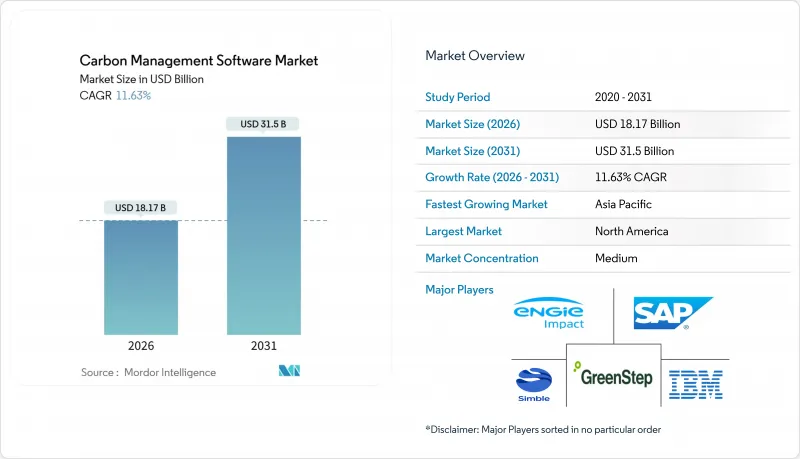
This report is Segmented by Offering (Software and Services), Deployment Mode (Cloud-Based and On-Premise), Application (Energy, Greenhouse Gas Management, Sustainability, and More), End-User Industry (Oil and Gas, Manufacturing, Healthcare, and More), Organization Size (Large Enterprises and Small and Medium Enterprises), and Geography. The Market Forecasts are Provided in Terms of Value (USD).
Global Carbon Management Software Market Trends and Insights
Stricter Carbon-Disclosure Regulations
The March 2024 SEC rule triggered a 40% year-over-year surge in U.S. demand for audit-ready platforms during 1H 2025. Parallel pressure stems from the Corporate Sustainability Reporting Directive, which extends mandatory reporting to roughly 50,000 European companies starting with fiscal 2025 filings. Multinationals, therefore, need multi-tenant solutions that toggle between divergent jurisdictional templates without duplicating data collection. Early adopters embedding carbon metrics into quarterly close reports have 25% lower external assurance costs compared with spreadsheet-based late movers. Competitive advantage now hinges on how quickly a vendor updates rule libraries and maintains immutable audit trails for regulators and investors alike.
Corporate Net-Zero Commitments and ESG Pressure
More than 4,000 companies with a market capitalization of USD 70 trillion have set net-zero targets, yet fewer than 1 in 5 maintain inventories granular enough to track progress against interim milestones. Asset managers overseeing USD 130 trillion expect portfolio firms to disclose full Scope-3 emissions, making carbon transparency a capital-access prerequisite. Supplier portals that enable tier-one manufacturers to pull product-level data via standardized APIs are therefore proliferating, especially in automotive and consumer goods. Verified reductions unlock cheaper sustainability-linked loans, a market that exceeded USD 450 billion in new issuance during 2024. Brand and talent risks add another layer: a 2025 survey found 62% of millennials shun employers without credible decarbonization plans.
High Implementation and Integration Costs for SMEs
Initial outlays range from USD 50,000 to USD 200,000, once integration and training are included, equal to 2-5% of a firm's annual IT budget for firms with fewer than 500 staff. Custom APIs for legacy enterprise resource planning platforms can add 30-50% to project costs and push payback beyond 12 months. Limited in-house sustainability talent forces reliance on consultants billing USD 150-USD 300 per hour, while the absent of interval-metered energy data inflates uncertainty in reported footprints. Freemium tiers and modular pricing are emerging, but financing programs still focus on physical assets rather than software subscriptions, slowing uptake among capital-constrained firms.
Other drivers and restraints analyzed in the detailed report include:
- AI-Driven Scope-3 Data Harmonization
- Cost Savings from Energy-Efficiency and Cloud Migration
- Data-Accuracy and Standardization Challenges
For complete list of drivers and restraints, kindly check the Table Of Contents.
Segment Analysis
Services captured 31.7% of 2025 revenue, but they are forecast to post the fastest 12.1% CAGR, as enterprises outsource data engineering and assurance tasks that internal teams struggle to staff. API build work, ERP connector setup, and data migration account for roughly 40% of service billings. Managed services are growing because resource-constrained companies prefer vendors that keep their emission-factor libraries up to date and prepare filings. Training and change-management support drive user adoption rates above 80% in successful rollouts. Outcome-based pricing that links fees to verified reductions is taking hold, though measurement and attribution remain contentious. As these models mature, the carbon management software market sees service providers embedding themselves in long-term client workflows rather than on one-off projects, boosting visibility into recurring revenue.
The consulting component commands premium rates when multinationals juggle U.S., EU, and Asia-Pacific regulations. Third-party assurance is a high-growth niche because investors now demand independent verification under the Corporate Sustainability Reporting Directive. Combined, these trends elevate services from a supporting role to a central growth lever, widening the total addressable market for carbon management software.
Cloud installations accounted for 73.7% of 2025 billings and are expected to maintain an 11.9% CAGR through 2031. Multi-tenant architectures cut per-user costs by up to 60% and automatically update the rule library, keeping customers current with evolving disclosure frameworks. Hyperscale infrastructure also supplies the compute needed for AI-driven Scope-3 estimation and real-time analytics. For regulated utilities and banks subject to data-residency mandates, hybrid models store sensitive operational data on-premise while dispatching anonymized aggregates to the cloud for processing. Although on-premises still holds a 26.3% share, its footprint shrinks each year as vendors announce the end of life for perpetual licenses, offering migration credits to cushion the transition. This shift keeps the carbon management software market aligned with broader enterprise-software trends toward subscription revenue and continuous delivery.
Edge deployments are gaining traction in steel and chemicals, where latency-free insights optimize furnace loads and cut energy waste by 10-15%. As 5G networks mature, vendors expect edge-native modules to free heavy industry from bandwidth constraints. Nonetheless, cloud remains the backbone because supply-chain data aggregation and investor reporting need globally accessible platforms.
Complete Report Scope:
- By Offering
- Software
- Services
- By Deployment Mode
- Cloud-Based
- On-Premise
- By Application
- Energy
- Greenhouse Gas Management
- Air Quality Management
- Sustainability
- Other Applications
- By End-User Industry
- Oil and Gas
- Manufacturing
- Healthcare
- IT and Telecom
- Power and Utilities
- Transportation and Logistics
- Construction and Infrastructure
- Other End-User Industries
- By Organization Size
- Large Enterprises
- Small and Medium Enterprises
- By Geography
- North America
- United States
- Canada
- Mexico
- South America
- Brazil
- Argentina
- Rest of South America
- Europe
- Germany
- United Kingdom
- France
- Italy
- Spain
- Russia
- Rest of Europe
- Asia-Pacific
- China
- Japan
- India
- South Korea
- ASEAN
- Australia and New Zealand
- Rest of Asia-Pacific
- Middle East and Africa
- Middle East
- Saudi Arabia
- United Arab Emirates
- Turkey
- Rest of Middle East
- Africa
- South Africa
- Nigeria
- Rest of Africa
- Middle East
- North America
Geography Analysis
North America retained 35.85% of 2025 turnover, buoyed by early regulatory moves and abundant venture capital that accelerated the formation of start-ups in climate analytics. Large U.S. corporates devote USD 2-USD 5 million annually to carbon-IT stacks, and Canada's federal carbon-pricing framework keeps domestic demand resilient. Yet the carbon management software market is seeing a shift in momentum toward the East.
Europe held a roughly 30% share on the back of the Corporate Sustainability Reporting Directive and the looming Carbon Border Adjustment Mechanism, which forces exporters to document cradle-to-gate emissions or face tariffs. Germany, the United Kingdom, and France account for 60% of regional spend, as headquarters functions centralize data governance. The directive's extraterritorial reach nudges non-EU suppliers toward compatible platforms, indirectly enlarging market scope.
Asia-Pacific is the fastest riser with an 11.85% CAGR, propelled by China's dual-carbon goals and India's energy-transition roadmap. Japan's Green Transformation Fund and South Korea's emissions-trading obligations add further pull. Association of Southeast Asian Nations members, led by Singapore, mandate reporting for listed companies, spurring adoption across export-oriented supply chains. Australia and New Zealand already show uptake levels akin to those in North America, thanks to long-standing cap-and-trade schemes.
South America accounts for 8% of revenue, led by Brazil's deforestation monitoring and Argentina's renewable build-out. The Middle East and Africa contribute 10%, anchored by net-zero pledges from Gulf energy giants and carbon-tax frameworks in South Africa and Nigeria. Though smaller bases temper absolute revenues, both regions show above-average pipeline growth as energy diversification policies and investor scrutiny converge.
- IBM Corporation
- SAP SE
- ENGIE Impact
- Simble Solutions Ltd
- GreenStep Solutions Inc.
- Microsoft Corporation
- Schneider Electric SE
- Salesforce.com Inc.
- Greenstone + Ltd
- Sphera Solutions
- Enablon SA (Wolters Kluwer)
- IsoMetrix
- Persefoni AI
- Watershed Technology Inc.
- Plan A
- Net0
- Sinai Technologies Inc.
- Workiva Inc.
- Brightly Software
- Terrascope Pte Ltd
- Carbmee GmbH
- Diligent Corporation
- Emitwise
- Sweep SAS
- Greenly
Additional Benefits:
- The market estimate (ME) sheet in Excel format
- 3 months of analyst support
TABLE OF CONTENTS
1 INTRODUCTION
- 1.1 Study Assumptions and Market Definition
- 1.2 Scope of the Study
2 RESEARCH METHODOLOGY
3 EXECUTIVE SUMMARY
4 MARKET LANDSCAPE
- 4.1 Market Overview
- 4.2 Market Drivers
- 4.2.1 Stricter Carbon-Disclosure Regulations (SEC, CSRD)
- 4.2.2 Corporate Net-Zero Commitments and ESG Pressure
- 4.2.3 Cost Savings from Energy-Efficiency and Cloud Migration
- 4.2.4 AI-Driven Scope-3 Data Harmonization Unlocks ESG Finance
- 4.2.5 Tokenized Carbon-Credit Integration into EMS Platforms
- 4.2.6 Mandated Digital Product Passports for Scope-3 Traceability
- 4.3 Market Restraints
- 4.3.1 High Implementation and Integration Costs for SMEs
- 4.3.2 Data-Accuracy and Standardization Challenges
- 4.3.3 Vendor Lock-In Risk from Proprietary Emission Factors
- 4.3.4 Cyber-Security Liabilities in Audit-Grade Data Trails
- 4.4 Impact of Macroeconomic Factors on the Market
- 4.5 Industry Value Chain Analysis
- 4.6 Regulatory Landscape
- 4.7 Technological Outlook
- 4.8 Porter's Five Forces Analysis
- 4.8.1 Bargaining Power of Suppliers
- 4.8.2 Bargaining Power of Buyers
- 4.8.3 Threat of New Entrants
- 4.8.4 Threat of Substitutes
- 4.8.5 Intensity of Competitive Rivalry
- 4.9 Other Structural Analyses
- 4.9.1 Investment and Funding Trends
- 4.9.2 Patent Landscape
5 MARKET SIZE AND GROWTH FORECASTS (VALUE)
- 5.1 By Offering
- 5.1.1 Software
- 5.1.2 Services
- 5.2 By Deployment Mode
- 5.2.1 Cloud-Based
- 5.2.2 On-Premise
- 5.3 By Application
- 5.3.1 Energy
- 5.3.2 Greenhouse Gas Management
- 5.3.3 Air Quality Management
- 5.3.4 Sustainability
- 5.3.5 Other Applications
- 5.4 By End-User Industry
- 5.4.1 Oil and Gas
- 5.4.2 Manufacturing
- 5.4.3 Healthcare
- 5.4.4 IT and Telecom
- 5.4.5 Power and Utilities
- 5.4.6 Transportation and Logistics
- 5.4.7 Construction and Infrastructure
- 5.4.8 Other End-User Industries
- 5.5 By Organization Size
- 5.5.1 Large Enterprises
- 5.5.2 Small and Medium Enterprises
- 5.6 By Geography
- 5.6.1 North America
- 5.6.1.1 United States
- 5.6.1.2 Canada
- 5.6.1.3 Mexico
- 5.6.2 South America
- 5.6.2.1 Brazil
- 5.6.2.2 Argentina
- 5.6.2.3 Rest of South America
- 5.6.3 Europe
- 5.6.3.1 Germany
- 5.6.3.2 United Kingdom
- 5.6.3.3 France
- 5.6.3.4 Italy
- 5.6.3.5 Spain
- 5.6.3.6 Russia
- 5.6.3.7 Rest of Europe
- 5.6.4 Asia-Pacific
- 5.6.4.1 China
- 5.6.4.2 Japan
- 5.6.4.3 India
- 5.6.4.4 South Korea
- 5.6.4.5 ASEAN
- 5.6.4.6 Australia and New Zealand
- 5.6.4.7 Rest of Asia-Pacific
- 5.6.5 Middle East and Africa
- 5.6.5.1 Middle East
- 5.6.5.1.1 Saudi Arabia
- 5.6.5.1.2 United Arab Emirates
- 5.6.5.1.3 Turkey
- 5.6.5.1.4 Rest of Middle East
- 5.6.5.2 Africa
- 5.6.5.2.1 South Africa
- 5.6.5.2.2 Nigeria
- 5.6.5.2.3 Rest of Africa
- 5.6.5.1 Middle East
- 5.6.1 North America
6 COMPETITIVE LANDSCAPE
- 6.1 Market Concentration
- 6.2 Strategic Moves
- 6.3 Market Share Analysis
- 6.4 Company Profiles (includes Global level Overview, Market Level Overview, Core Segments, Financials as Available, Strategic Information, Market Rank/Share for Key Companies, Products and Services, and Recent Developments)
- 6.4.1 IBM Corporation
- 6.4.2 SAP SE
- 6.4.3 ENGIE Impact
- 6.4.4 Simble Solutions Ltd
- 6.4.5 GreenStep Solutions Inc.
- 6.4.6 Microsoft Corporation
- 6.4.7 Schneider Electric SE
- 6.4.8 Salesforce.com Inc.
- 6.4.9 Greenstone + Ltd
- 6.4.10 Sphera Solutions
- 6.4.11 Enablon SA (Wolters Kluwer)
- 6.4.12 IsoMetrix
- 6.4.13 Persefoni AI
- 6.4.14 Watershed Technology Inc.
- 6.4.15 Plan A
- 6.4.16 Net0
- 6.4.17 Sinai Technologies Inc.
- 6.4.18 Workiva Inc.
- 6.4.19 Brightly Software
- 6.4.20 Terrascope Pte Ltd
- 6.4.21 Carbmee GmbH
- 6.4.22 Diligent Corporation
- 6.4.23 Emitwise
- 6.4.24 Sweep SAS
- 6.4.25 Greenly
7 MARKET OPPORTUNITIES AND FUTURE OUTLOOK
- 7.1 White-space and Unmet-Need Assessment

