PUBLISHER: Mordor Intelligence | PRODUCT CODE: 2113360

PUBLISHER: Mordor Intelligence | PRODUCT CODE: 2113360
United Kingdom Endoscopy Devices - Market Share Analysis, Industry Trends & Statistics, Growth Forecasts (2026 - 2031)
According to Mordor Intelligence, the United Kingdom endoscopy devices market size in 2026 is estimated at USD 1.87 billion, growing from 2025 value of USD 1.76 billion with 2031 projections showing USD 2.51 billion, growing at 6.09% CAGR over 2026-2031.
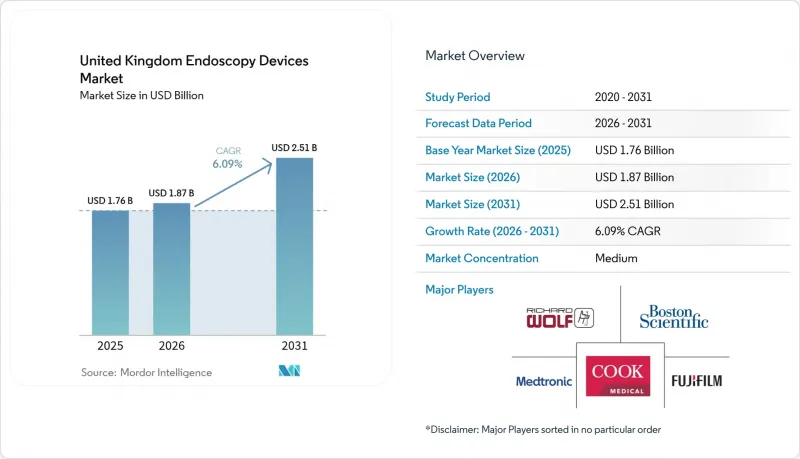
This report is Segmented by Device Type (Endoscopes [Rigid Endoscope, and More], Endoscopic Operative Devices [Suction Systems, and More], and Visualization Equipment), Application (Gastroenterology, Pulmonology, ENT Surgery, Gynecology, and More), and End User (Hospitals, Ambulatory Surgery Centres, and Out-Patient Clinics). The Market Forecasts are Provided in Terms of Value (USD).
United Kingdom Endoscopy Devices Market Trends and Insights
NHS Bowel-Cancer Screening Expansions Boost Colonoscopy Volumes
NHS England's GBP 6 million colon-capsule endoscopy pilot delivered 2,288 procedures across 51 trusts in 2024, underscoring a deliberate pivot toward less-invasive diagnostics that demand fewer clinical endoscopists. Early success has encouraged parallel rollouts in Scotland and Wales, signalling national scalability that will influence equipment procurement for both capsule systems and supporting visualization towers. Large-city teaching hospitals such as UCLH, Guy's & St Thomas' and Milton Keynes University Hospital are already reserving dedicated lists for capsule studies, building predictable throughput for vendors. As acceptance widens, traditional colonoscope fleets face slower replacement in favor of hybrid portfolios that include capsules for screening and conventional scopes for therapeutic follow-up. The resulting mixed-modality demand supports continued revenue growth even in the face of workforce scarcity.
AI-Enhanced Polyp-Detection Software Accelerates Diagnostic Adoption
Completion of the COLO-DETECT trial and NHS deployment of the GI Genius platform mark a watershed in UK gastroenterology, marrying 4K imaging with real-time lesion identification. Trusts adopting the software report higher adenoma detection and shorter withdrawal times, translating into higher list utilization and reduced overtime payments. Vendor-run training programs allow trainee endoscopists to achieve competency faster, partially offsetting attrition among experienced clinicians. Integration with existing picture-archiving systems has proven smooth under the MHRA's digital-health pre-submission route, encouraging broader uptake before the UKCA deadline. As early adopters demonstrate measurable productivity gains, peer organisations face mounting pressure to budget for AI add-ons during the next capital cycle.
Endoscopist Workforce Gap Limits Throughput
A 2023 pan-workforce survey recorded a 31.5% five-year intention-to-leave among clinical endoscopists, who already conduct 78% more sessions per capita than consultant gastroenterologists. Advanced ERCP capacity is even more fragile, with practitioners over 55 registering 76.6% exit intentions, jeopardising training pipelines. Just 9% of gastroenterology trainees are on track for ERCP competence at completion, while over a quarter plan to leave the NHS entirely. NHS England's long-term workforce plan requires 40,000 additional doctors to meet OECD averages, but medical-school caps and limited registrar slots undermine the objective. Without enough operators, new imaging towers risk under-utilisation, placing a structural ceiling on the growth trajectory of the United Kingdom endoscopy devices market.
Other drivers and restraints analyzed in the detailed report include:
- Disposable Bronchoscopes Mitigate Cross-Infection & Reprocessing Costs
- Surge in Day-Case GI Procedures Across UK Independent Treatment Centres
- Capital-Budget Squeeze in NHS Hospital Trusts
For complete list of drivers and restraints, kindly check the Table Of Contents.
Segment Analysis
Endoscopes accounted for 45.10% of United Kingdom endoscopy devices market share in 2025, confirming their centrality to both diagnostic and therapeutic workflows across public and private settings. Flexible scopes dominate because they serve high-volume gastroenterology and pulmonology lists, while rigid scopes remain essential for niche ENT and orthopedic procedures with higher per-case value. Capsule endoscope uptake jumped after the 51-trust NHS pilot, demonstrating patient preference for non-invasive screening and enabling hospitals to tackle growing bowel-cancer test backlogs without proportional staffing increases. In parallel, robotic-compatible scopes are gaining prominence as the NHS targets 500,000 robot-assisted operations annually by 2035, embedding endoscopy visualization within surgical arms.
Visualization equipment is the fastest-growing device cluster, projected at an 10.78% CAGR thanks to 4K procurement mandates and AI overlay requirements that transform legacy towers into decision-support hubs. Early adopters cite measurable improvement in adenoma detection, cut-through times and theatre utilisation, making investment justifiable even amid capital constraints. Endoscopic operative devices and single-use accessories also benefit: cross-contamination lawsuits and rising sterilisation premiums encourage hospitals to dedicate more of the United Kingdom endoscopy devices market size toward disposable snares, biopsy forceps and single-use bronchoscopes that reduce decontamination workload.
Complete Report Scope:
- By Device Type
- Endoscopes
- Rigid Endoscope
- Flexible Endoscope
- Capsule Endoscope
- Robot-assisted Endoscope
- Endoscopic Operative Devices
- Irrigation / Suction Systems
- Access Devices
- Operative Manual Instruments
- Single-use Accessories
- Visualization Equipment
- Endoscopes
- By Application
- Gastroenterology
- Pulmonology
- ENT Surgery
- Gynecology
- Neurology
- Urology
- Other Applications
- By End User
- Hospitals
- Ambulatory Surgery Centres
- Office-based / Out-patient Clinics
List of Companies Covered in this Report:
- Ambu
- Boston Scientific
- CapsoVision
- Conmed
- Cook Group
- Creo Medical Group plc
- Flexicare Medical
- FUJIFILM
- IntroMedic Co. Ltd.
- Johnson & Johnson
- Karl Storz
- Medtronic
- Olympus
- Pentax Medical
- Richard Wolf
- Smiths Group
- Stryker
- Timesco Healthcare Ltd.
- Vimex Endoscopy Sp.
Additional Benefits:
- The market estimate (ME) sheet in Excel format
- 3 months of analyst support
TABLE OF CONTENTS
1 Introduction
- 1.1 Study Assumptions & Market Definition
- 1.2 Scope of the Study
2 Research Methodology
3 Executive Summary
4 Market Landscape
- 4.1 Market Overview
- 4.2 Market Drivers
- 4.2.1 NHS Bowel-Cancer Screening Expansions Boost Colonoscopy Volumes
- 4.2.2 AI-Enhanced Polyp-Detection Software Accelerates Diagnostic Adoption
- 4.2.3 Disposable Bronchoscopes Mitigate Cross-Infection & Reprocessing Costs
- 4.2.4 Surge in Day-Case GI Procedures Across UK Independent Sector Treatment Centres
- 4.2.5 UKCA/CE Convergence Period Lowers Regulatory Uncertainty for Vendors
- 4.2.6 Sterile-Services Workforce Shortages Drive Outsourcing of Scope Reprocessing
- 4.3 Market Restraints
- 4.3.1 Capital-Budget Squeeze in NHS Hospital Trusts
- 4.3.2 Reusable-Scope Infection Lawsuits Raise Insurance Premiums
- 4.3.3 Endoscopist Workforce Gap Limits Throughput
- 4.3.4 Brexit-Linked Supply-Chain Friction Inflates Component Costs
- 4.4 Supply-Chain Analysis
- 4.5 Regulatory Landscape
- 4.6 Technological Outlook
- 4.7 Porter's Five Forces
- 4.7.1 Threat of New Entrants
- 4.7.2 Bargaining Power of Buyers
- 4.7.3 Bargaining Power of Suppliers
- 4.7.4 Threat of Substitutes
- 4.7.5 Competitive Rivalry
5 Market Size & Growth Forecasts (Value, USD)
- 5.1 By Device Type
- 5.1.1 Endoscopes
- 5.1.1.1 Rigid Endoscope
- 5.1.1.2 Flexible Endoscope
- 5.1.1.3 Capsule Endoscope
- 5.1.1.4 Robot-assisted Endoscope
- 5.1.2 Endoscopic Operative Devices
- 5.1.2.1 Irrigation / Suction Systems
- 5.1.2.2 Access Devices
- 5.1.2.3 Operative Manual Instruments
- 5.1.2.4 Single-use Accessories
- 5.1.3 Visualization Equipment
- 5.1.1 Endoscopes
- 5.2 By Application
- 5.2.1 Gastroenterology
- 5.2.2 Pulmonology
- 5.2.3 ENT Surgery
- 5.2.4 Gynecology
- 5.2.5 Neurology
- 5.2.6 Urology
- 5.2.7 Other Applications
- 5.3 By End User
- 5.3.1 Hospitals
- 5.3.2 Ambulatory Surgery Centres
- 5.3.3 Office-based / Out-patient Clinics
6 Competitive Landscape
- 6.1 Market Concentration
- 6.2 Market Share Analysis
- 6.3 Company Profiles (includes Global level Overview, Market level overview, Core Business Segments, Financials, Headcount, Key Information, Market Rank, Market Share, Products and Services, and analysis of Recent Developments)
- 6.3.1 Ambu A/S
- 6.3.2 Boston Scientific Corporation
- 6.3.3 CapsoVision Inc.
- 6.3.4 Conmed Corporation
- 6.3.5 Cook Medical
- 6.3.6 Creo Medical Group plc
- 6.3.7 Flexicare Medical Ltd.
- 6.3.8 Fujifilm Holdings
- 6.3.9 IntroMedic Co. Ltd.
- 6.3.10 Johnson & Johnson (Ethicon)
- 6.3.11 Karl Storz SE & Co. KG
- 6.3.12 Medtronic plc
- 6.3.13 Olympus Corporation
- 6.3.14 Pentax Medical (Hoya)
- 6.3.15 Richard Wolf GmbH
- 6.3.16 Smith & Nephew plc
- 6.3.17 Stryker Corporation
- 6.3.18 Timesco Healthcare Ltd.
- 6.3.19 Vimex Endoscopy Sp.
7 Market Opportunities & Future Outlook
- 7.1 White-space & Unmet-need Assessment

