PUBLISHER: Mordor Intelligence | PRODUCT CODE: 2113875

PUBLISHER: Mordor Intelligence | PRODUCT CODE: 2113875
Germany Endoscopy Devices - Market Share Analysis, Industry Trends & Statistics, Growth Forecasts (2026 - 2031)
According to Mordor Intelligence, the Germany endoscopy devices market size is expected to grow from USD 2.51 billion in 2025 to USD 2.69 billion in 2026 and is forecast to reach USD 3.81 billion by 2031 at 7.19% CAGR over 2026-2031.
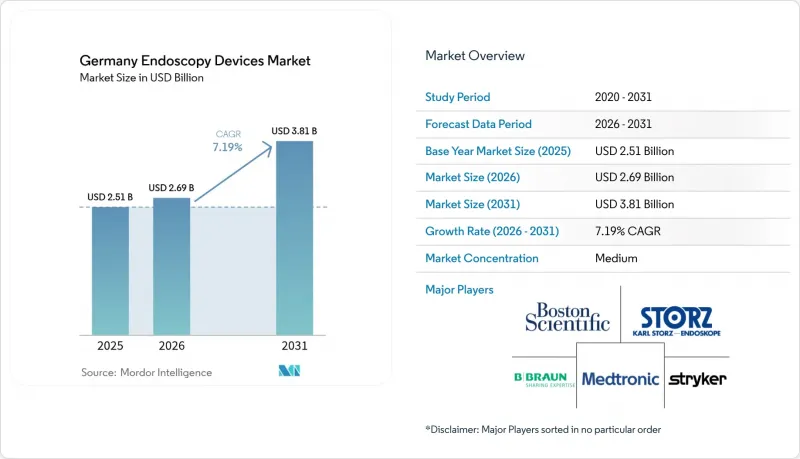
This report is Segmented by Device Type (Endoscopes [Flexible Endoscopes and More], Endoscopic Operative Devices, and Visualization Equipment), Application (Gastroenterology, Pulmonology, Orthopedic Surgery, Cardiology, and More), End User (Hospitals, Ambulatory Surgery Centres, and More), Hygiene & Reprocessing (Re-Usable and Single-Use). The Market Forecasts are Provided in Terms of Value (USD).
Germany Endoscopy Devices Market Trends and Insights
Technological Advancements Enabling AI-Assisted Imaging
AI platforms are steadily transforming the Germany endoscopy devices market. Olympus launched its cloud-based ENDO-AID suite, CADDIE, CADU, and SMARTIBD, in Q1 2025 to tackle high adenoma miss rates that reach 34% under conventional white-light screening. Government-funded GI-Insight research at the University of Wurzburg adds local algorithm refinement, while MHz-OCT projects in Schleswig-Holstein bring real-time 3D tissue mapping into routine workflows. EVIS X1 upgrade kits let hospitals embed AI without replacing entire towers, a cost advantage under the Leistungsgruppen budget ceilings. Regulatory amendments to the Medical Devices Operator Ordinance effective February 2025 mandate robust cybersecurity, giving established vendors with secure cloud infrastructure a clear competitive edge in the Germany endoscopy devices market.
Growing Preference for Minimally Invasive Surgeries
Hospitals are embracing laparoscopic and endoluminal techniques that shorten stays and cut DRG expenditures, fueling the Germany endoscopy devices market. Uptake of 4K scopes, Narrow Band Imaging, and Texture and Color Enhancement Imaging supports complex interventions such as endoscopic submucosal dissection, documented in more than 1,000 German cases with favorable outcomes. Demand for multi-energy devices like THUNDERBEAT grows as surgeons value single-instrument vessel sealing up to 7 mm. Interventional cardiology mirrors this shift; transesophageal and structural procedures propel a 9.85% CAGR in cardiology applications, broadening equipment portfolios and contributing to sustained equipment renewals in the Germany endoscopy devices market.
Shortage of Skilled Endoscopy Technicians
Germany faces a workforce shortfall that limits utilization despite adequate hardware. Part-time trends, constrained training slots, and migration to urban centers leave rural facilities understaffed. Advanced therapeutic procedures require specialized skills, delaying deployment of AI-enabled systems and dampening near-term growth in the Germany endoscopy devices market. Service consolidation into larger centers partially offsets this gap but raises patient-travel barriers.
Other drivers and restraints analyzed in the detailed report include:
- Aging Population & Rising GI Disorder Prevalence
- German Hospital Reform 2025 Centralizing Procurement
- High Capital Cost of Advanced Equipment
For complete list of drivers and restraints, kindly check the Table Of Contents.
Segment Analysis
Visualization equipment recorded the fastest 11.02% CAGR from 2026 to 2031, while endoscopes still anchor 45.10% of the 2025 Germany endoscopy devices market. Hospitals increasingly direct capital to 4K processors, OLED monitors, and AI overlay modules that raise mucosal detection accuracy without necessitating full tower replacements. Flexible scopes dominate the endoscope subset thanks to broad GI and pulmonary reach, whereas rigid systems cater to ENT and orthopedic niches. Capsule endoscopes, though reimbursed sparingly, offer non-invasive small-bowel views and keep incremental sales alive.
Adoption of single-use bronchoscopes and ureteroscopes accelerates as infection-control protocols tighten post-pandemic. EU MDR traceability favors disposable form factors, pushing vendors to refine biodegradable materials. Meanwhile, multi-energy hand instruments supporting advanced therapeutic procedures remain indispensable, ensuring balanced growth across the Germany endoscopy devices market. Enhanced imaging and AI analytics together re-shape hospital wish lists, firmly positioning visualization equipment at the investment forefront.
Gastroenterology held 48.05% of Germany endoscopy devices market size in 2025, sustained by nationwide colonoscopy programs and rising therapeutic ESD volumes. Cardiology, though smaller, posts the highest 9.62% CAGR as endoscopic ultrasound converges with structural heart interventions, creating hybrid workflows that rely on high-resolution probes. Pulmonology keeps steady momentum with AI-assisted nodule detection, while orthopedics and gynecology enlarge scope portfolios through minimally invasive arthroscopy and hysteroscopic procedures.
Cross-disciplinary innovation blurs boundaries: Olympus Aplio i800 EUS system extends from hepato-pancreato-biliary to cardiac imaging, illustrating platform convergence. Procedure complexity elevates demand for multi-modal devices and real-time analytics, which in turn solidify long-term procurement pipelines across clinical departments of the Germany endoscopy devices industry.
Complete Report Scope:
- By Device Type
- Endoscopes
- Flexible Endoscopes
- Rigid Endoscopes
- Capsule Endoscopes
- Disposable/Single-use Endoscopes
- Endoscopic Operative Devices
- Visualization Equipment
- Endoscopes
- By Application
- Gastroenterology
- Pulmonology
- Orthopaedic Surgery
- Cardiology
- Gynaecology & Urology
- Other Clinical Applications
- By End User
- Hospitals
- Ambulatory Surgery Centres
- Office-based / Out-patient Clinics
- By Hygiene & Reprocessing
- Re-usable Devices
- Single-use / Disposable Devices
List of Companies Covered in this Report:
- Ambu
- Arthrex
- B. Braun
- Boston Scientific
- BOWA Medical
- CapsoVision
- Conmed
- Cook Group
- Erbe Elektromedizin
- FUJIFILM
- Johnson & Johnson
- Karl Storz
- Medi-Globe
- Medtronic
- Olympus
- Pentax Medical (HOYA)
- Richard Wolf
- Smiths Group
- Stryker
- XION GmbH
Additional Benefits:
- The market estimate (ME) sheet in Excel format
- 3 months of analyst support
TABLE OF CONTENTS
1 Introduction
- 1.1 Study Assumptions & Market Definition
- 1.2 Scope of the Study
2 Research Methodology
3 Executive Summary
4 Market Landscape
- 4.1 Market Overview
- 4.2 Market Drivers
- 4.2.1 Technological Advancements Enabling AI-Assisted Imaging
- 4.2.2 Growing Preference for Minimally Invasive Surgeries
- 4.2.3 Aging Population & Rising GI Disorder Prevalence
- 4.2.4 German Hospital Reform 2025 Centralising Procurement
- 4.2.5 EU MDR-Driven Replacement Cycle of Ageing Endoscopes
- 4.2.6 Surge in Outpatient Tele-Endoscopy Networks
- 4.3 Market Restraints
- 4.3.1 Shortage of Skilled Endoscopy Technicians
- 4.3.2 High Capital Cost of Advanced Equipment
- 4.3.3 EU PFAS Restrictions on Fluoropolymer Components
- 4.3.4 MDR Recertification Backlog & Temporary Shortages
- 4.4 Supply-Chain Analysis
- 4.5 Regulatory Landscape
- 4.6 Technological Outlook
- 4.7 Porter's Five Forces
- 4.7.1 Threat of New Entrants
- 4.7.2 Bargaining Power of Buyers
- 4.7.3 Bargaining Power of Suppliers
- 4.7.4 Threat of Substitutes
- 4.7.5 Intensity of Competitive Rivalry
5 Market Size & Growth Forecasts (Value, USD)
- 5.1 By Device Type
- 5.1.1 Endoscopes
- 5.1.1.1 Flexible Endoscopes
- 5.1.1.2 Rigid Endoscopes
- 5.1.1.3 Capsule Endoscopes
- 5.1.1.4 Disposable/Single-use Endoscopes
- 5.1.2 Endoscopic Operative Devices
- 5.1.3 Visualization Equipment
- 5.1.1 Endoscopes
- 5.2 By Application
- 5.2.1 Gastroenterology
- 5.2.2 Pulmonology
- 5.2.3 Orthopaedic Surgery
- 5.2.4 Cardiology
- 5.2.5 Gynaecology & Urology
- 5.2.6 Other Clinical Applications
- 5.3 By End User
- 5.3.1 Hospitals
- 5.3.2 Ambulatory Surgery Centres
- 5.3.3 Office-based / Out-patient Clinics
- 5.4 By Hygiene & Reprocessing
- 5.4.1 Re-usable Devices
- 5.4.2 Single-use / Disposable Devices
6 Competitive Landscape
- 6.1 Market Concentration
- 6.2 Market Share Analysis
- 6.3 Company Profiles (includes Global level Overview, Market level overview, Core Business Segments, Financials, Headcount, Key Information, Market Rank, Market Share, Products and Services, and analysis of Recent Developments)
- 6.3.1 Ambu A/S
- 6.3.2 Arthrex GmbH
- 6.3.3 B. Braun Melsungen AG
- 6.3.4 Boston Scientific Corp.
- 6.3.5 BOWA-electronic GmbH & Co. KG
- 6.3.6 CapsoVision Inc.
- 6.3.7 CONMED Corporation
- 6.3.8 Cook Medical LLC
- 6.3.9 ERBE Elektromedizin GmbH
- 6.3.10 Fujifilm Holdings Corporation
- 6.3.11 Johnson & Johnson (Ethicon)
- 6.3.12 KARL STORZ SE & Co. KG
- 6.3.13 Medi-Globe GmbH
- 6.3.14 Medtronic plc
- 6.3.15 Olympus Corporation
- 6.3.16 Pentax Medical (HOYA)
- 6.3.17 Richard Wolf GmbH
- 6.3.18 Smith & Nephew plc
- 6.3.19 Stryker Corporation
- 6.3.20 XION GmbH
7 Market Opportunities & Future Outlook
- 7.1 White-space & Unmet-need Assessment

