PUBLISHER: Mordor Intelligence | PRODUCT CODE: 2113366

PUBLISHER: Mordor Intelligence | PRODUCT CODE: 2113366
Blood Testing - Market Share Analysis, Industry Trends & Statistics, Growth Forecasts (2026 - 2031)
According to Mordor Intelligence, the blood testing market size is expected to reach USD 103.53 billion in 2026 and is forecast to climb to USD 144.80 billion by 2031, advancing at a 6.94% CAGR.
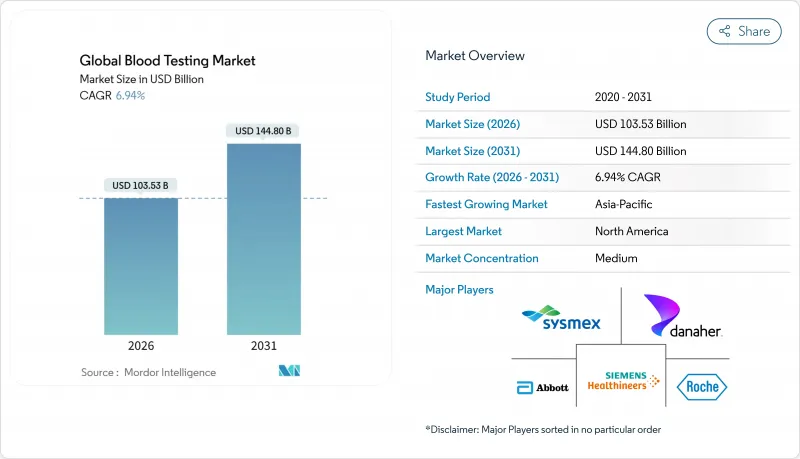
This report Segments the Industry Into by Test Type (Glucose, Lipid Panel, PSA, BUN, and More), by Product (Instruments and Consumables), by Technology (Clinical Chemistry, Molecular Diagnostics, Immunoassay and Others), by End User (Diagnostics Laboratories, Hospitals and Others), and Geography (North America, Europe, Asia-Pacific and More). The Report Offers the Value (in USD Million) for the Above Segments.
Global Blood Testing Market Trends and Insights
Rising Chronic-Disease Burden Fueling Routine & Preventive Blood Panels
Cardiovascular disease, diabetes, and chronic kidney disease affect 1.5 billion people and prompt recurring lipid, hemoglobin A1c, and creatinine testing in annual checkups . The 2024 USPSTF update expanded lipid-panel eligibility to every adult 40-75 years, widening U.S. screening by 20 million lives. Diabetes prevalence hit 537 million adults in 2024 and could reach 783 million by 2045, locking in annual glucose and A1c demand. These routine panels stabilize laboratory volumes even when discretionary testing softens, although tighter bundled-payment contracts now cap margins, prompting more reliance on high-throughput automation.
Rapid Automation & Point-of-Care Analyzer Innovation
FDA clearance of Beckman Coulter's DxC 500i in March 2025 delivered a 400-test-per-hour platform sized for community hospitals. Abbott gained January 2025 clearance for a high-sensitivity troponin I assay on its handheld i-STAT, enabling 15-minute myocardial-infarction rule-out at the bedside. Sysmex secured CLIA-waived status for its XW-100 hematology analyzer, allowing physician offices to run complete blood counts without a technologist. While POC devices accelerate care, reagent costs run 40-60% higher than central-lab equivalents, challenging cost-sensitive sites.
Stringent Multi-Region Regulatory Approvals
EU-IVDR reclassified thousands of assays, yet only four notified bodies were designated by end-2024, creating approval bottlenecks and shifting R&D budgets toward high-volume panels. FDA's May 2024 LDT rule now imposes USD 500,000-2 million validation costs per analyte and 12-24-month timelines, raising barriers for hospital-developed tests. China's NMPA demands multi-center trials enrolling 200-500 patients, stretching approvals to 30 months.
Other drivers and restraints analyzed in the detailed report include:
- Government-Funded Screening & Early-Diagnosis Programs
- Lab Reflex-Testing Algorithms Reducing Reagent Waste
- High Capex & Consumable Costs for Next-Gen Analyzers
For complete list of drivers and restraints, kindly check the Table Of Contents.
Segment Analysis
Infectious-disease serology is projected to post the fastest 8.12% CAGR through 2031 as the WHO pushes 90% hepatitis C diagnosis by 2030 and rapid HIV self-tests gain approval across sub-Saharan Africa. Conversely, glucose assays still held the largest blood testing market share at 29.5% in 2025, supported by 537 million individuals with diabetes. The arrival of over-the-counter continuous glucose monitors, including Dexcom's Stelo cleared in March 2024, will gradually divert insulin-treated patients away from episodic finger-stick testing. Lipid panels benefit from 2024 USPSTF guidelines recommending five-year screening intervals, yet retail pharmacy offerings fragment demand. PSA volumes soften as shared-decision guidelines curb annual screening, while BUN and creatinine remain stable due to chronic kidney disease prevalence. TSH and vitamin D utilization face payer scrutiny, trimming low-yield preventive orders, whereas hs-CRP retains a niche in cardiology risk stratification.
Demand diversity underscores a structural pivot from single-analyte orders to algorithm-guided panels that optimize reagent spend and clinical value. Laboratories that bundle serology, glucose, and lipid assays into preventive-care panels achieve higher throughput and amortize analyzer investments over more billable units. As the blood testing market size for infectious-disease serology climbs, platform vendors that broaden antigen libraries and develop multiplex rapid cards will seize share in public-health tenders. Meanwhile, growth in self-monitoring technologies shifts revenue from central labs to retail channels, signaling a gradual tilt in the blood testing market toward decentralized ecosystems.
Consumables represented 55.4% of 2025 revenue, consistent with laboratories' recurring reagent spend and the ubiquity of BD Vacutainer tubes, which hold an estimated significant global share. Shrinking fee schedules drive laboratories to negotiate high-volume reagent contracts and adopt reflex logic that trims low-yield follow-ons. Yet instruments are set for a 7.21% CAGR through 2031 as facilities replace aging analyzers with integrated chemistry-immunoassay platforms that automate pre-analytic sorting and barcode verification. Such upgrades lower error rates, shorten turnaround, and alleviate technologist shortages.
Capital budgets favor analyzers that run open channels and support middleware interoperability. The blood testing market size for instruments further expands as point-of-care devices penetrate ambulatory and emergency settings, despite higher per-test reagent costs. Total laboratory automation remains a premium niche but gains traction among academic centers processing more than 1 million annual tests, where 30-40% labor savings justify USD 2-5 million outlays. Overall, suppliers that bundle instrument placements with reagent-rental models lock in multi-year consumable cash flows, reinforcing consumables' revenue dominance even as instrument volumes rise.
Complete Report Scope:
- By Test Type
- Glucose
- Lipid Panel
- PSA
- BUN
- TSH
- Infectious-Disease Serology
- Vitamin D
- High-sensitivity CRP
- By Product
- Instruments
- Consumables (Kits, Reagents and others)
- By Technology
- Clinical Chemistry
- Molecular Diagnostics
- Immunoassay
- Others
- By End User
- Diagnostics Laboratories
- Hospitals
- Others
- By Geography
- North America
- United States
- Canada
- Mexico
- South America
- Brazil
- Argentina
- Rest of South America
- Europe
- Germany
- United Kingdom
- France
- Italy
- Spain
- Rest of Europe
- Asia-Pacific
- China
- Japan
- India
- South Korea
- Australia
- Rest of APAC
- Middle East and Africa
- GCC
- South Africa
- Rest of MEA
- North America
Geography Analysis
North America held 43.6% of global 2025 revenue, propelled by Medicare coverage for preventive panels and the outsized scale of Quest Diagnostics and LabCorp. U.S. laboratories processed 14 billion tests in 2024 for USD 85 billion but face Clinical Laboratory Fee Schedule cuts averaging 8% on 20 high-volume assays, compressing margins. A workforce deficit looms: 70% of labs reported staffing shortages in 2023, and BLS projects just 11% technologist employment growth through 2033, below retirement-replacement needs. Canada centralizes routine testing into provincial hubs, saving cost but extending outpatient turnaround to 24-48 hours.
Asia-Pacific is the fastest-growing region at an 8.54% CAGR. China's Healthy China 2030 policy mandates annual exams for 400 million workers, stimulating demand for Mindray, Autobio, and Maccura analyzers priced 20-30% below multinationals. India's Ayushman Bharat covers 550 million lives, yet 90-day claim lags strain small labs. Japan's super-aged population fuels lipid and kidney-function testing, but government price ceilings trimmed lab reimbursement by 5-7% in 2024, motivating automation investment.
Europe balances IVDR transition hurdles with budget caps that restrict spending growth to 1-2% annually. Germany's 8,000 lab sites consolidated rapidly after a 6% fee cut in 2024, while the U.K. experienced a three-week service disruption in June 2024 when a ransomware attack hit Synnovis, prompting NHS cybersecurity mandates. France's price-scheduled lab networks invest heavily in automation to maintain 8-12% margins. Gulf Cooperation Council states allocate oil-backed budgets to diagnostic hubs-Saudi Arabia alone earmarked USD 64 billion whereas sub-Saharan Africa relies heavily on donor programs for HIV and malaria testing, leaving the blood testing industry underpenetrated by commercial labs. South America's middle-class expansion lifts demand, but currency volatility and inconsistent regulations deter multinationals, enabling regional chains such as Dasa and Chopo to dominate through localized cash-pay models.
- Abbott Laboratories
- Beckton Dickinson
- bioMerieux
- Bio-Rad Laboratories
- Cepheid
- Danaher (-Beckman Coulter)
- DiaSorin
- Roche
- Grifols
- Hologic
- Laboratory Corp of America
- Mindray Medical
- Ortho Clinical Diagnostics
- PerkinElmer (-Revvity)
- Quest Diagnostics
- QuidelOrtho
- Siemens Healthineers
- Sysmex
- Thermo Fisher Scientific
- Trinity Biotech
Additional Benefits:
- The market estimate (ME) sheet in Excel format
- 3 months of analyst support
TABLE OF CONTENTS
1 Introduction
- 1.1 Study Assumptions & Market Definition
- 1.2 Scope of the Study
2 Research Methodology
3 Executive Summary
4 Market Landscape
- 4.1 Market Overview
- 4.2 Market Drivers
- 4.2.1 Rising Chronic-Disease Burden Fueling Routine & Preventive Blood Panels
- 4.2.2 Rapid Automation & Point-Of-Care Analyzer Innovation
- 4.2.3 Government-Funded Screening & Early-Diagnosis Programs
- 4.2.4 Lab Reflex-Testing Algorithms Reducing Reagent Waste & Boosting Throughput
- 4.2.5 Home Micro-Sampling & DIY Phlebotomy Kits Enabling Remote Testing
- 4.2.6 AI-Driven Decision Support Monetizing Longitudinal Lab Datasets
- 4.3 Market Restraints
- 4.3.1 Stringent Multi-Region Regulatory Approvals (FDA, EU-IVDR, NMPA)
- 4.3.2 High Capex & Consumable Costs for Next-Gen Analyzers
- 4.3.3 Shortage Of Trained Laboratory Technologists Worldwide
- 4.3.4 Data-Privacy Compliance Hurdles for Cloud-Connected Instruments
- 4.4 Supply-Chain Analysis
- 4.5 Regulatory Landscape
- 4.6 Technological Outlook
- 4.7 Porter's Five Forces
- 4.7.1 Bargaining Power of Suppliers
- 4.7.2 Bargaining Power of Buyers/Consumers
- 4.7.3 Threat of New Entrants
- 4.7.4 Threat of Substitute Products
- 4.7.5 Intensity of Competitive Rivalry
5 Market Size & Growth Forecasts (Value)
- 5.1 By Test Type
- 5.1.1 Glucose
- 5.1.2 Lipid Panel
- 5.1.3 PSA
- 5.1.4 BUN
- 5.1.5 TSH
- 5.1.6 Infectious-Disease Serology
- 5.1.7 Vitamin D
- 5.1.8 High-sensitivity CRP
- 5.2 By Product
- 5.2.1 Instruments
- 5.2.2 Consumables (Kits, Reagents and others)
- 5.3 By Technology
- 5.3.1 Clinical Chemistry
- 5.3.2 Molecular Diagnostics
- 5.3.3 Immunoassay
- 5.3.4 Others
- 5.4 By End User
- 5.4.1 Diagnostics Laboratories
- 5.4.2 Hospitals
- 5.4.3 Others
- 5.5 By Geography
- 5.5.1 North America
- 5.5.1.1 United States
- 5.5.1.2 Canada
- 5.5.1.3 Mexico
- 5.5.2 South America
- 5.5.2.1 Brazil
- 5.5.2.2 Argentina
- 5.5.2.3 Rest of South America
- 5.5.3 Europe
- 5.5.3.1 Germany
- 5.5.3.2 United Kingdom
- 5.5.3.3 France
- 5.5.3.4 Italy
- 5.5.3.5 Spain
- 5.5.3.6 Rest of Europe
- 5.5.4 Asia-Pacific
- 5.5.4.1 China
- 5.5.4.2 Japan
- 5.5.4.3 India
- 5.5.4.4 South Korea
- 5.5.4.5 Australia
- 5.5.4.6 Rest of APAC
- 5.5.5 Middle East and Africa
- 5.5.5.1 GCC
- 5.5.5.2 South Africa
- 5.5.5.3 Rest of MEA
- 5.5.1 North America
6 Competitive Landscape
- 6.1 Market Concentration
- 6.2 Market Share Analysis
- 6.3 Company Profiles (includes Global level Overview, Market level overview, Core Segments, Financials as available, Strategic Information, Market Rank/Share for key companies, Products & Services, and Recent Developments)
- 6.3.1 Abbott Laboratories
- 6.3.2 Becton Dickinson
- 6.3.3 bioMerieux SA
- 6.3.4 Bio-Rad Laboratories
- 6.3.5 Cepheid
- 6.3.6 Danaher (-Beckman Coulter)
- 6.3.7 DiaSorin
- 6.3.8 F. Hoffmann-La Roche AG
- 6.3.9 Grifols S.A.
- 6.3.10 Hologic
- 6.3.11 Laboratory Corp of America
- 6.3.12 Mindray Medical
- 6.3.13 Ortho Clinical Diagnostics
- 6.3.14 PerkinElmer (-Revvity)
- 6.3.15 Quest Diagnostics
- 6.3.16 QuidelOrtho
- 6.3.17 Siemens Healthineers
- 6.3.18 Sysmex Corporation
- 6.3.19 Thermo Fisher Scientific
- 6.3.20 Trinity Biotech
7 Market Opportunities & Future Outlook
- 7.1 White-Space & Unmet-Need Assessment

