PUBLISHER: Mordor Intelligence | PRODUCT CODE: 2113417

PUBLISHER: Mordor Intelligence | PRODUCT CODE: 2113417
India AYUSH And Alternative Medicine - Market Share Analysis, Industry Trends & Statistics, Growth Forecasts (2026 - 2031)
According to Mordor Intelligence, the India AYUSH and Alternative Medicine market size is expected to grow from USD 24.87 billion in 2025 to USD 26.53 billion in 2026 and is forecast to reach USD 36.62 billion by 2031 at 6.66% CAGR over 2026-2031.
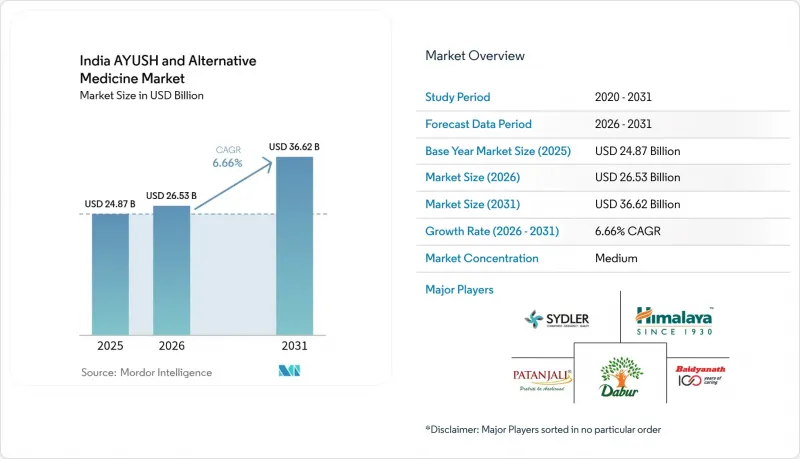
This report is Segmented by System Type (Ayurveda, Homeopathy, Unani, Siddha, and Yoga & Naturopathy), Product Category (Classical Medicines, Proprietary / OTC Formulations, and More), Form (Tablets / Capsules, Powders / Churnas, and More), Distribution Channel (Ayurveda & Homeopathy Pharmacies, E-Commerce & D2C, and More). The Market Forecasts are Provided in Terms of Value (USD).
India AYUSH And Alternative Medicine Market Trends and Insights
Government Insurance Mandate for AYUSH Treatments
The Insurance Regulatory and Development Authority of India mandated in April 2024 that every retail and public health plan reimburse 170 standardized AYUSH therapies, instantly converting previously out-of-pocket spending into claimable benefits. Initial actuarial skepticism eased after pilots in Karnataka and Kerala showed 22% lower average episode costs for chronic diabetes compared with allopathic care. Reimbursement also compels clinics to digitize records, accelerating outcome tracking and quality audits. Organized hospital chains scale faster under the new regime, yet informal practitioners race to upgrade premises and documentation to remain accredited. As a result, policy inclusion is expected to broaden the India AYUSH and Alternative Medicine market by nearly half within two years.
Accelerated E-Commerce & D2C Adoption for Herbal Products
Digital-native consumers now buy classical churnas, cosmeceuticals, and OTC nutraceuticals from branded websites and marketplace storefronts that guarantee QR-based authenticity tags. Direct-to-consumer start-ups exploit social media education campaigns and algorithmic recommendation engines to grow pan-India without costly brick-and-mortar logistics. Established brands, in turn, pivot to omnichannel, integrating in-clinic consult video chats and same-day fulfillment via hyper-local warehouses. While digital outreach lifts unit sales, it also heightens scrutiny; marketplace delistings jump when sellers fail real-time batch-testing audits. Consequently, only manufacturers with transparent supply chains and rapid customer-service loops sustain high ratings and repeat sales.
Limited GMP Compliance Among MSME Manufacturers
Roughly 4,200 micro and small units still miss WHO-GMP thresholds for air-handling, in-process validation, and residual solvent testing, prompting multiple deadline extensions to March 2025. Capital upgrades typically cost USD 60,000-240,000 per site, straining cash flows in a segment where average EBITDA margins hover near 9%. Non-compliance limits access to high-margin export orders and e-commerce platforms that mandate laboratory certificates. As insurers and marketplace portals tighten vendor rosters, sub-scale players face either attrition or acquisition by larger peers in search of incremental capacity.
Other drivers and restraints analyzed in the detailed report include:
- Herbal Raw-Material PLI Subsidy Boosting Domestic Supply
- WHO-GCTM Recognition Elevates Export Credibility
- Insurance Pricing Caps Compress Clinic Margins
For complete list of drivers and restraints, kindly check the Table Of Contents.
Segment Analysis
Ayurveda accounted for 71.10% of the India AYUSH and Alternative Medicine market in 2025, supported by 500,000 registered practitioners and a robust educational pipeline of 280 colleges. Yoga & Naturopathy, currently a smaller base, records the swiftest 14.79% CAGR through 2031, propelled by office-based stress disorders and social-media-amplified wellness retreats. Homeopathy maintains around 14.80% share, appealing to pediatric and chronic dermal cases that favor gentle dosing schedules. Unani and Siddha, while niche, leverage concentrated regional loyalty and benefit from tele-consult platforms that transcend geographic confines.
Digitization blurs system boundaries as integrative clinics bundle Ayurveda detox, Yogic breathing, and Homeopathic constitutional remedies under a single subscription. Insurance recognition further legitimizes cross-referrals, expanding each discipline's patient pool. Nevertheless, Ayurveda's entrenched pharmacopeia and industry-wide R&D spending ensure its continued dominance, even as newer modalities command media attention.
Classical Medicines contributed 37.20% to the India AYUSH and Alternative Medicine market size in 2025, anchored by chronic-disease protocols for joint pain, gastrointestinal issues, and metabolic disorders. Personal-Care & Cosmeceuticals outpace all other segments with a 10.63% CAGR, riding urban demand for natural skin-brightening creams, anti-aging serums, and sulfate-free shampoos. Nutraceuticals & Dietary Supplements garner rising share from lifestyle conditions such as non-alcoholic fatty liver disease, while Proprietary OTC combinations serve first-time herbal users seeking familiar pill formats. Regulatory clarity under the Food Safety and Standards Authority of India tightens label claims and boosts consumer confidence.
Brands increasingly launch cosmeceuticals as gateway offerings, then up-sell therapeutic lines after trust forms. Conversely, companies rooted in classical therapeutics diversify into beauty SKUs to smooth revenue seasonality. Supply-side investments in nano-emulsion and liposomal delivery unlock higher-potency cosmetic actives, blending traditional botanicals with modern cosmeceutical science.
Complete Report Scope:
- By System Type
- Ayurveda
- Homeopathy
- Unani
- Siddha
- Yoga & Naturopathy
- By Product Category
- Classical Medicines
- Proprietary / OTC Formulations
- Nutraceuticals & Dietary Supplements
- Personal-Care & Cosmeceuticals
- Others
- By Form
- Tablets / Capsules
- Powders / Churnas
- Juices / Syrups
- Oils / Ointments
- Patches / Topicals
- By Distribution Channel
- Ayurveda & Homeopathy Pharmacies
- Modern Trade & Supermarkets
- E-Commerce & D2C
- Hospitals & Clinics
- Other Distribution Channels
List of Companies Covered in this Report:
- Baidyanath
- Charak Pharma
- Dabur India
- Ganga Pharmaceuticals
- Hamdard Laboratories
- Himalaya
- Hootone Remedies
- Indian Herbs Specialities
- Kerala Ayurveda Ltd
- Krishna's Herbal & Ayurveda
- Lotus Herbals
- Medimix (AVP)
- Patanjali Ayurved
- Sandu Pharmaceuticals
- SBL Homeopathy
- Schwabe India
- Sri Sri Tattva
- Sunetra Pharma (Homeopathy)
- Sydler India
- Vicco Laboratories
- Zandu (Emami)
Additional Benefits:
- The market estimate (ME) sheet in Excel format
- 3 months of analyst support
TABLE OF CONTENTS
1 Introduction
- 1.1 Study Assumptions & Market Definition
- 1.2 Scope of the Study
2 Research Methodology
3 Executive Summary
4 Market Landscape
- 4.1 Market Overview
- 4.2 Market Drivers
- 4.2.1 Government Insurance Mandate for AYUSH Treatments
- 4.2.2 Accelerated E-Commerce & D2C Adoption for Herbal Products
- 4.2.3 Herbal-Raw-Material PLI Subsidy Boosting Domestic Supply
- 4.2.4 WHO-GCTM Recognition Elevates Export Credibility
- 4.2.5 AI-Enabled Prakriti Personalised Formulations
- 4.2.6 Tele-AYUSH Integration with Ayushman Arogya Mandir Network
- 4.3 Market Restraints
- 4.3.1 Limited GMP Compliance Among MSME Manufacturers
- 4.3.2 Insurance-Pricing Caps Compress Clinic Margins
- 4.3.3 Raw-Herb Climate-Risk (Aloe, Giloy, Tulsi) Supply Shocks
- 4.3.4 Rising Global Scrutiny on Heavy-Metal Contamination
- 4.4 Supply-Chain Analysis
- 4.5 Regulatory Landscape
- 4.6 Porter's Five Forces
- 4.6.1 Bargaining Power of Buyers
- 4.6.2 Bargaining Power of Suppliers
- 4.6.3 Threat of New Entrants
- 4.6.4 Threat of Substitutes
- 4.6.5 Intensity of Competitive Rivalry
5 Market Size & Growth Forecasts (Value, USD)
- 5.1 By System Type
- 5.1.1 Ayurveda
- 5.1.2 Homeopathy
- 5.1.3 Unani
- 5.1.4 Siddha
- 5.1.5 Yoga & Naturopathy
- 5.2 By Product Category
- 5.2.1 Classical Medicines
- 5.2.2 Proprietary / OTC Formulations
- 5.2.3 Nutraceuticals & Dietary Supplements
- 5.2.4 Personal-Care & Cosmeceuticals
- 5.2.5 Others
- 5.3 By Form
- 5.3.1 Tablets / Capsules
- 5.3.2 Powders / Churnas
- 5.3.3 Juices / Syrups
- 5.3.4 Oils / Ointments
- 5.3.5 Patches / Topicals
- 5.4 By Distribution Channel
- 5.4.1 Ayurveda & Homeopathy Pharmacies
- 5.4.2 Modern Trade & Supermarkets
- 5.4.3 E-Commerce & D2C
- 5.4.4 Hospitals & Clinics
- 5.4.5 Other Distribution Channels
6 Competitive Landscape
- 6.1 Market Concentration
- 6.2 Market Share Analysis
- 6.3 Company Profiles (includes Global level Overview, Market level overview, Core Segments, Financials as available, Strategic Information, Market Rank/Share for key companies, Products & Services, and Recent Developments)
- 6.3.1 Baidyanath
- 6.3.2 Charak Pharma
- 6.3.3 Dabur India
- 6.3.4 Ganga Pharmaceuticals
- 6.3.5 Hamdard Laboratories
- 6.3.6 Himalaya Wellness
- 6.3.7 Hootone Remedies
- 6.3.8 Indian Herbs Specialities
- 6.3.9 Kerala Ayurveda Ltd
- 6.3.10 Krishna's Herbal & Ayurveda
- 6.3.11 Lotus Herbals
- 6.3.12 Medimix (AVP)
- 6.3.13 Patanjali Ayurved
- 6.3.14 Sandu Pharmaceuticals
- 6.3.15 SBL Homeopathy
- 6.3.16 Schwabe India
- 6.3.17 Sri Sri Tattva
- 6.3.18 Sunetra Pharma (Homeopathy)
- 6.3.19 Sydler India
- 6.3.20 Vicco Laboratories
- 6.3.21 Zandu (Emami)
7 Market Opportunities & Future Outlook
- 7.1 White-space & Unmet-need Assessment

