PUBLISHER: Mordor Intelligence | PRODUCT CODE: 2113422

PUBLISHER: Mordor Intelligence | PRODUCT CODE: 2113422
Europe Soup - Market Share Analysis, Industry Trends & Statistics, Growth Forecasts (2026 - 2031)
According to Mordor Intelligence, the European soup market size was valued at USD 2.53 billion in 2025 and estimated to grow from USD 2.57 billion in 2026 to reach USD 2.76 billion by 2031, at a CAGR of 1.44% during the forecast period (2026-2031).
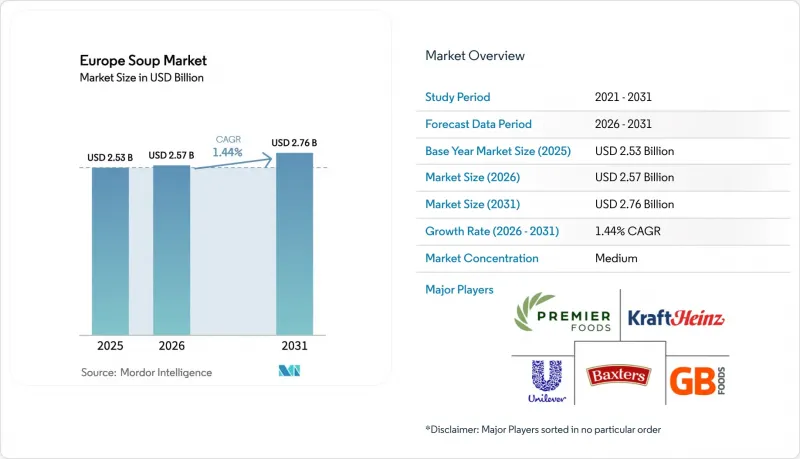
This report is Segmented by Product Type (Dry Soup, Shelf Stable Soup, and More), Category (Vegeterian Soup and Non-Vegetarian Soup), Packaging Type (Canned, Pouches, and More), Distribution Channel (Supermarkets/Hypermarkets, Convenience/Grocery Stores, and More), and Country (United Kingdom, Germany, France, Italy, Spain, Netherlands, Sweden, and More). The Market Forecasts are Provided in Terms of Value (USD).
Europe Soup Market Trends and Insights
Increasing demand for convenient and ready-to-eat foods
The demand for convenient meal options is driving the European soup market, as busy lifestyles and shifting work habits leave consumers with less time to prepare meals. As more people return to office routines, the demand for convenient lunch options, such as soup, has steadily increased. According to the Agriculture and Horticulture Development Board UK, soup consumption rose by 0.1% in March 2025, reflecting this trend. Ready-to-eat soups, such as ambient and chilled varieties that can be heated in minutes, are becoming a popular choice for busy weekdays. These soups offer a simple, portion-controlled alternative to takeout or frozen meals. Both private-label retailers and well-known brands are expanding their soup offerings to meet this demand. Innovations in packaging, such as resealable caps and portable designs, are making soups even more appealing for quick desk lunches or on-the-go consumption.
Growth in plant-based and vegan soup offerings
The growth of plant-based and vegan soup options is driving the European soup market as more people adopt flexitarian, vegetarian, and vegan diets. This trend is particularly pronounced in Germany, which has the largest vegetarian population in Europe and over 1.5 million vegans, according to ProVeg as of April 2024. To meet this demand, brands are introducing innovative plant-based soups that cater to both health-conscious and convenience-focused consumers. For example, Heinz UK launched its creamy tomato soup with beans and sausages in 2023, which combines plant-based protein with familiar flavors to appeal to a wider audience. Plant-based soups are gaining popularity due to their environmental benefits, such as lower carbon emissions compared to animal-based soups. Improvements in taste and texture are also encouraging more consumers, especially those who are environmentally conscious or looking for protein-rich options, to try these products.
Perception of processed foods as less healthy
The belief that processed foods are less healthy is limiting the growth of the European soup market. Increasing scientific studies and public health recommendations are making consumers more cautious about industrially processed products. For instance, a 2024 British Medical Journal review highlighted that consuming large amounts of ultra-processed foods is linked to higher risks of heart disease and overall mortality. Similarly, findings from the European Prospective Investigation into Cancer and Nutrition study, published in The Lancet, supported these concerns across Europe, drawing attention to products such as canned and dehydrated soups. Even when manufacturers reformulate their products, many soups still face challenges in overcoming the negative perception associated with industrial processing methods, such as high-temperature sterilization and spray-drying.
Other drivers and restraints analyzed in the detailed report include:
- Innovation in packaging functionality and sustainability
- Shift toward clean-label and transparent products
- Competition from alternative meal solutions
For complete list of drivers and restraints, kindly check the Table Of Contents.
Segment Analysis
Shelf-stable canned soups dominated the European soup market in 2025, accounting for 47.54% of the market share. These soups are popular due to their long shelf life, affordability, and easy availability, making them a convenient choice for households. They are especially favored by consumers who prefer stocking up on ready-to-eat meals for quick and hassle-free meal preparation. Dry soup sachets and frozen soups make up the rest of the market, appealing to those who value portability, cost-effectiveness, or extended storage options. Their strong presence in supermarkets, discount stores, and private-label offerings further boosts their demand across the region.
The chilled soup segment is projected to grow at a compound annual growth rate (CAGR) of 3.54% from 2026 to 2031, emerging as the fastest-growing product category in Europe. This growth is driven by increasing consumer demand for fresh, minimally processed foods with shorter ingredient lists. Chilled soups are often marketed as premium, clean-label, or chef-inspired alternatives to traditional canned soups, appealing to health-conscious and quality-focused consumers. These products are gaining popularity in urban areas and among higher-income consumers, as they are willing to pay more for healthier and fresher options. Retailers are also expanding shelf space for chilled soups to meet this growing demand.
In 2025, non-vegetarian soups made up 65.72% of the European soup market, highlighting the region's strong preference for chicken, beef, and seafood-based broths. These soups are popular due to their rich flavors and association with traditional home-cooked meals, especially in Southern and Eastern Europe. Many consumers view meat-based soups as comforting and nutritious, making them a staple in both retail and foodservice channels. Products like canned and chilled soups, as well as those served in restaurants, continue to rely heavily on animal-protein ingredients, ensuring this segment remains dominant.
Vegetarian soups are expected to grow at a 3.02% CAGR through 2031, driven by the increasing popularity of plant-based and health-conscious eating habits. Increasing numbers of consumers are adopting flexitarian diets, which focus on reducing meat consumption while incorporating more plant-based foods. Vegetarian soups, made with ingredients such as legumes, vegetables, and alternative proteins, are gaining popularity due to their perceived health benefits and affordability. Additionally, their lower production costs compared to meat-based soups allow brands to offer competitive pricing, appealing to budget-conscious and environmentally aware shoppers.
Complete Report Scope:
- By Product Type
- Dry Soup
- Shelf Stable Soup
- Chilled Soup
- Frozen Soup
- By Category
- Vegeterian Soup
- Non-Vegeterian Soup
- By Packaging Type
- Canned
- Pouches
- Others
- By Distribution Channel
- Supermarkets/Hypermarkets
- Convenience/Grocery Stores
- Online Retail Stores
- Others
- By Country
- United Kingdom
- Germany
- France
- Italy
- Spain
- Netherlands
- Sweden
- Poland
- Switzerland
- Rest of Europe
List of Companies Covered in this Report:
- Unilever plc
- The Kraft Heinz Company
- GB Foods SA
- Premier Foods plc
- Baxters Food Group Ltd.
- Campbells Soup Company
- Conagra Brands Inc.
- General Mills Inc.
- Hain Celestial Group Inc.
- Orkla ASA
- Nestle S.A.
- Nissin Foods Holdings Co.
- Ajinomoto Co. Inc.
- New Covent Garden Soup Co.
- BOL Foods Ltd.
- Re:Nourish Ltd.
- Souper Cubed Ltd.
- Glorious Foods Ltd.
- Fratelli Revello SpA
- Valio Ltd
Additional Benefits:
- The market estimate (ME) sheet in Excel format
- 3 months of analyst support
TABLE OF CONTENTS
1 INTRODUCTION
- 1.1 Study Assumptions and Market Definition
- 1.2 Scope of the Study
2 RESEARCH METHODOLOGY
3 EXECUTIVE SUMMARY
4 MARKET LANDSCAPE
- 4.1 Market Overview
- 4.2 Market Drivers
- 4.2.1 Increasing demand for convenient and ready-to-eat foods
- 4.2.2 Growth in plant-based and vegan soup offerings
- 4.2.3 Premiumisation and gourmet product demand
- 4.2.4 Shift toward clean-label and transparent products
- 4.2.5 Innovation in packaging functionality and sustainability
- 4.2.6 Growth of seasonal and limited-edition launches
- 4.3 Market Restraints
- 4.3.1 Competition from alternative meal solutions
- 4.3.2 Perception of processed foods as less healthy
- 4.3.3 High price sensitivity in staple food categories
- 4.3.4 Taste and texture compromises from health reformulation
- 4.4 Value Chain Analysis
- 4.5 Regulatory Outlook
- 4.6 Consumer Behaviour Analysis
- 4.7 Porter's Five Forces
- 4.7.1 Threat of New Entrants
- 4.7.2 Bargaining Power of Buyers
- 4.7.3 Bargaining Power of Suppliers
- 4.7.4 Threat of Substitute Products
- 4.7.5 Intensity of Competitive Rivalry
5 MARKET SIZE AND GROWTH FORECASTS (VALUE)
- 5.1 By Product Type
- 5.1.1 Dry Soup
- 5.1.2 Shelf Stable Soup
- 5.1.3 Chilled Soup
- 5.1.4 Frozen Soup
- 5.2 By Category
- 5.2.1 Vegeterian Soup
- 5.2.2 Non-Vegeterian Soup
- 5.3 By Packaging Type
- 5.3.1 Canned
- 5.3.2 Pouches
- 5.3.3 Others
- 5.4 By Distribution Channel
- 5.4.1 Supermarkets/Hypermarkets
- 5.4.2 Convenience/Grocery Stores
- 5.4.3 Online Retail Stores
- 5.4.4 Others
- 5.5 By Country
- 5.5.1 United Kingdom
- 5.5.2 Germany
- 5.5.3 France
- 5.5.4 Italy
- 5.5.5 Spain
- 5.5.6 Netherlands
- 5.5.7 Sweden
- 5.5.8 Poland
- 5.5.9 Switzerland
- 5.5.10 Rest of Europe
6 COMPETITIVE LANDSCAPE
- 6.1 Market Concentration
- 6.2 Strategic Moves
- 6.3 Market Positioning Analysis
- 6.4 Company Profiles (includes Global-level Overview, Market-level Overview, Core Segments, Financials (if available), Strategic Information, Market Rank/Share, Products and Services, Recent Developments)
- 6.4.1 Unilever plc
- 6.4.2 The Kraft Heinz Company
- 6.4.3 GB Foods SA
- 6.4.4 Premier Foods plc
- 6.4.5 Baxters Food Group Ltd.
- 6.4.6 Campbells Soup Company
- 6.4.7 Conagra Brands Inc.
- 6.4.8 General Mills Inc.
- 6.4.9 Hain Celestial Group Inc.
- 6.4.10 Orkla ASA
- 6.4.11 Nestle S.A.
- 6.4.12 Nissin Foods Holdings Co.
- 6.4.13 Ajinomoto Co. Inc.
- 6.4.14 New Covent Garden Soup Co.
- 6.4.15 BOL Foods Ltd.
- 6.4.16 Re:Nourish Ltd.
- 6.4.17 Souper Cubed Ltd.
- 6.4.18 Glorious Foods Ltd.
- 6.4.19 Fratelli Revello SpA
- 6.4.20 Valio Ltd
7 MARKET OPPORTUNITIES AND FUTURE OUTLOOK

