PUBLISHER: Mordor Intelligence | PRODUCT CODE: 2121565

PUBLISHER: Mordor Intelligence | PRODUCT CODE: 2121565
North America Soup - Market Share Analysis, Industry Trends & Statistics, Growth Forecasts (2026 - 2031)
According to Mordor Intelligence, the North America soup market size is projected to expand from USD 6.96 billion in 2025 and USD 7.12 billion in 2026 to USD 8.68 billion by 2031, registering a CAGR of 4.04% between 2026 to 2031.
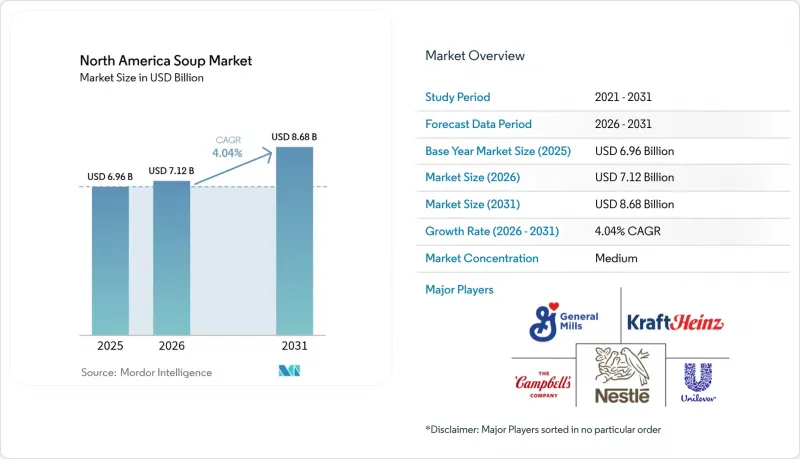
This report is Segmented by Product Type (Dry Soup, Shelf Stable Soup, Chilled Soup, Frozen Soup, and Others), Category (Vegetarian Soup and Non-Vegetarian Soup), Packaging Type (Cans, Pouches, and More), Distribution Channel (On-Trade and Off-Trade), and Geography (North America, Europe, Asia-Pacific and More). The Market Forecasts are Provided in Terms of Value (USD) and Volume (Unit).
North America Soup Market Trends and Insights
Rising demand for convenient single-serve meal options
Single-serve soup formats are gaining market share from multi-serving cans as consumers with limited time prioritize portion control and convenience. In 2024, Campbell Soup Company launched microwaveable bowl formats for its Chunky line, reducing preparation time to under 90 seconds. This product targets office workers and college students who often lack access to full kitchens. By 2025, retailers are expected to allocate more linear shelf space to single-serve stock-keeping units compared to 2023, driven by higher per-unit margins and reduced markdown risks. This shift also allows brands to explore premium pricing, with single-serve pouches retailing at higher prices compared to per-serving costs in family-size cans. Consumers are less resistant to these higher prices, viewing single-serve options as a distinct convenience category rather than a direct substitute. This trend is particularly evident in convenience stores and airport retail, where impulse purchases account for a significant portion of soup transactions, and speed of consumption takes precedence over price sensitivity.
Expansion of ready-to-eat and frozen soup varieties
Frozen soup is increasingly positioned as a middle ground between shelf-stable and chilled formats, offering extended shelf life without the use of preservatives while maintaining fresh-like taste profiles. According to Conagra Brands' 2026 Future of Frozen report, a growing number of consumers now perceive frozen soup as nutritionally comparable to refrigerated options. This shift is attributed to advancements in blast-freezing techniques that better preserve vegetable texture and color. Retailers are expanding frozen soup shelf space annually, strategically placing these products near frozen entrees to attract meal-planning shoppers. In the ready-to-eat chilled soup category, products like Campbell's Chunky Chili with Beans, introduced in a refrigerated format in 2024, are leveraging clean-label claims and shorter ingredient lists. These attributes enable chilled soups to command a price premium over canned alternatives, appealing to health-conscious consumers who prioritize perceived freshness over extended shelf life. The combined frozen and chilled soup segments are projected to represent a significant portion of total soup volume in the coming years. This growth is supported by improvements in cold-chain infrastructure and the entry of private-label brands offering competitive pricing.
Consumer concerns regarding ultra-processed and canned food perceptions
Ultra-processed food consumption makes up 55% of total caloric intake in the United States. However, increasing awareness of its connection to metabolic diseases is influencing consumer preferences toward minimally processed alternatives [2]. Canned soup, traditionally seen as a pantry staple, is now often categorized by younger consumers as ultra-processed. This classification is associated with a decline in purchase intent among households with children under the age of twelve. According to the International Food Information Council's 2025 survey, a growing percentage of U.S. consumers actively avoid products labeled as "processed," reflecting a significant rise compared to 2023. This trend creates challenges for traditional canned soup formats that rely on preservatives and flavor enhancers [3]. In response, brands are focusing on highlighting "no artificial ingredients" and "recognizable components" on front-of-package labels. However, addressing long-standing perceptions requires significant marketing efforts and product reformulation, which many regional players find financially challenging. This shift is driving premiumization, as consumers are willing to pay a higher price for chilled or organic soups, perceiving them as less processed, even when the functionality of their ingredients is similar.
Other drivers and restraints analyzed in the detailed report include:
- Increasing introduction of plant-based and dairy-free soups
- Growing health awareness boosting demand for low-sodium and organic soups
- High sodium levels in traditional canned soups
For complete list of drivers and restraints, kindly check the Table Of Contents.
Segment Analysis
Campbell Soup Company's planned launch of Chunky Chili with Beans in a refrigerated format in 2024 highlights a strategic focus on the chilled soup category. This segment is projected to grow at a compound annual growth rate (CAGR) of 4.31% through 2031, despite representing only 8% to 10% of total market volume in 2025. Shelf-stable soup, which is expected to hold a 47.12% market share in 2025, remains the dominant category. Its popularity is driven by legacy brands and private-label offerings that prioritize cost-effectiveness and pantry convenience. However, this segment is experiencing slower growth as consumers increasingly prefer formats perceived as fresher and less processed.
Dry soup, which includes instant noodles and powder-based varieties, constitutes a significant portion of the market and is growing steadily. This growth is fueled by innovations in single-serve packaging and the rising demand for ethnic flavors, such as ramen and pho, particularly among younger consumers. Meanwhile, frozen soup is expanding at a notable compound annual growth rate, supported by advancements in blast-freezing technology. These technological improvements enhance vegetable texture and color while extending shelf life without the need for preservatives. Chilled soup, priced at a premium compared to canned alternatives, benefits from consumer perceptions associating refrigeration with minimal processing and higher ingredient quality, even when functional differences are minimal. Retailers are responding to this trend by increasing refrigerated shelf space for soup by a significant percentage compared to previous years. These products are strategically placed near fresh salads and deli entrees to appeal to meal-planning shoppers.
Non-vegetarian soups are projected to hold a 65.88% market share in 2025, driven by strong consumer preferences for chicken, beef, and pork-based broths that provide savory flavors and high protein content. Meanwhile, vegetarian soups are anticipated to grow at a compound annual growth rate (CAGR) through 2031, supported by the increasing popularity of flexitarian diets. The Kraft Heinz Company's launch of oat milk-based cream soups in early 2025 highlights a strategic focus on dairy-free and plant-based products. These offerings are expected to command a 20% to 25% price premium, appealing to lactose-intolerant and environmentally conscious consumers. Consumers seeking animal-based nutrition are increasingly turning to alternatives such as jerky, protein bars, and ready-to-eat chicken bowls, which offer higher protein density per calorie. On the other hand, vegetarian soups are benefiting from ingredient innovations that go beyond traditional vegetable broths. Examples include lentil-based bisques, mushroom-focused varieties, and chickpea-thickened soups, which deliver 6% to 8% of plant protein per serving.
Retailers are responding to the rising demand for vegetarian soups by expanding their product offerings. For example, Natural Grocers increased its organic soup assortment by 22% in January 2025, with a focus on vegetarian stock-keeping units (SKUs). This expansion reflects confidence in sustained consumer interest and a willingness to allocate premium shelf space to these products. The growing demand for vegetarian soups is also driven by consumers' increasing awareness of health benefits and environmental sustainability, encouraging retailers to prioritize these products in their assortments and marketing strategies.
Complete Report Scope:
- By Product Type
- Dry Soup
- Shelf Stable Soup
- Chilled Soup
- Frozen Soup
- By Category
- Vegetarian Soup
- Non-Vegetarian Soup
- By Packaging Type
- Cans
- Pouches
- Cartons
- Others
- By Distribution Channel
- On-trade
- Off-trade
- Supermarkets/Hypermarkets
- Convenience/ Grocery Stores
- Online Retail Stores
- Other Distribution Channels
- By Geography
- United States
- Canada
- Mexico
- Rest of North America
List of Companies Covered in this Report:
- The Campbell's Company
- General Mills Inc.
- Kraft Heinz Company
- Nestle SA
- Unilever PLC
- B&G Foods, Inc.
- Conagra Brands Inc.
- Amy's Kitchen
- The Hain Celestial Group, Inc.
- Baxters Food Group Ltd.
- Blount Fine Foods
- Del Monte Foods Corporation Inc.
- Kettle & Fire Inc.
- Nissin Foods
- Uptons Naturals
- Ottogi Corporation
- Bes'Dam Soup
- Aylmer soups
- Mitchell's Soup Co.
- Evolution Fresh
Additional Benefits:
- The market estimate (ME) sheet in Excel format
- 3 months of analyst support
TABLE OF CONTENTS
1 INTRODUCTION
- 1.1 Study Assumptions and Market Definition
- 1.2 Scope of the Study
2 RESEARCH METHODOLOGY
3 EXECUTIVE SUMMARY
4 MARKET LANDSCAPE
- 4.1 Market Overview
- 4.2 Market Drivers
- 4.2.1 Rising demand for convenient single-serve meal options
- 4.2.2 Expansion of ready-to-eat and frozen soup varieties
- 4.2.3 Increasing introduction of plant-based and dairy-free soups
- 4.2.4 Growing health awareness boosting demand for low-sodium and organic soups
- 4.2.5 Advancements in shelf-stable packaging, including pouches and cartons
- 4.2.6 Increasing preference for soups aligned with clean-label and "simply-made" trends
- 4.3 Market Restraints
- 4.3.1 Consumer concerns regarding ultra-processed and canned food perceptions
- 4.3.2 High sodium levels in traditional canned soups
- 4.3.3 Competition for shelf space from snacks and refrigerated entrees
- 4.3.4 Food safety and recall risks associated with canned and packaged soups
- 4.4 Value Chain Analysis
- 4.5 Regulatory Outlook
- 4.6 Porter's Five Forces
- 4.6.1 Threat of New Entrants
- 4.6.2 Bargaining Power of Buyers
- 4.6.3 Bargaining Power of Suppliers
- 4.6.4 Threat of Substitute Products
- 4.6.5 Intensity of Competitive Rivalry
5 MARKET SIZE AND GROWTH FORECASTS (VALUE AND VOLUME)
- 5.1 By Product Type
- 5.1.1 Dry Soup
- 5.1.2 Shelf Stable Soup
- 5.1.3 Chilled Soup
- 5.1.4 Frozen Soup
- 5.2 By Category
- 5.2.1 Vegetarian Soup
- 5.2.2 Non-Vegetarian Soup
- 5.3 By Packaging Type
- 5.3.1 Cans
- 5.3.2 Pouches
- 5.3.3 Cartons
- 5.3.4 Others
- 5.4 By Distribution Channel
- 5.4.1 On-trade
- 5.4.2 Off-trade
- 5.4.2.1 Supermarkets/Hypermarkets
- 5.4.2.2 Convenience/ Grocery Stores
- 5.4.2.3 Online Retail Stores
- 5.4.2.4 Other Distribution Channels
- 5.5 By Geography
- 5.5.1 United States
- 5.5.2 Canada
- 5.5.3 Mexico
- 5.5.4 Rest of North America
6 COMPETITIVE LANDSCAPE
- 6.1 Market Concentration
- 6.2 Strategic Moves
- 6.3 Market Ranking Analysis
- 6.4 Company Profiles (includes Global-level Overview, Market-level Overview, Core Segments, Financials (if available), Strategic Information, Market Rank/Share, Products and Services, Recent Developments)
- 6.4.1 The Campbell's Company
- 6.4.2 General Mills Inc.
- 6.4.3 Kraft Heinz Company
- 6.4.4 Nestle SA
- 6.4.5 Unilever PLC
- 6.4.6 B&G Foods, Inc.
- 6.4.7 Conagra Brands Inc.
- 6.4.8 Amy's Kitchen
- 6.4.9 The Hain Celestial Group, Inc.
- 6.4.10 Baxters Food Group Ltd.
- 6.4.11 Blount Fine Foods
- 6.4.12 Del Monte Foods Corporation Inc.
- 6.4.13 Kettle & Fire Inc.
- 6.4.14 Nissin Foods
- 6.4.15 Uptons Naturals
- 6.4.16 Ottogi Corporation
- 6.4.17 Bes'Dam Soup
- 6.4.18 Aylmer soups
- 6.4.19 Mitchell's Soup Co.
- 6.4.20 Evolution Fresh
7 MARKET OPPORTUNITIES AND FUTURE OUTLOOK

