PUBLISHER: Mordor Intelligence | PRODUCT CODE: 2113426

PUBLISHER: Mordor Intelligence | PRODUCT CODE: 2113426
Europe Aquafeed - Market Share Analysis, Industry Trends & Statistics, Growth Forecasts (2026 - 2031)
According to Mordor Intelligence, the Europe aquafeed market size was valued at USD 7.28 billion in 2025 and estimated to grow from USD 7.65 billion in 2026 to reach USD 9.84 billion by 2031, at a CAGR of 5.14% during the forecast period (2026-2031).
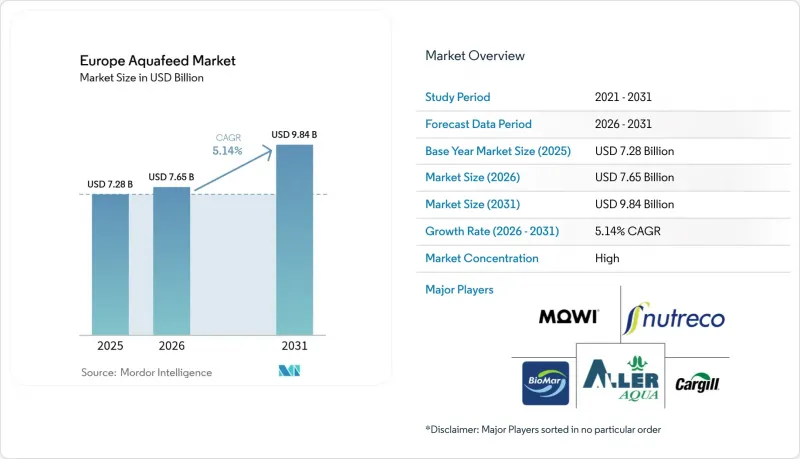
This report is Segmented by Type (Fish Feed, Crustaceans Feed, Mollusks Feed, and Other Aquafeed), by Ingredient (Cereals, Fishmeal, Supplements, and Other Ingredients), and by Geography (Germany, France, Italy, Spain, United Kingdom, Norway, and Rest of Europe). The Market Forecasts are Provided in Terms of Value (USD).
Europe Aquafeed Market Trends and Insights
Rising Intensification of Aquaculture Across the Region
European aquaculture production is increasing as operators transition from extensive ponds to high-density sea cages and land-based facilities. This intensification creates concentrated feed demand, enabling feed mills to benefit from economies of scale and optimize delivery networks. The 2023 harvest in Norway's Trondelag region, which reached 239,800 metric tons valued at NOK 17.1 billion (USD 1.6 billion), illustrates how concentrated production creates high-volume demand centers. Simplified permitting processes for compliant intensive operations support this transition, while environmental regulations limit extensive farming. This development pattern sustains demand for high-performance feeds that command higher prices due to improved feed conversion ratios and lower environmental impact.
Growth of Recirculating Aquaculture Systems (RAS) Demanding Specialized High-density Feeds
Recirculating Aquaculture Systems (RAS) are expanding across Germany, the Netherlands, and Norway, supported by stable energy prices and improved engineering reliability. These closed-loop systems require specialized feeds with high digestibility and low phosphorus content to maintain water quality. Feed manufacturers, such as BioMar, developed RAS-specific product lines in 2021 with enhanced nutrient absorption and durability features that reduce solid waste output. The technical complexity of these specialized feeds enables premium pricing while creating barriers for conventional feed producers. The integration between feed manufacturers and RAS technology suppliers increases customer retention and competitive advantages. RAS adoption is anticipated to grow through 2030, driven by land availability constraints and regulations aimed at preventing fish escapes, which will support continued growth in feed revenue.
High Capital Cost of Extrusion and Pelletizing Upgrades for Novel Ingredients
The processing of insect meal and algal oils requires specialized equipment with specific shear forces, temperature controls, and coating capabilities that existing production lines cannot accommodate. Production line upgrades cost between EUR 2-5 million (USD 2.2-5.4 million), which creates financial constraints for regional feed mills. The EUR 37 million (USD 40 million) loan from the European Investment Bank to Protix in 2024 for its Polish operations demonstrates the significant capital requirements. Large companies, including Nutreco N.V., can distribute investment costs across multiple facilities, which increases market consolidation. This financial barrier causes smaller manufacturers to delay the adoption of alternative ingredients, impeding the industry's transition from marine-based proteins.
Other drivers and restraints analyzed in the detailed report include:
- European Union Green Deal Incentives for Low-Carbon Feed Ingredients
- Retailer Sustainability Scorecards Pushing Certified Aquafeed Sourcing
- Biosecurity Threats Lengthening Product-Approval Timelines
For complete list of drivers and restraints, kindly check the Table Of Contents.
Segment Analysis
Fish feed accounts for 37.28% of the Europe aquafeed market share in 2025, driven by Norway's salmon and trout production and consistent demand for carp and tilapia in Central and Southern Europe. Salmon feed represents the highest volume, supporting extensive sea-cage operations and increasing land-based recirculating aquaculture systems (RAS) that require concentrated feed formulations. Carp feed sustains pond systems in Poland and the Czech Republic, while tilapia feed serves Mediterranean pond operations that maintain year-round production cycles.
The crustacean feed segment is projected to grow at a 7.06% CAGR, representing the highest growth rate in the market. This growth is primarily driven by shrimp farming, with Spain and Portugal expanding their Litopenaeus vannamei production systems, which require specific protein and lipid compositions different from fish feed. Additional demand comes from experimental crab farming operations in France and the United Kingdom. Crustacean feed commands higher prices than fish feed, resulting in faster revenue growth compared to volume increases. The expansion of crustacean feed production offers market diversification opportunities for producers looking to reduce their dependence on salmon feed market fluctuations.
Complete Report Scope:
- By Type
- Fish Feed
- Carp
- Salmon
- Tilapia
- Catfish
- Other Fish Feed
- Crustaceans Feed
- Shrimp
- Other Crustacean Feed
- Mollusks Feed
- Other Aquafeed
- Fish Feed
- By Ingredient
- Cereals
- Fishmeal
- Supplements
- Other Ingredients
- By Geography
- Germany
- France
- Italy
- Spain
- United Kingdom
- Norway
- Rest of Europe
List of Companies Covered in this Report:
- Nutreco N.V. (SHV Holdings N.V.)
- BioMar Group A/S (Schouw & Co. A/S)
- Cargill, Incorporated
- Aller Aqua A/S
- Mowi Feed AS (Mowi ASA)
- Alltech Inc.
- BASF SE
- ADM (Archer Daniels Midland Company)
- Adisseo (A Bluestar Company)
- DSM-Firmenich
- De Heus Animal Nutrition B.V.
- Kemin Industries, Inc.
- Charoen Pokphand Foods PCL
- Zooca - Calanus AS
- Dibaq Acuaculture (Grupo Dibaq)
Additional Benefits:
- The market estimate (ME) sheet in Excel format
- 3 months of analyst support
TABLE OF CONTENTS
1 Introduction
- 1.1 Study Assumptions and Market Definition
- 1.2 Scope of the Study
2 Research Methodology
3 Executive Summary
4 Market Landscape
- 4.1 Market Overview
- 4.2 Market Drivers
- 4.2.1 Rising Intensification of Aquaculture Across the Region
- 4.2.2 Growth of Recirculating Aquaculture Systems (RAS) Demanding Specialized High-density Feeds
- 4.2.3 European Union Green Deal Incentives for Low-Carbon Feed Ingredients
- 4.2.4 Widening Adoption of Single-Cell Protein (SCP) to Bridge Europe's Protein Gap
- 4.2.5 Digital Twin-Enabled Precision Feeding Reducing Feed Conversion Ratio
- 4.2.6 Retailer Sustainability Scorecards Pushing Certified Aquafeed Sourcing
- 4.3 Market Restraints
- 4.3.1 High Capital Cost of Extrusion and Pelletizing Upgrades for Novel Ingredients
- 4.3.2 Consumer Skepticism Toward Genetically Edited Feed Ingredients
- 4.3.3 Biosecurity Threats Lengthening Product-Approval Timelines
- 4.3.4 Energy Price Swings Elevating Production Costs for Feed Mills
- 4.4 Regulatory Landscape
- 4.5 Technological Outlook
- 4.6 Porter's Five Forces Analysis
- 4.6.1 Bargaining Power of Suppliers
- 4.6.2 Bargaining Power of Buyers
- 4.6.3 Threat of New Entrants
- 4.6.4 Threat of Substitutes
- 4.6.5 Intensity of Competitive Rivalry
5 Market Size and Growth Forecasts (Value)
- 5.1 By Type
- 5.1.1 Fish Feed
- 5.1.1.1 Carp
- 5.1.1.2 Salmon
- 5.1.1.3 Tilapia
- 5.1.1.4 Catfish
- 5.1.1.5 Other Fish Feed
- 5.1.2 Crustaceans Feed
- 5.1.2.1 Shrimp
- 5.1.2.2 Other Crustacean Feed
- 5.1.3 Mollusks Feed
- 5.1.4 Other Aquafeed
- 5.1.1 Fish Feed
- 5.2 By Ingredient
- 5.2.1 Cereals
- 5.2.2 Fishmeal
- 5.2.3 Supplements
- 5.2.4 Other Ingredients
- 5.3 By Geography
- 5.3.1 Germany
- 5.3.2 France
- 5.3.3 Italy
- 5.3.4 Spain
- 5.3.5 United Kingdom
- 5.3.6 Norway
- 5.3.7 Rest of Europe
6 Competitive Landscape
- 6.1 Market Concentration
- 6.2 Strategic Moves
- 6.3 Market Share Analysis
- 6.4 Company Profiles (Includes Global-Level Overview, Market-Level Overview, Core Segments, Financials as Available, Strategic Information, Market Rank/Share, Products and Services, Recent Developments)
- 6.4.1 Nutreco N.V. (SHV Holdings N.V.)
- 6.4.2 BioMar Group A/S (Schouw & Co. A/S)
- 6.4.3 Cargill, Incorporated
- 6.4.4 Aller Aqua A/S
- 6.4.5 Mowi Feed AS (Mowi ASA)
- 6.4.6 Alltech Inc.
- 6.4.7 BASF SE
- 6.4.8 ADM (Archer Daniels Midland Company)
- 6.4.9 Adisseo (A Bluestar Company)
- 6.4.10 DSM-Firmenich
- 6.4.11 De Heus Animal Nutrition B.V.
- 6.4.12 Kemin Industries, Inc.
- 6.4.13 Charoen Pokphand Foods PCL
- 6.4.14 Zooca - Calanus AS
- 6.4.15 Dibaq Acuaculture (Grupo Dibaq)
7 Market Opportunities and Future Outlook

