PUBLISHER: Mordor Intelligence | PRODUCT CODE: 2121523

PUBLISHER: Mordor Intelligence | PRODUCT CODE: 2121523
Asia-Pacific Aqua Feed - Market Share Analysis, Industry Trends & Statistics, Growth Forecasts (2026 - 2031)
According to Mordor Intelligence, Asia-Pacific aquafeed market size in 2026 is estimated at USD 27.57 billion, growing from 2025 value of USD 25.7 billion with 2031 projections showing USD 39.18 billion, growing at 7.28% CAGR over 2026-2031.
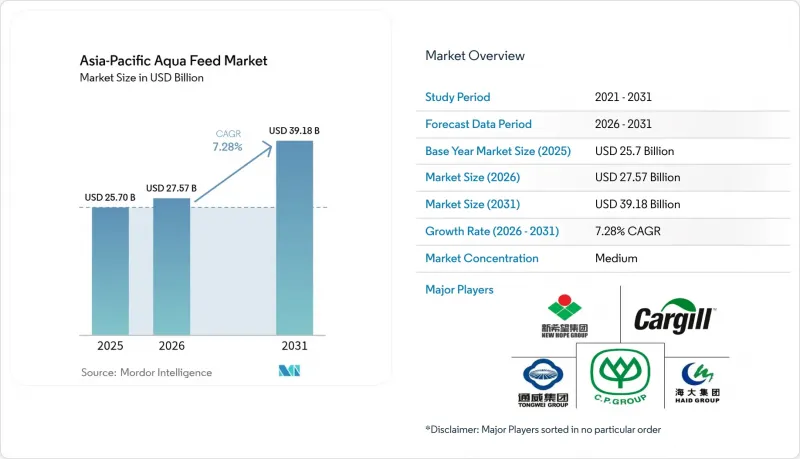
This report is Segmented by Species (Fish, Crustaceans, and More), Ingredient (Soybean Meal, Fishmeal, Fish-Oil, and More), Form (Pellets, Extruded Feed, and More), and Geography (China, India, Indonesia, and More). The Market Forecasts are Provided in Terms of Value (USD).
Asia-Pacific Aqua Feed Market Trends and Insights
Intensifying Aquaculture Production in China and India
China's aquaculture output in 2024 represented a modest year-over-year rise and underscores Beijing's policy commitment to diversifying national protein sources. India mirrors that focus but wrestles with disease-linked losses each year. Larger pond stocking densities and expanding shrimp estates, therefore, compel feed makers to deliver higher amino-acid precision and stronger immune additives. Local supply chain investments in Vietnam and Thailand benefit as regional processing hubs capture a portion of surging raw-feed demand. Enforcement of stricter ingredient standards by China's Ministry of Agriculture and Rural Affairs raises compliance hurdles, favoring producers that can document nutrient consistency and traceability.
Rising Seafood Consumption Driven by Income Growth
Seafood demand in the Asia-Pacific is flourishing, lifted by swelling middle-class wallets and fast-urbanizing diets. Domestic buyers across Shanghai, Mumbai, and Jakarta fuel a premium shift that rewards feed with superior digestibility, flavor, and shelf-life performance. As producers command higher farm-gate prices, they allocate bigger budgets toward functional additives that protect stock health, reinforcing a virtuous spending loop for quality formulations. Indonesia's goal of 2 million metric tons of shrimp output galvanizes local hatcheries, even if timelines appear optimistic in light of infrastructure gaps.
Volatile Fishmeal and Fish-Oil Prices
Spot fishmeal averaged USD 1,504 to USD 1,882 per metric ton in 2024, whipsawing margins and complicating inventory planning. Smaller Asian mills lacking hedging tools scramble for soybean meal substitutions, but carnivorous species still require concentrated marine amino acids. Fish-oil turbulence echoes meal swings and fuels algae-oil pilots despite higher upfront costs. Vietnamese and Thai exporters face thin price flexibility against global buyers, magnifying the squeeze. Broad substitution accelerates R&D toward microbial and insect oils that soothe price shocks but retain essential fatty-acid profiles.
Other drivers and restraints analyzed in the detailed report include:
- Advances in Nutritionally Balanced, Species-Specific Formulations
- Increasing Adoption of Extruded Aquafeed for Improved Digestibility
- Disease Outbreaks Leading to Temporary Stocking Cuts
For complete list of drivers and restraints, kindly check the Table Of Contents.
Segment Analysis
Fish diets generated 51.35% of the Asia-Pacific aquafeed market share in 2025, confirming the segment's volume supremacy within the Asia-Pacific aquafeed market. Carp, tilapia, catfish, and diverse marine finfish underpin China's mammoth output, with each species requiring unique amino-acid ratios to hit optimal feed-conversion benchmarks. The Asia-Pacific aquafeed market size attached to crustaceans remains smaller today, yet is rising quickly as shrimp estates in Vietnam, Thailand, and Indonesia pursue intensification and higher protein feeds. Crustaceans are estimated to grow at the highest rate, with an estimated CAGR of 8.22% from 2026 to 2031, reflecting strong demand momentum.
Mollusk feed sees steady orders from Chinese coastal polyculture schemes that recycle excess nutrients through bivalves. Emerging eel and ornamental species stay in niche but command premium prices, enabling specialty manufacturers to charge higher margins. Precision-nutrition gains, delivering up to 20% feed-conversion efficiencies, allow growers to trim feeding days while lifting survival rates. Producers calibrate vitamin and mineral packs against water-temperature swings to mitigate stress-related diseases. Ultimately, wide species variety ensures sustained tonnage growth while inviting tailored feed niches that cushion producers from commodity price pressure.
Complete Report Scope:
- By Species
- Fish
- Crustaceans
- Mollusks
- Others (Eels, etc.)
- By Ingredient
- Soybean Meal
- Fishmeal
- Fish-oil
- Functional Additives
- Others (Corn Gluten, etc.)
- By Form
- Pellets
- Extruded Feed
- Powdered Meal
- Liquid Feed
- By Country
- China
- India
- Indonesia
- Vietnam
- Thailand
- Rest of Asia-Pacific
List of Companies Covered in this Report:
- Charoen Pokphand Foods PCL
- Cargill, Inc.
- Tongwei Group Co., Ltd.
- SHV Holdings
- New Hope Group
- ADM
- Alltech
- Guangdong HAID Group Co., Ltd.
- Aller Aqua A/S
- Thai Union Feedmill Public Company Limited.
- De Heus Animal Nutrition
- Avanti Feeds Limited
- IFB Agro Industries Ltd
- Schouw & Co., (Biomar)
- Maruichi Co., Ltd. (Dainichi)
- Godrej Agrovet Limited
- Ridley Corporation Limited.
- Kemin Industries, Inc.
Additional Benefits:
- The market estimate (ME) sheet in Excel format
- 3 months of analyst support
TABLE OF CONTENTS
1 Introduction
- 1.1 Study Assumptions and Market Definition
- 1.2 Scope of the Study
2 Research Methodology
3 Executive Summary
4 Market Landscape
- 4.1 Market Overview
- 4.2 Market Drivers
- 4.2.1 Intensifying aquaculture production in China and India
- 4.2.2 Rising seafood consumption driven by income growth
- 4.2.3 Advances in nutritionally-balanced, species-specific formulations
- 4.2.4 Increasing adoption of extruded aquafeed for improved digestibility
- 4.2.5 Government push for integrated multi-trophic aquaculture
- 4.2.6 Expansion of offshore cage farming
- 4.3 Market Restraints
- 4.3.1 Volatile fishmeal and fish-oil prices
- 4.3.2 Disease outbreaks leading to temporary stocking cuts
- 4.3.3 Regulatory caps on phosphorus discharge from feed
- 4.3.4 Competition from single-cell protein alternatives
- 4.4 Regulatory Landscape
- 4.5 Technological Outlook
- 4.6 Porter's Five Forces
- 4.6.1 Threat of New Entrants
- 4.6.2 Bargaining Power of Suppliers
- 4.6.3 Bargaining Power of Buyers
- 4.6.4 Threat of Substitutes
- 4.6.5 Intensity of Competitive Rivalry
5 Market Size and Growth Forecasts (Value)
- 5.1 By Species
- 5.1.1 Fish
- 5.1.2 Crustaceans
- 5.1.3 Mollusks
- 5.1.4 Others (Eels, etc.)
- 5.2 By Ingredient
- 5.2.1 Soybean Meal
- 5.2.2 Fishmeal
- 5.2.3 Fish-oil
- 5.2.4 Functional Additives
- 5.2.5 Others (Corn Gluten, etc.)
- 5.3 By Form
- 5.3.1 Pellets
- 5.3.2 Extruded Feed
- 5.3.3 Powdered Meal
- 5.3.4 Liquid Feed
- 5.4 By Country
- 5.4.1 China
- 5.4.2 India
- 5.4.3 Indonesia
- 5.4.4 Vietnam
- 5.4.5 Thailand
- 5.4.6 Rest of Asia-Pacific
6 Competitive Landscape
- 6.1 Market Concentration
- 6.2 Strategic Moves
- 6.3 Market Share Analysis
- 6.4 Company Profiles (Includes Global Level Overview, Market Level Overview, Core Segments, Financials as Available, Strategic Information, Market Rank/Share for Key Companies, Products and Services, and Recent Developments)
- 6.4.1 Charoen Pokphand Foods PCL
- 6.4.2 Cargill, Inc.
- 6.4.3 Tongwei Group Co., Ltd.
- 6.4.4 SHV Holdings
- 6.4.5 New Hope Group
- 6.4.6 ADM
- 6.4.7 Alltech
- 6.4.8 Guangdong HAID Group Co., Ltd.
- 6.4.9 Aller Aqua A/S
- 6.4.10 Thai Union Feedmill Public Company Limited.
- 6.4.11 De Heus Animal Nutrition
- 6.4.12 Avanti Feeds Limited
- 6.4.13 IFB Agro Industries Ltd
- 6.4.14 Schouw & Co., (Biomar)
- 6.4.15 Maruichi Co., Ltd. (Dainichi)
- 6.4.16 Godrej Agrovet Limited
- 6.4.17 Ridley Corporation Limited.
- 6.4.18 Kemin Industries, Inc.
7 Market Opportunities and Future Outlook

