PUBLISHER: Mordor Intelligence | PRODUCT CODE: 2113468

PUBLISHER: Mordor Intelligence | PRODUCT CODE: 2113468
Spain Over-the-counter (OTC) Drugs - Market Share Analysis, Industry Trends & Statistics, Growth Forecasts (2026 - 2031)
According to Mordor Intelligence, the spain over-the-counter drugs market size is estimated at USD 2.96 billion in 2026, and is expected to reach USD 3.67 billion by 2031, at a CAGR of 4.43% during the forecast period (2026-2031).
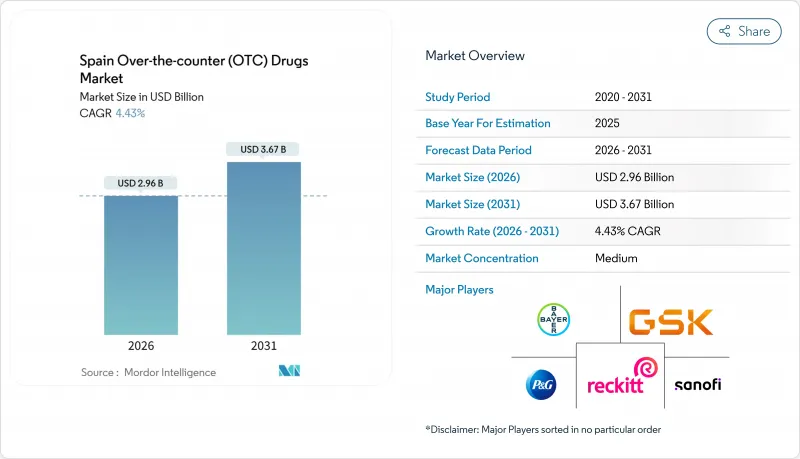
This report is Segmented by Product (Cough, Cold & Flu, Analgesics, Dermatology, Gastrointestinal, VMS, Weight-Loss, Ophthalmic, Sleep Aids, Others), Dosage Form (Tablets & Capsules, Liquids & Syrups, Topicals, Powders & Granules, Others), Distribution Channel (Retail Pharmacies, and More), and Consumer Demographic (Adults, and More). Market Forecasts are Provided in Terms of Value (USD).
Spain Over-the-counter (OTC) Drugs Market Trends and Insights
Rx-to-OTC Switches Accelerating Post-EU Reclassification
The European regulator downgraded pantoprazole 20 mg and cetirizine 10 mg in 2024, and AEMPS mirrored the decision within three months, allowing pharmacies nationwide to dispense both molecules without prescriptions. Manufacturers quickly introduced lower-dose packs priced 20-30% below prescription equivalents, helping price-sensitive patients who previously delayed treatment. Cinfa's 14-tablet pantoprazole pack at EUR 6.50 (USD 7.10) undercut a leading multinational rival by EUR 3.00. General-practitioner visits for minor gastric complaints fell 8% in 2025, freeing capacity for chronic-disease management. The policy therefore expands access, lowers out-of-pocket costs, and reduces strain on the public health system, jointly lifting the Spain over the counter (otc) drugs market.
Growing Preference for Self-Care Among Aging Population
Spain counted 9.8 million residents aged 65 and above in 2025, equal to 20.8% of all citizens, and demographic forecasts suggest the share will reach 25% by 2030. Retirees favor familiar brands, consult pharmacists about drug-drug interactions, and self-fund vitamins and minerals excluded from public reimbursement, sustaining steady demand for analgesics, laxatives, and vitamin D. Faes Farma's Fisiogen cognitive-health line grew sales 18% in 2025 on the back of targeted newspaper ads and pharmacy loyalty programs. WHO guidelines published in 2024 encourage older adults to manage minor ailments themselves, reinforcing the strategic pivot toward geriatric-focused portfolios. As these consumers purchase repeatedly for chronic conditions, they underpin the Spain over the counter (otc) drugs market's long-run volume growth.
Risk of Misdiagnosis and Delayed Professional Care
Ready OTC access can mask serious conditions and postpone specialist consultations. A 2024 study tracking 1,200 self-medicating heartburn patients found that 9% later received diagnoses of Barrett's esophagus or early gastric cancer after delaying endoscopy eight months on average. Chronic headache sufferers who rely on analgesics risk overlooking hypertension or intracranial lesions. Although AEMPS mandates on-pack warnings to seek medical advice if symptoms persist beyond 10 days, compliance audits in 2025 showed that 30% of consumers ignore the guidance. Some chains deploy digital triage tools that flag red-flag symptoms, yet adoption outside large cities remains limited. The resulting disease-progression costs temper the positive trajectory of the Spain over the counter (otc) drugs market.
Other drivers and restraints analyzed in the detailed report include:
- Expansion of E-Pharmacy and Click-and-Collect Models
- High Tourism Inflow Boosting Point-of-Sale Volumes
- Rising Substance-Abuse Flags for Codeine Combinations
For complete list of drivers and restraints, kindly check the Table Of Contents.
Segment Analysis
Analgesics generated 28.62% of revenue in 2025, but sleep aids are forecast to record a 7.36% CAGR to 2031, the quickest of any category. The Spain over the counter (otc) drugs market size for sleep aids is expected to expand as digital-device exposure prolongs wakefulness among urban professionals. Melatonin gummies and valerian capsules resonate with consumers seeking drug-free solutions, and EFSA's 2024 approval of a health claim stating that 1 mg melatonin reduces sleep-onset latency legitimizes marketing. Spanish players launched affordable gummy lines priced below EUR 10 per monthly supply, while multinationals promote premium herbal blends with sustained-release technology.
Growing consumer interest in preventive health also lifts vitamins, minerals, and supplements, while dermatology products benefit from high UV exposure in coastal regions. Cough, cold, and flu remedies remain a seasonal staple, reinforced by lingering COVID-19 circulation. Gastrointestinal products serve both aging residents managing chronic reflux and tourists adjusting to new cuisines. Weight-control and ophthalmic segments retain niche status because advertising rules restrict bold efficacy claims, yet they round out pharmacy assortments, ensuring comprehensive choice within the Spain over the counter (otc) drugs market.
Tablets and capsules still accounted for 41.57% of value in 2025, but novel forms are eroding share. Gummies, sprays, and drops are projected to climb 7.55% CAGR, thanks to palatability, perceived naturalness, and on-the-go convenience. Consumers accept a 30-40% price premium per dose, which lifts category profitability. For example, Bayer's vitamin C oral spray targets commuters who want quick immune support without water.
Liquids and syrups remain critical in pediatrics, yet sachets and chewables are winning over parents who prefer spill-proof administration. Topical creams and transdermal patches see steady demand for dermatology and localized pain relief. Powders and granules hold a niche for rehydration salts and fiber supplements. The dosage-form shift reflects broader expectations that OTC remedies integrate seamlessly into daily routines, reinforcing growth prospects for the Spain over the counter (otc) drugs market.
Complete Report Scope:
- By Product
- Cough, Cold & Flu Products
- Analgesics
- Dermatology Products
- Gastrointestinal Products
- Vitamin, Mineral & Supplements (VMS)
- Weight-loss/Dietary Products
- Ophthalmic Products
- Sleep Aids
- Other Product Types
- By Dosage Form
- Tablets & Capsules
- Liquids & Syrups
- Topicals (Creams/Ointments/Patches)
- Powders & Granules
- Others (Sprays, Drops, Gummies)
- By Distribution Channel
- Retail Pharmacies
- Online Pharmacies
- Supermarkets/Hypermarkets
- Drug-Parapharmacy Chains
- Other Channels (Gas stations, Vending)
- By Consumer Demographic
- Adults (19-59 yrs)
- Geriatric (>=60 yrs)
- Pediatric (0-18 yrs)
List of Companies Covered in this Report:
- Almirall S.A.
- Angelini Pharma S.p.A.
- Bayer
- Cinfa Laboratories
- Esteve Pharmaceuticals S.A.
- Faes Farma S.A.
- Ferrer Internacional S.A.
- GlaxoSmithKline
- Johnson & Johnson
- P&G Health
- Perrigo Company
- Reckitt Benckiser Group
- Sanofi
- Stada Arzneimittel
- Uriach Pharma
Additional Benefits:
- The market estimate (ME) sheet in Excel format
- 3 months of analyst support
TABLE OF CONTENTS
1 Introduction
- 1.1 Study Assumptions & Market Definition
- 1.2 Scope of the Study
2 Research Methodology
3 Executive Summary
4 Market Landscape
- 4.1 Market Overview
- 4.2 Market Drivers
- 4.2.1 Rx-To-OTC Switches Accelerating Post-EU Re-Classification
- 4.2.2 Growing Preference for Self-Care Among the Ageing Population
- 4.2.3 Expansion Of E-Pharmacy & Click-and-Collect Models
- 4.2.4 High Tourism Inflow Boosting Point-Of-Sale Volumes
- 4.2.5 Regional Reimbursement Cuts Driving OTC Uptake
- 4.2.6 Emerging CBD-Based OTC Remedies
- 4.3 Market Restraints
- 4.3.1 Risk of Misdiagnosis & Delayed Professional Care
- 4.3.2 Rising Substance-Abuse Flags For Codeine Combinations
- 4.3.3 Stringent Spanish Advertising Code CAP 2024
- 4.3.4 Price-Containment Pacts with Regional Health Authorities
- 4.4 Value / Supply-Chain Analysis
- 4.5 Regulatory Landscape
- 4.6 Technological Outlook
- 4.7 Porter's Five Forces Analysis
- 4.7.1 Threat of New Entrants
- 4.7.2 Bargaining Power of Buyers/Consumers
- 4.7.3 Bargaining Power of Suppliers
- 4.7.4 Threat of Substitute Products
- 4.7.5 Intensity of Competitive Rivalry
5 Market Size & Growth Forecasts (Value in USD)
- 5.1 By Product
- 5.1.1 Cough, Cold & Flu Products
- 5.1.2 Analgesics
- 5.1.3 Dermatology Products
- 5.1.4 Gastrointestinal Products
- 5.1.5 Vitamin, Mineral & Supplements (VMS)
- 5.1.6 Weight-loss/Dietary Products
- 5.1.7 Ophthalmic Products
- 5.1.8 Sleep Aids
- 5.1.9 Other Product Types
- 5.2 By Dosage Form
- 5.2.1 Tablets & Capsules
- 5.2.2 Liquids & Syrups
- 5.2.3 Topicals (Creams/Ointments/Patches)
- 5.2.4 Powders & Granules
- 5.2.5 Others (Sprays, Drops, Gummies)
- 5.3 By Distribution Channel
- 5.3.1 Retail Pharmacies
- 5.3.2 Online Pharmacies
- 5.3.3 Supermarkets/Hypermarkets
- 5.3.4 Drug-Parapharmacy Chains
- 5.3.5 Other Channels (Gas stations, Vending)
- 5.4 By Consumer Demographic
- 5.4.1 Adults (19-59 yrs)
- 5.4.2 Geriatric (>=60 yrs)
- 5.4.3 Pediatric (0-18 yrs)
6 Competitive Landscape
- 6.1 Market Concentration
- 6.2 Market Share Analysis
- 6.3 Company Profiles (includes Global level Overview, Market level overview, Core Segments, Financials as available, Strategic Information, Market Rank/Share for key companies, Products and Services, and Recent Developments)
- 6.3.1 Almirall S.A.
- 6.3.2 Angelini Pharma S.p.A.
- 6.3.3 Bayer AG
- 6.3.4 Cinfa Laboratories
- 6.3.5 Esteve Pharmaceuticals S.A.
- 6.3.6 Faes Farma S.A.
- 6.3.7 Ferrer Internacional S.A.
- 6.3.8 GSK plc
- 6.3.9 Johnson & Johnson
- 6.3.10 P&G Health
- 6.3.11 Perrigo Company plc
- 6.3.12 Reckitt Benckiser Group PLC
- 6.3.13 Sanofi SA
- 6.3.14 STADA Arzneimittel AG
- 6.3.15 Uriach Pharma
7 Market Opportunities & Future Outlook
- 7.1 White-space & Unmet-need Assessment

