PUBLISHER: Mordor Intelligence | PRODUCT CODE: 2113407

PUBLISHER: Mordor Intelligence | PRODUCT CODE: 2113407
North America Over The Counter Drugs - Market Share Analysis, Industry Trends & Statistics, Growth Forecasts (2026 - 2031)
According to Mordor Intelligence, the North America over the counter drugs market size in 2026 is estimated at USD 42.98 billion, growing from 2025 value of USD 39.77 billion with 2031 projections showing USD 63.38 billion, growing at 8.08% CAGR over 2026-2031.
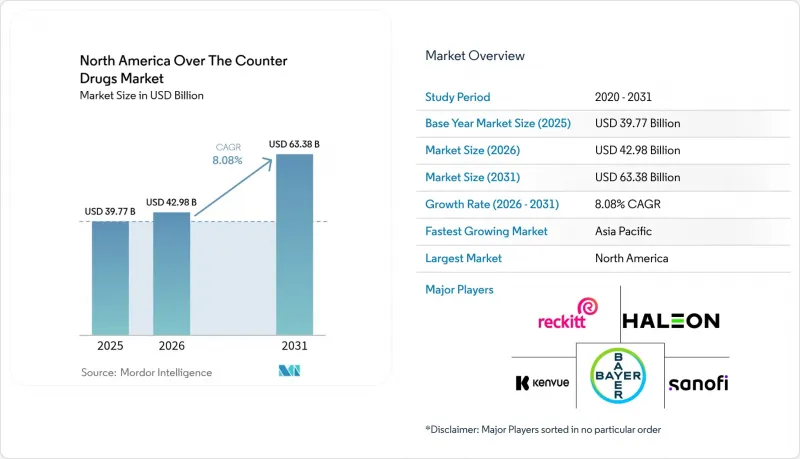
This report is Segmented by Product Type (Cough, Cold and Flu Products, Analgesics, and More), Distribution Channel (Hospital Pharmacies, and More), Dosage Form (Tablets and Caps, and More), Route of Administration(Oral, Topical, and More), Category (Branded OTC and Generic OTC), and Geography (United States, Canada, Mexico). The Market Sizes and Forecasts are Provided in Terms of Value (USD).
North America Over The Counter Drugs Market Trends and Insights
Shift Toward Self-Medication & Preventive Healthcare
Eighty-one percent of adults now select OTC medicines as first-line relief, saving the health system USD 146 billion annually. Pandemic-era telehealth adoption familiarized consumers with self-triage and rising primary-care wait times, reinforcing the habit. Millennials and Generation Z show the strongest comfort with symptoms of self-management, fueling demand for condition-specific formulations and dosage innovations that prioritize convenience and taste. Manufacturers respond through smaller pack sizes and multi-symptom SKUs that align with home-medicine-cabinet behavior. The result is steady volume growth across pain, digestive, and immune-support lines within the North America OTC drugs market.
Rx-to-OTC Switch Approvals
The FDA cleared OTC-status naloxone in 2023 and the first daily oral contraceptive, Opill, in 2024. These landmark switches strip away prescriber barriers for public-health-critical therapies and establish a regulatory template for future transitions, including migraine abortives and cholesterol-lowering low-dose statins. The policy tailwind enlarges the North America OTC drugs market by introducing high-value categories traditionally reserved for prescription channels, spurring investment in consumer education and adherence packaging.
Substance Misuse of Analgesics & Cough Medicines
Dextromethorphan and loperamide misuse prompted FDA package-size limits and age-verification programs, targeting adolescent abuse hotspots. The DEA recorded 84,076 drug-overdose deaths in 2024, and non-prescription products were present in a rising share of incidents. Retailers relocating high-risk SKUs behind the counter can cut impulse sales, trimming volume growth in the North American OTC drugs market. Manufacturers must balance tamper-proof features with user convenience to prevent consumer backlash.
Other drivers and restraints analyzed in the detailed report include:
- Expansion of E-Commerce & Digital Pharmacy Platforms
- Aging Population with Chronic Self-Care Needs
- API Supply-Chain Disruptions from Asia
For complete list of drivers and restraints, kindly check the Table Of Contents.
Segment Analysis
Cough & cold medicines generated the most significant revenue slice at 27.75% in 2025, underscoring seasonal resilience and household replenishment patterns. Weight-loss and dietary OTCs, buoyed by public interest in GLP-1 analogues, deliver the highest 9.32% CAGR, lifting the North American over-the-counter drugs market size for metabolic care solutions. Formulators focus on stimulant-free blends, plant extracts, and satiety fibers to comply with evolving safety expectations. Analgesics still anchor basket value but face stricter labelling around acetaminophen hepatic risk. Dermatology creams and gastrointestinal remedies round out portfolios that address lifestyle-linked conditions across all age cohorts.
Second-order dynamics highlight cross-category innovation. Seattle Gummy secured the first IND for an allergy treatment in gummy form, signaling delivery-format convergence. As a result, cough relief chews and fiber gummies migrate toward areas previously dominated by tablets, supporting adherence and driving incremental sales within the North America OTC drugs market.
Retail pharmacies preserved a 60.85% share in 2025 by offering pharmacist guidance and insurance-linked footfall. Yet online pharmacies' 17.95% CAGR captures the loyalty of digital natives seeking 24/7 availability and subscription savings, steadily redirecting flows from storefront to screen. Hospitals keep a niche role for discharge packs and acute-care bundles. Convenience stores extend assortments to monetise quick-trip missions, serving commuters and rural deserts underserved by large chains.
Traditional chains respond by offering same-day delivery and curbside pick-up and integrating loyalty apps that transfer couponing to mobile wallets. These omnichannel moves aim to hold basket size inside the North American OTC drugs market and defend against pure-play entrants that wield algorithmic pricing and AI-driven counselling. Pharmacy staff are being redeployed into vaccination and point-of-care testing, a differentiator that online platforms cannot replicate at scale.
Complete Report Scope:
- By Product Type
- Cough, Cold & Flu Products
- Analgesics
- Dermatology Products
- Gastrointestinal Products
- Vitamins, Minerals & Supplements (VMS)
- Weight-loss / Dietary Products
- Ophthalmic Products
- Sleeping Aids
- Other Product Types
- By Distribution Channel
- Hospital Pharmacies
- Retail Pharmacies
- Online Pharmacies
- Convenience / Grocery Stores
- By Dosage Form
- Tablets & Caplets
- Liquids & Syrups
- Gummies & Chewables
- Sprays & Drops
- Topicals & Ointments
- By Route of Administration
- Oral
- Topical
- Nasal
- Ophthalmic
- Rectal / Vaginal
- By Category
- Branded OTC
- Private-label / Store Brands
- Generic OTC
- Geography
- United States
- Canada
- Mexico
List of Companies Covered in this Report:
- Johnson & Johnson (Kenvue Inc.)
- Bayer
- GSK plc (Haleon)
- Pfizer
- Sanofi
- Novartis
- Perrigo plc
- Takeda Pharmaceuticals
- Reckitt Benckiser Group
- Procter & Gamble
- Church & Dwight Co.
- Bausch Health
- Abbott Laboratories
- Prestige Consumer Healthcare
- Herbalife Nutrition
- Teva Pharmaceutical Industries
- Haleon (consumer health spin-off)
- CVS Health (OTC private-label)
- Walgreens Boots Alliance
- Boiron
Additional Benefits:
- The market estimate (ME) sheet in Excel format
- 3 months of analyst support
TABLE OF CONTENTS
1 Introduction
- 1.1 Study Assumptions & Market Definition
- 1.2 Scope of the Study
2 Research Methodology
3 Executive Summary
4 Market Landscape
- 4.1 Market Overview
- 4.2 Market Drivers
- 4.2.1 Shift Toward Self-Medication & Preventive Healthcare
- 4.2.2 Rx-To-OTC Switch Approvals (Naloxone, Oral Contraceptive)
- 4.2.3 Expansion Of E-Commerce & Digital Pharmacy Platforms
- 4.2.4 Aging Population with Chronic Self-Care Needs
- 4.2.5 Growth Of Hispanic Consumer Demand for Herbal Otcs
- 4.2.6 AI-Driven Personalized OTC Recommendations
- 4.3 Market Restraints
- 4.3.1 Substance Misuse of Analgesics & Cough Medicines
- 4.3.2 FDA Monograph Modernization Delays
- 4.3.3 API Supply-Chain Disruptions from Asia
- 4.3.4 PBM Margin Pressure Limiting Shelf Space for SMEs
- 4.4 Supply Chain Analysis
- 4.5 Regulatory Landscape
- 4.6 Technological Outlook
- 4.7 Porter's Five Forces
- 4.7.1 Threat of New Entrants
- 4.7.2 Bargaining Power of Buyers
- 4.7.3 Bargaining Power of Suppliers
- 4.7.4 Threat of Substitutes
- 4.7.5 Competitive Rivalry
5 Market Size & Growth Forecasts (Value)
- 5.1 By Product Type
- 5.1.1 Cough, Cold & Flu Products
- 5.1.2 Analgesics
- 5.1.3 Dermatology Products
- 5.1.4 Gastrointestinal Products
- 5.1.5 Vitamins, Minerals & Supplements (VMS)
- 5.1.6 Weight-loss / Dietary Products
- 5.1.7 Ophthalmic Products
- 5.1.8 Sleeping Aids
- 5.1.9 Other Product Types
- 5.2 By Distribution Channel
- 5.2.1 Hospital Pharmacies
- 5.2.2 Retail Pharmacies
- 5.2.3 Online Pharmacies
- 5.2.4 Convenience / Grocery Stores
- 5.3 By Dosage Form
- 5.3.1 Tablets & Caplets
- 5.3.2 Liquids & Syrups
- 5.3.3 Gummies & Chewables
- 5.3.4 Sprays & Drops
- 5.3.5 Topicals & Ointments
- 5.4 By Route of Administration
- 5.4.1 Oral
- 5.4.2 Topical
- 5.4.3 Nasal
- 5.4.4 Ophthalmic
- 5.4.5 Rectal / Vaginal
- 5.5 By Category
- 5.5.1 Branded OTC
- 5.5.2 Private-label / Store Brands
- 5.5.3 Generic OTC
- 5.6 Geography
- 5.6.1 United States
- 5.6.2 Canada
- 5.6.3 Mexico
6 Competitive Landscape
- 6.1 Market Concentration
- 6.2 Market Share Analysis
- 6.3 Company Profiles (includes Global level Overview, Market level overview, Core Segments, Financials as available, Strategic Information, Market Rank/Share for key companies, Products & Services, and Recent Developments)
- 6.3.1 Johnson & Johnson (Kenvue Inc.)
- 6.3.2 Bayer AG
- 6.3.3 GSK plc (Haleon)
- 6.3.4 Pfizer Inc.
- 6.3.5 Sanofi
- 6.3.6 Novartis AG
- 6.3.7 Perrigo plc
- 6.3.8 Takeda Pharmaceutical
- 6.3.9 Reckitt Benckiser Group
- 6.3.10 Procter & Gamble
- 6.3.11 Church & Dwight Co.
- 6.3.12 Bausch Health Companies
- 6.3.13 Abbott Laboratories
- 6.3.14 Prestige Consumer Healthcare
- 6.3.15 Herbalife Nutrition
- 6.3.16 Teva Pharmaceutical Industries
- 6.3.17 Haleon (consumer health spin-off)
- 6.3.18 CVS Health (OTC private-label)
- 6.3.19 Walgreens Boots Alliance
- 6.3.20 Boiron
7 Market Opportunities & Future Outlook
- 7.1 White-space & Unmet-need Assessment

