PUBLISHER: Mordor Intelligence | PRODUCT CODE: 2113477

PUBLISHER: Mordor Intelligence | PRODUCT CODE: 2113477
Germany Skincare Product - Market Share Analysis, Industry Trends & Statistics, Growth Forecasts (2026 - 2031)
According to Mordor Intelligence, the Germany skincare product market size is expected to grow from USD 5.74 billion in 2025 to USD 6.04 billion in 2026 and is forecast to reach USD 7.83 billion by 2031 at 5.29% CAGR over 2026-2031.
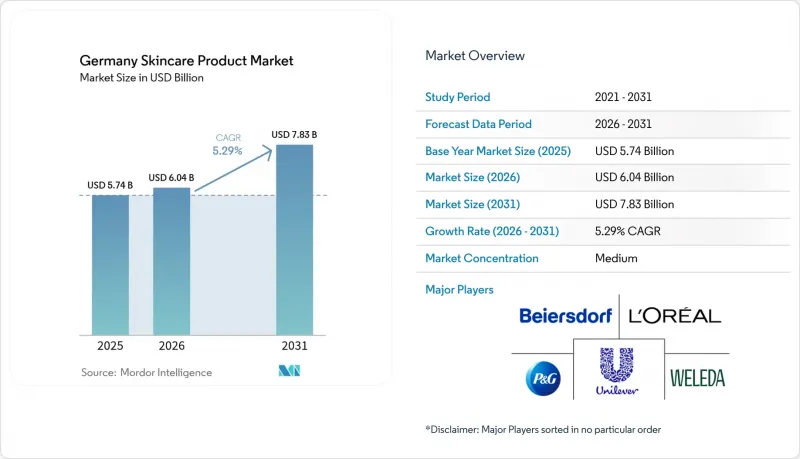
This report is Segmented by Type (Facial Care Products, Body Care Products, and Lip Care Products) Price Range (Mass, and Premium), End-User (Men, Women, and Kids/Children), Category (Conventional, and Natural/Organic), and Distribution Channel (Supermarkets/Hypermarkets, Health and Beauty Stores, Online Retail Stores and Other Retail Channels). The Market Forecasts are Provided in Terms of Value (USD).
Germany Skincare Product Market Trends and Insights
Aging population and demand for anti-aging skincare
The aging population and the growing demand for anti-aging skincare are driving the Germany skincare product market. This trend is fueled by sustained demand for specialized formulations targeting visible signs of aging, such as fine lines, loss of elasticity, and hyperpigmentation. Mature consumers, particularly women, are increasingly investing in preventive and reparative skincare routines that emphasize ingredients like peptides, retinoids, and collagen boosters to maintain skin firmness and luminosity amidst hormonal changes and cumulative environmental damage. This demographic shift is contributing to the growth of the premium skincare segment, as consumers show a preference for clinical-grade serums, overnight repair masks, and eye contour treatments that offer measurable results, such as wrinkle reduction and improved skin density. For example, according to the Federal Statistical Office, in 2024, approximately 15.5% of the German population was aged between 65 and 79 years . This highlights the expanding demographic actively seeking advanced anti-aging solutions to address age-specific concerns, such as sagging skin and uneven tone.
Innovation in product formulations and formats
Innovation in product formulations and formats is driving the growth of the German skincare product market by enhancing consumer adoption through advanced actives and delivery systems. The demand for multifunctional products combining hydration, SPF, and anti-aging benefits in a single application further supports this trend. Research and Development (R&D) efforts are catering to tech-savvy consumers who embrace novel formats, while derma-cosmetic innovations focus on hypoallergenic, pH-balanced formulations for sensitive skin. These advancements drive premium pricing and customer loyalty by delivering tangible before-and-after results, often validated by at-home scanning devices. For example, in February 2025, the Japanese beauty brand Curel entered German pharmacies as part of its strategy to expand in the skincare category. The brand emphasizes derma-cosmetics and skin protection, leveraging Japanese expertise in ceramide-restoring emulsions and aqueous gels. These products, distributed through pharmacy-trusted channels, address the needs of eczema-prone and post-barrier-compromised skin with gentle, high-tech protective solutions.
Strict regulatory and compliance requirements
Strict regulatory and compliance requirements pose a significant restraint on the Germany Skincare Product Market. These challenges stem from the rigorous standards established by the EU Cosmetics Regulation 1223/2009 and oversight from Germany's Bundesinstitut fur Risikobewertung (BfR). Under EU Regulation 1223/2009, all cosmetic products sold in Germany must undergo extensive safety assessments, comply with stringent ingredient restrictions, maintain detailed product information files (PIFs), and adhere to bans on animal testing. Additional requirements include proper labeling, substantiation of claims, allergen disclosure, and traceability across the supply chain. These regulations compel brands, particularly new entrants and smaller manufacturers, to allocate significant resources to regulatory expertise, documentation, and testing. Furthermore, the BfR conducts scientific evaluations and health risk assessments, which often serve as national benchmarks. This adds another layer of scrutiny, particularly for ingredients such as preservatives, UV filters, fragrances, and potential endocrine disruptors.
Other drivers and restraints analyzed in the detailed report include:
- Shift toward sustainable, eco-friendly products
- Digital marketing and beauty influencers
- Allergies and sensitive skin concerns
For complete list of drivers and restraints, kindly check the Table Of Contents.
Segment Analysis
Facial care products account for 83.21% of 2025 revenue and are projected to grow at a rate of 5.37% through 2031. This growth is driven by the increasing popularity of serums, essences, and targeted treatments incorporating ingredients such as peptides, ceramides, and encapsulated retinoids. While cleansers and moisturizers continue to lead in volume, higher-margin serums are gaining traction. These serums combine multiple active ingredients, including hyaluronic acid for hydration, niacinamide for barrier repair, and bakuchiol as a retinol alternative, meeting the preferences of German consumers for clinically proven efficacy. Face masks have reached a plateau as the novelty of sheet masks diminishes and consumers reassess the cost-effectiveness of single-use formats. Toners are being repositioned as essence-like treatments with active ingredients, influenced by Korean beauty trends, rather than serving as traditional astringent post-cleanse steps.
Body care and lip care products are experiencing growth but face challenges due to lower purchase frequency and commoditization. Body lotions are under pressure from private-label competition, with drugstore chains offering large-format, fragrance-free options at significantly lower prices than branded alternatives. Demand for foot and hand creams surged during heightened hygiene routines but has since stabilized, with brands finding it difficult to differentiate beyond texture and scent. Lip care products, primarily consisting of balms and treatments, experience seasonal demand spikes during winter but lack the innovation pace seen in facial care, limiting opportunities for premiumization. The concentration of growth in facial care highlights a strategic imperative: brands unable to innovate in serums and active-ingredient delivery risk losing market share to dermocosmetic lines and digitally native competitors.
The mass price range segment is projected to dominate the Germany skincare product market in 2025, holding a significant 68.64% market share. This segment thrives by offering accessible and reliable everyday essentials that cater to diverse consumer routines, emphasizing broad functionality over niche luxury. Growth in this segment is driven by strong brand loyalty, with established players providing consistent, dermatologist-tested formulations that focus on core benefits such as hydration, cleansing, and basic protection. These attributes encourage repeat purchases among practical consumers across various demographics who prioritize dependability and simplicity. Additionally, the appeal of no-frills products aligns with time-constrained lifestyles, while increasing health awareness boosts demand for gentle, sensitivity-friendly options that address common concerns like dryness and irritation at an affordable price.
The premium segment of the German skincare product market is expected to grow at a compound annual growth rate (CAGR) of 5.45% through 2031, surpassing the overall market growth rate. This segment attracts discerning consumers by offering high-efficacy, science-backed formulations that deliver transformative results beyond basic care. Growth is fueled by advanced innovations such as biotech-derived active ingredients, AI-personalized serums, and clinical-grade anti-aging solutions targeting visible concerns like wrinkles, pigmentation, and skin firmness. Affluent consumers are drawn to these products as they prioritize long-term skin health over volume-driven mass-market options. Luxury branding further enhances perceived value through sustainable sourcing, cruelty-free certifications, and premium sensory experiences, such as silk-like textures and subtle botanical fragrances. These features foster consumer loyalty by integrating wellness rituals and exclusivity into the skincare experience.
Complete Report Scope:
- By Product Type
- Facial Care Products
- Cleansers
- Moisturizers and creams
- Serums and Essence
- Toners
- Face Masks
- Other Facial Care Products
- Body Care Products
- Body Lotion
- Foot and Hand Cream
- Other Body Care Products
- Lip Care Products
- Facial Care Products
- By Price Range
- Mass
- Premium
- End User
- Men
- Women
- Kids/Children
- By Category
- Conventional
- Natural/Organic
- By Distribution Channel
- Supermarkets/Hypermarkets
- Health and Beauty Stores
- Online Retail Stores
- Other Retail Channels
List of Companies Covered in this Report:
- Beiersdorf AG
- L'Oreal S.A.
- Unilever PLC
- Procter & Gamble Company
- Shiseido Germany GmbH
- Weleda AG
- Johnson & Johnson GmbH
- Coty Inc
- LVMH Moet Hennessy Louis Vuitton SE
- dm-drogerie markt GmbH (Balea)
- Dirk Rossmann GmbH (Isana)
- Dr. Hauschka / WALA Heilmittel GmbH
- Babor GmbH & Co. KG
- The Estee Lauder Companies Inc.
- Sebapharma GmbH
- Kneipp GmbH
- Lush Retail GmbH
- Flaconi GmbH (brand portfolio)
- Galderma Germany GmbH
- Symrise AG (actives division)
Additional Benefits:
- The market estimate (ME) sheet in Excel format
- 3 months of analyst support
TABLE OF CONTENTS
1 INTRODUCTION
- 1.1 Study Assumptions and Market Definition
- 1.2 Scope of the Study
2 RESEARCH METHODOLOGY
3 EXECUTIVE SUMMARY
4 MARKET LANDSCAPE
- 4.1 Market Overview
- 4.2 Market Drivers
- 4.2.1 Aging population and demand for anti-aging skincare
- 4.2.2 Innovation in product formulations and formats
- 4.2.3 Shift toward sustainable, eco-friendly products
- 4.2.4 Digital marketing and beauty influencers
- 4.2.5 Vegan product proliferation
- 4.2.6 Surge in men's skincare participation
- 4.3 Market Restraints
- 4.3.1 Strict regulatory and compliance requirements
- 4.3.2 Allergies and sensitive skin concerns
- 4.3.3 Intense competition and market saturation
- 4.3.4 Inflation-driven price sensitivity in mass retail
- 4.4 Consumer Behaviour Analysis
- 4.5 Regulatory Landscape
- 4.6 Technological Outlook
- 4.7 Porter's Five Forces Analysis
- 4.7.1 Threat of New Entrants
- 4.7.2 Bargaining Power of Buyers
- 4.7.3 Bargaining Power of Suppliers
- 4.7.4 Threat of Substitutes
- 4.7.5 Intensity of Competitive Rivalry
5 MARKET SIZE AND GROWTH FORECASTS (VALUE AND VOLUME)
- 5.1 By Product Type
- 5.1.1 Facial Care Products
- 5.1.1.1 Cleansers
- 5.1.1.2 Moisturizers and creams
- 5.1.1.3 Serums and Essence
- 5.1.1.4 Toners
- 5.1.1.5 Face Masks
- 5.1.1.6 Other Facial Care Products
- 5.1.2 Body Care Products
- 5.1.2.1 Body Lotion
- 5.1.2.2 Foot and Hand Cream
- 5.1.2.3 Other Body Care Products
- 5.1.3 Lip Care Products
- 5.1.1 Facial Care Products
- 5.2 By Price Range
- 5.2.1 Mass
- 5.2.2 Premium
- 5.3 End User
- 5.3.1 Men
- 5.3.2 Women
- 5.3.3 Kids/Children
- 5.4 By Category
- 5.4.1 Conventional
- 5.4.2 Natural/Organic
- 5.5 By Distribution Channel
- 5.5.1 Supermarkets/Hypermarkets
- 5.5.2 Health and Beauty Stores
- 5.5.3 Online Retail Stores
- 5.5.4 Other Retail Channels
6 COMPETITIVE LANDSCAPE
- 6.1 Market Concentration
- 6.2 Strategic Moves
- 6.3 Market Share Analysis
- 6.4 Company Profiles (includes Global level Overview, Market level overview, Core Segments, Financials as available, Strategic Information, Market Rank/Share for key companies, Products and Services, and Recent Developments)
- 6.4.1 Beiersdorf AG
- 6.4.2 L'Oreal S.A.
- 6.4.3 Unilever PLC
- 6.4.4 Procter & Gamble Company
- 6.4.5 Shiseido Germany GmbH
- 6.4.6 Weleda AG
- 6.4.7 Johnson & Johnson GmbH
- 6.4.8 Coty Inc
- 6.4.9 LVMH Moet Hennessy Louis Vuitton SE
- 6.4.10 dm-drogerie markt GmbH (Balea)
- 6.4.11 Dirk Rossmann GmbH (Isana)
- 6.4.12 Dr. Hauschka / WALA Heilmittel GmbH
- 6.4.13 Babor GmbH & Co. KG
- 6.4.14 The Estee Lauder Companies Inc.
- 6.4.15 Sebapharma GmbH
- 6.4.16 Kneipp GmbH
- 6.4.17 Lush Retail GmbH
- 6.4.18 Flaconi GmbH (brand portfolio)
- 6.4.19 Galderma Germany GmbH
- 6.4.20 Symrise AG (actives division)
7 MARKET OPPORTUNITIES AND FUTURE OUTLOOK

