PUBLISHER: Roots Analysis | PRODUCT CODE: 2107343

PUBLISHER: Roots Analysis | PRODUCT CODE: 2107343
Skincare Market by Type of Product by Application, Type of Product (by Body Part), Distribution Channel, Type of Packaging, Product Category, Gender, Ingredient and Geography - Trends and Forecast Till 2035
SKINCARE MARKET: OVERVIEW
As per Roots Analysis, the global skincare market is estimated to grow from USD 198.5 billion in the current year to USD 407 billion by 2035, at an impressive CAGR of 7.4%, during the forecast period, till 2035.
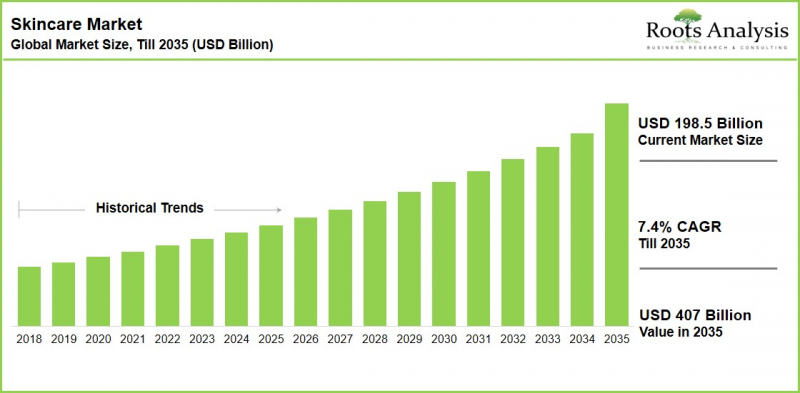
Skincare Market: Growth and Trends
Skin care has moved from an occasional cosmetic indulgence to a routine, multi-step daily practice for consumers across income brackets and geographies. Rising disposable income, greater exposure to global beauty standards through social media, and growing awareness of the long-term effects of pollution, sun exposure, and lifestyle stress on skin condition are together sustaining demand for skincare products.
Historically, skincare purchasing decisions were driven primarily by brand recognition and price. However, consumers are now increasingly ingredient-literate, analysing formulations for actives such as retinoids, peptides, hyaluronic acid, and niacinamide. They are favoring brands that can substantiate efficacy claims with clinical or dermatological evidence. This has elevated the role of research and development in brand differentiation and is prompting legacy consumer goods companies to acquire or partner with clinically oriented, direct-to-consumer skincare brands.
In response, manufacturers are investing in multifunctional formulations, clean and sustainably sourced ingredients, and personalization technologies such as AI-enabled skin diagnostics. Regulatory bodies across major markets have also focused on ingredient safety disclosures and sustainable packaging norms, pushing the industry toward greater formulation transparency. Taken together, these shifts indicate a market that is transitioning from broad-based volume growth toward value growth anchored in efficacy, personalization, and trust.
Growth Drivers: Factors Fueling Expansion of the Global Skincare Market
A primary driver of market expansion is the growing awareness of everyday self-care routines among the global population. Consumers are layering multiple products into their regimens rather than relying on a single all-purpose item. This behavioural shift has been reinforced by technological progress in product formulation and use of digital tools, including artificial intelligence-enabled skin assessment platforms, for customer engagement and personalization.
Personalized skincare, in particular, is emerging as a key trend, as products tailored to an individual's skin profile are perceived to deliver more consistent outcomes than generic formulations. In addition, mounting consumer concern regarding the long-term health and environmental impact of synthetic ingredients has fueled demand for clean-label and naturally derived products. This trend is prompting sustained investment in natural sourcing and green chemistry across the value chain.
Market Challenges: Critical Barriers Hindering Progress
Despite high demand, the skincare market is witnessing several challenges. Increasing price competition from mass-market and private-label brands is reducing mid-tier margins, while the growing volume of similar ingredient claims is making it difficult for consumers to distinguish products based on efficacy. Additionally, tightening regulatory scrutiny of ingredient disclosures and sustainable packaging requirements in key markets is raising compliance costs, particularly for smaller and emerging brands with limited regulatory infrastructure.
Skincare Market: Key Insights
The report examines the current state of the global skincare industry and identifies potential growth opportunities available to stakeholders across the value chain. Some of the key findings include:
- Sustained Early-Stage Capital Flow: Skincare-focused brands and platforms continue to attract seed and early-stage funding, reflecting continued investor appetite for efficacy-driven, digitally native skincare businesses, particularly in high-growth markets such as India and Southeast Asia.
- Active Consolidation by Strategics: Larger beauty and consumer goods conglomerates continue to acquire innovative, clinically positioned skincare brands to strengthen their premium and dermatology based cosmetic portfolios, a trend that is expected to continue as legacy players seek faster routes to category leadership.
- Asia-Pacific as the Innovation and Volume Epicenter: The region combines the largest consumer base with the most culturally embedded, multi-step skincare routines, making it both the leading revenue contributor and a preferred launch market for premium global brands.
- Premiumization in Mature Markets: North America and parts of Europe are witnessing a pronounced shift toward clinically backed, dermatologist-endorsed "dermaceutical" products, supporting higher price realization even amid slower volume growth.
- Key Watch-Point: The pace at which regulatory frameworks around ingredient transparency and sustainable packaging evolve across regions is likely to be a key determinant of competitive positioning and is a metric investor and operators alike should track closely.
Skincare Market Segments
The market sizing and opportunity analysis has been segmented across the following parameters:
By Type of Product (by Application)
- Skin Cleansers
- Skin Moisturizers
- Anti-aging Products
- Sun Protectors
- Others
By Type of Product (by Body Part)
- Facial Care Products
- Body Care Products
- Lip and Eye Care Products
By Distribution Channel
- Online Distribution Channels
- Offline Distribution Channels
- Convenience Stores
- Supermarkets
- Pharmacies
By Type of Packaging
- Tubes
- Bottles
- Jars
- Others
By Product Category
- Luxury Skincare Products
- Mass Skincare Products
By Gender
- Men
- Women
- Other Genders
By Type of Ingredient
- Natural Ingredients
- Chemical Ingredients
By Geographical Regions
- North America
- US
- Canada
- Mexico
- Europe
- Germany
- France
- Italy
- UK
- Spain
- Rest of Europe
- Asia-Pacific
- China
- Japan
- South Korea
- India
- Australia
- Rest of Asia-Pacific
- Latin America
- Brazil
- Argentina
- Rest of Latin America
- Middle East and Africa
- Africa
- UAE
- Rest of Middle East and Africa
Skincare Market: Key Segmentation Insights
Skin Cleansers Hold Highest Share by Application
Based on market assessment, skin cleansers account for the largest share (approximately 42%) of the skincare market by type of product application. This leadership position is largely because cleansing is a a non-negotiable, twice-daily step in nearly every skincare routine, unlike moisturizers or treatment products that may be used more selectively. Rising awareness around double cleansing to remove pollutants, sebum, sunscreen, and makeup residue, particularly among millennial and Gen Z consumers, continues to reinforce repeat purchase frequency within this category.
On the other hand, anti-aging products are projected to register the highest CAGR of 7.2% during the forecast period. Growth is being driven by earlier adoption of preventive skincare among younger consumers, increasing dermatologist and influencer-led education around actives such as retinol, peptides, and niacinamide, and a growing base of older consumers across North America, Europe, and Asia-Pacific seeking effective age-related solutions.
Facial Products Lead the Market by Body Part
Facial care products hold the highest share of the market. This highest share is driven by the universal focus on facial appearance across nearly every age cohort. Meanwhile, lip and eye care products are emerging as the fastest-growing sub-segment, propelled by growing consumer focus on these delicate areas, particularly among working professionals seeking solutions for fatigue and fine lines.
Offline Channel Secures the Highest Share
Offline distribution channels, comprising supermarkets, specialty beauty retailers, pharmacies, and dermatology clinics, currently capture the largest share of the market. This highest share reflects continued consumer preference for physically evaluating products prior to purchase, particularly in developing markets across Asia, Africa, and Latin America.
However, online distribution channels are expected to expand at the fastest CAGR through the forecast period. This highest growth is driven by the growing influence of e-commerce platforms, personalized digital recommendations, and influencer-linked shopping journeys among younger consumers.
Bottles Occupy the Largest Share
Bottles account for the largest share of the skincare packaging segment, owing to their versatility across product formats and strong consumer familiarity. Tubes, meanwhile, are the fastest-growing packaging format, benefiting from their alignment with consumer preferences around hygiene, portability, and sustainability, and are particularly favored for sunscreens, acne treatments, and other contamination-sensitive formulations.
Women Represent the Largest Consumer Base; Men's Skincare Emerges as the Fastest Growing Segment
Women continue to represent the majority share of skincare consumption, supported by deep cultural association of skincare with self-care and grooming, and a greater propensity to follow multi-step routines. The men's skincare segment, however, is emerging as the fastest-growing segment, driven by increasing normalization of grooming routines among millennial and Gen Z men, and growing brand investment in gender-specific formulations targeting concerns such as razor burn and oiliness.
Asia-Pacific Holds the Highest Share and North America Grows at Higher CAGR
According to our projections, Asia-Pacific holds the largest regional share (close to 35%) of the global skincare market. This dominance is underpinned by deep-rooted cultural emphasis on daily skin health rituals across China, Japan, South Korea, and India, alongside a rapidly expanding middle-class consumer base.
Meanwhile, North America is projected to grow at the highest CAGR of 7.0% during the forecast period. This growth is driven by a pronounced consumer shift toward clinically backed "dermaceutical" products and rising adoption of advanced, clean-labeled skincare solutions.
Example Players in Skincare Market
- Amorepacific
- Beiersdorf
- Chanel
- Coty
- Estee Lauder
- Galderma
- Johnson & Johnson
- Kao Corporation
- L'Oreal
- LVMH
- Procter & Gamble
- Shiseido
- Unilever
SKINCARE MARKET: RESEARCH COVERAGE
- Market Sizing and Opportunity Analysis: An in-depth analysis of the global skincare market, covering all key segments, including type of product, distribution channel, packaging, product category, gender, ingredient type, and geography.
- Skincare Market Landscape: A detailed assessment of the competitive landscape, capturing manufacturers by year of establishment, company size, headquarters location, product type, product application, formulation, packaging, and target gender segment.
- Company Profiles: In-depth profiles of prominent players engaged in the skincare industry, featuring information on their year of establishment, headquarters, company size, leadership team, product portfolio, financial performance, and recent initiatives.
- Porter's Five Forces Analysis: A qualitative analysis of the five competitive forces shaping this industry, namely threat of new entrants, bargaining power of buyers, bargaining power of suppliers, threat of substitutes, and rivalry among existing competitors.
- Megatrends Analysis: A qualitative assessment of the megatrends shaping the industry, including waterless beauty, AI and AR-enabled personalization, digitization and e-commerce, clean and sustainable beauty, and evolving regulatory guidelines.
- Market Impact Analysis: An analysis of the key drivers, restraints, opportunities, and challenges influencing the growth trajectory of the skincare market.
Key Questions Answered in this Report
- Which are the leading companies in the skincare market?
- Which region dominates the skincare market, and which is growing fastest?
- What are the key trends observed across the skincare industry?
- What factors are likely to influence the evolution of this market?
- What are the primary challenges faced by skincare product manufacturers?
- What is the current and future market size?
- What is the CAGR of this market through 2035?
- How is the current and future market opportunity distributed across key segments?
Reasons to Buy this Report
Roots Analysis combines proprietary primary research with rigorous secondary validation to deliver skincare market intelligence that goes beyond headline market sizing, equipping stakeholders with the depth of insight needed to act with confidence.
- Granular, Multi-Parameter Segmentation: The market is dissected across nine distinct parameters, including product application, body part, distribution channel, packaging, category, gender, ingredient type, and geography, enabling stakeholders to isolate the precise opportunity relevant to their business.
- Three-Scenario Forecast Modelling: Conservative, base, and optimistic forecast scenarios are built for every segment, allowing investors and strategy teams to stress-test assumptions against a range of plausible market trajectories rather than relying on a single point estimate.
- Investor-Grade Company Intelligence: In-depth profiles of leading and emerging skincare players cover financial performance, leadership composition, product portfolios, and recent strategic initiatives, supporting due diligence, benchmarking, and competitive mapping exercises.
- Deal and Funding Tracking: The report captures recent funding rounds, M&A transactions, and partnership activity across the skincare ecosystem, offering a real-time lens on where capital and strategic interest are concentrated.
- Complimentary Analytical Deliverables: Every purchase includes editable Excel data packs for all analytical modules and a complimentary PowerPoint summary, reducing the time stakeholders need to operationalize the findings internally.
Additional Benefits
- 15% Free Content Customization
- Detailed Report Walkthrough Session with Research Team
- Free Updated report if the report is 6-12 months old or older
TABLE OF CONTENTS
1. BACKGROUND
- 1.1. Context
- 1.2. Project Objectives
2. RESEARCH METHODOLOGY
- 2.1. Chapter Overview
- 2.2. Research Assumptions
- 2.3. Project Methodology
- 2.4. Forecast Methodology
- 2.5. Robust Quality Control
- 2.6. Key Market Segmentations
- 2.7. Key Considerations
- 2.7.1. Demographics
- 2.7.2. Economic Factors
- 2.7.3. Government Regulations
- 2.7.4. Supply Chain
- 2.7.5. COVID Impact
- 2.7.6. Market Access
- 2.7.7. Healthcare Policies
- 2.7.8. Industry Consolidation
3. ECONOMIC AND OTHER PROJECT SPECIFIC CONSIDERATIONS
- 3.1. Chapter Overview
- 3.2. Market Dynamics
- 3.2.1. Time Period
- 3.2.1.1. Historical Trends
- 3.2.1.2. Current and Forecasted Estimates
- 3.2.2. Currency Coverage and Foreign Exchange Rate
- 3.2.2.1. Major Currencies Affecting the Market
- 3.2.2.2. Factors affecting Currency Fluctuations and Foreign Exchange Rates
- 3.2.2.3. Impact of Foreign Exchange Rate Volatility on Market
- 3.2.2.4. Strategies For Mitigating Foreign Exchange Risk
- 3.2.3. Trade Policies
- 3.2.3.1. Impact of Trade Barriers on the Market
- 3.2.3.2. Strategies for Mitigating the Risks Associated with Trade Barriers
- 3.2.4. Recession
- 3.2.4.1. Historical Analysis of Past Recessions and Lessons Learnt
- 3.2.4.2. Assessment of Current Economic Conditions and Potential Impact on the Market
- 3.2.5. Inflation
- 3.2.5.1. Measurement and Analysis of Inflationary Pressures in the Economy
- 3.2.5.2. Potential Impact of Inflation on the Market Evolution
- 3.2.1. Time Period
4. EXECUTIVE SUMMARY
5. INTRODUCTION
- 5.1. Overview of the Skincare Industry
- 5.1.1. Factors Contributing to Improper Skin Health
- 5.2. Rise of the Clean Beauty Movement
- 5.2.1. Key Principles of Clean Beauty
- 5.3. Challenges Prevailing in the Skincare Industry
- 5.4. Recent Developments in the Skincare Industry
- 5.5. Future Perspectives
6. MARKET LANDSCAPE: LEADING PLAYERS IN THE SKINCARE MARKET
- 6.1. Skincare Market: Market Landscape of Leading Players
- 6.1.1. Analysis by Year of Establishment
- 6.1.2. Analysis by Company Size
- 6.1.3. Analysis by Company Size and Year of Establishment
- 6.1.4. Analysis by Location of Headquarters
- 6.1.5. Analysis by Company Size and Location of Headquarters
- 6.1.6. Analysis by Type of Product
- 6.1.7. Analysis by Product Application
- 6.1.8. Analysis by Product Formulation
- 6.1.9. Analysis by Type of Packaging
- 6.1.10. Analysis by Gender
7. COMPANY PROFILES
- 7.1. Chapter Overview
- 7.2. Leading Players in the Skincare Market
- 7.2.1. Amorepacific
- 7.2.1.1. Company Overview
- 7.2.1.2. Product Portfolio
- 7.2.1.3. Financial Details
- 7.2.1.4. Recent Developments and Future Outlook
- 7.2.2. Coty
- 7.2.2.1. Company Overview
- 7.2.2.2. Product Portfolio
- 7.2.2.3. Financial Details
- 7.2.2.4. Recent Developments and Future Outlook
- 7.2.3. Estee Lauder
- 7.2.3.1. Company Overview
- 7.2.3.2. Product Portfolio
- 7.2.3.3. Financial Details
- 7.2.3.4. Recent Developments and Future Outlook
- 7.2.4. Galderma
- 7.2.4.1. Company Overview
- 7.2.4.2. Product Portfolio
- 7.2.4.3. Financial Details
- 7.2.4.4. Recent Developments and Future Outlook
- 7.2.5. Kao
- 7.2.5.1. Company Overview
- 7.2.5.2. Product Portfolio
- 7.2.5.3. Financial Details
- 7.2.5.4. Recent Developments and Future Outlook
- 7.2.6. L'Oreal
- 7.2.6.1. Company Overview
- 7.2.6.2. Product Portfolio
- 7.2.6.3. Financial Details
- 7.2.6.4. Recent Developments and Future Outlook
- 7.2.7. LVMH
- 7.2.7.1. Company Overview
- 7.2.7.2. Product Portfolio
- 7.2.7.3. Financial Details
- 7.2.7.4. Recent Developments and Future Outlook
- 7.2.8. Procter & Gamble
- 7.2.8.1. Company Overview
- 7.2.8.2. Product Portfolio
- 7.2.8.3. Financial Details
- 7.2.8.4. Recent Developments and Future Outlook
- 7.2.9. Shiseido
- 7.2.9.1. Company Overview
- 7.2.9.2. Product Portfolio
- 7.2.9.3. Financial Details
- 7.2.9.4. Recent Developments and Future Outlook
- 7.2.10. Unilever
- 7.2.10.1. Company Overview
- 7.2.10.2. Product Portfolio
- 7.2.10.3. Financial Details
- 7.2.10.4. Recent Developments and Future Outlook
- 7.2.1. Amorepacific
- 7.3. Other Prominent Players in the Skincare Market
- 7.3.1 Beiersdorf
- 7.3.1.1 Company Overview
- 7.3.1.2. Product Portfolio
- 7.3.2. Chanel
- 7.3.2.1 Company Overview
- 7.3.2.2. Product Portfolio
- 7.3.3. Colgate-Palmolive
- 7.3.3.1 Company Overview
- 7.3.3.2. Product Portfolio
- 7.3.4. Clarins
- 7.3.4.1 Company Overview
- 7.3.4.2. Product Portfolio
- 7.3.5. Cult Beauty
- 7.3.5.1 Company Overview
- 7.3.5.2. Product Portfolio
- 7.3.6. Deciem
- 7.3.6.1 Company Overview
- 7.3.6.2. Product Portfolio
- 7.3.7. Johnson & Johnson
- 7.3.7.1 Company Overview
- 7.3.7.2. Product Portfolio
- 7.3.8. Natura & Co
- 7.3.8.1 Company Overview
- 7.3.8.2. Product Portfolio
- 7.3.9. Revlon
- 7.3.9.1 Company Overview
- 7.3.9.2. Product Portfolio
- 7.3.10. Shanghai Jahwa
- 7.3.10.1 Company Overview
- 7.3.10.2. Product Portfolio
- 7.3.1 Beiersdorf
8. PORTER'S FIVE FORCES ANALYSIS
- 8.1. Chapter Overview
- 8.2. Research Methodology
- 8.3. Key Parameters
- 8.3.1. Threats to New Entrants
- 8.3.2. Bargaining Power of Buyers
- 8.3.3. Bargaining Power of Product Providers
- 8.3.4. Threats of Substitute Products
- 8.3.5. Rivalry among Existing Competitors
- 8.4. Harvey Ball Analysis
- 8.5. Concluding Remarks
9. SKINCARE MARKET: MEGATRENDS ANALYSIS
- 9.1 Megatrends in the Skincare Market
- 9.1.1. Adoption of Waterless Beauty Products
- 9.1.2. Personalized Skincare with AI and AR
- 9.1.3. Digitization and E-commerce
- 9.1.4. Inclusion of Innovative Bio-products
- 9.1.5. Adoption of Clean Beauty and Sustainable Practices
- 9.1.6. Promoting Brands on Social Media
- 9.1.7. Influence of Gaming and Metaverse
- 9.1.8. The Evolving Regulatory Guidelines
10. MARKET IMPACT ANALYSIS: DRIVERS, RESTRAINTS, OPPORTUNITIES AND CHALLENGES
- 10.1. Chapter Overview
- 10.2. Market Drivers
- 10.3. Market Restraints
- 10.4. Market Opportunities
- 10.5. Market Challenges
- 10.6. Conclusion
11. GLOBAL SKINCARE MARKET
- 11.1. Assumptions and Methodology
- 11.2. Global Skincare Market, Historical Trends (Since 2018) and Forecasted Estimates (Till 2035)
- 11.2.1. Scenario Analysis
- 11.2.1.1. Conservative Scenario
- 11.2.1.2. Optimistic Scenario
- 11.2.2. Key Market Segmentations
- 11.2.1. Scenario Analysis
12. SKINCARE MARKET, BY TYPE OF PRODUCT (BY APPLICATION)
- 12.1. Assumptions and Methodology
- 12.2. Skincare Market: Distribution by Type of Product (by Application), Till 2035
- 12.2.1. Skincare Market for Skin Cleansers: Historical Trends (Since 2018) and Forecasted Estimates (Till 2035)
- 12.2.2. Skincare Market for Skin Moisturizers: Historical Trends (Since 2018) and Forecasted Estimates (Till 2035)
- 12.2.3. Skincare Market for Anti-aging Products: Historical Trends (Since 2018) and Forecasted Estimates (Till 2035)
- 12.2.4. Skincare Market for Sun Protectors and Others: Historical Trends (Since 2018) and Forecasted Estimates (Till 2035)
- 12.3. Data Triangulation and Validation
13. SKINCARE MARKET, BY TYPE OF PRODUCT (BY BODY PART)
- 13.1. Assumptions and Methodology
- 13.2. Skincare Market: Distribution by Type of Product (by Body Part), Till 2035
- 13.2.1. Skincare Market for Facial Care Products: Historical Trends (Since 2018) and Forecasted Estimates (Till 2035)
- 13.2.2. Skincare Market for Body Care Products: Historical Trends (Since 2018) and Forecasted Estimates (Till 2035)
- 13.2.3. Skincare Market for Lip and Eye Care Products: Historical Trends (Since 2018) and Forecasted Estimates (Till 2035)
- 13.3. Data Triangulation and Validation
14. SKINCARE MARKET, BY DISTRIBUTION CHANNEL
- 14.1. Assumptions and Methodology
- 14.2. Skincare Market: Distribution by Distribution Channel, Till 2035
- 14.2.1. Skincare Market for Online Distribution Channels: Historical Trends (Since 2018) and Forecasted Estimates (Till 2035)
- 14.2.2. Skincare Market for Offline Distribution Channels: Historical Trends (Since 2018) and Forecasted Estimates (Till 2035)
- 14.3. Data Triangulation and Validation
15. SKINCARE MARKET, BY TYPE OF OFFLINE DISTRIBUTION CHANNEL
- 15.1. Assumptions and Methodology
- 15.2. Skincare Market: Distribution by Type of Offline Distribution Channel, Till 2035
- 15.2.1. Skincare Market for Convenience Stores: Historical Trends (Since 2018) and Forecasted Estimates (Till 2035)
- 15.2.2. Skincare Market for Super Markets: Historical Trends (Since 2018) and Forecasted Estimates (Till 2035)
- 15.2.3. Skincare Market for Pharmacies: Historical Trends (Since 2018) and Forecasted Estimates (Till 2035)
- 15.3. Data Triangulation and Validation
16. SKINCARE MARKET, BY TYPE OF PACKAGING
- 16.1. Assumptions and Methodology
- 16.2. Skincare Market: Distribution by Type of Packaging, Till 2035
- 16.2.1. Skincare Market for Tubes: Historical Trends (Since 2018) and Forecasted Estimates (Till 2035)
- 16.2.2. Skincare Market for Bottles: Historical Trends (Since 2018) and Forecasted Estimates (Till 2035)
- 16.2.3. Skincare Market for Jars: Historical Trends (Since 2018) and Forecasted Estimates (Till 2035)
- 16.2.4. Skincare Market for Others: Historical Trends (Since 2018) and Forecasted Estimates (Till 2035)
- 16.3. Data Triangulation and Validation
17. SKINCARE MARKET, BY PRODUCT CATEGORY
- 17.1. Assumptions and Methodology
- 17.2. Skincare Market: Distribution by Product Category, Till 2035
- 17.2.1. Skincare Market for Luxury Skincare Products: Historical Trends (Since 2018) and Forecasted Estimates (Till 2035)
- 17.2.2. Skincare Market for Mass Skincare Products: Historical Trends (Since 2018) and Forecasted Estimates (Till 2035)
- 17.3. Data Triangulation and Validation
18. SKINCARE MARKET, BY GENDER
- 18.1. Assumptions and Methodology
- 18.2. Skincare Market: Distribution by Gender, Till 2035
- 18.2.1. Skincare Market for Men: Historical Trends (Since 2018) and Forecasted Estimates (Till 2035)
- 18.2.2. Skincare Market for Women: Historical Trends (Since 2018) and Forecasted Estimates (Till 2035)
- 18.2.3. Skincare Market for Other Genders: Historical Trends (Since 2018) and Forecasted Estimates (Till 2035)
- 18.3. Data Triangulation and Validation
19. SKINCARE MARKET, BY TYPE OF INGREDIENT
- 19.1. Assumptions and Methodology
- 19.2. Skincare Market: Distribution by Type of Ingredient, Till 2035
- 19.2.1. Skincare Market for Natural Ingredients: Historical Trends (Since 2018) and Forecasted Estimates (Till 2035)
- 19.2.2. Skincare Market for Chemical Ingredients: Historical Trends (Since 2018) and Forecasted Estimates (Till 2035)
- 19.3. Data Triangulation and Validation
20. SKINCARE MARKET, BY GEOGRAPHY
- 20.1. Assumptions and Methodology
- 20.2. Skincare Market: Distribution by Geography, Till 2035
- 20.2.1. Skincare Market in North America: Historical Trends (Since 2018) and Forecasted Estimates (Till 2035)
- 20.2.1.1. Skincare Market in the US: Historical Trends (Since 2018) and Forecasted Estimates (Till 2035)
- 20.2.1.2. Skincare Market in Canada: Historical Trends (Since 2018) and Forecasted Estimates (Till 2035)
- 20.2.1.3. Skincare Market in Mexico: Historical Trends (Since 2018) and Forecasted Estimates (Till 2035)
- 20.2.2. Skincare Market in Europe: Historical Trends (Since 2018) and Forecasted Estimates (Till 2035)
- 20.2.2.1. Skincare Market in Germany: Historical Trends (Since 2018) and Forecasted Estimates (Till 2035)
- 20.2.2.2. Skincare Market in France: Historical Trends (Since 2018) and Forecasted Estimates (Till 2035)
- 20.2.2.3. Skincare Market in Italy: Historical Trends (Since 2018) and Forecasted Estimates (Till 2035)
- 20.2.2.4. Skincare Market in the UK: Historical Trends (Since 2018) and Forecasted Estimates (Till 2035)
- 20.2.2.5. Skincare Market in Spain: Historical Trends (Since 2018) and Forecasted Estimates (Till 2035)
- 20.2.2.6. Skincare Market in Rest of Europe: Historical Trends (Since 2018) and Forecasted Estimates (Till 2035)
- 20.2.3. Skincare Market in Asia-Pacific: Historical Trends (Since 2018) and Forecasted Estimates (Till 2035)
- 20.2.3.1. Skincare Market in China: Historical Trends (Since 2018) and Forecasted Estimates (Till 2035)
- 20.2.3.2. Skincare Market in Japan: Historical Trends (Since 2018) and Forecasted Estimates (Till 2035)
- 20.2.3.3. Skincare Market in South Korea: Historical Trends (Since 2018) and Forecasted Estimates (Till 2035)
- 20.2.3.4. Skincare Market in India: Historical Trends (Since 2018) and Forecasted Estimates (Till 2035)
- 20.2.3.5. Skincare Market in Australia: Historical Trends (Since 2018) and Forecasted Estimates (Till 2035)
- 20.2.3.6. Skincare Market in Rest of Asia-Pacific: Historical Trends (Since 2018) and Forecasted Estimates (Till 2035)
- 20.2.4. Skincare Market in Latin America: Historical Trends (Since 2018) and Forecasted Estimates (Till 2035)
- 20.2.4.1. Skincare Market in Brazil: Historical Trends (Since 2018) and Forecasted Estimates (Till 2035)
- 20.2.4.2. Skincare Market in Argentina: Historical Trends (Since 2018) and Forecasted Estimates (Till 2035)
- 20.2.4.3. Skincare Market in Rest of Latin America: Historical Trends (Since 2018) and Forecasted Estimates (Till 2035)
- 20.2.5. Skincare Market in Middle East and Africa: Historical Trends (Since 2018) and Forecasted Estimates (Till 2035)
- 20.2.5.1. Skincare Market in Africa: Historical Trends (Since 2018) and Forecasted Estimates (Till 2035)
- 20.2.5.2. Skincare Market in UAE: Historical Trends (Since 2018) and Forecasted Estimates (Till 2035)
- 20.2.5.3. Skincare Market in Rest of Middle East and Africa: Historical Trends (Since 2018) and Forecasted Estimates (Till 2035)
- 20.2.1. Skincare Market in North America: Historical Trends (Since 2018) and Forecasted Estimates (Till 2035)
- 20.3. Data Triangulation and Validation
21. EXECUTIVE INSIGHTS
22. APPENDIX 1: TABULATED DATA
23. APPENDIX 2: LIST OF COMPANIES AND ORGANIZATIONS
List of Tables
- Table 6.1 List of Leading Skincare Product Manufacturers
- Table 7.1 Amorepacific: Product Portfolio
- Table 7.2 Coty: Product Portfolio
- Table 7.3 Estee Lauder: Product Portfolio
- Table 7.4 Galderma: Product Portfolio
- Table 7.5 Kao: Product Portfolio
- Table 7.6 L'Oreal: Product Portfolio
- Table 7.7 LVMH: Product Portfolio
- Table 7.8 Procter & Gamble: Product Portfolio
- Table 7.9 Shiseido: Product Portfolio
- Table 7.10 Unilever: Product Portfolio
- Table 7.11 Beiersdorf: Product Portfolio
- Table 7.12 Chanel: Product Portfolio
- Table 7.13 Colgate-Palmolive: Product Portfolio
- Table 7.14 Clarins: Product Portfolio
- Table 7.15 Cult Beauty: Product Portfolio
- Table 7.16 Deciem: Product Portfolio
- Table 7.17 Johnson & Johnson: Product Portfolio
- Table 7.18 Natura & Co: Product Portfolio
- Table 7.19 Revlon: Product Portfolio
- Table 7.20 Shanghai Jahwa: Product Portfolio
- Table 22.1 Skincare Market: Distribution by Year of Establishment
- Table 22.2 Skincare Market: Distribution by Company Size
- Table 22.3 Skincare Market: Distribution by Company Size and Year of Establishment
- Table 22.4 Skincare Market: Distribution by Location of Headquarters
- Table 22.5 Skincare Market: Distribution by Company Size and Location of Headquarters
- Table 22.6 Skincare Market: Distribution by Type of Product
- Table 22.7 Skincare Market: Distribution by Product Application
- Table 22.8 Skincare Market: Distribution by Product Formulation
- Table 22.9 Skincare Market: Distribution by Type of Packaging
- Table 22.10 Skincare Market: Distribution by Gender
- Table 22.11 Amorepacific: Annual Revenues, FY 2021- FY 2023 (USD Billion)
- Table 22.12 Coty: Annual Revenues, FY 2021- FY 2023 (USD Billion)
- Table 22.13 Estee Lauder: Annual Revenues, FY 2021- FY 2023 (USD Billion)
- Table 22.14 Galderma: Annual Revenues, FY 2021-FY 2023 (USD Billion)
- Table 22.15 Kao: Annual Revenues, FY 2018-FY 2023 (JPY Billion)
- Table 22.16 L'Oreal: Annual Revenues, FY 2021-FY 2023 (EUR Billion)
- Table 22.17 LVMH: Annual Revenues, FY 2021-FY 2023 (EUR Billion)
- Table 22.18 Procter & Gamble: Annual Revenues, FY 2021-FY 2023 (USD Billion)
- Table 22.19 Shiseido: Annual Revenues, FY 2021-FY 2023 (JPY Billion)
- Table 22.20 Unilever: Annual Revenues, FY 2021-FY 2023 (EUR Billion)
- Table 22.21 Global Skincare Market, Historical Trends (Since 2018) (USD Billion)
- Table 22.22 Global Skincare Market, Forecasted Estimates (Till 2035): Conservative, Base and Optimistic Scenarios (USD Billion)
- Table 22.23 Skincare Market: Distribution by Type of Product (by Application), Till 2035 (USD Billion)
- Table 22.24 Skincare Market for Skin Cleansers: Historical Trends (Since 2018) (USD Billion)
- Table 22.25 Skincare Market for Skin Cleansers: Forecasted Estimates (Till 2035), Conservative, Base and Optimistic Scenarios (USD Billion)
- Table 22.26 Skincare Market for Skin Moisturizers: Historical Trends (Since 2018) (USD Billion)
- Table 22.27 Skincare Market for Skin Moisturizers: Forecasted Estimates (Till 2035), Conservative, Base and Optimistic Scenarios
- Table 22.28 Skincare Market for Anti-aging Products: Historical Trends (Since 2018) (USD Billion)
- Table 22.29 Skincare Market for Anti-aging Products: Forecasted Estimates (Till 2035), Conservative, Base and Optimistic Scenarios (USD Billion)
- Table 22.30 Skincare Market for Sun Protectors and Others: Historical Trends (Since 2018) (USD Billion)
- Table 22.31 Skincare Market for Sun Protectors and Others: Forecasted Estimates (Till 2035), Conservative, Base and Optimistic Scenarios (USD Billion)
- Table 22.32 Skincare Market: Distribution by Type of Product (by Body Part), Till 2035 (USD Billion)
- Table 22.33 Skincare Market for Facial Care Products: Historical Trends (Since 2018) (USD Billion)
- Table 22.34 Skincare Market for Facial Care Products: Forecasted Estimates (Till 2035), Conservative, Base and Optimistic Scenarios (USD Billion)
- Table 22.35 Skincare Market for Body Care Products: Historical Trends (Since 2018) (USD Billion)
- Table 22.36 Skincare Market for Body Care Products: Forecasted Estimates (Till 2035), Conservative, Base and Optimistic Scenarios (USD Billion)
- Table 22.37 Skincare Market for Lip and Eye Care Products: Historical Trends (Since 2018) (USD Billion)
- Table 22.38 Skincare Market for Lip and Eye Care Products: Forecasted Estimates (Till 2035), Conservative, Base and Optimistic Scenarios (USD Billion)
- Table 22.39 Skincare Market: Distribution by Distribution Channel, Till 2035 (USD Billion)
- Table 22.40 Skincare Market for Online Distribution Channels: Historical Trends (Since 2018) (USD Billion)
- Table 22.41 Skincare Market for Online Distribution Channels: Forecasted Estimates (Till 2035), Conservative, Base and Optimistic Scenarios (USD Billion)
- Table 22.42 Skincare Market for Offline Distribution Channels: Historical Trends (Since 2018) (USD Billion)
- Table 22.43 Skincare Market for Offline Distribution Channels: Forecasted Estimates (Till 2035), Conservative, Base and Optimistic Scenarios (USD Billion)
- Table 22.44 Skincare Market: Distribution by Type of Offline Distribution Channel, Till 2035 (USD Billion)
- Table 22.45 Skincare Market for Convenience Stores: Historical Trends (Since 2018) (USD Billion)
- Table 22.46 Skincare Market for Convenience Stores: Forecasted Estimates (Till 2035), Conservative, Base and Optimistic Scenarios (USD Billion)
- Table 22.47 Skincare Market for Super Markets: Historical Trends (Since 2018) (USD Billion)
- Table 22.48 Skincare Market for Super Markets: Forecasted Estimates (Till 2035), Conservative, Base and Optimistic Scenarios (USD Billion)
- Table 22.49 Skincare Market for Pharmacies: Historical Trends (Since 2018) (USD Billion)
- Table 22.50 Skincare Market for Pharmacies: Forecasted Estimates (Till 2035), Conservative, Base and Optimistic Scenarios (USD Billion)
- Table 22.51 Skincare Market: Distribution by Type of Packaging, Till 2035 (USD Billion)
- Table 22.52 Skincare Market for Tubes: Historical Trends (Since 2018) (USD Billion)
- Table 22.53 Skincare Market for Tubes: Forecasted Estimates (Till 2035), Conservative, Base and Optimistic Scenarios (USD Billion)
- Table 22.54 Skincare Market for Bottles: Historical Trends (Since 2018) (USD Billion)
- Table 22.55 Skincare Market for Bottles: Forecasted Estimates (Till 2035), Conservative, Base and Optimistic Scenarios (USD Billion)
- Table 22.56 Skincare Market for Jars: Historical Trends (Since 2018) (USD Billion)
- Table 22.57 Skincare Market for Jars: Forecasted Estimates (Till 2035), Conservative, Base and Optimistic Scenarios (USD Billion)
- Table 22.58 Skincare Market for Other Type of Packaging: Historical Trends (Since 2018) (USD Billion)
- Table 22.59 Skincare Market for Other Type of Packaging: Forecasted Estimates (Till 2035), Conservative, Base and Optimistic Scenarios (USD Billion)
- Table 22.60 Skincare Market: Distribution by Product Category, Till 2035 (USD Billion)
- Table 22.61 Skincare Market for Luxury Skincare Products: Historical Trends (Since 2018) (USD Billion)
- Table 22.62 Skincare Market for Luxury Skincare Products: Forecasted Estimates (Till 2035), Conservative, Base and Optimistic Scenarios (USD Billion)
- Table 22.63 Skincare Market for Mass Skincare Products: Historical Trends (Since 2018) (USD Billion)
- Table 22.64 Skincare Market for Mass Skincare Products: Forecasted Estimates (Till 2035), Conservative, Base and Optimistic Scenarios (USD Billion)
- Table 22.65 Skincare Market: Distribution by Gender, Till 2035 (USD Billion)
- Table 22.66 Skincare Market for Men: Historical Trends (Since 2018) (USD Billion)
- Table 22.67 Skincare Market for Men: Forecasted Estimates (Till 2035), Conservative, Base and Optimistic Scenarios (USD Billion)
- Table 22.68 Skincare Market for Women: Historical Trends (Since 2018) (USD Billion)
- Table 22.69 Skincare Market for Women: Forecasted Estimates (Till 2035), Conservative, Base and Optimistic Scenarios (USD Billion)
- Table 22.70 Skincare Market for Other Genders: Historical Trends (Since 2018) (USD Billion)
- Table 22.71 Skincare Market for Other Genders: Forecasted Estimates (Till 2035), Conservative, Base and Optimistic Scenarios (USD Billion)
- Table 22.72 Skincare Market: Distribution by Type of Ingredient, Till 2035 (USD Billion)
- Table 22.73 Skincare Market for Natural Ingredients: Historical Trends (Since 2018) (USD Billion)
- Table 22.74 Skincare Market for Natural Ingredients: Forecasted Estimates (Till 2035), Conservative, Base and Optimistic Scenarios (USD Billion)
- Table 22.75 Skincare Market for Chemical Ingredients: Historical Trends (Since 2018) (USD Billion)
- Table 22.76 Skincare Market for Chemical Ingredients: Forecasted Estimates (Till 2035), Conservative, Base and Optimistic Scenarios (USD Billion)
- Table 22.77 Skincare Market: Distribution by Geography, Till 2035 (USD Billion)
- Table 22.78 Skincare Market in North America: Historical Trends (Since 2018) (USD Billion)
- Table 22.79 Skincare Market in North America: Forecasted Estimates (Till 2035), Conservative, Base and Optimistic Scenarios (USD Billion)
- Table 22.80 Skincare Market in the US: Historical Trends (Since 2018) (USD Billion)
- Table 22.81 Skincare Market in the US: Forecasted Estimates (Till 2035), Conservative, Base and Optimistic Scenarios (USD Billion)
- Table 22.82 Skincare Market in Canada: Historical Trends (Since 2018) (USD Billion)
- Table 22.83 Skincare Market in Canada: Forecasted Estimates (Till 2035), Conservative, Base and Optimistic Scenarios (USD Billion)
- Table 22.84 Skincare Market in Mexico: Historical Trends (Since 2018) (USD Billion)
- Table 22.85 Skincare Market in Mexico: Forecasted Estimates (Till 2035), Conservative, Base and Optimistic Scenarios (USD Billion)
- Table 22.86 Skincare Market in Europe: Historical Trends (Since 2018) (USD Billion)
- Table 22.87 Skincare Market in Europe: Forecasted Estimates (Till 2035), Conservative, Base and Optimistic Scenarios (USD Billion)
- Table 22.88 Skincare Market in Germany: Historical Trends (Since 2018) (USD Billion)
- Table 22.89 Skincare Market in Germany: Forecasted Estimates (Till 2035), Conservative, Base and Optimistic Scenarios (USD Billion)
- Table 22.90 Skincare Market in France: Historical Trends (Since 2018) (USD Billion)
- Table 22.91 Skincare Market in France: Forecasted Estimates (Till 2035), Conservative, Base and Optimistic Scenarios (USD Billion)
- Table 22.92 Skincare Market in Italy: Historical Trends (Since 2018) (USD Billion)
- Table 22.93 Skincare Market in Italy: Forecasted Estimates (Till 2035), Conservative, Base and Optimistic Scenarios (USD Billion)
- Table 22.94 Skincare Market in the UK: Historical Trends (Since 2018) (USD Billion)
- Table 22.95 Skincare Market in the UK: Forecasted Estimates (Till 2035), Conservative, Base and Optimistic Scenarios (USD Billion)
- Table 22.96 Skincare Market in Spain: Historical Trends (Since 2018) (USD Billion)
- Table 22.97 Skincare Market in Spain: Forecasted Estimates (Till 2035), Conservative, Base and Optimistic Scenarios (USD Billion)
- Table 22.98 Skincare Market in Rest of Europe: Historical Trends (Since 2018) (USD Billion)
- Table 22.99 Skincare Market in Rest of Europe: Forecasted Estimates (Till 2035), Conservative, Base and Optimistic Scenarios (USD Billion)
- Table 22.100 Skincare Market in Asia-Pacific: Historical Trends (Since 2018) (USD Billion)
- Table 22.101 Skincare Market in Asia-Pacific: Forecasted Estimates (Till 2035), Conservative, Base and Optimistic Scenarios (USD Billion)
- Table 22.102 Skincare Market in China: Historical Trends (Since 2018) (USD Billion)
- Table 22.103 Skincare Market in China: Forecasted Estimates (Till 2035), Conservative, Base and Optimistic Scenarios (USD Billion)
- Table 22.104 Skincare Market in Japan: Historical Trends (Since 2018) (USD Billion)
- Table 22.105 Skincare Market in Japan: Forecasted Estimates (Till 2035), Conservative, Base and Optimistic Scenarios (USD Billion)
- Table 22.106 Skincare Market in South Korea: Historical Trends (Since 2018) (USD Billion)
- Table 22.107 Skincare Market in South Korea: Forecasted Estimates (Till 2035), Conservative, Base and Optimistic Scenarios (USD Billion)
- Table 22.108 Skincare Market in India: Historical Trends (Since 2018) (USD Billion)
- Table 22.109 Skincare Market in India: Forecasted Estimates (Till 2035), Conservative, Base and Optimistic Scenarios (USD Billion)
- Table 22.110 Skincare Market in Australia: Historical Trends (Since 2018) (USD Billion)
- Table 22.111 Skincare Market in Australia: Forecasted Estimates (Till 2035), Conservative, Base and Optimistic Scenarios (USD Billion)
- Table 22.112 Skincare Market in Rest of Asia-Pacific: Historical Trends (Since 2018) (USD Billion)
- Table 22.113 Skincare Market in Rest of Asia-Pacific: Forecasted Estimates (Till 2035), Conservative, Base and Optimistic Scenarios (USD Billion)
- Table 22.114 Skincare Market in Latin America: Historical Trends (Since 2018) (USD Billion)
- Table 22.115 Skincare Market in Latin America: Forecasted Estimates (Till 2035), Conservative, Base and Optimistic Scenarios (USD Billion)
- Table 22.116 Skincare Market in Brazil: Historical Trends (Since 2018) (USD Billion)
- Table 22.117 Skincare Market in Brazil: Forecasted Estimates (Till 2035), Conservative, Base and Optimistic Scenarios (USD Billion)
- Table 22.118 Skincare Market in Argentina: Historical Trends (Since 2018) (USD Billion)
- Table 22.119 Skincare Market in Argentina: Forecasted Estimates (Till 2035), Conservative, Base and Optimistic Scenarios (USD Billion)
- Table 22.120 Skincare Market in Rest of Latin America: Historical Trends (Since 2018) (USD Billion)
- Table 22.121 Skincare Market in Rest of Latin America: Forecasted Estimates (Till 2035), Conservative, Base and Optimistic Scenarios (USD Billion)
- Table 22.122 Skincare Market in Middle East and Africa: Historical Trends (Since 2018) (USD Billion)
- Table 22.123 Skincare Market in Middle East and Africa: Forecasted Estimates (Till 2035), Conservative, Base and Optimistic Scenarios (USD Billion)
- Table 22.124 Skincare Market in Africa: Historical Trends (Since 2018) (USD Billion)
- Table 22.125 Skincare Market in Africa: Forecasted Estimates (Till 2035), Conservative, Base and Optimistic Scenarios (USD Billion)
- Table 22.126 Skincare Market in UAE: Historical Trends (Since 2018) (USD Billion)
- Table 22.127 Skincare Market in UAE: Forecasted Estimates (Till 2035), Conservative, Base and Optimistic Scenarios (USD Billion)
- Table 22.128 Skincare Market in Rest of Middle East and Africa: Historical Trends (Since 2018) (USD Billion)
- Table 22.129 Skincare Market in Rest of Middle East and Africa: Forecasted Estimates (Till 2035), Conservative, Base and Optimistic Scenarios (USD Billion)
List of Figures
- Figure 2.1 Research Methodology: Project Methodology
- Figure 2.2 Research Methodology: Forecast Methodology
- Figure 4.1 Executive Summary: Market Landscape of Leading Players
- Figure 4.2 Executive Summary: Market Sizing and Opportunity Analysis
- Figure 5.1 Factors Contributing to Improper Skin Health
- Figure 5.2 Key Principles of Clean Beauty
- Figure 5.3 Challenges Prevailing in the Skincare Industry
- Figure 6.1 Skincare Market: Distribution by Year of Establishment
- Figure 6.2 Skincare Market: Distribution by Company Size
- Figure 6.3 Skincare Market: Distribution by Company Size and Year of Establishment
- Figure 6.4 Skincare Market: Distribution by Location of Headquarters
- Figure 6.5 Skincare Market: Distribution by Company Size and Location of Headquarters
- Figure 6.6 Skincare Market: Distribution by Type of Product
- Figure 6.7 Skincare Market: Distribution by Product Application
- Figure 6.8 Skincare Market: Distribution by Product Formulation
- Figure 6.9 Skincare Market: Distribution by Type of Packaging
- Figure 6.10 Skincare Market: Distribution by Gender
- Figure 7.1 Amorepacific: Annual Revenues, FY 2021- FY 2023 (USD Billion)
- Figure 7.2 Coty: Annual Revenues, FY 2021- FY 2023 (USD Billion)
- Figure 7.3 Estee Lauder: Annual Revenues, FY 2021- FY 2023 (USD Billion)
- Figure 7.4 Galderma: Annual Revenues, FY 2021-FY 2023 (USD Billion)
- Figure 7.5 Kao: Annual Revenues, FY 2018-FY 2023 (JPY Billion)
- Figure 7.6 L'Oreal: Annual Revenues, FY 2021-FY 2023 (EUR Billion)
- Figure 7.7 LVMH: Annual Revenues, FY 2021-FY 2023 (EUR Billion)
- Figure 7.8 Procter & Gamble: Annual Revenues, FY 2021-FY 2023 (USD Billion)
- Figure 7.9 Shiseido: Annual Revenues, FY 2021-FY 2023 (JPY Billion)
- Figure 7.10 Unilever: Annual Revenues, FY 2021-FY 2023 (EUR Billion)
- Figure 8.1 Porter's Five Forces Analysis: Research Methodology
- Figure 8.2 Harvey Ball Analysis
- Figure 8.3 Concluding Remarks
- Figure 9.1 Megatrends in the Skincare Market
- Figure 10.1 Market Drivers
- Figure 10.2 Market Restraints
- Figure 10.3 Market Opportunities
- Figure 10.4 Market Challenges
- Figure 11.1 Global Skincare Market, Historical Trends (Since 2018) and Forecasted Estimates (Till 2035) (USD Billion)
- Figure 11.2 Global Skincare Market, Forecasted Estimates (till 2035): Conservative Scenario
- Figure 11.3 Global Skincare Market, Forecasted Estimates (till 2035): Optimistic Scenario
- Figure 12.1 Skincare Market: Distribution by Type of Product (by Application), Till 2035
- Figure 12.2 Skincare Market for Skin Cleansers: Historical Trends (Since 2018) and Forecasted Estimates (Till 2035) (USD Billion)
- Figure 12.3 Skincare Market for Skin Moisturizers: Historical Trends (Since 2018) and Forecasted Estimates (Till 2035) (USD Billion)
- Figure 12.4 Skincare Market for Anti-aging Products: Historical Trends (Since 2018) and Forecasted Estimates (Till 2035) (USD Billion)
- Figure 12.5 Skincare Market for Sun Protectors and Others: Historical Trends (Since 2018) and Forecasted Estimates (Till 2035) (USD Billion)
- Figure 13.1 Skincare Market: Distribution by Type of Product (by Body Part), Till 2035
- Figure 13.2 Skincare Market for Facial Care Products: Historical Trends (Since 2018) and Forecasted Estimates (Till 2035) (USD Billion)
- Figure 13.3 Skincare Market for Body Care Products: Historical Trends (Since 2018) and Forecasted Estimates (Till 2035) (USD Billion)
- Figure 13.4 Skincare Market for Lip and Eye Care Products: Historical Trends (Since 2018) and Forecasted Estimates (Till 2035) (USD Billion)
- Figure 14.1 Skincare Market: Distribution by Distribution Channel, Till 2035
- Figure 14.2 Skincare Market for Online Distribution Channels: Historical Trends (Since 2018) and Forecasted Estimates (Till 2035) (USD Billion)
- Figure 14.3 Skincare Market for Offline Distribution Channels: Historical Trends (Since 2018) and Forecasted Estimates (Till 2035) (USD Billion)
- Figure 15.1 Skincare Market: Distribution by Type of Offline Distribution Channel, Till 2035
- Figure 15.2 Skincare Market for Convenience Stores: Historical Trends (Since 2018) and Forecasted Estimates (Till 2035) (USD Billion)
- Figure 15.3 Skincare Market for Super Markets: Historical Trends (Since 2018) and Forecasted Estimates (Till 2035) (USD Billion)
- Figure 15.4 Skincare Market for Pharmacies: Historical Trends (Since 2018) and Forecasted Estimates (Till 2035) (USD Billion)
- Figure 16.1 Skincare Market: Distribution by Type of Packaging, Till 2035
- Figure 16.2 Skincare Market for Tubes: Historical Trends (Since 2018) and Forecasted Estimates (Till 2035) (USD Billion)
- Figure 16.3 Skincare Market for Bottles: Historical Trends (Since 2018) and Forecasted Estimates (Till 2035) (USD Billion)
- Figure 16.4 Skincare Market for Jars: Historical Trends (Since 2018) and Forecasted Estimates (Till 2035) (USD Billion)
- Figure 16.5 Skincare Market for Others: Historical Trends (Since 2018) and Forecasted Estimates (Till 2035) (USD Billion)
- Figure 17.1 Skincare Market: Distribution by Product Category, Till 2035
- Figure 17.2 Skincare Market for Luxury Skincare Products: Historical Trends (Since 2018) and Forecasted Estimates (Till 2035) (USD Billion)
- Figure 17.3 Skincare Market for Mass Skincare Products: Historical Trends (Since 2018) and Forecasted Estimates (Till 2035) (USD Billion)
- Figure 18.1 Skincare Market: Distribution by Gender, Till 2035
- Figure 18.2 Skincare Market for Men: Historical Trends (Since 2018) and Forecasted Estimates (Till 2035) (USD Billion)
- Figure 18.3 Skincare Market for Women: Historical Trends (Since 2018) and Forecasted Estimates (Till 2035) (USD Billion)
- Figure 18.4 Skincare Market for Other Genders: Historical Trends (Since 2018) and Forecasted Estimates (Till 2035) (USD Billion)
- Figure 19.1 Skincare Market: Distribution by Type of Ingredient, Till 2035
- Figure 19.2 Skincare Market for Natural Ingredients: Historical Trends (Since 2018) and Forecasted Estimates (Till 2035)
- Figure 19.3 Skincare Market for Chemical Ingredients: Historical Trends (Since 2018) and Forecasted Estimates (Till 2035)
- Figure 20.1 Skincare Market: Distribution by Geography, Till 2035
- Figure 20.2 Skincare Market in North America: Historical Trends (Since 2018) and Forecasted Estimates (Till 2035) (USD Billion)
- Figure 20.3 Skincare Market in the US: Historical Trends (Since 2018) and Forecasted Estimates (Till 2035) (USD Billion)
- Figure 20.4 Skincare Market in Canada: Historical Trends (Since 2018) and Forecasted Estimates (Till 2035) (USD Billion)
- Figure 20.5 Skincare Market in Mexico: Historical Trends (Since 2018) and Forecasted Estimates (Till 2035) (USD Billion)
- Figure 20.6 Skincare Market in Europe: Historical Trends (Since 2018) and Forecasted Estimates (Till 2035) (USD Billion)
- Figure 20.7 Skincare Market in Germany: Historical Trends (Since 2018) and Forecasted Estimates (Till 2035) (USD Billion)
- Figure 20.8 Skincare Market in France: Historical Trends (Since 2018) and Forecasted Estimates (Till 2035) (USD Billion)
- Figure 20.9 Skincare Market in Italy: Historical Trends (Since 2018) and Forecasted Estimates (Till 2035) (USD Billion)
- Figure 20.10 Skincare Market in the UK: Historical Trends (Since 2018) and Forecasted Estimates (Till 2035) (USD Billion)
- Figure 20.11 Skincare Market in Spain: Historical Trends (Since 2018) and Forecasted Estimates (Till 2035) (USD Billion)
- Figure 20.12 Skincare Market in Rest of Europe: Historical Trends (Since 2018) and Forecasted Estimates (Till 2035) (USD Billion)
- Figure 20.13 Skincare Market in Asia-Pacific: Historical Trends (Since 2018) and Forecasted Estimates (Till 2035) (USD Billion)
- Figure 20.14 Skincare Market in China: Historical Trends (Since 2018) and Forecasted Estimates (Till 2035) (USD Billion)
- Figure 20.15 Skincare Market in Japan: Historical Trends (Since 2018) and Forecasted Estimates (Till 2035) (USD Billion)
- Figure 20.16 Skincare Market in South Korea: Historical Trends (Since 2018) and Forecasted Estimates (Till 2035) (USD Billion)
- Figure 20.17 Skincare Market in India: Historical Trends (Since 2018) and Forecasted Estimates (Till 2035) (USD Billion)
- Figure 20.18 Skincare Market in Australia: Historical Trends (Since 2018) and Forecasted Estimates (Till 2035) (USD Billion)
- Figure 20.19 Skincare Market in Rest of Asia-Pacific: Historical Trends (Since 2018) and Forecasted Estimates (Till 2035) (USD Billion)
- Figure 20.20 Skincare Market in Latin America: Historical Trends (Since 2018) and Forecasted Estimates (Till 2035) (USD Billion)
- Figure 20.21 Skincare Market in Brazil: Historical Trends (Since 2018) and Forecasted Estimates (Till 2035) (USD Billion)
- Figure 20.22 Skincare Market in Argentina: Historical Trends (Since 2018) and Forecasted Estimates (Till 2035) (USD Billion)
- Figure 20.23 Skincare Market in Rest of Latin America: Historical Trends (Since 2018) and Forecasted Estimates (Till 2035) (USD Billion)
- Figure 20.24 Skincare Market in Middle East and Africa: Historical Trends (Since 2018) and Forecasted Estimates (Till 2035) (USD Billion)
- Figure 20.25 Skincare Market in Africa: Historical Trends (Since 2018) and Forecasted Estimates (Till 2035) (USD Billion)
- Figure 20.26 Skincare Market in UAE: Historical Trends (Since 2018) and Forecasted Estimates (Till 2035) (USD Billion)
- Figure 20.27 Skincare Market in Rest of Middle East and Africa: Historical Trends (Since 2018) and Forecasted Estimates (Till 2035) (USD Billion)

