PUBLISHER: Mordor Intelligence | PRODUCT CODE: 2113532

PUBLISHER: Mordor Intelligence | PRODUCT CODE: 2113532
Wind Turbine Gearbox Repair And Refurbishment - Market Share Analysis, Industry Trends & Statistics, Growth Forecasts (2026 - 2031)
According to Mordor Intelligence, wind turbine gearbox repair and refurbishment market size in 2026 is estimated at USD 5.28 billion, growing from 2025 value of USD 5.07 billion with 2031 projections showing USD 6.43 billion, growing at 4.05% CAGR over 2026-2031.
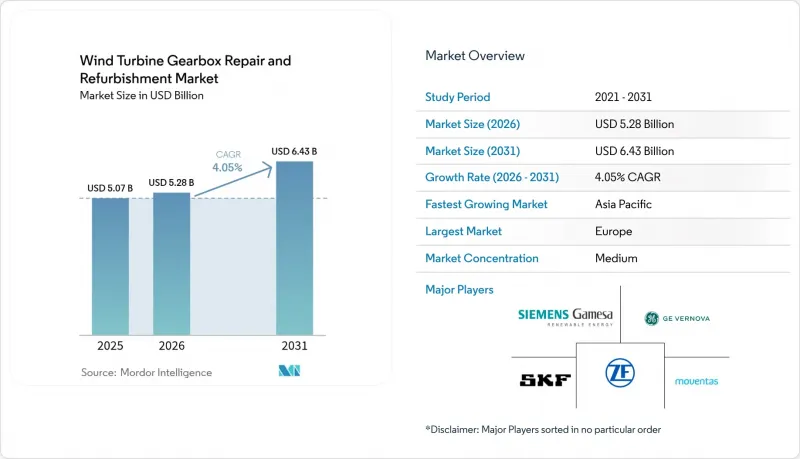
This report is Segmented by Type (Repair and Refurbishment), Gearbox Failure Component (Bearings, Gears, Shafts and Housings, and Others), Turbine Rated Capacity (Below 2 MW, 2 To 5 MW, and Above 5 MW), Service Provider (OEM Service Divisions, Independent Service Providers, and More), Deployment (Onshore and Offshore), Geography (North America, Europe, Asia-Pacific, and More).
Global Wind Turbine Gearbox Repair And Refurbishment Market Trends and Insights
Rapid Ageing of Over 10-Year Onshore Turbine Fleet
Installations commissioned between 2010-2014 are now hitting the 7-10-year window when gearboxes typically demand major intervention. The absence of advanced condition monitoring on many legacy turbines pushes operators toward reactive repairs that cost USD 250,000-300,000 each. Europe feels the crunch first because early wind build-outs in Germany and Denmark created synchronized maintenance cycles. This demographic swell will intensify through 2027, ensuring sustained demand for the wind turbine gearbox repair and refurbishment market.
OEM-Backed Global Repair-Hub Roll-Outs
OEMs invest in centralized remanufacturing hubs to shorten turnaround times and capture aftermarket margins. GE Vernova earmarked USD 100 million for gearbox refurbishment capacity in Amarillo, Texas, under a broader USD 600 million U.S. supply-chain program. Siemens Gamesa runs a Spanish refurbishment plant that completes 10-week overhaul cycles for Eneco's Princess Amalia farm. Centralized hubs maintain specialized tooling for planetary gear repairs and enable predictive inventory stocking, further enlarging the wind turbine gearbox repair and refurbishment market.
Accelerated Migration to Direct-Drive Turbines Eliminating Gearboxes
Offshore developers prefer direct-drive configurations that remove the gearbox and improve reliability, especially where access is difficult. Peer-reviewed comparisons show geared turbines incur 9.3% higher OPEX per MW than direct-drive counterparts.Yet rare-earth magnet requirements and higher capital expense confine adoption to large offshore projects, limiting near-term displacement of the existing geared fleet.
Other drivers and restraints analyzed in the detailed report include:
- Shift from Time-Based to Data-Driven Predictive Maintenance Contracts
- Scarcity of New Gearbox Supply & 18-Month Lead Time
- High Logistics Cost for Offshore Gearbox Handling
For complete list of drivers and restraints, kindly check the Table Of Contents.
Segment Analysis
The wind turbine gearbox repair and refurbishment market for repair services reached USD 3.51 billion in 2025, 69.14% of total revenue. Operators historically run gearboxes to failure, favoring quick repairs that restore availability. Refurbishment, however, is advancing at 4.7% CAGR as asset owners seek extended warranties and lifecycle gains. GE Vernova's Spanish hub embeds engineering upgrades into refurbished drivetrains, cutting repeat interventions and signalling a strategic pivot toward proactive overhauls. The segment evolution shows how the wind turbine gearbox repair and refurbishment market balances immediate uptime needs with long-term asset optimization.
Refurbishment's higher materials scope allows bearing upgrades, gear re-profiling, and lubrication redesigns targeting known failure modes. Insurers often grant longer coverage on refurbished units, enhancing owner economics. With aging fleets entering their second decade, refurbishment will progressively narrow the revenue gap to repair across the wind turbine gearbox repair and refurbishment industry.
Bearings triggered 60.55% of failures in 2025, driving specialized replacement and lubrication services. Contaminants, variable loads, and micro-pitting cause premature wear, making bearing health the focal point of predictive analytics. Gear tooth damage follows at a smaller share, yet a 4.95% CAGR will be seen as white-etching cracks gain industry attention. Lubrication-system optimization can avoid up to 50% of energy loss and extend component life. Service providers that master bearing diagnostics and flush-and-fill services capture the bulk of near-term value in the wind turbine gearbox repair and refurbishment market.
Complete Report Scope:
- By Type
- Repair
- Refurbishment
- By Gearbox Failure Component
- Bearings
- Gears
- Shafts and Housings
- Others (Seals, Lubrication system)
- By Turbine Rated Capacity
- Below 2 MW
- 2 to 5 MW
- Above 5 MW
- By Service Provider
- OEM Service Divisions
- Independent Service Providers (ISP)
- In-house Utility Workshops
- By Deployment
- Onshore
- Offshore
- By Geography
- North America
- United States
- Canada
- Mexico
- Europe
- Germany
- United Kingdom
- France
- Italy
- NORDIC Countries
- Russia
- Rest of Europe
- Asia-Pacific
- China
- India
- Japan
- South Korea
- ASEAN Countries
- Rest of Asia-Pacific
- South America
- Brazil
- Argentina
- Rest of South America
- Middle East and Africa
- Saudi Arabia
- United Arab Emirates
- South Africa
- Egypt
- Rest of Middle East and Africa
- North America
Geography Analysis
Europe delivered 37.45% of global revenue in 2025, reflecting the continent's early adoption and now-aging fleet. Policies such as WindEurope's Clean Industrial Deal push domestic servicing capacity to protect competitiveness. Offshore wind in the North Sea lifts demand for advanced logistics and uptower repair tools. Predictive maintenance roll-outs gain regulatory favor, ensuring steady workload growth inside the wind turbine gearbox repair and refurbishment market.
Asia Pacific is the fastest-growing region at 6.55% CAGR to 2031. China's vast fleet is shifting from warranty to multiyear service agreements that emphasize predictive monitoring, while India's Repowering Policy funnels sub-2 MW turbines into refurbishment pipelines. Domestic champions like Goldwind collaborate with ISPs on component exchange pools, but technology-transfer rules preserve local content advantages.
North America maintains a sizeable installed base serviced by OEM hubs like GE Vernova's Amarillo remanufacturing facility, ensuring fast turnaround for U.S. operators. Latin America, the Middle East & Africa remain nascent, constrained by limited class-certified workshops, yet maturing fleets promise incremental demand across the wind turbine gearbox repair and refurbishment market.
- Siemens Gamesa Renewable Energy SA
- GE Vernova (incl. Winergy)
- ZF Friedrichshafen AG
- Dana-Brevini SpA
- Moventas Gears Oy
- Stork Gears & Services BV
- NGC (Nanjing High Speed)
- SKF Group (Driveline Services)
- Timken Power Systems
- Romax Technology (Hexagon)
- ME Production A/S
- Connected Wind Services A/S
- Turbine Repair Solutions
- Grenaa Motorfabrik A/S
- Bachmann electronic GmbH
- Flender GmbH
- ENERCON GmbH
- Vestas Service & Solutions
- Bonfiglioli Riduttori SpA
- Heli Gearbox (Zhejiang Hengfengtai)
Additional Benefits:
- The market estimate (ME) sheet in Excel format
- 3 months of analyst support
TABLE OF CONTENTS
1 Introduction
- 1.1 Study Assumptions & Market Definition
- 1.2 Scope of the Study
2 Research Methodology
3 Executive Summary
4 Market Landscape
- 4.1 Market Overview
- 4.2 Market Drivers
- 4.2.1 Rapid ageing of Over 10-year onshore turbine fleet
- 4.2.2 OEM-backed global repair-hub roll-outs (e.g., GE Vernova, Siemens Gamesa)
- 4.2.3 Shift from time-based to data-driven predictive maintenance contracts
- 4.2.4 Scarcity of new gearbox supply & 18-month lead-time post-COVID
- 4.2.5 Insurance-mandated proactive repairs to lower outage payouts
- 4.2.6 Modular, exchange-pool business models cutting crane hours by 35-50 %
- 4.3 Market Restraints
- 4.3.1 Accelerated migration to direct-drive turbines eliminating gearboxes
- 4.3.2 High logistics cost for offshore gearbox handling (Above 30 % of ticket)
- 4.3.3 Limited availability of class-certified refurbishment facilities in LATAM & MEA
- 4.3.4 IP-restricted design data hindering multi-brand repairs
- 4.4 Supply-Chain Analysis
- 4.5 Regulatory Landscape
- 4.6 Technological Outlook
- 4.7 Porter's Five Forces
- 4.7.1 Bargaining Power of Suppliers
- 4.7.2 Bargaining Power of Consumers
- 4.7.3 Threat of New Entrants
- 4.7.4 Threat of Substitutes Products and Services
- 4.7.5 Intensity of Competitive Rivalry
5 Market Size & Growth Forecasts
- 5.1 By Type
- 5.1.1 Repair
- 5.1.2 Refurbishment
- 5.2 By Gearbox Failure Component
- 5.2.1 Bearings
- 5.2.2 Gears
- 5.2.3 Shafts and Housings
- 5.2.4 Others (Seals, Lubrication system)
- 5.3 By Turbine Rated Capacity
- 5.3.1 Below 2 MW
- 5.3.2 2 to 5 MW
- 5.3.3 Above 5 MW
- 5.4 By Service Provider
- 5.4.1 OEM Service Divisions
- 5.4.2 Independent Service Providers (ISP)
- 5.4.3 In-house Utility Workshops
- 5.5 By Deployment
- 5.5.1 Onshore
- 5.5.2 Offshore
- 5.6 By Geography
- 5.6.1 North America
- 5.6.1.1 United States
- 5.6.1.2 Canada
- 5.6.1.3 Mexico
- 5.6.2 Europe
- 5.6.2.1 Germany
- 5.6.2.2 United Kingdom
- 5.6.2.3 France
- 5.6.2.4 Italy
- 5.6.2.5 NORDIC Countries
- 5.6.2.6 Russia
- 5.6.2.7 Rest of Europe
- 5.6.3 Asia-Pacific
- 5.6.3.1 China
- 5.6.3.2 India
- 5.6.3.3 Japan
- 5.6.3.4 South Korea
- 5.6.3.5 ASEAN Countries
- 5.6.3.6 Rest of Asia-Pacific
- 5.6.4 South America
- 5.6.4.1 Brazil
- 5.6.4.2 Argentina
- 5.6.4.3 Rest of South America
- 5.6.5 Middle East and Africa
- 5.6.5.1 Saudi Arabia
- 5.6.5.2 United Arab Emirates
- 5.6.5.3 South Africa
- 5.6.5.4 Egypt
- 5.6.5.5 Rest of Middle East and Africa
- 5.6.1 North America
6 Competitive Landscape
- 6.1 Market Concentration
- 6.2 Strategic Moves (M&A, Partnerships, PPAs)
- 6.3 Market Share Analysis (Market Rank/Share for key companies)
- 6.4 Company Profiles (includes Global level Overview, Market level overview, Core Segments, Financials as available, Strategic Information, Products & Services, and Recent Developments)
- 6.4.1 Siemens Gamesa Renewable Energy SA
- 6.4.2 GE Vernova (incl. Winergy)
- 6.4.3 ZF Friedrichshafen AG
- 6.4.4 Dana-Brevini SpA
- 6.4.5 Moventas Gears Oy
- 6.4.6 Stork Gears & Services BV
- 6.4.7 NGC (Nanjing High Speed)
- 6.4.8 SKF Group (Driveline Services)
- 6.4.9 Timken Power Systems
- 6.4.10 Romax Technology (Hexagon)
- 6.4.11 ME Production A/S
- 6.4.12 Connected Wind Services A/S
- 6.4.13 Turbine Repair Solutions
- 6.4.14 Grenaa Motorfabrik A/S
- 6.4.15 Bachmann electronic GmbH
- 6.4.16 Flender GmbH
- 6.4.17 ENERCON GmbH
- 6.4.18 Vestas Service & Solutions
- 6.4.19 Bonfiglioli Riduttori SpA
- 6.4.20 Heli Gearbox (Zhejiang Hengfengtai)
7 Market Opportunities & Future Outlook
- 7.1 White-space & Unmet-need Assessment

