PUBLISHER: Mordor Intelligence | PRODUCT CODE: 2113545

PUBLISHER: Mordor Intelligence | PRODUCT CODE: 2113545
North America Thermoplastics - Market Share Analysis, Industry Trends & Statistics, Growth Forecasts (2026 - 2031)
According to Mordor Intelligence, North America thermoplastics market size in 2026 is estimated at USD 6.37 billion, growing from 2025 value of USD 6.12 billion with 2031 projections showing USD 7.78 billion, growing at 4.07% CAGR over 2026-2031.
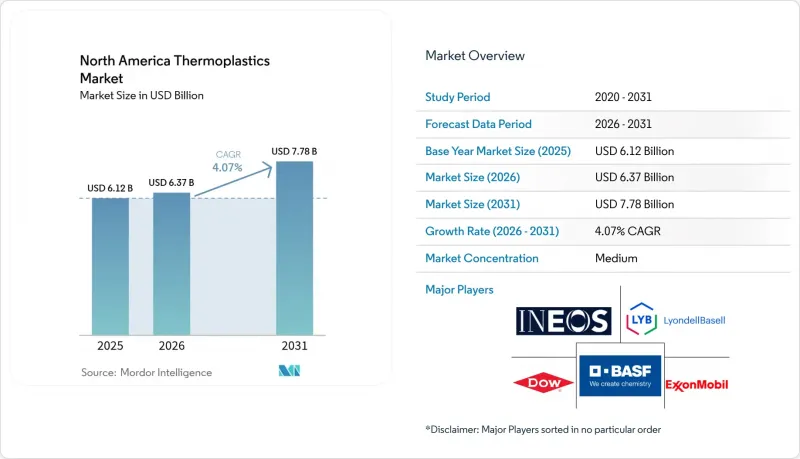
This report is Segmented by Product Type (Commodity, Engineering, High-Performance, and Other Product Types), End-User Industry (Packaging, Building and Construction, Automotive and Transportation, Electrical and Electronics, Sports and Leisure, Furniture and Bedding, Agriculture, and More), and Geography (United States, Canada, Mexico). Market Forecasts are Provided in Terms of Value (USD).
North America Thermoplastics Market Trends and Insights
Surging Demand for Lightweight Electric Vehicle Components
Battery-electric platforms require 10-15% curb-weight reductions to extend the single-charge range beyond 300 miles. Polyamide 6.6 and polyphthalamide are now replacing aluminum in brackets, battery housings, and thermal management parts because these resins can endure continuous service at 150 °C while delivering a 40% mass savings. SABIC's long-fiber polypropylene composite underpins General Motors' Ultium battery tray, providing stiffness previously reserved for stamped steel. A 2024 SAE technical paper quantified that swapping 50 kg of metal for engineering plastics extends range by 8-12 km per charge. Automakers Ford and Stellantis now qualify resin grades during concept design, accelerating adoption and concentrating volume among suppliers with North American compounding lines.
Mandatory Post-Consumer-Recycled-Content Mandates Across U.S. States
California, Oregon, Colorado, and Maine enacted laws requiring all plastic packaging to meet specific recycling rates, effectively creating a nationwide floor because brand owners avoid SKU complexity. Berry Global budgeted USD 65 million in 2024 for optical-sorting upgrades that isolate multilayer films into food-grade polyethylene streams. Amcor pledged to reach 30% recycled content across its North American flexible packaging by 2025, requiring annual intake of 120,000 t of certified PCR resin. PCR polyethylene still commands USD 200-400 per-ton premiums over virgin resin, a delta that narrows only when Brent crude exceeds USD 90 bbl.
Volatile Ethane and Naphtha Feedstock Prices
Ethane at Mont Belvieu fluctuated between USD 0.18 and USD 0.32 per gallon in 2024 due to shifts in associated-gas supply. Naphtha-tracked crude prices rose, squeezing margins for merchant crackers in Canada that rely on external feedstocks. Integrated giants Dow, Chevron Phillips, and ExxonMobil sheltered spreads with captive ethane. Volatility drives converters to quarterly rather than annual resin contracts, transferring risk downstream and deterring greenfield cracker commitments that need 15-year paybacks.
Other drivers and restraints analyzed in the detailed report include:
- Re-shoring of Plastics Conversion Capacity to Mexico
- Chemical-Recycling Investments Securing Circular Feedstock
- Escalating Extended-Producer-Responsibility Fees
For complete list of drivers and restraints, kindly check the Table Of Contents.
Segment Analysis
Commodity-grade thermoplastics held 60.72 % of the North America thermoplastics market share in 2025. Polyethylene dominates due to its broad film and pipe applications, while polypropylene grows in automotive interiors and hygiene non-wovens because of a 10% density edge that reduces weight. Polyvinyl chloride remains entrenched in building pipe, though scrutiny over chlorine chemistries prompts some municipalities to favor polyethylene. Polystyrene faces bans on single-use packaging, dampening demand.
Engineering polymers fill the middle tier, serving under-hood parts, connectors, and appliance housings. They fetch 30-50% premiums over commodity grades thanks to improved heat and impact resistance. High-performance thermoplastics are the fastest risers, with a 5.96% CAGR, driven by the aerospace, semiconductor, and medical segments. Polyether ether ketone, liquid-crystal polymer, and polyimide withstand continuous service temperatures of>=200 °C and maintain dimensional precision under cycling loads. Producers with regional compounding lines secure faster adoption because OEMs insist on local supply continuity.
Complete Report Scope:
- By Product Type
- Commodity Thermoplastics
- Polyethylene (PE)
- Polypropylene (PP)
- Polyvinyl Chloride (PVC)
- Polystyrene (PS)
- Engineering Thermoplastics
- Polyamide (PA)
- Polycarbonate (PC)
- Polymethyl Methacrylate (PMMA)
- Polyoxymethylene (POM)
- Polyethylene Terephthalate (PET)
- Polybutylene Terephthalate (PBT)
- Acrylonitrile-Butadiene-Styrene (ABS) / SAN
- High-Performance Thermoplastics
- Polyether Ether Ketone (PEEK)
- Liquid Crystal Polymer (LCP)
- Polytetrafluoroethylene (PTFE)
- Polyimide (PI)
- Other Product Types (PPE, PSU, PEI, PPS, ETFE, PFA, FEP, PBI)
- Commodity Thermoplastics
- By End-user Industry
- Packaging
- Building and Construction
- Automotive and Transportation
- Electrical and Electronics
- Sports and Leisure
- Furniture and Bedding
- Agriculture
- Medical
- Other End-user Industries
- Geography
- United States
- Canada
- Mexico
List of Companies Covered in this Report:
- 3M
- Arkema
- Asahi Kasei Corporation
- BASF
- Celanese Corporation
- Chevron Phillips Chemical Company
- Covestro AG
- Dow
- DSM
- DuPont
- Eastman Chemical Company
- Evonik Industries AG
- Exxon Mobil Corporation
- INEOS
- LANXESS
- LG Chem
- LyondellBasell
- Mitsubishi Engineering-Plastics Corporation
- Polyplastics Co.
- Rochling
- SABIC
- Solvay
- TEIJIN LIMITED
Additional Benefits:
- The market estimate (ME) sheet in Excel format
- 3 months of analyst support
TABLE OF CONTENTS
1 Introduction
- 1.1 Study Assumptions and Market Definition
- 1.2 Scope of the Study
2 Research Methodology
3 Executive Summary
4 Market Landscape
- 4.1 Market Overview
- 4.2 Market Drivers
- 4.2.1 Surging demand for lightweight Electric Vehicle components
- 4.2.2 Mandatory post-consumer-recycled-content mandates across U.S. states
- 4.2.3 Re-shoring of plastics conversion capacity to Mexico
- 4.2.4 Chemical-recycling investments securing circular feedstock
- 4.2.5 AI-enabled process control cutting scrap rates
- 4.3 Market Restraints
- 4.3.1 Volatile ethane and naphtha feedstock prices
- 4.3.2 Escalating extended-producer-responsibility fees
- 4.3.3 Skilled-labour shortages in high-precision molding
- 4.4 Value Chain Analysis
- 4.5 Porter's Five Forces
- 4.5.1 Threat of New Entrants
- 4.5.1.1 Bargaining Power of Buyers
- 4.5.1.2 Bargaining Power of Suppliers
- 4.5.1.3 Threat of Substitutes
- 4.5.1.4 Degree of Competition
- 4.5.1 Threat of New Entrants
5 Market Size and Growth Forecasts (Value)
- 5.1 By Product Type
- 5.1.1 Commodity Thermoplastics
- 5.1.1.1 Polyethylene (PE)
- 5.1.1.2 Polypropylene (PP)
- 5.1.1.3 Polyvinyl Chloride (PVC)
- 5.1.1.4 Polystyrene (PS)
- 5.1.2 Engineering Thermoplastics
- 5.1.2.1 Polyamide (PA)
- 5.1.2.2 Polycarbonate (PC)
- 5.1.2.3 Polymethyl Methacrylate (PMMA)
- 5.1.2.4 Polyoxymethylene (POM)
- 5.1.2.5 Polyethylene Terephthalate (PET)
- 5.1.2.6 Polybutylene Terephthalate (PBT)
- 5.1.2.7 Acrylonitrile-Butadiene-Styrene (ABS) / SAN
- 5.1.3 High-Performance Thermoplastics
- 5.1.3.1 Polyether Ether Ketone (PEEK)
- 5.1.3.2 Liquid Crystal Polymer (LCP)
- 5.1.3.3 Polytetrafluoroethylene (PTFE)
- 5.1.3.4 Polyimide (PI)
- 5.1.4 Other Product Types (PPE, PSU, PEI, PPS, ETFE, PFA, FEP, PBI)
- 5.1.1 Commodity Thermoplastics
- 5.2 By End-user Industry
- 5.2.1 Packaging
- 5.2.2 Building and Construction
- 5.2.3 Automotive and Transportation
- 5.2.4 Electrical and Electronics
- 5.2.5 Sports and Leisure
- 5.2.6 Furniture and Bedding
- 5.2.7 Agriculture
- 5.2.8 Medical
- 5.2.9 Other End-user Industries
- 5.3 Geography
- 5.3.1 United States
- 5.3.2 Canada
- 5.3.3 Mexico
6 Competitive Landscape
- 6.1 Market Concentration
- 6.2 Strategic Moves
- 6.3 Market Share (%)/ Ranking Analysis
- 6.4 Company Profiles (includes Global level Overview, Market level overview, Core Segments, Financials as available, Strategic Information, Market Rank/Share, Products and Services, Recent Developments)
- 6.4.1 3M
- 6.4.2 Arkema
- 6.4.3 Asahi Kasei Corporation
- 6.4.4 BASF
- 6.4.5 Celanese Corporation
- 6.4.6 Chevron Phillips Chemical Company
- 6.4.7 Covestro AG
- 6.4.8 Dow
- 6.4.9 DSM
- 6.4.10 DuPont
- 6.4.11 Eastman Chemical Company
- 6.4.12 Evonik Industries AG
- 6.4.13 Exxon Mobil Corporation
- 6.4.14 INEOS
- 6.4.15 LANXESS
- 6.4.16 LG Chem
- 6.4.17 LyondellBasell
- 6.4.18 Mitsubishi Engineering-Plastics Corporation
- 6.4.19 Polyplastics Co.
- 6.4.20 Rochling
- 6.4.21 SABIC
- 6.4.22 Solvay
- 6.4.23 TEIJIN LIMITED
7 Market Opportunities and Future Outlook
- 7.1 White-space and Unmet-need Assessment

