PUBLISHER: Mordor Intelligence | PRODUCT CODE: 2115002

PUBLISHER: Mordor Intelligence | PRODUCT CODE: 2115002
High-temperature Thermoplastic - Market Share Analysis, Industry Trends & Statistics, Growth Forecasts (2026 - 2031)
According to Mordor Intelligence, high-temperature thermoplastic market size in 2026 is estimated at USD 28.27 billion, growing from 2025 value of USD 26.18 billion with 2031 projections showing USD 41.47 billion, growing at 7.98% CAGR over 2026-2031.
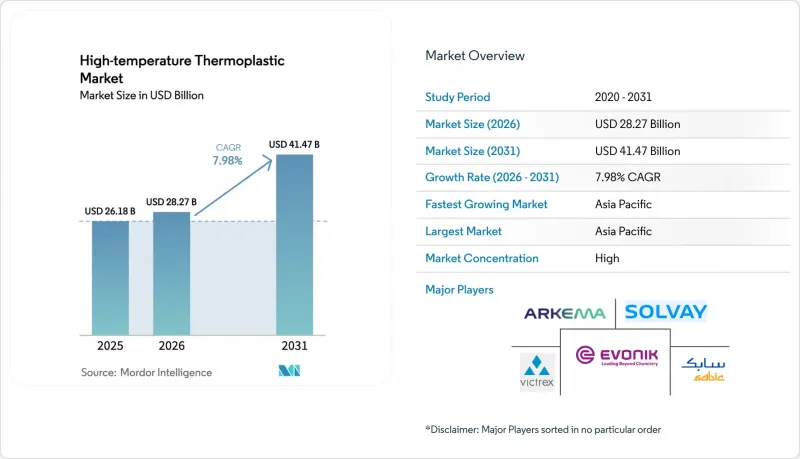
This report is Segmented by Polymer Type (Polyetheretherketone (PEEK), Polyether Ketone (PEKK), and More), Molecular Structure (Amorphous, Semi-Crystalline), End-User Industry (Automotive, Electrical and Electronics, Aerospace, Medical, Others), and Geography (Asia-Pacific, North America, Europe, South America, and Middle-East and Africa). The Market Forecasts are Provided in Terms of Value (USD).
Global High-temperature Thermoplastic Market Trends and Insights
Rising Demand for Lightweight Automotive Components
Electric vehicles require resin grades that endure battery pack temperatures, flame exposure, and constant vibration. SABIC's NORYL NHP8000VT3 delivers a CTI PLC0 rating that helps protect 800-volt power-train architectures against tracking failure. The 2024 Bluebus e-bus integrated a thermoplastic battery housing, trimming mass versus an aluminum shell while exceeding fire-safety limits. Tesla specified roughly 9 kg of PEEK per Optimus-Gen2 humanoid robot and removed 10 kg of total weight, proving the polymer's versatility beyond vehicles. Automakers pursuing longer range and faster charging combine those examples to confirm a structural shift toward advanced thermoplastics.
Growth in Electronics Miniaturization and High-Heat PCB Applications
Shrinking form factors raise component heat flux, pushing board temperatures above 300 °C during assembly reflow. Polyimide film maintains dimensional stability and matches copper's coefficient of thermal expansion, reducing delamination in high-density circuits. The IEEE Heterogeneous Integration Roadmap flags high-temperature thermoplastics as critical die-attach and under-fill materials for chiplet packaging, enabling further transistor scaling. As data-center operators chase higher rack power and 5G radios proliferate, board makers specify polymers that survive rapid thermal cycling without embrittlement. Asia-Pacific foundries already line up additional laminator lines, indicating a near-term pull that benefits regional resin suppliers.
High Raw-Material and Compounding Cost
Specialty monomers face tight balances and geopolitical disruptions. Composite resin producer AOC raised prices by EUR 200 per ton for vinyl ester blends in 2024, passing energy hikes through the chain. Medical device firms coping with PTFE shortages were forced to verticalize fluoropolymer extrusion to secure supply. High-temperature twin-screw extruders and mold-temperature control units rated above 400 °C require capital that smaller firms cannot easily deploy. Until unit costs go down, price-sensitive segments will continue to substitute with engineering plastics or aluminum.
Other drivers and restraints analyzed in the detailed report include:
- Growing Demand from the Aerospace and Defense Industry
- High Usage in 3D Printing and Additive Manufacturing
- Rising Demand from Healthcare Industry
- Recycling and Circular-Economy Challenges
For complete list of drivers and restraints, kindly check the Table Of Contents.
Segment Analysis
PEEK held 45.35% of the high-temperature thermoplastic market share in 2025. Tensile strength near 115 MPa and continuous-use temperature around 260 °C keep the polymer on most qualified parts lists. Aerospace seat frames, spinal cages, and semiconductor wafer-handling components rely on that track record. PEKK's lower crystallization speed supports layer-by-layer fusion in additive manufacturing, a trait that underpins its 10.78% CAGR. Arkema's licensing deal with SEQENS enables back-integration of anode-grade raw materials, thereby reducing exposure to supply shocks.
Second-tier materials advance as well. Liquid-crystal polymer grades with a glass transition temperature above 280 °C meet the next-generation connector pin density requirements in 5G base stations. Ultra-high-molecular-weight polybenzimidazole is used in downhole seals at 350 °C, but it is sold in kilograms rather than tonnes. Collectively, these specialty niches limit commoditization, sustaining premium margins across the high-temperature thermoplastic market.
Complete Report Scope:
- By Polymer Type
- Polyetheretherketone (PEEK)
- Polyether Ketone (PEKK)
- Polyphenylene sulphide (PPS)
- Polyetherimide (PEI)
- Polyethersulfone (PESU)
- Polysulfone (PSU)
- Other Polymer Types (Liquid crystal polymer (LCP), etc.)
- By Molecular Structure
- Amorphous
- Semi-crystalline
- By End-user Industry
- Automotive
- Electrical and Electronics
- Aerospace
- Medical
- Other End-users Industries (Oil and Gas, etc.)
- By Geography
- Asia-Pacific
- China
- India
- Japan
- South Korea
- Rest of Asia-Pacific
- North America
- United States
- Canada
- Mexico
- Europe
- Germany
- United Kingdom
- France
- Italy
- Rest of Europe
- South America
- Brazil
- Argentina
- Rest of South America
- Middle-East and Africa
- Saudi Arabia
- South Africa
- Rest of Middle-East and Africa
- Asia-Pacific
Geography Analysis
Asia-Pacific's 39.05% 2025 share stems from vertically integrated supply chains that connect monomer synthesis, compounding, and part fabrication within a day's trucking distance. The region is expected to post the fastest 8.45% CAGR to 2031. Government incentives for new-energy vehicles in China, India, and Thailand boost demand for PEEK battery frames and PPS coolant fittings. Japanese OEMs are pioneering PEI-based connector blocks for ultrafast chargers, thereby expanding the domestic converter base.
North America maintains a resilient position. The aerospace backbone of Washington state and Alabama anchors steady polymer off-take, while the Texas chemical corridor supplies key monomers. Post-pandemic reshoring policies are encouraging battery manufacturers to invest in Michigan and Georgia, where processors are installing new 450-ton presses.
- AKRO-PLASTIC GmbH
- Arkema
- BASF
- Celanese Corporation
- Drake Plastics
- DuPont
- Ensinger
- Evonik Industries AG
- GSF Plastics
- Hexcel Corporation
- Polyplastics Co., Ltd.
- RTP Company
- SABIC
- Solvay
- Sumitomo Chemical Co., Ltd.
- TORAY INDUSTRIES, INC.
- Victrex plc
Additional Benefits:
- The market estimate (ME) sheet in Excel format
- 3 months of analyst support
TABLE OF CONTENTS
1 Introduction
- 1.1 Study Assumptions and Market Definition
- 1.2 Scope of the Study
2 Research Methodology
3 Executive Summary
4 Market Landscape
- 4.1 Market Overview
- 4.2 Market Drivers
- 4.2.1 Rising Demand for Lightweight Automotive Components
- 4.2.2 Growth Electronics Miniaturisation and High-Heat PCB Applications
- 4.2.3 Growing Demand from the Aerospace and Defense Industry
- 4.2.4 High Usage in 3D Printing and Additive Manufacturing
- 4.2.5 Rising Demand from Healthcare Industry
- 4.3 Market Restraints
- 4.3.1 High Raw-Material and Compounding Cost
- 4.3.2 Recycling and Circular-Economy Challenges
- 4.3.3 Capital-Intensive High-Temperature Processing Equipment
- 4.4 Value Chain Analysis
- 4.5 Porter's Five Forces
- 4.5.1 Threat of New Entrants
- 4.5.2 Bargaining Power of Buyers
- 4.5.3 Bargaining Power of Suppliers
- 4.5.4 Threat of Substitute Products
- 4.5.5 Degree of Competition
5 Market Size and Growth Forecasts (Value)
- 5.1 By Polymer Type
- 5.1.1 Polyetheretherketone (PEEK)
- 5.1.2 Polyether Ketone (PEKK)
- 5.1.3 Polyphenylene sulphide (PPS)
- 5.1.4 Polyetherimide (PEI)
- 5.1.5 Polyethersulfone (PESU)
- 5.1.6 Polysulfone (PSU)
- 5.1.7 Other Polymer Types (Liquid crystal polymer (LCP), etc.)
- 5.2 By Molecular Structure
- 5.2.1 Amorphous
- 5.2.2 Semi-crystalline
- 5.3 By End-user Industry
- 5.3.1 Automotive
- 5.3.2 Electrical and Electronics
- 5.3.3 Aerospace
- 5.3.4 Medical
- 5.3.5 Other End-users Industries (Oil and Gas, etc.)
- 5.4 By Geography
- 5.4.1 Asia-Pacific
- 5.4.1.1 China
- 5.4.1.2 India
- 5.4.1.3 Japan
- 5.4.1.4 South Korea
- 5.4.1.5 Rest of Asia-Pacific
- 5.4.2 North America
- 5.4.2.1 United States
- 5.4.2.2 Canada
- 5.4.2.3 Mexico
- 5.4.3 Europe
- 5.4.3.1 Germany
- 5.4.3.2 United Kingdom
- 5.4.3.3 France
- 5.4.3.4 Italy
- 5.4.3.5 Rest of Europe
- 5.4.4 South America
- 5.4.4.1 Brazil
- 5.4.4.2 Argentina
- 5.4.4.3 Rest of South America
- 5.4.5 Middle-East and Africa
- 5.4.5.1 Saudi Arabia
- 5.4.5.2 South Africa
- 5.4.5.3 Rest of Middle-East and Africa
- 5.4.1 Asia-Pacific
6 Competitive Landscape
- 6.1 Market Concentration
- 6.2 Strategic Moves
- 6.3 Market Share (%)/Ranking Analysis
- 6.4 Company Profiles (includes Global level Overview, Market level overview, Core Segments, Financials as available, Strategic Information, Market Rank/Share for key companies, Products and Services, and Recent Developments)
- 6.4.1 AKRO-PLASTIC GmbH
- 6.4.2 Arkema
- 6.4.3 BASF
- 6.4.4 Celanese Corporation
- 6.4.5 Drake Plastics
- 6.4.6 DuPont
- 6.4.7 Ensinger
- 6.4.8 Evonik Industries AG
- 6.4.9 GSF Plastics
- 6.4.10 Hexcel Corporation
- 6.4.11 Polyplastics Co., Ltd.
- 6.4.12 RTP Company
- 6.4.13 SABIC
- 6.4.14 Solvay
- 6.4.15 Sumitomo Chemical Co., Ltd.
- 6.4.16 TORAY INDUSTRIES, INC.
- 6.4.17 Victrex plc
7 Market Opportunities and Future Outlook
- 7.1 White-space and unmet-need assessment

