PUBLISHER: Mordor Intelligence | PRODUCT CODE: 2113546

PUBLISHER: Mordor Intelligence | PRODUCT CODE: 2113546
Air-based C4ISR - Market Share Analysis, Industry Trends & Statistics, Growth Forecasts (2026 - 2031)
According to Mordor Intelligence, the air-based C4ISR market is expected to grow from USD 3.76 billion in 2026 to USD 4.71 billion by 2031, registering a CAGR of 4.65%.
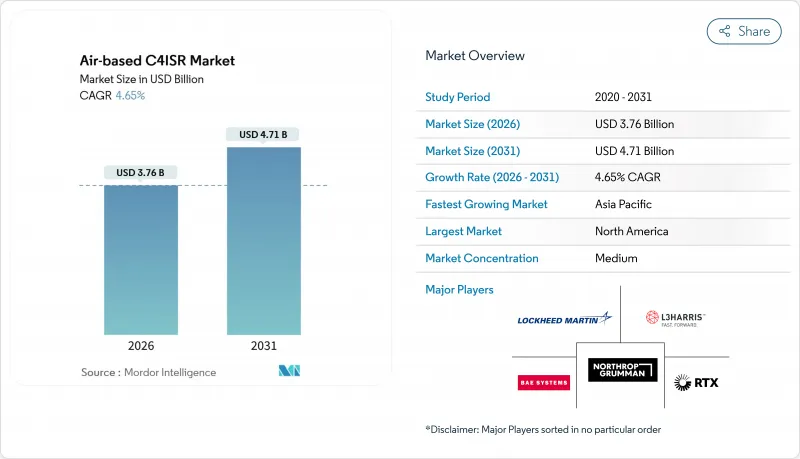
This report is Segmented by System Type (C4 Systems, Intelligence Surveillance and Reconnaissance, Electronic Warfare), Platform (Manned Fixed Wing, Manned Rotary Wing, Unmanned), Component (Hardware, Software), End-User (Defense Forces, Civil and Government Agencies), and Geography (North America, South America, and More). Market Forecasts are Provided in Terms of Value (USD).
Global Air-based C4ISR Market Trends and Insights
Multi-Domain Operations Doctrine Reshaping Procurement Priorities
Joint all-domain frameworks demonstrated during Exercise Northern Edge 2025 enabled an F-35 to share target coordinates with an Army missile battery, completing engagement in under 90 seconds. Canada allocated USD 1.5 billion to integrate CP-140 Aurora aircraft into the same network in 2025, while Australia's Project AIR 7000 mandated open mission systems for P-8A Poseidon upgrades. These initiatives are redirecting spending toward middleware capable of transmitting high-resolution sensor data beyond the capacity of legacy Link 16 systems. As a result, integrators that can rapidly certify new waveforms are securing contracts, while primes resisting the Modular Open Systems Approach (MOSA) standards risk disqualification from future competitions.
AI-Driven Sensor Fusion Accelerating Decision Cycles
Northrop Grumman's AI planning suite on the RQ-4 Global Hawk achieved 92% target-identification accuracy and reduced analyst workload by 60% in 2025. Israel's Air Force deployed an autonomous mission manager on Hermes 900 UAVs, enabling aircraft rerouting without human intervention. Additionally, the US Joint Artificial Intelligence Center standardized 12 petabytes of imagery for algorithm training. However, certification remains a challenge, as FAA and EASA regulations for AI-powered flight-critical software are still in draft form, delaying civil adoption despite military demand for greater autonomy. The advancements in AI-driven sensor fusion are expected to significantly enhance operational efficiency and decision-making capabilities in complex scenarios.
Spectrum Congestion in Anti-Access Environments Degrading Link Reliability
China's coordinated jamming during the 2025 exercises reduced Global Hawk datalink availability to below 70% for extended periods. Similarly, Russia's Krasukha-4 system caused comparable disruptions in the Baltic region, prompting NATO members to adopt frequency-hopping radios, which add USD 4 million per aircraft. DARPA's Spectrum Collaboration Challenge awarded USD 3.5 million to autonomous algorithms capable of identifying open frequencies. However, FAA approval for integration into manned aircraft remains pending. As a result, Air-based C4ISR market participants must develop multi-band solutions capable of operating in high-noise environments until regulatory frameworks are finalized. The increasing spectrum congestion highlights the need for robust and adaptive communication technologies to maintain operational effectiveness in contested environments.
Other drivers and restraints analyzed in the detailed report include:
- Proliferation of HALE / MALE UAV Fleets Requiring Plug-and-Play C4ISR
- MOSA Mandates Fragmenting Traditional Integration Models
- Gallium and Rare-Earth Supply Concentration Threatening T/R Module Production
For complete list of drivers and restraints, kindly check the Table Of Contents.
Segment Analysis
Intelligence, surveillance, and reconnaissance (ISR) solutions accounted for 42.35% of the Air-based C4ISR market share in 2025, growing at a 6.47% CAGR due to the demand for persistent wide-area coverage. Armed forces are replacing single-purpose platforms with drones and pods that integrate synthetic-aperture radar, electro-optical, and SIGINT sensors. This transition reduces per-hour operating costs while improving detection probabilities. In 2024, BAE Systems delivered a laser-guided rocket equipped with ISR sensors, demonstrating how expendable ordnance now serves dual purposes as both a weapon and a data collector.
Conversely, command-and-control networks are growing at a slower pace due to the maturity of Link 16 infrastructure and episodic demand for electronic warfare (EW), which spikes after incidents such as Russia's jamming activities in Ukraine. However, ISR and EW are increasingly converging. For example, Elbit's SPECTRO XR pod combines passive collection with active jamming, reducing drag by 18% compared to separate passive and active jamming pods. This integration is expected to sustain dynamism in the Air-based C4ISR market throughout the forecast period.
Manned aircraft retained 36.41% of revenue in 2025, supported by platforms like the P-8A Poseidon, which provides maritime reach that most drones cannot achieve. Rotary-wing variants remain essential for anti-submarine warfare, as dipping sonar technology has not yet been miniaturized for unmanned helicopters.
Unmanned systems, however, are growing at a 5.98% CAGR as operators shift risk to machines and leverage endurance profiles of up to 48 hours, exemplified by Turkey's Bayraktar Akinci demonstrations. Countries such as India, the United Kingdom, and South Korea are prioritizing UAVs over new manned fleets, signaling a long-term shift toward platform autonomy in the Air-based C4ISR market.
Complete Report Scope:
- By System Type
- C4 Systems
- Intelligence, Surveillance and Reconnaissance (ISR)
- Electronic Warfare (EW)
- By Platform
- Manned
- Fixed Wing
- Rotary Wing
- Unmanned
- Manned
- By Component
- Hardware
- Software
- By End-user
- Defense Forces
- Civil and Government Agencies
- By Geography
- North America
- United States
- Canada
- Mexico
- South America
- Brazil
- Rest of South America
- Europe
- United Kingdom
- Germany
- France
- Russia
- Rest of Europe
- Asia-Pacific
- China
- India
- Japan
- South Korea
- Rest of Asia-Pacific
- Middle East and Africa
- Middle East
- Saudi Arabia
- United Arab Emirates
- Rest OF Middle East
- Africa
- South Africa
- Rest of Africa
- Middle East
- North America
Geography Analysis
North America accounted for 36.82% of the revenue in 2025, supported by Pentagon funding for Joint All-Domain Command and Control (JADC2) and FAA waivers that facilitated unmanned operations beyond the visual line of sight. Canada is integrating CP-140 Aurora aircraft into combined networks, while Mexico's King Air 260 ISR fleet addresses counter-narcotics missions. Although ITAR export controls limit external sales, domestic demand ensures a stable trajectory for the regional Air-based C4ISR market.
The Asia-Pacific region is growing at a 5.08% CAGR, driven by India's USD 3.5 billion MQ-9B acquisition, Japan's ISR enhancements following North Korean missile activity, and South Korea's indigenous drone programs. China's GJ-11 stealth UAVs are prompting neighboring countries to accelerate upgrades, while Taiwan's additional E-2D Advanced Hawkeye orders highlight continued reliance on crewed early-warning aircraft.
Europe and the Middle East exhibit similar growth trends, with NATO standardization and GCC joint procurement initiatives helping to reduce unit costs. Germany's Airbus A321MPA acquisition reflects Europe's preference for native sensors, while Saudi Arabia's Vision 2030 localization strategy is fostering joint ventures that redirect a portion of the global Air-based C4ISR market into Gulf supply chains.
- Lockheed Martin Corporation
- Northrop Grumman Corporation
- The Boeing Company
- L3Harris Technologies Inc.
- BAE Systems plc
- General Dynamics Corporation
- RTX Corporation
- Elbit Systems Ltd
- CACI International Inc.
- Kratos Defense & Security Solutions
- Rheinmetall AG
- THALES
- Airbus SE
- Leonardo S.p.A.
- Saab AB
- Israel Aerospace Industries Ltd.
- General Atomics Aeronautical Systems
- Collins Aerospace
- Teledyne FLIR LLC
Additional Benefits:
- The market estimate (ME) sheet in Excel format
- 3 months of analyst support
TABLE OF CONTENTS
1 INTRODUCTION
- 1.1 Study Assumptions and Market Definition
- 1.2 Scope of the Study
2 RESEARCH METHODOLOGY
3 EXECUTIVE SUMMARY
4 MARKET LANDSCAPE
- 4.1 Market Overview
- 4.2 Market Drivers
- 4.2.1 Rapid multi-domain operations doctrine (JADC2, CJADC2) adoption
- 4.2.2 AI-enabled sensor-to-shooter data-fusion demand
- 4.2.3 Proliferation of HALE/MALE UAV fleets requiring plug-and-play C4ISR
- 4.2.4 Modular Open Systems Architecture (MOSA) mandates in US/NATO procurements
- 4.2.5 Low-Earth-Orbit sat-com constellations closing airborne comms black-spots
- 4.2.6 Silicon-photonics-based RF front-ends slashing SWaP on airborne payloads
- 4.3 Market Restraints
- 4.3.1 Dense spectrum congestion over peer-adversary A2AD bubbles
- 4.3.2 Sovereign data-localization laws hampering cross-border ISR clouding
- 4.3.3 Acute gallium/rare-earth supply risk for T/R modules
- 4.3.4 Certification delays for AI-driven mission software on legacy airframes
- 4.4 Value Chain Analysis
- 4.5 Regulatory Landscape
- 4.6 Technological Outlook
- 4.7 Porter's Five Forces Analysis
- 4.7.1 Bargaining Power of Buyers
- 4.7.2 Bargaining Power of Suppliers
- 4.7.3 Threat of New Entrants
- 4.7.4 Threat of Substitutes
- 4.7.5 Competitive Rivalry
5 MARKET SIZE AND GROWTH FORECASTS (VALUE)
- 5.1 By System Type
- 5.1.1 C4 Systems
- 5.1.2 Intelligence, Surveillance and Reconnaissance (ISR)
- 5.1.3 Electronic Warfare (EW)
- 5.2 By Platform
- 5.2.1 Manned
- 5.2.1.1 Fixed Wing
- 5.2.1.2 Rotary Wing
- 5.2.2 Unmanned
- 5.2.1 Manned
- 5.3 By Component
- 5.3.1 Hardware
- 5.3.2 Software
- 5.4 By End-user
- 5.4.1 Defense Forces
- 5.4.2 Civil and Government Agencies
- 5.5 By Geography
- 5.5.1 North America
- 5.5.1.1 United States
- 5.5.1.2 Canada
- 5.5.1.3 Mexico
- 5.5.2 South America
- 5.5.2.1 Brazil
- 5.5.2.2 Rest of South America
- 5.5.3 Europe
- 5.5.3.1 United Kingdom
- 5.5.3.2 Germany
- 5.5.3.3 France
- 5.5.3.4 Russia
- 5.5.3.5 Rest of Europe
- 5.5.4 Asia-Pacific
- 5.5.4.1 China
- 5.5.4.2 India
- 5.5.4.3 Japan
- 5.5.4.4 South Korea
- 5.5.4.5 Rest of Asia-Pacific
- 5.5.5 Middle East and Africa
- 5.5.5.1 Middle East
- 5.5.5.1.1 Saudi Arabia
- 5.5.5.1.2 United Arab Emirates
- 5.5.5.1.3 Rest OF Middle East
- 5.5.5.2 Africa
- 5.5.5.2.1 South Africa
- 5.5.5.2.2 Rest of Africa
- 5.5.5.1 Middle East
- 5.5.1 North America
6 COMPETITIVE LANDSCAPE
- 6.1 Market Concentration
- 6.2 Strategic Moves
- 6.3 Market Share Analysis
- 6.4 Company Profiles (includes Global level Overview, Market level overview, Core Segments, Financials as available, Strategic Information, Market Rank/Share for key companies, Products and Services, and Recent Developments)
- 6.4.1 Lockheed Martin Corporation
- 6.4.2 Northrop Grumman Corporation
- 6.4.3 The Boeing Company
- 6.4.4 L3Harris Technologies Inc.
- 6.4.5 BAE Systems plc
- 6.4.6 General Dynamics Corporation
- 6.4.7 RTX Corporation
- 6.4.8 Elbit Systems Ltd
- 6.4.9 CACI International Inc.
- 6.4.10 Kratos Defense & Security Solutions
- 6.4.11 Rheinmetall AG
- 6.4.12 THALES
- 6.4.13 Airbus SE
- 6.4.14 Leonardo S.p.A.
- 6.4.15 Saab AB
- 6.4.16 Israel Aerospace Industries Ltd.
- 6.4.17 General Atomics Aeronautical Systems
- 6.4.18 Collins Aerospace
- 6.4.19 Teledyne FLIR LLC
7 MARKET OPPORTUNITIES AND FUTURE OUTLOOK
- 7.1 White-space and Unmet-Need Assessment

