PUBLISHER: Mordor Intelligence | PRODUCT CODE: 2121844

PUBLISHER: Mordor Intelligence | PRODUCT CODE: 2121844
Space-based C4ISR - Market Share Analysis, Industry Trends & Statistics, Growth Forecasts (2026 - 2031)
According to Mordor Intelligence, the space-based C4ISR market size is expected to grow from USD 3.45 billion in 2025 to USD 3.63 billion in 2026 and is forecasted to reach USD 4.61 billion by 2031 at a 4.91% CAGR over 2026-2031.
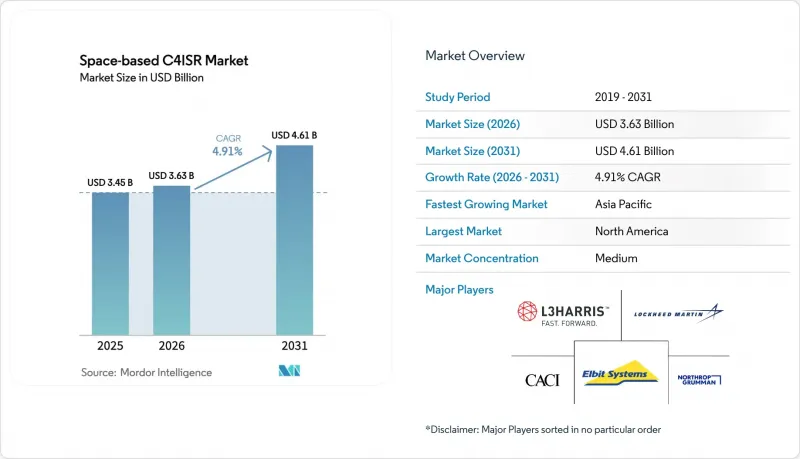
This report is Segmented by Purpose (C4 and ISR), Orbit Type (Low-Earth Orbit, Medium-Earth Orbit, and Geostationary Orbit), Platform Type (Small, Medium, and Large), End-User (Defense Forces and Civil, Government, and Space Agencies), and Geography (North America, Europe, Asia-Pacific, South America, and Middle East and Africa). The Market Forecasts are Provided in Terms of Value (USD).
Global Space-based C4ISR Market Trends and Insights
Rising Demand for Real-Time Situational Awareness
Commanders now require sub-minute decision cycles to counter maneuvering threats, prompting investment in transport-layer satellites able to push sensor data to shooters within 10 seconds. L3Harris delivered 10 Tranche 1 platforms in 2024, featuring 10 Gbps optical crosslinks, which eliminate ground-station latency. Israel Aerospace Industries launched Ofek 19 in 2025, adding 0.5 m all-weather imaging that commanders in the Eastern Mediterranean integrate into theater command systems. Constellations of 100-plus satellites now guarantee sub-15-minute revisit times, satisfying the tempo required for hypersonic defense. Growth in the space-based C4ISR market is therefore anchored in latency-driven procurement that favors proliferated LEO designs.
Proliferation of Low-Cost Small-Sat Constellations
Rideshare missions priced near USD 1 million per 200 kg payload democratize access to orbit. Hanwha Systems is investing KRW 100 billion (USD 68.86 million) in additional small-satellite production, enabling South Korea to field radar payloads without relying on foreign primes. India's DRDO plans 50 satellites by 2030, leveraging indigenous launchers for autonomy. These developments compress refresh cycles to three-year intervals, stimulating recurring demand and enlarging the addressable space-based C4ISR market.
Orbital Congestion and Space-Debris Collision Risk
ESA tracks 33,290 debris objects larger than 10 cm, yielding a 1-in-1,000 annual collision probability for satellites in busy sun-synchronous bands. The February 2024 breakup of a Russian satellite forced 47 conjunction warnings within three days, raising insurance premiums by up to 20% for spacecraft lacking propulsion. Active debris removal remains experimental, with Astroscale's ADRAS-J only proving rendezvous capability so far. Until regulators mandate end-of-life deorbiting, congestion will inflate costs and moderate growth in the space-based C4ISR market.
Other drivers and restraints analyzed in the detailed report include:
- Higher Defense Spending Dedicated to Space Domain Awareness
- Integration of C4ISR Constellations with Autonomous UAV Swarms
- High Upfront Capex and Long Development Cycles
For complete list of drivers and restraints, kindly check the Table Of Contents.
Segment Analysis
ISR applications produced 75.35% of 2025 revenue, underpinning the space-based C4ISR market size leadership as governments relied on electro-optical (EO), radar, and signals payloads for strategic warning. Maxar's WorldView Legion achieved full operations in 2025, offering 30 cm imagery with daily revisit for the National Geospatial-Intelligence Agency. Israel's Ofek 19 added 0.5 m radar imaging in adverse weather, bolstering Eastern Mediterranean surveillance.
The C4 segment is projected to grow at a 5.29% CAGR through 2031, as tactical mesh networks link Patriot batteries, collaborative combat aircraft, and maneuver brigades in near real-time. L3Harris's optical cross-links exemplify this shift, merging communications and ISR on a single bus and expanding functional overlap across the space-based C4ISR industry.
LEO held 70.12% of 2025 revenue and is forecasted to rise at a 5.63% CAGR, reflecting the preference for sub-20 millisecond latency missions central to the space-based C4ISR market. L3Harris won USD 919 million for Tranche 2 and USD 843 million for Tranche 3, including missile-tracking satellites that integrate optical and IR sensors.
MEO supports wide-area coverage, as illustrated by the GPS III spacecraft, which also hosts nuclear-detonation detectors. Geostationary remains vital for persistent surveillance; Northrop Grumman's polar OPIR satellites, in highly elliptical orbits, complement GEO vantage points over the Arctic.
Complete Report Scope:
- By Purpose
- Command, Control, Communications, and Computers (C4)
- Intelligence, Surveillance, and Reconnaissance (ISR)
- By Orbit Type
- Low-Earth Orbit (LEO)
- Medium-Earth Orbit (MEO)
- Geostationary Orbit (GEO)
- By Platform Type
- Small (Less than 500 kg)
- Medium (500 kg to 1,500 kg)
- Large (Greater than 1,500 kg)
- By End-User
- Defense Forces
- Civil, Government, and Space Agencies
- By Geography
- North America
- United States
- Canada
- Mexico
- Europe
- United Kingdom
- France
- Germany
- Russia
- Rest of Europe
- Asia-Pacific
- China
- India
- Japan
- South Korea
- Rest of Asia-Pacific
- South America
- Brazil
- Argentina
- Rest of South America
- Middle East and Africa
- Middle East
- United Arab Emirates
- Saudi Arabia
- Rest of Middle East
- Africa
- South Africa
- Rest of Africa
- Middle East
- North America
Geography Analysis
North America accounted for 46.72% of 2025 revenue thanks to the US Space Development Agency's (SDA's) prolific Tranche architecture and Canada's RADARSAT maritime surveillance fleet. L3Harris's USD 919 million Tranche 2 award and Northrop Grumman's USD 1.8 billion polar OPIR contract signal continued dominance. Vertically integrated suppliers control manufacturing, launch, and ground infrastructure, reinforcing regional leadership within the space-based C4ISR market.
The Asia-Pacific region is projected to grow at the fastest rate, with a 5.89% CAGR. China expanded its Yaogan constellation with 12 launches across 2024-2025 for coverage of the South China Sea. India plans to launch 50 defense satellites by 2030 using indigenous PSLV vehicles. South Korea's 425 Project and Hanwha's Jeju expansion highlight the country's growing domestic production capacity. Australia hosts Transport Layer ground stations, creating an Indo-Pacific relay backbone for allied forces.
Europe and the Middle East invest in sovereign capability to curb reliance on US assets. The EU committed EUR 10.60 billion (USD 12.36 billion) for IRIS2, deploying 290 satellites across multiple orbits. NATO's Toulouse center sets doctrine for collective orbital defense. The UAE's USD 500 million ISR satellite plan positions Abu Dhabi as a regional hub for data. Saudi Arabia partners with Thales on radar satellites for infrastructure security. South America and Africa remain nascent, with Brazil exploring environmental partnerships and South Africa hosting foreign ground nodes, resulting in a modest near-term impact on global space-based C4ISR market growth.
- Elbit Systems Ltd.
- General Dynamics Corporation
- Maxar Technologies Inc.
- Lockheed Martin Corporation
- Northrop Grumman Corporation
- BAE Systems plc
- CACI International Inc.
- Kratos Defense & Security Solutions, Inc.
- The Boeing Company
- L3Harris Technologies, Inc.
- Defence Research and Development Organisation
- Hanwha Systems Co. Ltd. (Hanwha Group)
- Israel Aerospace Industries Ltd.
- Saab AB
- Sierra Nevada Company, LLC
Additional Benefits:
- The market estimate (ME) sheet in Excel format
- 3 months of analyst support
TABLE OF CONTENTS
1 INTRODUCTION
- 1.1 Study Assumptions and Market Definition
- 1.2 Scope of the Study
2 RESEARCH METHODOLOGY
3 EXECUTIVE SUMMARY
4 MARKET LANDSCAPE
- 4.1 Market Overview
- 4.2 Market Drivers
- 4.2.1 Rising demand for real-time situational awareness
- 4.2.2 Proliferation of low-cost small-sat constellations
- 4.2.3 Higher defense spending dedicated to space domain awareness
- 4.2.4 Integration of C4ISR constellations with autonomous UAV swarms
- 4.2.5 COTS software-defined payloads enabling rapid re-tasking
- 4.2.6 Multi-orbit network architectures optimising tactical latency
- 4.3 Market Restraints
- 4.3.1 Orbital congestion and space-debris collision risk
- 4.3.2 High upfront capex and long development cycles
- 4.3.3 Spectrum clashes with emerging 5G/6G terrestrial services
- 4.3.4 Cyber-vulnerabilities in software-defined satellites
- 4.4 Value Chain Analysis
- 4.5 Regulatory Landscape
- 4.6 Technological Outlook
- 4.7 Porter's Five Forces Analysis
- 4.7.1 Threat of New Entrants
- 4.7.2 Bargaining Power of Suppliers
- 4.7.3 Bargaining Power of Buyers
- 4.7.4 Threat of Substitutes
- 4.7.5 Intensity of Competitive Rivalry
5 MARKET SIZE AND GROWTH FORECASTS (VALUE)
- 5.1 By Purpose
- 5.1.1 Command, Control, Communications, and Computers (C4)
- 5.1.2 Intelligence, Surveillance, and Reconnaissance (ISR)
- 5.2 By Orbit Type
- 5.2.1 Low-Earth Orbit (LEO)
- 5.2.2 Medium-Earth Orbit (MEO)
- 5.2.3 Geostationary Orbit (GEO)
- 5.3 By Platform Type
- 5.3.1 Small (Less than 500 kg)
- 5.3.2 Medium (500 kg to 1,500 kg)
- 5.3.3 Large (Greater than 1,500 kg)
- 5.4 By End-User
- 5.4.1 Defense Forces
- 5.4.2 Civil, Government, and Space Agencies
- 5.5 By Geography
- 5.5.1 North America
- 5.5.1.1 United States
- 5.5.1.2 Canada
- 5.5.1.3 Mexico
- 5.5.2 Europe
- 5.5.2.1 United Kingdom
- 5.5.2.2 France
- 5.5.2.3 Germany
- 5.5.2.4 Russia
- 5.5.2.5 Rest of Europe
- 5.5.3 Asia-Pacific
- 5.5.3.1 China
- 5.5.3.2 India
- 5.5.3.3 Japan
- 5.5.3.4 South Korea
- 5.5.3.5 Rest of Asia-Pacific
- 5.5.4 South America
- 5.5.4.1 Brazil
- 5.5.4.2 Argentina
- 5.5.4.3 Rest of South America
- 5.5.5 Middle East and Africa
- 5.5.5.1 Middle East
- 5.5.5.1.1 United Arab Emirates
- 5.5.5.1.2 Saudi Arabia
- 5.5.5.1.3 Rest of Middle East
- 5.5.5.2 Africa
- 5.5.5.2.1 South Africa
- 5.5.5.2.2 Rest of Africa
- 5.5.5.1 Middle East
- 5.5.1 North America
6 COMPETITIVE LANDSCAPE
- 6.1 Market Concentration
- 6.2 Strategic Moves
- 6.3 Market Share Analysis
- 6.4 Company Profiles (includes Global level Overview, Market level overview, Core Segments, Financials as available, Strategic Information, Market Rank/Share for key companies, Products and Services, and Recent Developments)
- 6.4.1 Elbit Systems Ltd.
- 6.4.2 General Dynamics Corporation
- 6.4.3 Maxar Technologies Inc.
- 6.4.4 Lockheed Martin Corporation
- 6.4.5 Northrop Grumman Corporation
- 6.4.6 BAE Systems plc
- 6.4.7 CACI International Inc.
- 6.4.8 Kratos Defense & Security Solutions, Inc.
- 6.4.9 The Boeing Company
- 6.4.10 L3Harris Technologies, Inc.
- 6.4.11 Defence Research and Development Organisation
- 6.4.12 Hanwha Systems Co. Ltd. (Hanwha Group)
- 6.4.13 Israel Aerospace Industries Ltd.
- 6.4.14 Saab AB
- 6.4.15 Sierra Nevada Company, LLC
7 MARKET OPPORTUNITIES AND FUTURE OUTLOOK
- 7.1 White-space and Unmet-need Assessment

