PUBLISHER: Mordor Intelligence | PRODUCT CODE: 2113550

PUBLISHER: Mordor Intelligence | PRODUCT CODE: 2113550
Asia-Pacific Agricultural Machinery - Market Share Analysis, Industry Trends & Statistics, Growth Forecasts (2026 - 2031)
According to Mordor Intelligence, the Asia-Pacific agricultural machinery market size is expected to grow from USD 61.67 billion in 2025 to USD 65.14 billion in 2026 and is forecast to reach USD 85.64 billion by 2031 at 5.62% CAGR over 2026-2031.
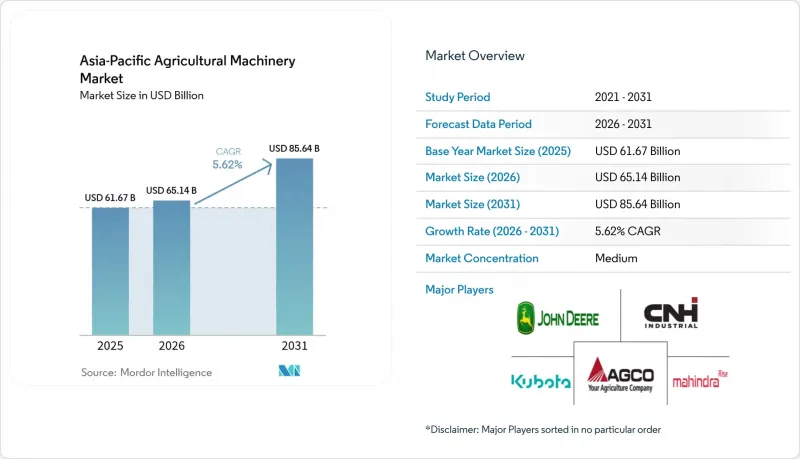
This report is Segmented by Product Type (Tractors by Horsepower and Type, Plowing and Cultivating Machinery, Planting Machinery, Harvesting Machinery, Haying and Forage Machinery, Irrigation Machinery, and Other Types) and Geography (China, India, Japan, Australia, and Rest of Asia-Pacific). The Market Forecasts are Provided in Terms of Value (USD).
Asia-Pacific Agricultural Machinery Market Trends and Insights
Farm-labor scarcity accelerating mechanization
Severe worker shortages lift demand for hands-free machinery. Japan's agriculture ministry earmarked JPY 1 billion (USD 7.5 million) for automation grants, leading vegetable growers to deploy autonomous harvesters that slash labor inputs by 50%. Malaysian palm estates now rely on self-driving trucks and drone sprayers to offset curtailed migrant inflows. Thai rice operations adopt high-speed transplanters, lifting daily planting capacity fivefold. Together, these responses accelerate equipment turnover across the Asia-Pacific agricultural machinery market.
Precision-farming adoption and smart implements
IoT platforms, variable-rate controllers, and UAVs are penetrating field operations. Kubota's Thai farm-management application logged 100 pilot plots, boosting yields up to 30% by matching soil tests to fertilizer maps. Taiwan's 25-year precision-agriculture program now integrates GIS, multispectral drones, and cloud analytics to refine irrigation scheduling. Beijing's USD 1.4 trillion digital-infrastructure pledge, alongside a USD 320 million World Bank loan for climate-smart practices, underwrites future smart-implement uptake. These initiatives widen the addressable base for data-driven devices within the Asia-Pacific agricultural machinery market.
Low digital literacy among farmers
Adoption of data-rich platforms lags where smartphone penetration and connectivity remain spotty. Training programs embedded in Thailand's 4.0 initiative and China's rural broadband rollout are narrowing the gap, yet consistent user-skill building is still required to unlock full value from precision equipment. The integration of precision farming technologies and sustainable practices positions the market for substantial growth, though infrastructure and training challenges need to be addressed for widespread adoption.
Other drivers and restraints analyzed in the detailed report include:
- Climate-linked yield-assurance incentives
- Ag-carbon credit monetization potential
- Fragmented land holdings limiting ROI
For complete list of drivers and restraints, kindly check the Table Of Contents.
Segment Analysis
Tractors represented 57.15% of the Asia-Pacific agricultural machinery market share in 2025 as growers rely on them for land preparation, transport, and power take-off tasks. The tractor market is projected to widen steadily through 2031 as below-40 HP models dominate Indian sales and above-50 HP units gain traction in Australian broad-acre farms. Utility tractors stand out for versatility, whereas row-crop variants support GPS steering and variable-rate seeding for precision agriculture. Daedong's plan to introduce Korea's first level-4 autonomous tractor by end-2025 signals a competitive leap that could reshape buyer expectations. Complementary plowing and cultivating implements form the second-largest category, as rice systems demand efficient puddling and seedbed preparation.
Demand for harvesting machinery follows labor-cost escalation. Combine harvesters cut rice reaping time from seven to two days, a gain valued in Thailand, where daily wages jumped 15% in 2024. Drip irrigation equipment, while currently smaller in revenue, is the fastest-growing sub-segment at 13.02% CAGR, reflecting intensified water-management mandates and incentive schemes. The attached to micro-irrigation could triple as drought episodes spur adoption across China's northern plains and India's Deccan plateau. OEMs offering bundled pumps, fertigation controllers, and cloud analytics stand to capture emerging cross-sell opportunities.
Complete Report Scope:
- By Product Type
- Tractors
- Horsepower
- Below 20 HP
- 21 - 30 HP
- 31 - 50 HP
- Above 50 HP
- Type
- Utility Tractor
- Row-Crop Tractor
- Compact Utility Tractor
- Other Types
- Horsepower
- Plowing and Cultivating Machinery
- Ploughs
- Harrows
- Cultivators and Tillers
- Other Ploughing and Cultivating Machinery
- Planting Machinery
- Seed Drills
- Planters
- Spreaders
- Other Planting Machinery
- Harvesting Machinery
- Combine Harvesters
- Forage Harvetsers
- Other Harvesting Machinery
- Haying and Forage Machinery
- Mowers
- Balers
- Other Haying and Forage Machinery
- Irrigation Machinery
- Sprinkler Irrigation
- Drip Irrigation
- Other Irrigation Machinery
- Other Types
- Tractors
- By Geography
- China
- India
- Japan
- Australia
- Rest of Asia-Pacific
List of Companies Covered in this Report:
- Deere & Company
- CLAAS KGaA mbH
- AGCO Corporation
- Kubota Corporation
- CNH Industrial N.V.
- Yanmar Co. Ltd.
- Same Deutz-Fahr (SDF Group)
- Lovol Heavy Industry (Weichai Group)
- Mahindra and Mahindra Ltd.
- Iseki & Co., Ltd.
- International Tractors Ltd. (Sonalika Group)
- Daedong Corporation
- Zoomlion Heavy Industry Science & Technology Co., Ltd.
Additional Benefits:
- The market estimate (ME) sheet in Excel format
- 3 months of analyst support
TABLE OF CONTENTS
1 Introduction
- 1.1 Study Assumptions and Market Definition
- 1.2 Scope of the Study
2 Research Methodology
3 Executive Summary
4 Market Landscape
- 4.1 Market Overview
- 4.2 Market Drivers
- 4.2.1 Farm-Labor Scarcity Accelerating Mechanization
- 4.2.2 Precision-Farming Adoption and Smart Implements
- 4.2.3 Climate-Linked Yield-Assurance Incentives
- 4.2.4 Government Credit Lines Targeting Smallholders
- 4.2.5 OEM "Power-as-a-Service" Subscription Models
- 4.2.6 Ag-Carbon Credit Monetization Potential
- 4.3 Market Restraints
- 4.3.1 High Up-Front Capital Costs
- 4.3.2 Fragmented Land Holdings Limiting ROI
- 4.3.3 Poor After-Sales Service Networks
- 4.3.4 Low Digital Literacy Among Farmers
- 4.4 Regulatory Landscape
- 4.5 Technological Outlook
- 4.6 Porter's Five Forces
- 4.6.1 Threat of New Entrants
- 4.6.2 Bargaining Power of Buyers
- 4.6.3 Bargaining Power of Suppliers
- 4.6.4 Threat of Substitutes
- 4.6.5 Intensity of Competitive Rivalry
5 Market Size and Growth Forecasts (Value)
- 5.1 By Product Type
- 5.1.1 Tractors
- 5.1.1.1 Horsepower
- 5.1.1.1.1 Below 20 HP
- 5.1.1.1.2 21 - 30 HP
- 5.1.1.1.3 31 - 50 HP
- 5.1.1.1.4 Above 50 HP
- 5.1.1.2 Type
- 5.1.1.2.1 Utility Tractor
- 5.1.1.2.2 Row-Crop Tractor
- 5.1.1.2.3 Compact Utility Tractor
- 5.1.1.2.4 Other Types
- 5.1.1.1 Horsepower
- 5.1.2 Plowing and Cultivating Machinery
- 5.1.2.1 Ploughs
- 5.1.2.2 Harrows
- 5.1.2.3 Cultivators and Tillers
- 5.1.2.4 Other Ploughing and Cultivating Machinery
- 5.1.3 Planting Machinery
- 5.1.3.1 Seed Drills
- 5.1.3.2 Planters
- 5.1.3.3 Spreaders
- 5.1.3.4 Other Planting Machinery
- 5.1.4 Harvesting Machinery
- 5.1.4.1 Combine Harvesters
- 5.1.4.2 Forage Harvetsers
- 5.1.4.3 Other Harvesting Machinery
- 5.1.5 Haying and Forage Machinery
- 5.1.5.1 Mowers
- 5.1.5.2 Balers
- 5.1.5.3 Other Haying and Forage Machinery
- 5.1.6 Irrigation Machinery
- 5.1.6.1 Sprinkler Irrigation
- 5.1.6.2 Drip Irrigation
- 5.1.6.3 Other Irrigation Machinery
- 5.1.7 Other Types
- 5.1.1 Tractors
- 5.2 By Geography
- 5.2.1 China
- 5.2.2 India
- 5.2.3 Japan
- 5.2.4 Australia
- 5.2.5 Rest of Asia-Pacific
6 Competitive Landscape
- 6.1 Market Concentration
- 6.2 Strategic Moves
- 6.3 Market Share Analysis
- 6.4 Company Profiles (Includes Global Level Overview, Market Level Overview, Core Segments, Financials As Available, Strategic Information, Market Rank/Share For Key Companies, Products And Services, And Recent Developments)
- 6.4.1 Deere & Company
- 6.4.2 CLAAS KGaA mbH
- 6.4.3 AGCO Corporation
- 6.4.4 Kubota Corporation
- 6.4.5 CNH Industrial N.V.
- 6.4.6 Yanmar Co. Ltd.
- 6.4.7 Same Deutz-Fahr (SDF Group)
- 6.4.8 Lovol Heavy Industry (Weichai Group)
- 6.4.9 Mahindra and Mahindra Ltd.
- 6.4.10 Iseki & Co., Ltd.
- 6.4.11 International Tractors Ltd. (Sonalika Group)
- 6.4.12 Daedong Corporation
- 6.4.13 Zoomlion Heavy Industry Science & Technology Co., Ltd.
7 Market Opportunities and Future Outlook

