PUBLISHER: Mordor Intelligence | PRODUCT CODE: 2113752

PUBLISHER: Mordor Intelligence | PRODUCT CODE: 2113752
France Agricultural Machinery - Market Share Analysis, Industry Trends & Statistics, Growth Forecasts (2026 - 2031)
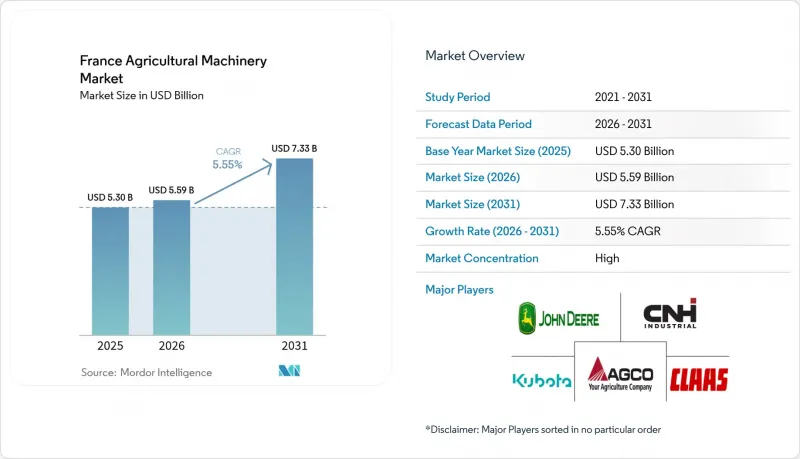
According to Mordor Intelligence, the agricultural machinery market size in France was valued at USD 5.30 billion in 2025 and estimated to grow from USD 5.59 billion in 2026 to reach USD 7.33 billion by 2031, at a CAGR of 5.55% during the forecast period (2026-2031).
This report is Segmented by Product Type (Tractors, Plowing and Cultivating Machinery, Planting Machinery, Sprayers, Irrigation Machinery, Harvesting Machinery, Haying and Forage Machinery, and Other Types). The Market Forecasts are Provided in Terms of Value (USD).
France Agricultural Machinery Market Trends and Insights
Increasing Shortage of Agricultural Labor
The Ministry of Agriculture's permanent scheme for seasonal agricultural worker assistance, introduced in the 2025 budget, exempts employers from contributions for hires under specific salary thresholds, yet fails to address the structural decline in available workers. This labor scarcity is driving unprecedented adoption of autonomous weeding robots, with companies like Naio Technologies reporting 100% electric robots achieving work rates up to 1,000 square meters per hour, effectively replacing manual labor in organic farming operations where chemical alternatives are prohibited. The contractor fleet model is emerging as a critical solution, allowing smaller farms to access sophisticated automation without capital investment, while contractors achieve economies of scale across multiple operations.
Growing Demand for High-Horsepower Tractors in Large Farms
The consolidation of French agriculture into larger operational units is driving a fundamental shift in power requirements, with tractors exceeding 300 horsepower experiencing high registration growth in 2024 despite overall market contraction. This trend reflects the economic reality that large-scale operations in regions like Beauce and Champagne require equipment capable of handling wider implements and faster field operations to maintain profitability margins compressed by input cost inflation. French farms averaging over 200 hectares increasingly view high-horsepower tractors as productivity multipliers rather than mere field implements, justifying premium pricing through reduced labor requirements and enhanced operational flexibility.
High Upfront and Maintenance Cost
The average price of precision-enabled tractors has increased 15-20% over conventional alternatives, while maintenance costs for GPS guidance and autonomous systems require specialized technician expertise that commands premium service rates. Equipment-as-a-service models are emerging as a partial solution, allowing farmers to access advanced machinery through operational expense structures rather than capital investments, though adoption remains limited by contractor availability in remote regions.
Other drivers and restraints analyzed in the detailed report include:
- Government Subsidies for Precision Farming Equipment
- Rising Need for Climate-Smart Machinery
- Data Ownership and Cyber-Security Concerns
For complete list of drivers and restraints, kindly check the Table Of Contents.
Segment Analysis
Tractors contributed 31.60% agricultural machinery market share in 2025, cementing their role as the power and data hub for modern French farms. Demand clusters at >= 150 horsepower where advanced hydraulics support variable-rate seeders and smart sprayers. Below 50 horsepower, specialty vineyard units face pressure from muted wine margins. Registrations fell to 2,531 units in 2024. The agricultural machinery market size for the high-horsepower subclass is forecast to outpace overall equipment spending between 2026 and 2031 as large holdings in Beauce consolidate land and pursue fewer passes per hectare. Digital retrofits, such as Global Navigation Satellite System (GNSS) antennas and ISOBUS UT displays, push resale values higher, extending trade-in cycles while raising lifetime service revenues for dealers. Combined with subsidy-driven demand for auto-guidance, tractor Original Equipment Manufacturer (OEMs) are layering subscription telematics and over-the-air updates to lock in post-sale recurring income opportunities.
Irrigation equipment registers a 23.1% CAGR, the highest among product lines, as farms seek drought resilience amid tightened abstraction quotas. Drip systems dominate high-value fruit and vegetable acres, whereas center-pivot retrofits with variable-rate sprinklers are more suitable for broad-acre cereals. The agricultural machinery market size for connected micro-irrigation kits is poised to grow by 2031, enabled by France 2030 grants covering soil-sensor-linked pumps. Cloud dashboards cluster multiple pivots, weather stations, and fertigation injectors, allowing contractors to oversee dispersed clients. OEMs are integrating 4G/LTE gateways factory-side to simplify edge-to-cloud connectivity under General Data Protection Regulation (GDPR) consent protocols.
Complete Report Scope:
- By Product Type
- Tractors
- Below 50 HP
- 50 - 99 HP
- 100 - 149 HP
- 150 HP and Above
- Plowing and Cultivating Machinery
- Plows
- Harrows
- Rotovators and Cultivators
- Other Equipment
- Planting Machinery
- Seed Drills
- Planters
- Spreaders
- Other Planting Machinery
- Sprayers
- Irrigation Machinery
- Drip Irrigation Systems
- Sprinkler Irrigation Systems
- Other Irrigation Machinery
- Harvesting Machinery
- Combine Harvesters
- Other Harvesting Machinery
- Haying and Forage Machinery
- Mowers and Conditioners
- Balers
- Other Haying and Forage Machinery
- Other Types
- Tractors
List of Companies Covered in this Report:
- Deere & Company
- CNH Industrial N.V.
- AGCO Corporation
- Kubota Corporation
- Claas KGaA mbH
- Same Deutz-Fahr (SDF Group)
- Yanmar Co. Ltd.
- Mahindra and Mahindra Ltd.
- Lovol International Heavy Industry Co Ltd (Weichai Group)
- Iseki and Co. Ltd
- TAFE (Amalgamations Group)
- Zoomlion Heavy Industry Science and Technology Co., Ltd.
- Argo Tractors S.p.A.
- Lindsay Corporation
- Kuhn Group (Bucher Industries AG)
- Netafim (Orbia Advance Corp.)
Additional Benefits:
- The market estimate (ME) sheet in Excel format
- 3 months of analyst support
TABLE OF CONTENTS
1 Introduction
- 1.1 Study Assumptions and Market Definition
- 1.2 Scope of the Study
2 Research Methodology
3 Executive Summary
4 Market Landscape
- 4.1 Market Overview
- 4.2 Market Drivers
- 4.2.1 Increasing shortage of agricultural labor
- 4.2.2 Growing demand for high-horsepower tractors in large farms
- 4.2.3 Government subsidies for precision farming equipment
- 4.2.4 Rising need for climate-smart machinery
- 4.2.5 Adoption of autonomous field robots by contractor fleets
- 4.2.6 Growth of equipment-as-a-service financing models
- 4.3 Market Restraints
- 4.3.1 High upfront and maintenance cost
- 4.3.2 Data ownership and cyber-security concerns
- 4.3.3 Grid capacity limits for electrified machinery charging
- 4.3.4 Fragmented digital standards inhibiting interoperability
- 4.4 Regulatory Landscape
- 4.5 Technological Outlook
- 4.6 Porter's Five Forces Analysis
- 4.6.1 Bargaining Power of Buyers
- 4.6.2 Bargaining Power of Suppliers
- 4.6.3 Threat of New Entrants
- 4.6.4 Threat of Substitutes
- 4.6.5 Intensity of Competitive Rivalry
5 Market Size and Growth Forecasts (Value)
- 5.1 By Product Type
- 5.1.1 Tractors
- 5.1.1.1 Below 50 HP
- 5.1.1.2 50 - 99 HP
- 5.1.1.3 100 - 149 HP
- 5.1.1.4 150 HP and Above
- 5.1.2 Plowing and Cultivating Machinery
- 5.1.2.1 Plows
- 5.1.2.2 Harrows
- 5.1.2.3 Rotovators and Cultivators
- 5.1.2.4 Other Equipment
- 5.1.3 Planting Machinery
- 5.1.3.1 Seed Drills
- 5.1.3.2 Planters
- 5.1.3.3 Spreaders
- 5.1.3.4 Other Planting Machinery
- 5.1.4 Sprayers
- 5.1.5 Irrigation Machinery
- 5.1.5.1 Drip Irrigation Systems
- 5.1.5.2 Sprinkler Irrigation Systems
- 5.1.5.3 Other Irrigation Machinery
- 5.1.6 Harvesting Machinery
- 5.1.6.1 Combine Harvesters
- 5.1.6.2 Other Harvesting Machinery
- 5.1.7 Haying and Forage Machinery
- 5.1.7.1 Mowers and Conditioners
- 5.1.7.2 Balers
- 5.1.7.3 Other Haying and Forage Machinery
- 5.1.8 Other Types
- 5.1.1 Tractors
6 Competitive Landscape
- 6.1 Market Concentration
- 6.2 Strategic Moves
- 6.3 Market Share Analysis
- 6.4 Company Profiles (Includes Global Level Overview, Market Level Overview, Core Segments, Financials as Available, Strategic Information, Market Rank/Share for Key Companies, Products and Services, and Recent Developments)
- 6.4.1 Deere & Company
- 6.4.2 CNH Industrial N.V.
- 6.4.3 AGCO Corporation
- 6.4.4 Kubota Corporation
- 6.4.5 Claas KGaA mbH
- 6.4.6 Same Deutz-Fahr (SDF Group)
- 6.4.7 Yanmar Co. Ltd.
- 6.4.8 Mahindra and Mahindra Ltd.
- 6.4.9 Lovol International Heavy Industry Co Ltd (Weichai Group)
- 6.4.10 Iseki and Co. Ltd
- 6.4.11 TAFE (Amalgamations Group)
- 6.4.12 Zoomlion Heavy Industry Science and Technology Co., Ltd.
- 6.4.13 Argo Tractors S.p.A.
- 6.4.14 Lindsay Corporation
- 6.4.15 Kuhn Group (Bucher Industries AG)
- 6.4.16 Netafim (Orbia Advance Corp.)
7 Market Opportunities and Future Outlook

