PUBLISHER: Mordor Intelligence | PRODUCT CODE: 2113561

PUBLISHER: Mordor Intelligence | PRODUCT CODE: 2113561
Europe Medical Clinical Nutrition - Market Share Analysis, Industry Trends & Statistics, Growth Forecasts (2026 - 2031)
According to Mordor Intelligence, the Europe medical clinical nutrition market size is projected to be USD 22.65 billion in 2025, USD 24.16 billion in 2026, and reach USD 33.33 billion by 2031, growing at a CAGR of 6.65% from 2026 to 2031.
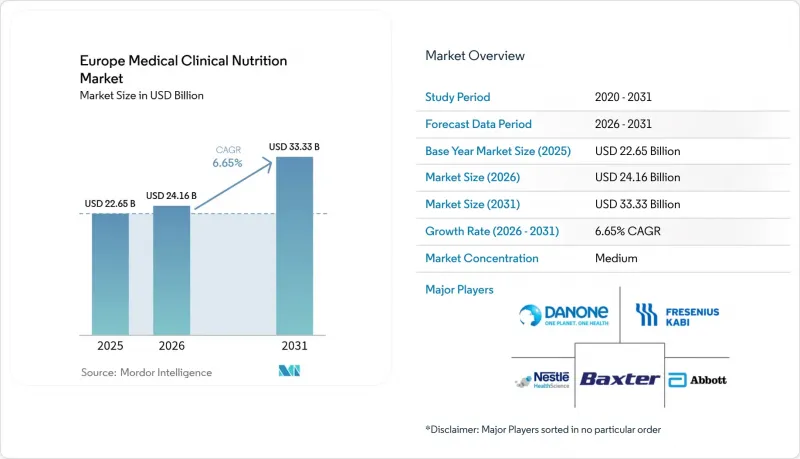
This report is Segmented by Route of Administration (Oral & Enteral, Parenteral), Product Type (Standardized Enteral Formulas, and More), Application (Oncology, Metabolic Disorders, and More), End User (Infant, Pediatric, and More), Distribution Channel (Hospital Pharmacies, and More), and Country (Germany, United Kingdom, and More). The Market Forecasts are Provided in Terms of Value (USD).
Europe Medical Clinical Nutrition Market Trends and Insights
Rising Prevalence of Chronic & Metabolic Disorders
Cancer cases climbed to 4.2 million in 2024 and cachexia now affects up to 80% of late-stage patients, prompting ESMO's 2025 protocol that pairs high-protein oral supplements with resistance exercise within 48 hours of diagnosis, improving six-month survival by 18%. Type 2 diabetes counts 62 million European adults, and EASD backs low-glycemic enteral formulas that hold post-prandial glucose 35% lower than polymeric alternatives. IBD prevalence exceeded 3.2 million in 2024; ECCO guidelines upgraded exclusive enteral nutrition to first-line pediatric Crohn's therapy, lifting remission to 65% and reshaping hospital formularies in Germany, France, and the Netherlands. Nephrologists now rely on renal-specific formulas to defer dialysis 12-18 months for 15% of adults with chronic kidney disease.
Aging Population & Escalating Healthcare Spend
Europe will host 150 million residents aged 65-plus by 2030; one-third of hospitalized seniors already present with protein-energy malnutrition, lengthening stays 4-6 days. ESPEN designated sarcopenia as a reimbursable condition in 2024, enabling high-protein oral nutrition supplement coverage across Germany, France, and the Netherlands. EU healthcare outlays reached EUR 1.8 trillion (USD 1.95 trillion) in 2024, but systematic nutrition screening cut total costs 12% through fewer complications. The NHS England framework mandated 24-hour malnutrition screening from April 2025 and standard prescription criteria for oral supplements, abolishing postcode disparities that had excluded 30% of qualifying patients.
Limited Patient / HCP Awareness of Clinical Nutrition
Malnutrition screening still reaches under 50% of admissions in Italy and Spain, leaving 40% of at-risk patients untreated. Only 35% of European general practitioners routinely prescribe oral nutrition supplements, citing limited product knowledge. Rural Portuguese uptake of validated tools such as MUST stands below 30% despite a national campaign that trained 5,000 physicians in 2025. Patient misconceptions persist; 70% of cancer patients in Italy and Spain do not know nutritional therapy can mitigate chemotherapy-related weight loss. Eastern Europe is further constrained by dietitian-to-patient ratios of 1:10,000 versus 1:2,500 in Western Europe.
Other drivers and restraints analyzed in the detailed report include:
- Home-Based Enteral Nutrition Adoption Surge
- ERAS-Driven Clinical-Nutrition Stewardship
- Complex EU Regulatory & Reimbursement Landscape
For complete list of drivers and restraints, kindly check the Table Of Contents.
Segment Analysis
Oral and enteral modalities retained 68.55% Europe medical clinical nutrition market share in 2025, anchored by ESPEN's "gut-first" doctrine that favors tube feeding whenever the intestine is functional. Early enteral delivery within 48 hours of ICU admission now covers 45% of patients and trims ventilator-associated pneumonia by 25%. Standard oral supplements dominate geriatric and oncology cohorts, supplying 60% of high-protein prescriptions.
Parenteral therapy is nevertheless accelerating at an 8.25% CAGR through 2031 as national insurers expand HPN coverage. Scandinavia's registries logged 12% annual growth and extended median catheter life to 26 months thanks to omega-3 lipid emulsions that curb occlusion. Fresenius Kabi's ready-to-infuse Numeta bags reduced preparation time from 45 to under five minutes and lowered compounding errors 70%, illustrating how innovation can reposition parenteral solutions for home environments.
Generic polymeric formulas held 45.53% of 2025 revenue, remaining the workhorse in mixed medical-surgical wards. Fiber-enriched versions now cut diarrhea 30% and improve glycemic profiles.
High-acuity care is tilting toward disease-specific blends. The Europe medical clinical nutrition market size for parenteral macronutrient solutions is on pace to advance 7.75% annually, powered by fourth-generation lipid emulsions licensed by the EMA in 2024-2025 that lower bloodstream infections 30%. Germany's insurer now reimburses 90% of these lipids, freeing ICUs from prior-authorization bottlenecks.
Complete Report Scope:
- By Route of Administration
- Oral & Enteral
- Parenteral
- By Product Type
- Standardised Enteral Formulas
- Disease-specific Enteral Formulas
- Parenteral Macronutrient Solutions
- By Application
- Oncology
- Metabolic Disorders
- Gastro-intestinal Diseases
- Neurological Disorders
- Other Diseases
- By End User
- Infant
- Pediatric
- Adult
- Geriatric
- By Distribution Channel
- Hospital Pharmacies
- Retail Pharmacies
- Online Pharmacies
- Institutional / Tender Sales
- Country
- Germany
- United Kingdom
- France
- Italy
- Spain
- Rest of Europe
List of Companies Covered in this Report:
- Abbott Laboratories
- Ajinomoto
- AYMES Nutrition
- B. Braun
- BASF
- Baxter
- Conmed
- Cook Group
- Danone
- Fresenius
- Haleon
- Medtrition
- Nestle
- Nualtra
- Otsuka
- Perrigo
- Vifor Pharma
Additional Benefits:
- The market estimate (ME) sheet in Excel format
- 3 months of analyst support
TABLE OF CONTENTS
1 Introduction
- 1.1 Study Assumptions & Market Definition
- 1.2 Scope of the Study
2 Research Methodology
3 Executive Summary
4 Market Landscape
- 4.1 Market Overview
- 4.2 Market Drivers
- 4.2.1 Rising prevalence of chronic & metabolic disorders
- 4.2.2 Ageing population & escalating healthcare spend
- 4.2.3 Home-based enteral nutrition adoption surge
- 4.2.4 ERAS-driven clinical-nutrition stewardship
- 4.2.5 AI-enabled personalised nutrient profiling
- 4.2.6 EU e-pharmacy liberalisation broadening D2C reach
- 4.3 Market Restraints
- 4.3.1 Limited patient / HCP awareness of clinical nutrition
- 4.3.2 Complex EU regulatory & reimbursement landscape
- 4.3.3 Volatile polymer & packaging input costs
- 4.3.4 Stricter macronutrient caps in specialised formulas
- 4.4 Supply-Chain Analysis
- 4.5 Regulatory Landscape
- 4.6 Technological Outlook
- 4.7 Porter's Five Forces
- 4.7.1 Bargaining Power of Suppliers
- 4.7.2 Bargaining Power of Buyers
- 4.7.3 Threat of New Entrants
- 4.7.4 Threat of Substitutes
- 4.7.5 Competitive Rivalry
5 Market Size & Growth Forecasts (Value, USD)
- 5.1 By Route of Administration
- 5.1.1 Oral & Enteral
- 5.1.2 Parenteral
- 5.2 By Product Type
- 5.2.1 Standardised Enteral Formulas
- 5.2.2 Disease-specific Enteral Formulas
- 5.2.3 Parenteral Macronutrient Solutions
- 5.3 By Application
- 5.3.1 Oncology
- 5.3.2 Metabolic Disorders
- 5.3.3 Gastro-intestinal Diseases
- 5.3.4 Neurological Disorders
- 5.3.5 Other Diseases
- 5.4 By End User
- 5.4.1 Infant
- 5.4.2 Pediatric
- 5.4.3 Adult
- 5.4.4 Geriatric
- 5.5 By Distribution Channel
- 5.5.1 Hospital Pharmacies
- 5.5.2 Retail Pharmacies
- 5.5.3 Online Pharmacies
- 5.5.4 Institutional / Tender Sales
- 5.6 Country
- 5.6.1 Germany
- 5.6.2 United Kingdom
- 5.6.3 France
- 5.6.4 Italy
- 5.6.5 Spain
- 5.6.6 Rest of Europe
6 Competitive Landscape
- 6.1 Market Concentration
- 6.2 Market Share Analysis
- 6.3 Company Profiles (includes Global level Overview, Market level overview, Core Segments, Financials as available, Strategic Information, Market Rank/Share, Products & Services, Recent Developments)
- 6.3.1 Abbott
- 6.3.2 Ajinomoto
- 6.3.3 AYMES Nutrition
- 6.3.4 B. Braun SE
- 6.3.5 BASF
- 6.3.6 Baxter International
- 6.3.7 Conmed Corp.
- 6.3.8 Cook Medical
- 6.3.9 Danone (Nutricia)
- 6.3.10 Fresenius Kabi
- 6.3.11 Haleon
- 6.3.12 Medtrition
- 6.3.13 Nestle Health Science
- 6.3.14 Nualtra
- 6.3.15 Otsuka Pharmaceutical
- 6.3.16 Perrigo
- 6.3.17 Vifor Pharma
7 Market Opportunities & Future Outlook
- 7.1 White-space & Unmet-need Assessment

