PUBLISHER: Mordor Intelligence | PRODUCT CODE: 2113565

PUBLISHER: Mordor Intelligence | PRODUCT CODE: 2113565
Spice And Herb Extracts - Market Share Analysis, Industry Trends & Statistics, Growth Forecasts (2026 - 2031)
According to Mordor Intelligence, the spice and herb extracts market size in 2026 is estimated at USD 14.06 billion, growing from 2025 value of USD 13.21 billion with 2031 projections showing USD 19.19 billion, growing at 6.42% CAGR over 2026-2031.
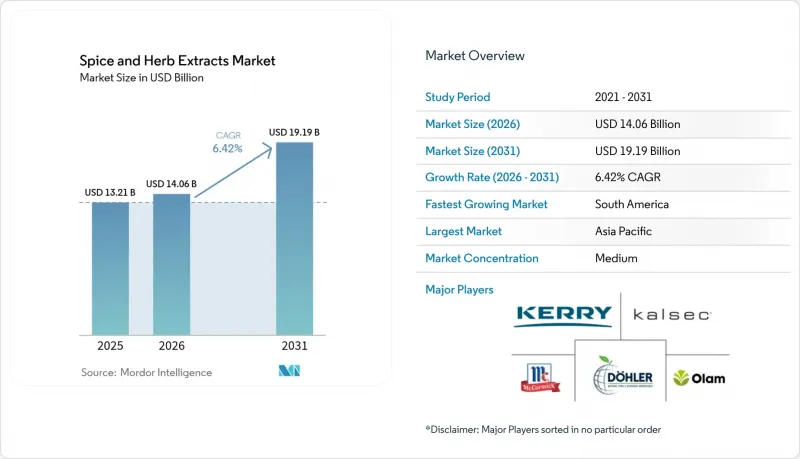
This report is Segmented by Source Type (Celery, Cumin, Chili, Coriander, and More), Form (Liquid Oleoresins, Powder Extracts, and More), Application (Food, Beverages, Pharmaceuticals, Personal Care and Cosmetics, Other Applications), and Geography (North America, Europe, Asia-Pacific, South America, Middle East and Africa). The Market Forecasts are Provided in Terms of Value (USD) and Volume (Tons).
Global Spice And Herb Extracts Market Trends and Insights
Growing demand for natural and clean-label ingredients
Growing demand for natural and clean-label ingredients propels the spice and herb extracts market as food manufacturers replace synthetic flavors and preservatives with authentic botanical alternatives. According to recent industry surveys, 73% of European consumers are prioritizing products with fewer synthetic additives driving significant changes in European food formulation strategies and this shift aligns with the European Food Safety Authority's updated Novel Foods guidance, effective February 2025. Consumers scrutinize labels for transparency, favoring extracts that deliver potent aroma, taste, and bioactives without artificial additives or chemical residues. Regulatory pressures on clean-label compliance accelerate adoption in processed foods, beverages, and snacks where spice oleoresins enhance shelf stability naturally. This shift enables premium positioning, as certified natural extracts command higher margins amid wellness trends emphasizing whole-food purity. Retail expansion of "natural" aisles and e-commerce boosts visibility for extract-infused products.
Growth in health-conscious consumer preferences for antioxidant-rich extracts
Growth in health-conscious consumer preferences for antioxidant-rich extracts accelerates the spice and herb extracts market as buyers seek functional ingredients delivering polyphenols, flavonoids, and curcuminoids from turmeric, ginger, and black pepper. Black pepper extract is gaining traction as a bioavailability enhancer; piperine increases curcumin absorption by up to 2,000%, making it a mandatory co-ingredient in premium turmeric supplements. These bioactives combat oxidative stress, support immunity, and reduce inflammation, aligning with preventive wellness trends in supplements and fortified foods. Demand surges for standardized extracts with verified ORAC values, enabling precise dosing in nutraceuticals and RTD beverages. Wellness influencers and clinical studies amplify awareness, positioning spice extracts as natural alternatives to synthetic antioxidants. Food formulators incorporate them into clean-label snacks, sauces, and meal kits for health halo claims.
High production costs due to raw material volatility
High production costs due to raw material volatility significantly restrain the spice and herb extracts market, as prices fluctuate from weather disruptions, climate change, and geopolitical tensions in key producing regions like India and Vietnam. Droughts, floods, and crop diseases reduce yields of critical spices such as black pepper and turmeric, creating supply shortages that inflate procurement expenses. Currency fluctuations and export restrictions further exacerbate cost unpredictability for global buyers dependent on imported botanicals. Labor-intensive harvesting and stringent post-harvest handling to preserve extract quality add to overheads, squeezing manufacturer margins. These volatilities hinder long-term pricing stability, deterring investment in capacity expansion and innovation. Smaller processors face acute challenges, often passing costs to consumers via premium pricing that limits market penetration.
Other drivers and restraints analyzed in the detailed report include:
- Increasing adoption in pharmaceuticals and nutraceuticals for therapeutic benefits
- Surge in global cuisines and ethnic food trends boosting spice usage
- Limited supply of high-quality organic and sustainable spice sources
For complete list of drivers and restraints, kindly check the Table Of Contents.
Segment Analysis
Pepper commanded the largest share of source-type revenue in the spice and herb extracts market in 2025, accounting for 21.06% of the total. This dominance stems from pepper's exceptional versatility, making it indispensable across diverse applications in food preparation, pharmaceutical formulations, and cosmetic products. In the food sector, pepper serves as a staple seasoning, enhancing flavors in savory dishes, sauces, and ready-to-eat meals worldwide. Its pharmaceutical uses leverage piperine for bioavailability enhancement and anti-inflammatory properties in drug delivery systems. Cosmetics benefit from pepper extracts in skincare for antioxidant and antimicrobial effects, supporting anti-aging and acne treatments. This broad applicability across industries solidifies pepper's position as the leading source type, underpinned by consistent global demand and established supply chains.
Cumin, on the other hand, stands out as the fastest-growing source in the spice and herb extracts market, achieving a compound annual growth rate (CAGR) of 7.53% through 2031. This accelerated expansion is propelled by surging popularity in Middle Eastern and Latin American cuisines, where cumin imparts distinctive earthy flavors to traditional dishes and fusion recipes. Rising global interest in ethnic foods drives its integration into mainstream menus and packaged products. Cuminaldehyde, cumin's key bioactive compound, fuels growth through emerging applications in digestive health supplements, offering benefits like improved gut motility and reduced bloating. Health-conscious consumers increasingly seek cumin-based extracts for natural remedies targeting indigestion and metabolic support.
Complete Report Scope:
- By Source Type
- Celery
- Cumin
- Chili
- Coriander
- Cardamom
- Oregano
- Pepper
- Basil
- Ginger
- Thyme
- Cinnamon
- Other Source Types
- By Form
- Liquid Oleoresins
- Powder Extracts
- Essential Oils
- Micro-encapsulated Extracts
- By Application
- Food
- Dairy
- Dressings, Soups and Sauces
- Meat and Poultry
- Snacks and Convenience Food
- Other Applications
- Beverages
- Pharmaceuticals
- Personal Care and Cosmetics
- Other Applications
- Food
- By Region
- North America
- United States
- Canada
- Mexico
- Rest of North America
- Europe
- United Kingdom
- Germany
- France
- Spain
- Italy
- Netherlands
- Rest of Europe
- Asia-Pacific
- China
- Japan
- India
- Australia
- South Korea
- Indonesia
- Philippines
- Singapore
- Rest of Asia-Pacific
- South America
- Brazil
- Argentina
- Rest of South America
- Middle East and Africa
- Saudi Arabia
- United Arab Emirates
- South Africa
- Rest of Middle East and Africa
- North America
Geography Analysis
Asia-Pacific commanded the largest share of the global spice and herb extracts market in 2025, capturing 35.85% of total market value. This dominance is firmly anchored by India's unparalleled position as the world's leading producer and exporter of spices, supplying a vast array of raw materials and extracts to international markets. The region's expansive agricultural base, favorable climates, and traditional expertise in spice cultivation underpin its market leadership. Proximity to major consumption hubs in Asia further enhances supply chain efficiency and cost competitiveness. Government initiatives promoting spice processing and value-added extraction technologies bolster production capacities. Overall, Asia-Pacific's entrenched role ensures its continued preeminence in driving global spice and herb extracts revenue.
South America emerges as the fastest-growing region in the spice and herb extracts market, projected to expand at a compound annual growth rate (CAGR) of 7.73% through 2031. This accelerated growth is propelled by Brazil's strategic expansion of black pepper and pink pepper cultivation, targeting high-demand export markets. Favorable agro-climatic conditions and investments in modern farming practices enhance yield and quality standards. Rising global interest in South American botanicals for exotic flavors and functional ingredients fuels export momentum. Infrastructure improvements in processing facilities support scalable extract production for food and pharmaceutical applications.
North America maintains a strong market presence through advanced processing capabilities and high demand for premium extracts in food and nutraceuticals, supported by robust import networks from Asia-Pacific. Europe exhibits steady growth driven by stringent food safety regulations and consumer preference for clean-label products, with key hubs in the Netherlands and Germany facilitating trade and innovation. These regions collectively contribute to market stability, with North America focusing on value-added applications and Europe emphasizing sustainability certifications.
- McCormick & Company, Inc.
- Kerry Group plc
- Dohler GmbH
- Olam International
- Kalsec Inc.
- Givaudan S.A.
- Symrise AG
- International Flavors & Fragrances (IFF)
- DSM Firmenich AG
- Sensient Technologies Inc.
- Archer Daniels Midland Company
- Takasago
- Robertet
- Naturex
- Synthite Industries
- Plant Lipids
- Universal Oleoresins
- Sabinsa
- Arjuna Natural
- Vidya Herbs
Additional Benefits:
- The market estimate (ME) sheet in Excel format
- 3 months of analyst support
TABLE OF CONTENTS
1 INTRODUCTION
- 1.1 Study Assumptions and Market Definition
- 1.2 Scope of the Study
2 RESEARCH METHODOLOGY
3 EXECUTIVE SUMMARY
4 MARKET LANDSCAPE
- 4.1 Market Overview
- 4.2 Market Drivers
- 4.2.1 Growing demand for natural and clean-label ingredients
- 4.2.2 Growth in health-conscious consumer preferences for antioxidant-rich extracts
- 4.2.3 Increasing adoption in pharmaceuticals and nutraceuticals for therapeutic benefits
- 4.2.4 Surge in global cuisines and ethnic food trends boosting spice usage
- 4.2.5 Advancements in extraction technologies improving yield and purity
- 4.2.6 Supportive regulations favoring natural over synthetic additives
- 4.3 Market Restraints
- 4.3.1 High production costs due to raw material volatility
- 4.3.2 Limited supply of high-quality organic and sustainable spice sources
- 4.3.3 Price sensitivity in mass-market and emerging economy segments
- 4.3.4 Competition from cheaper synthetic flavor alternatives
- 4.4 Supply Chain Analysis
- 4.5 Regulatory Outlook
- 4.6 Porter's Five Forces
- 4.6.1 Bargaining Power of Buyers/Consumers
- 4.6.2 Bargaining Power of Suppliers
- 4.6.3 Threat of New Entrants
- 4.6.4 Threat of Substitute Products
- 4.6.5 Intensity of Competitive Rivalry
5 MARKET SIZE AND GROWTH FORECASTS (VALUE AND VOLUME)
- 5.1 By Source Type
- 5.1.1 Celery
- 5.1.2 Cumin
- 5.1.3 Chili
- 5.1.4 Coriander
- 5.1.5 Cardamom
- 5.1.6 Oregano
- 5.1.7 Pepper
- 5.1.8 Basil
- 5.1.9 Ginger
- 5.1.10 Thyme
- 5.1.11 Cinnamon
- 5.1.12 Other Source Types
- 5.2 By Form
- 5.2.1 Liquid Oleoresins
- 5.2.2 Powder Extracts
- 5.2.3 Essential Oils
- 5.2.4 Micro-encapsulated Extracts
- 5.3 By Application
- 5.3.1 Food
- 5.3.1.1 Dairy
- 5.3.1.2 Dressings, Soups and Sauces
- 5.3.1.3 Meat and Poultry
- 5.3.1.4 Snacks and Convenience Food
- 5.3.1.5 Other Applications
- 5.3.2 Beverages
- 5.3.3 Pharmaceuticals
- 5.3.4 Personal Care and Cosmetics
- 5.3.5 Other Applications
- 5.3.1 Food
- 5.4 By Region
- 5.4.1 North America
- 5.4.1.1 United States
- 5.4.1.2 Canada
- 5.4.1.3 Mexico
- 5.4.1.4 Rest of North America
- 5.4.2 Europe
- 5.4.2.1 United Kingdom
- 5.4.2.2 Germany
- 5.4.2.3 France
- 5.4.2.4 Spain
- 5.4.2.5 Italy
- 5.4.2.6 Netherlands
- 5.4.2.7 Rest of Europe
- 5.4.3 Asia-Pacific
- 5.4.3.1 China
- 5.4.3.2 Japan
- 5.4.3.3 India
- 5.4.3.4 Australia
- 5.4.3.5 South Korea
- 5.4.3.6 Indonesia
- 5.4.3.7 Philippines
- 5.4.3.8 Singapore
- 5.4.3.10 Rest of Asia-Pacific
- 5.4.4 South America
- 5.4.4.1 Brazil
- 5.4.4.2 Argentina
- 5.4.4.3 Rest of South America
- 5.4.5 Middle East and Africa
- 5.4.5.1 Saudi Arabia
- 5.4.5.2 United Arab Emirates
- 5.4.5.3 South Africa
- 5.4.5.4 Rest of Middle East and Africa
- 5.4.1 North America
6 COMPETITIVE LANDSCAPE
- 6.1 Market Concentration
- 6.2 Strategic Moves
- 6.3 Market Ranking Analysis
- 6.4 Company Profiles (includes Global Overview, Market-level Overview, Core Segments, Financials, Strategic Information, Market Rank/Share, Products & Services, Recent Developments)
- 6.4.1 McCormick & Company, Inc.
- 6.4.2 Kerry Group plc
- 6.4.3 Dohler GmbH
- 6.4.4 Olam International
- 6.4.5 Kalsec Inc.
- 6.4.6 Givaudan S.A.
- 6.4.7 Symrise AG
- 6.4.8 International Flavors & Fragrances (IFF)
- 6.4.9 DSM Firmenich AG
- 6.4.10 Sensient Technologies Inc.
- 6.4.11 Archer Daniels Midland Company
- 6.4.12 Takasago
- 6.4.13 Robertet
- 6.4.14 Naturex
- 6.4.15 Synthite Industries
- 6.4.16 Plant Lipids
- 6.4.17 Universal Oleoresins
- 6.4.18 Sabinsa
- 6.4.19 Arjuna Natural
- 6.4.20 Vidya Herbs
7 MARKET OPPORTUNITIES AND FUTURE OUTLOOK

