PUBLISHER: Mordor Intelligence | PRODUCT CODE: 2113791

PUBLISHER: Mordor Intelligence | PRODUCT CODE: 2113791
North America Spice And Herb Extracts - Market Share Analysis, Industry Trends & Statistics, Growth Forecasts (2026 - 2031)
According to Mordor Intelligence, the North America spice and herb extracts market size stood at USD 3.41 billion in 2026 and is projected to reach USD 4.67 billion by 2031, advancing at a 6.51% CAGR during the forecast period.
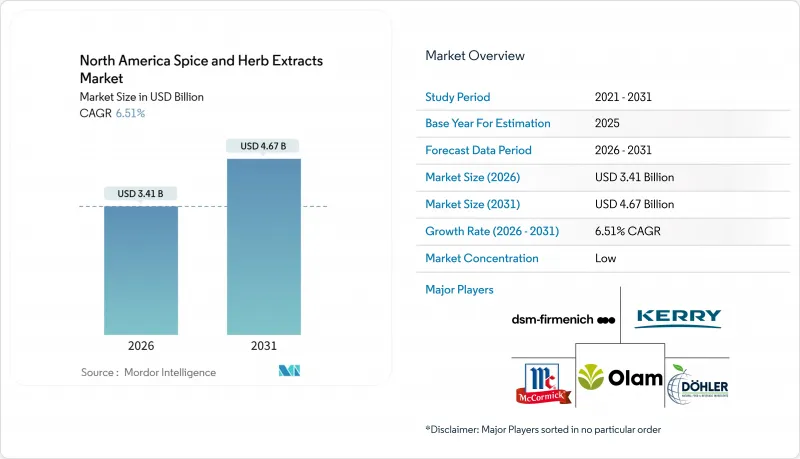
This report is Segmented by Source Type (Celery, Cumin, Chili, Coriander, Cardamom, Oregano, and More), Form (Liquid Oleoresins, Powder Extracts, and More), Application (Food, Beverage, Pharmaceuticals, and More), and Geography(United States, Canada, Mexico, and Rest of North America). The Market Forecasts are Provided in Terms of Both Value (USD) and Volume (Tons).
North America Spice And Herb Extracts Market Trends and Insights
Increasing Demand for Natural and Clean-Label Ingredients
Processors are replacing synthetic flavor compounds with spice oleoresins to satisfy transparency mandates from retailers such as Whole Foods and Kroger, which now require suppliers to disclose all flavoring agents on front-of-pack labels. Ingredion's 2025 clean-label survey found that 68% of North American consumers actively avoid products listing "natural flavors" without botanical specificity, pushing formulators toward ingredients like paprika oleoresin and black pepper extract that carry recognizable names. This shift is compressing reformulation cycles, with Kalsec reporting a 22% increase in customer requests for Foreign Exchange Management Act GRAS-certified hop and spice extracts during 2025. The Food and Drug Administration's updated guidance on "natural" claims in January 2025 further tightened definitions, requiring extraction methods that avoid synthetic solvents-a standard that supercritical CO2 and ethanol-based processes inherently meet..
Rising Adoption of Spice and Herb Extracts in Functional and Fortified Food and Beverages
Functional-beverage brands are embedding ginger and turmeric extracts into ready-to-drink formats targeting inflammation reduction and immune support, capitalizing on clinical evidence linking curcumin and gingerol to biomarker improvements. A 2024 study in Nutrients demonstrated that 500 milligrams of standardized ginger extract reduced C-reactive protein levels by 14% over 8 weeks, providing formulators with dosage benchmarks for label claims. Doehler's 2025 product catalog introduced microencapsulated cinnamon extract designed for protein shakes, delivering sustained release that masks bitterness while contributing antioxidant capacity. Regulatory frameworks are adapting, with Health Canada granting Natural Health Product Numbers to 17 spice-extract formulations in 2025, up from 9 in 2024, signaling faster pathways for structure-function claims.
Fluctuating Prices and Inconsistent Supply of Raw Materials
Black pepper prices climbed 18% in 2024 following drought conditions in Vietnam's Central Highlands, which account for 34% of global exports, forcing North American processors to activate contingency contracts with Brazilian and Indonesian suppliers at premium rates. Ginger supply tightened in early 2025 when China-responsible for 28% of global production-imposed temporary export quotas to stabilize domestic food inflation, creating a 6-week lead-time gap for oleoresin manufacturers. Cardamom prices remain volatile, oscillating between USD 25 and USD 38 per kilogram during 2025 due to erratic monsoons in Guatemala and India, the two dominant origins, according to the Financial Times. Processors are responding by diversifying sourcing footprints and investing in vertical integration, with McCormick's 2025 annual report disclosing the acquisition of a 500-acre organic turmeric farm in southern India to secure supply for its North American oleoresin operations.
Other drivers and restraints analyzed in the detailed report include:
- Growing Appeal of Ethnic and Exotic Cuisines
- Advancements in Extraction Technologies
- Intense Competition from Synthetic Substitutes
For complete list of drivers and restraints, kindly check the Table Of Contents.
Segment Analysis
In 2025, pepper dominated 38.15% of North America's spice and herb extracts market, primarily due to its significant applications in savory foods and nutraceutical blends. A key factor driving its demand is piperine, which enhances curcumin absorption by an impressive 2,000%, making it indispensable in health-focused formulations. Ginger, projected to grow at a robust CAGR of 7.82%, is gaining traction across multiple industries, including functional beverages, anti-nausea pharmaceuticals, and anti-inflammatory cosmetic products. Cumin is increasingly favored in plant-based meat alternatives, effectively masking the off-notes associated with pea protein. Additionally, chili oleoresins remain a cornerstone of the hot sauce segment, as evidenced by Huy Fong Foods' substantial 200 metric-ton supply agreement in 2025, highlighting their critical role in this category.
Herbs such as coriander, cardamom, oregano, basil, and thyme are establishing themselves in high-margin niches, particularly in premium spirits and preservative-free cosmetic products. The cinnamon market is undergoing a notable segmentation into Ceylon and Cassia variants. Ceylon cinnamon, with its lower coumarin content that complies with European Union safety regulations, commands a premium of 35%, reflecting its growing preference among health-conscious consumers. Meanwhile, celery extract remains a vital ingredient in "no nitrate added" meat curing processes, ensuring natural color and flavor while meeting United States Department of Agriculture Food Safety and Inspection Service (FSIS) tolerance requirements, thereby catering to the demand for clean-label meat products.
Complete Report Scope:
- By Source Type
- Celery
- Cumin
- Chili
- Coriander
- Cardamom
- Oregano
- Pepper
- Basil
- Ginger
- Thyme
- Cinnamon
- Other Source Types
- By Form
- Liquid Oleoresins
- Powder Extracts
- Essential Oils
- Micro-encapsulated Extracts
- By Application
- Food
- Dairy
- Dressings, Soups and Sauces
- Meat and Poultry
- Snacks and Convenience Food
- Other Applications
- Beverage
- Soft Drinks
- Tea & Herbal Drinks
- Alcoholic Beverages
- Pharmaceuticals
- Personal Care and Cosmetics
- Other Applications
- Food
- By Geography
- United States
- Canada
- Mexico
- Rest of North America
List of Companies Covered in this Report:
- McCormick and Company
- Sensient Technologies
- Kalsec Inc.
- Olam International (Ingred. Spices NA)
- Kerry Group
- Givaudan (Naturex)
- Symrise AG
- International Flavors and Fragrances Inc.
- Firmenich SA
- Archer Daniels Midland Company (Wild Flavors)
- Doehler Group
- Oterra
- Plant Lipids
- Synthite Industries
- Universal Oleoresins
- Ajinomoto Co.
- Robertet Group
- SHS Group
- Badia Spices
- Spiceology
- Cargill Inc.
Additional Benefits:
- The market estimate (ME) sheet in Excel format
- 3 months of analyst support
TABLE OF CONTENTS
1 INTRODUCTION
- 1.1 Study Assumptions and Market Definition
- 1.2 Scope of the Study
2 RESEARCH METHODOLOGY
3 EXECUTIVE SUMMARY
4 MARKET LANDSCAPE
- 4.1 Market Overview
- 4.2 Market Drivers
- 4.2.1 Increasing demand for natural and clean-label ingredients
- 4.2.2 Rising adoption of spice and herb extracts in functional and fortified food and beverages
- 4.2.3 Growing appeal of ethnic and exotic cuisines
- 4.2.4 Preference for organic spices and herbs on the rise
- 4.2.5 Advancements in extraction technologies
- 4.2.6 Export expansion by major supplying countries
- 4.3 Market Restraints
- 4.3.1 Stringent and evolving European food safety and allergen labeling regulations
- 4.3.2 High cost of implementing advanced extraction technologies
- 4.3.3 Intense competition from synthetic substitutes
- 4.3.4 Fluctuating prices and inconsistent supply of raw materials
- 4.4 Supply Chain Analysis
- 4.5 Regulatory Outlook
- 4.6 Porter's Five Forces
- 4.6.1 Threat of New Entrants
- 4.6.2 Bargaining Power of Buyers/Consumers
- 4.6.3 Bargaining Power of Suppliers
- 4.6.4 Threat of Substitute Products
- 4.6.5 Intensity of Competitive Rivalry
5 MARKET SIZE AND GROWTH FORECAST (in Value and Volume)
- 5.1 By Source Type
- 5.1.1 Celery
- 5.1.2 Cumin
- 5.1.3 Chili
- 5.1.4 Coriander
- 5.1.5 Cardamom
- 5.1.6 Oregano
- 5.1.7 Pepper
- 5.1.8 Basil
- 5.1.9 Ginger
- 5.1.10 Thyme
- 5.1.11 Cinnamon
- 5.1.12 Other Source Types
- 5.2 By Form
- 5.2.1 Liquid Oleoresins
- 5.2.2 Powder Extracts
- 5.2.3 Essential Oils
- 5.2.4 Micro-encapsulated Extracts
- 5.3 By Application
- 5.3.1 Food
- 5.3.1.1 Dairy
- 5.3.1.2 Dressings, Soups and Sauces
- 5.3.1.3 Meat and Poultry
- 5.3.1.4 Snacks and Convenience Food
- 5.3.1.5 Other Applications
- 5.3.2 Beverage
- 5.3.2.1 Soft Drinks
- 5.3.2.2 Tea & Herbal Drinks
- 5.3.2.3 Alcoholic Beverages
- 5.3.3 Pharmaceuticals
- 5.3.4 Personal Care and Cosmetics
- 5.3.5 Other Applications
- 5.3.1 Food
- 5.4 By Geography
- 5.4.1 United States
- 5.4.2 Canada
- 5.4.3 Mexico
- 5.4.4 Rest of North America
6 COMPETITIVE LANDSCAPE
- 6.1 Market Concentration
- 6.2 Strategic Moves
- 6.3 Market Ranking Analysis
- 6.4 Company Profiles (includes Global-level Overview, Market-level Overview, Core Segments, Financials (if available), Strategic Information, Market Rank/Share, Products and Services, Recent Developments)
- 6.4.1 McCormick and Company
- 6.4.2 Sensient Technologies
- 6.4.3 Kalsec Inc.
- 6.4.4 Olam International (Ingred. Spices NA)
- 6.4.5 Kerry Group
- 6.4.6 Givaudan (Naturex)
- 6.4.7 Symrise AG
- 6.4.8 International Flavors and Fragrances Inc.
- 6.4.9 Firmenich SA
- 6.4.10 Archer Daniels Midland Company (Wild Flavors)
- 6.4.11 Doehler Group
- 6.4.12 Oterra
- 6.4.13 Plant Lipids
- 6.4.14 Synthite Industries
- 6.4.15 Universal Oleoresins
- 6.4.16 Ajinomoto Co.
- 6.4.17 Robertet Group
- 6.4.18 SHS Group
- 6.4.19 Badia Spices
- 6.4.20 Spiceology
- 6.4.21 Cargill Inc.
7 MARKET OPPORTUNITIES AND FUTURE OUTLOOK

