PUBLISHER: Mordor Intelligence | PRODUCT CODE: 2113589

PUBLISHER: Mordor Intelligence | PRODUCT CODE: 2113589
Retort Packaging - Market Share Analysis, Industry Trends & Statistics, Growth Forecasts (2026 - 2031)
According to Mordor Intelligence, the retort packaging market size is expected to grow from USD 5.85 billion in 2025 to USD 6.13 billion in 2026 and is forecast to reach USD 8.14 billion by 2031 at a 5.82% CAGR over 2026-2031.
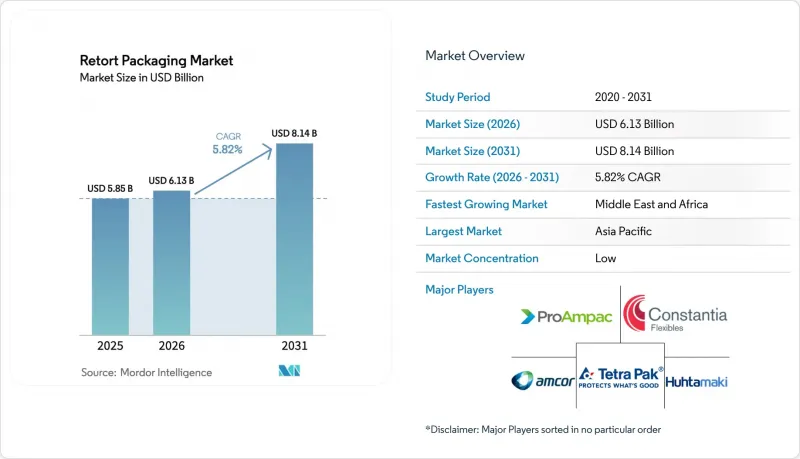
This report is Segmented by Product Type (Pouches, Cartons, Trays, and More), Material (Plastic, Aluminum Foil, and Paperboard), Packaging Format (Flexible, and Rigid), End-User Industry (Food, Beverage, Pet Food, Pharmaceutical, and More), and Geography (North America, South America, Europe, Asia-Pacific, and Middle East and Africa). The Market Forecasts are Provided in Terms of Value (USD).
Global Retort Packaging Market Trends and Insights
Growing Demand for Lightweight and Compact Packaging
Retort pouches weigh 85% less than equivalent metal cans, cutting pallet cube by 40% and driving logistics savings for cross-border shipments. Amazon waived dimensional-weight surcharges in 2025 for parcels under 200 grams, nudging suppliers toward flexible retort formats, and Indian defense agencies broadened pouch specifications to improve helicopter payload efficiency, accelerating orders across institutional channels. The preference spreads fastest in high-density Asian cities where elevators, public transit, and limited kitchen storage reward compact packs. Brand owners also benefit from lower warehouse rents, as lightweight inventory enables tiered racking systems.
Rapid Adoption of Shelf-Stable Ready-to-Eat Meals
In 2025, China recorded a 28% year-on-year jump in retort-processed ready meals, fueled by same-day e-commerce delivery of hot pots and braised dishes that bypass cold chains. Japan's convenience chains introduced 18-month ambient curry and rice bowls, trimming store-level waste by 35% through centralized production. Middle Eastern hospitality groups adopted retort trays for airline catering and banquet operations where halal certification and extended hold times justify a 15% to 20% premium over frozen meals. Tier-2 and tier-3 cities in India, Indonesia, and Vietnam face persistent cold-chain gaps, making ambient-stable formats structurally advantageous. This driver reinforces Asia-Pacific dominance while opening opportunities in African markets where refrigeration infrastructure is even weaker.
High Initial Capital for Retort Sterilization Lines
A rotary retort autoclave capable of processing 10,000 pouches per hour requires an investment of USD 800,000 to USD 1.2 million, with ancillary filling, sealing, and quality-inspection equipment adding another USD 500,000 to USD 700,000. Small and mid-sized food processors in Brazil, South Africa, and Southeast Asia face financing challenges, as commercial lending rates for capital equipment ranged from 9% to 14% in 2025, pushing payback periods beyond 5 years. Amcor's 2025 annual report noted that customer hesitation to commit to retort lines delayed USD 45 million in expected equipment sales, particularly among regional dairy and vegetable processors evaluating format migration from metal cans. Leasing models and tolling arrangements are emerging as partial solutions, with contract manufacturers in India and Thailand offering retort processing services at USD 0.08 to USD 0.12 per pouch, enabling brands to test acceptance before committing capital. This restraint is most binding in emerging markets where access to low-cost capital is constrained, and it is likely to persist until modular, lower-capacity retort systems priced under USD 300,000 reach commercial scale.
Other drivers and restraints analyzed in the detailed report include:
- Surge in E-Commerce Driving Lightweight Parcel Formats
- Regulatory Push for Recycle-Ready Mono-Material Laminates
- Limited Recycling Infrastructure for Multilayer Films
For complete list of drivers and restraints, kindly check the Table Of Contents.
Segment Analysis
Pouches held 54.32% of 2025 revenue, anchored by their cost efficiency and compatibility with high-speed filling lines, but trays are expanding at a 6.12% CAGR through 2031, the fastest rate among product formats. Quick-service restaurant chains and meal-kit providers are adopting single-serve retort trays that double as microwave-safe serving vessels, eliminating the need for consumers to transfer contents and reducing post-meal cleanup. Nestle's 2025 investor presentation highlighted that its retort tray portfolio for the Stouffer's brand grew 19% year-on-year, driven by direct-to-consumer e-commerce orders where presentation quality influences repeat purchase rates. Cartons occupy a niche position, primarily in aseptic beverage applications where retort processing competes with ultra-high-temperature treatment, and this segment is growing modestly as dairy-alternative brands seek ambient-stable formats for oat and almond milk.
Other product types, including retort bottles and jars, serve pharmaceutical and specialty-food applications where glass-like clarity and tamper-evidence justify higher unit costs. The tray segment's outperformance reflects a broader shift toward formats that enhance convenience and perceived quality, particularly in markets where consumers associate flexible pouches with economy-tier offerings. Regulatory compliance is shaping product-type selection, as the U.S. Food and Drug Administration's 2025 guidance on low-acid canned foods now explicitly includes retort trays and pouches, requiring process-authority validation for each container geometry. This has standardized sterilization protocols and reduced the perceived risk of adopting non-traditional formats. European food-safety authorities are harmonizing retort-process approval across member states, with EFSA publishing unified thermal-process guidelines in early 2025 that treat pouches, trays, and cartons equivalently, removing a historical bias toward metal cans. Asia-Pacific markets are seeing innovation in stand-up retort pouches with reinforced gussets that enable vertical display on retail shelves, a format that combines the cost advantages of flexible packaging with the shelf presence of rigid containers. Japan's retort-pouch market grew 11% in 2025, with stand-up formats accounting for 62% of new product launches, signaling a maturation of consumer acceptance.
Plastic materials commanded 58.82% of 2025 revenue, with polypropylene and polyethylene dominating due to their heat-seal reliability and barrier-coating compatibility, yet paperboard is the fastest-growing material at a 6.65% CAGR through 2031. Brands targeting sustainability-conscious consumers are piloting fiber-based retort trays coated with water-based barrier layers that withstand 121°C sterilization while remaining recyclable in existing paper streams. Huhtamaki launched a paperboard retort tray in Europe in late 2025 that achieved a 72% fiber content by weight, meeting the threshold for paper-recycling classification under EU guidelines, and early adopters include organic soup and baby-food brands willing to absorb a 25% to 30% packaging-cost premium. Aluminum foil remains essential for high-barrier applications requiring oxygen transmission rates below 0.5 cubic centimeters per square meter per day, particularly for retort pouches containing fatty or oxygen-sensitive foods, but supply constraints in 2025 pushed lead times to 16 weeks and prices to EUR 3,200 per metric ton (USD 3,600 per metric ton), prompting converters to explore metallized-film alternatives.
Polypropylene's share within the plastic segment is rising as resin suppliers introduce clarified grades that offer transparency comparable to polyethylene terephthalate while maintaining the higher heat-deflection temperature required for retort processing. Dow's Retain polymer, commercialized in 2025, enables all-polypropylene retort pouches that eliminate the polyester layer traditionally needed for structural integrity, simplifying end-of-life recycling. Polyethylene is favored for cost-sensitive applications and remains the sealant layer in most multilayer structures, but its lower melting point limits use in retort processes exceeding 125°C, a constraint that matters for ultra-high-barrier applications in pharmaceutical packaging. Other plastics, including polyamide (nylon) and ethylene vinyl alcohol, serve as barrier layers in multilayer laminates, and their pricing volatility; nylon 6 resin surged 18% in early 2025 due to tight adipic-acid supply, is pushing converters to reduce gauge thickness through advanced coextrusion techniques. The material landscape is fragmenting as brands balance cost, sustainability, and performance, with no single material positioned to dominate across all applications.
Complete Report Scope:
- By Product Type
- Pouches
- Cartons
- Trays
- Other Product Types
- By Material
- Plastic
- Polypropylene
- Polyethylene
- Other Plastics
- Aluminum Foil
- Paperboard
- Plastic
- By Packaging Format
- Flexible
- Rigid
- By End-User Industry
- Food
- Beverage
- Pet Food
- Pharmaceutical
- Other End-User Industries
- By Geography
- North America
- United States
- Canada
- Mexico
- South America
- Brazil
- Argentina
- Rest of South America
- Europe
- United Kingdom
- Germany
- France
- Italy
- Spain
- Rest of Europe
- Asia-Pacific
- China
- Japan
- India
- South Korea
- Australia
- Rest of Asia-Pacific
- Middle East and Africa
- Middle East
- Saudi Arabia
- United Arab Emirates
- Turkey
- Rest of Middle East
- Africa
- South Africa
- Egypt
- Rest of Africa
- Middle East
- North America
Geography Analysis
Asia-Pacific held 40.23% of global retort packaging market revenue in 2025, a position underpinned by China's ready-to-eat meal sector, Japan's convenience-retail infrastructure, and India's expanding military and institutional catering contracts. China's retort-pouch consumption grew 26% year-on-year in 2025, driven by e-commerce platforms such as JD.com and Alibaba's Tmall offering ambient-stable hot pots, braised meats, and rice bowls with an 18-month shelf life, a format that enables centralized production and nationwide distribution without cold-chain investment. Japan's Ministry of Economy, Trade, and Industry reported that retort packaging accounted for 34% of convenience-store meal volume in 2025, with Seven-Eleven and FamilyMart expanding retort curry and pasta offerings that require only microwave reheating. India's Defence Food Research Laboratory awarded contracts worth INR 2.4 billion (USD 29 million) in 2025 for retort pouches supplying border troops, specifying 24-month ambient shelf life and resistance to altitude and temperature extremes. South Korea's retort-tray market is growing as meal-kit delivery services adopt formats that combine cooking and serving functions, reducing packaging waste and enhancing user convenience.
Middle East and Africa is expanding at a 7.21% CAGR through 2031, the fastest regional growth rate, fueled by Saudi Arabia's food-security investments and the United Arab Emirates' role as a logistics hub for African exports. Saudi Arabia's Vision 2030 framework mandates that 50% of processed-food consumption be locally produced by 2030, and retort packaging's ambient stability makes it the preferred format for stockpiling strategic food reserves in a climate where summer temperatures exceed 45°C. The UAE's Jebel Ali Free Zone hosts retort-packaging converters supplying East African markets, where cold-chain gaps and electricity unreliability make ambient-stable formats essential for humanitarian aid and commercial food distribution. South Africa's retort packaging market consumption grew 14% in 2025, driven by ready-meal brands targeting urban consumers and mining companies provisioning remote work camps. Egypt's government launched a food-security initiative in 2025 that includes subsidies for retort-processing equipment, aiming to reduce post-harvest losses in tomato and vegetable canning. Regulatory harmonization is lagging, with each Gulf Cooperation Council member state maintaining distinct food-contact material approvals, a fragmentation that raises compliance costs for converters serving the region.
North America and Europe are investing in closed-loop recycling systems for retort packaging, with Germany's DIN CERTCO certifying the first mechanically recyclable mono-polypropylene retort pouch in late 2025, a milestone that validates the technical feasibility of sustainable retort formats. The United States retort packaging market grew 7% in 2025, with military meal-ready-to-eat contracts and pet-food applications offsetting slower growth in traditional canned-soup categories where consumer preferences are shifting toward fresh and refrigerated options. Canada's retort-pouch adoption is concentrated in outdoor-recreation and emergency-preparedness segments, where lightweight and long shelf life justify premium pricing. Europe's retort packaging market growth is constrained by mature food-retail markets and consumer skepticism toward flexible formats, but plant-based protein brands are driving incremental demand as they seek ambient-stable formats for export to markets lacking refrigeration infrastructure. South America's trajectory depends on Brazil's agricultural processors, which are piloting retort pouches for tomato paste, black beans, and palm hearts, targeting both domestic e-commerce and export to North America and Europe where Brazilian specialty foods command premium shelf space.
- Amcor plc
- ProAmpac LLC
- Sealed Air Corporation
- Mondi plc
- Sonoco Products Company
- Constantia Flexibles Group GmbH
- Coveris Holding SA
- Huhtamaki Oyj
- Winpak Ltd.
- Clondalkin Group Holdings BV
- Clifton Packaging Group Limited
- Flair Flexible Packaging Corporation
- Tetra Pak Group
- Sopakco Packaging
- Printpack Inc.
- Alpha Packaging Ltd.
- DNP America LLC
- HPM Global Inc.
- Floeter India Retort Pouches (P) Ltd
Additional Benefits:
- The market estimate (ME) sheet in Excel format
- 3 months of analyst support
TABLE OF CONTENTS
1 INTRODUCTION
- 1.1 Study Assumptions and Market Definition
- 1.2 Scope of the Study
2 RESEARCH METHODOLOGY
3 EXECUTIVE SUMMARY
4 MARKET LANDSCAPE
- 4.1 Market Overview
- 4.2 Market Drivers
- 4.2.1 Growing Demand for Lightweight and Compact Packaging
- 4.2.2 Rapid Adoption of Shelf-Stable Ready-to-Eat Meals
- 4.2.3 Surge in E-Commerce Driving Lightweight Parcel Formats
- 4.2.4 Regulatory Push for Recycle-Ready Mono-Material Laminates
- 4.2.5 Growth of Pet-Food in Retort-Compatible Formats
- 4.2.6 AI-Enabled Retort Process Optimization Reducing Downtime
- 4.3 Market Restraints
- 4.3.1 High Initial Capital for Retort Sterilization Lines
- 4.3.2 Limited Recycling Infrastructure for Multilayer Films
- 4.3.3 Supply Risk of High-Barrier Nylon and Aluminum Foil
- 4.3.4 Consumer Perception of Flexible Packs as "Less Premium"
- 4.4 Industry Value Chain Analysis
- 4.5 Regulatory Landscape
- 4.6 Technological Outlook
- 4.7 Porter's Five Forces Analysis
- 4.7.1 Bargaining Power of Suppliers
- 4.7.2 Bargaining Power of Buyers
- 4.7.3 Threat of New Entrants
- 4.7.4 Threat of Substitutes
- 4.7.5 Intensity of Competitive Rivalry
- 4.8 Impact of Macroeconomic Factors on the Market
5 MARKET SIZE AND GROWTH FORECASTS (VALUE)
- 5.1 By Product Type
- 5.1.1 Pouches
- 5.1.2 Cartons
- 5.1.3 Trays
- 5.1.4 Other Product Types
- 5.2 By Material
- 5.2.1 Plastic
- 5.2.1.1 Polypropylene
- 5.2.1.2 Polyethylene
- 5.2.1.3 Other Plastics
- 5.2.2 Aluminum Foil
- 5.2.3 Paperboard
- 5.2.1 Plastic
- 5.3 By Packaging Format
- 5.3.1 Flexible
- 5.3.2 Rigid
- 5.4 By End-User Industry
- 5.4.1 Food
- 5.4.2 Beverage
- 5.4.3 Pet Food
- 5.4.4 Pharmaceutical
- 5.4.5 Other End-User Industries
- 5.5 By Geography
- 5.5.1 North America
- 5.5.1.1 United States
- 5.5.1.2 Canada
- 5.5.1.3 Mexico
- 5.5.2 South America
- 5.5.2.1 Brazil
- 5.5.2.2 Argentina
- 5.5.2.3 Rest of South America
- 5.5.3 Europe
- 5.5.3.1 United Kingdom
- 5.5.3.2 Germany
- 5.5.3.3 France
- 5.5.3.4 Italy
- 5.5.3.5 Spain
- 5.5.3.6 Rest of Europe
- 5.5.4 Asia-Pacific
- 5.5.4.1 China
- 5.5.4.2 Japan
- 5.5.4.3 India
- 5.5.4.4 South Korea
- 5.5.4.5 Australia
- 5.5.4.6 Rest of Asia-Pacific
- 5.5.5 Middle East and Africa
- 5.5.5.1 Middle East
- 5.5.5.1.1 Saudi Arabia
- 5.5.5.1.2 United Arab Emirates
- 5.5.5.1.3 Turkey
- 5.5.5.1.4 Rest of Middle East
- 5.5.5.2 Africa
- 5.5.5.2.1 South Africa
- 5.5.5.2.2 Egypt
- 5.5.5.2.3 Rest of Africa
- 5.5.5.1 Middle East
- 5.5.1 North America
6 COMPETITIVE LANDSCAPE
- 6.1 Market Concentration
- 6.2 Strategic Moves
- 6.3 Market Share Analysis
- 6.4 Company Profiles (Includes Global Level Overview, Market Level Overview, Core Segments, Financials as Available, Strategic Information, Market Rank/Share, Products and Services, and Recent Developments)
- 6.4.1 Amcor plc
- 6.4.2 ProAmpac LLC
- 6.4.3 Sealed Air Corporation
- 6.4.4 Mondi plc
- 6.4.5 Sonoco Products Company
- 6.4.6 Constantia Flexibles Group GmbH
- 6.4.7 Coveris Holding SA
- 6.4.8 Huhtamaki Oyj
- 6.4.9 Winpak Ltd.
- 6.4.10 Clondalkin Group Holdings BV
- 6.4.11 Clifton Packaging Group Limited
- 6.4.12 Flair Flexible Packaging Corporation
- 6.4.13 Tetra Pak Group
- 6.4.14 Sopakco Packaging
- 6.4.15 Printpack Inc.
- 6.4.16 Alpha Packaging Ltd.
- 6.4.17 DNP America LLC
- 6.4.18 HPM Global Inc.
- 6.4.19 Floeter India Retort Pouches (P) Ltd
7 MARKET OPPORTUNITIES AND FUTURE OUTLOOK
- 7.1 White-Space and Unmet-Need Assessment

