PUBLISHER: Mordor Intelligence | PRODUCT CODE: 2116039

PUBLISHER: Mordor Intelligence | PRODUCT CODE: 2116039
Retort Pouch Packaging - Market Share Analysis, Industry Trends & Statistics, Growth Forecasts (2026 - 2031)
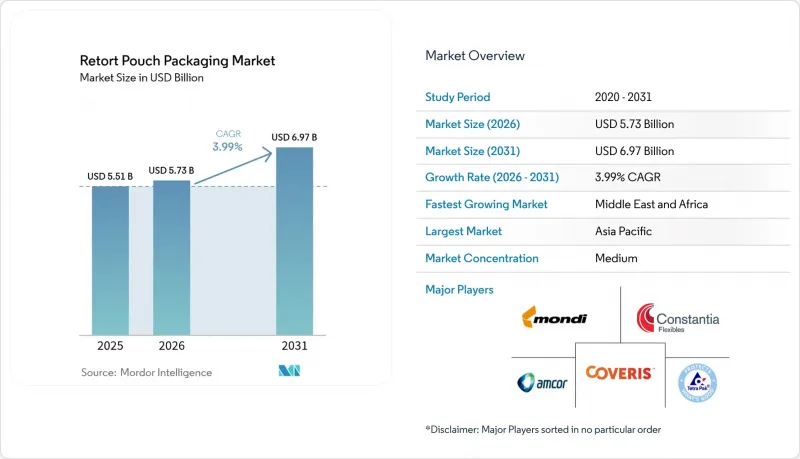
According to Mordor Intelligence, the retort pouch packaging market size was valued at USD 5.51 billion in 2025 and estimated to grow from USD 5.73 billion in 2026 to reach USD 6.97 billion by 2031, at a CAGR of 3.99% during the forecast period (2026-2031).
This report is Segmented by Type (Stand-Up Pouch, Flat Pouch), Material (Polypropylene, Polyester, Aluminum Foil, Cast Polypropylene Film, Paperboard, and More), Closure Type (Spout, Zipper, Tear Notch, and More), Layer Structure (3-Layer, 4-Layer, 5-Layer, and More), End-User (Food, Beverages, Pharmaceutical, and More), and Geography. The Market Forecasts are Provided in Terms of Value (USD).
Global Retort Pouch Packaging Market Trends and Insights
Rising Demand for Ready-to-Eat Meals
Time-pressed households are replacing traditional canned goods with premium retort pouches that heat in under five minutes. Brands now position ethnic recipes, organic ingredients, and chef collaborations in stand-up pouches that command price premiums of 40-60% over metal cans. Quick-commerce warehouses, which favor ambient SKUs to avoid refrigeration costs, accelerate this shift. Regulatory clarity, such as explicit recognition of retort pouches under U.S. low-acid canned food rules, reduces compliance uncertainty for smaller processors. Together, these factors enhance retail visibility, differentiate the brand, and expand ambient reach while maintaining safety standards.
Advancements in High-Barrier Film Technologies
Silicon-oxide coatings, oriented high-density polyethylene, and hybrid organic-inorganic layers now achieve oxygen transmission rates under 3 cc/m2-day, enabling aluminum-free designs. MultiNanoLayer technology stacks 256 layers of polypropylene and polyvinyl alcohol to deliver 2.46 cc/m2/day at 121 °C, lowering material costs by 20-25% and permitting microwave use.Borealis' XPP enhanced polypropylene maintains seal strength above 130 °C, eliminating delamination in all-polyolefin pouches. These advances broaden applications from low-acid soups to high-acid sauces, cut rely on foil use, and simplify recycling.
High Initial Capital Cost of Retort Equipment
Automated pouch filling and sealing lines cost USD 180,000-280,000 for a modest output of 60 pouches per minute. Processors unable to finance such equipment often resort to co-packing agreements, which erode margins by up to 25%. Low-priced semi-automated Chinese systems (USD 9,800-12,800) reduce entry cost but deliver seal failure rates above 2%, disqualifying the product for multinational procurement. Capital barriers thus bifurcate the market between high-volume converters and niche premium players.
Other drivers and restraints analyzed in the detailed report include:
- Growing Focus on Lightweight Sustainable Packaging
- Rapid Expansion of Pet Food Segment
- Recycling Challenges due to Multi-Layer Structures
For complete list of drivers and restraints, kindly check the Table Of Contents.
Segment Analysis
Stand-up formats accounted for 62.95% of the demand in 2025. Retailers favor the format for customizable graphics and efficient facings, while brands leverage shaped panels for ergonomic grip and pour control. Flat pouches, which expand at 5.42% through 2031, serve institutional food service, military contracts, and humanitarian aid, where stackability and pallet density take precedence over shelf appeal. The U.S. Department of Defense now permits flat retort pouches in Meal Ready-to-Eat rations, increasing payload efficiency on transport flights. Converters typically dedicate separate lines to each format, as forming collars and sealing jaws are not interchangeable. Shaped pouches introduced for baby food in 2024 boosted sales 9% by minimizing spillage during one-handed feeding. Despite higher tooling costs, shaped designs command 20-30% price premiums, making them attractive at retail price points above USD 3.00. The retort pouch packaging market size for stand-up variants is projected to expand steadily as supermarkets allocate more space in their ambient aisles to premium ready meals. Flat configurations will remain crucial where logistics cost per calorie transported is the primary metric, underscoring a dual-format landscape.
Second-generation stand-ups feature transparent windows and matte varnishes that offset the "industrial" perception long associated with foil pouches. Advanced laminators integrate near-field communication antennas beneath print layers without compromising seal integrity, linking shoppers to recipe videos and sourcing data. These smart add-ons are costly today but are increasingly being adopted by premium private-label ranges aiming to match the presentation of national brands. Within the retort pouch packaging market, regional converters that install digital presses are capturing short-run orders for ethnic cuisines and limited-time flavors, a revenue pool previously served by rigid jars. Meanwhile, flat pouches retain a material advantage in high-altitude air drops for humanitarian relief, where aerodynamic stability and puncture resistance are critical.
In the retort pouch packaging market, polypropylene held a 27.88% share in 2025, driven by its reliable sealing properties and consistent global resin supply. However, retailers are beginning to favor paperboard laminates, accepting an 18-month shelf life, as opposed to the 24-month standard for all-plastic pouches. This shift is largely driven by the fact that 67% of European shoppers prioritize recyclability over shelf life for ambient foods. Looking ahead, paperboard is set to grow at a robust 5.48% CAGR through 2031. Amcor's innovative AmFiber design substitutes the traditional outer polyester layer with a barrier-coated paperboard. This change not only slashes plastic usage by 60% but also ensures durability, withstanding temperatures of 121 °C for up to 50 minutes - a feat ideal for packaging vegetable stews, pasta meals, and gravies for pet food.
Billerud's 2024 water-based coating has made significant strides, curbing moisture transmission to just 5 g/m2-day. This advancement paves the way for fiber pouches to venture beyond just dry mixes. However, it's worth noting that retort cooling condensation poses a risk, potentially degrading the moisture barrier in fillings with very low moisture content. The financials are favorable; a 20-30% retail price premium on products priced above USD 4.00 translates to an absolute cost increase of under 10%. This strategy enables premium brands to attract sustainability-conscious shoppers while maintaining their profit margins.
Complete Report Scope:
- By Type
- Stand-Up Pouch
- Flat Pouch
- By Material
- Polypropylene
- Polyester
- Aluminum Foil
- Cast Polypropylene Film
- Paperboard
- Other Materials
- By Closure Type
- Spout
- Zipper
- Tear Notch
- Flip-Top Cap
- Other Closure Types
- By Layer Structure
- 3-Layer
- 4-Layer
- 5-Layer
- Above 5 Layer
- By End-User
- Food
- Beverages
- Pharmaceutical
- Pet Food
- Other End Users
- By Geography
- North America
- United States
- Canada
- Mexico
- Europe
- United Kingdom
- France
- Germany
- Italy
- Spain
- Rest of Europe
- Asia-Pacific
- China
- India
- Japan
- South Korea
- Rest of Asia-Pacific
- South America
- Brazil
- Argentina
- Rest of South America
- Middle East and Africa
- Middle East
- Saudi Arabia
- United Arab Emirates
- Turkey
- Rest of Middle East
- Africa
- South Africa
- Nigeria
- Rest of Africa
- Middle East
- North America
Geography Analysis
Asia-Pacific contributed 39.75% of 2025 revenue, anchored by China and India where urban lifestyles lift demand for convenient meals and limited refrigeration infrastructure favors ambient formats. Government-backed food parks cluster converters, equipment makers, and brand owners, slashing transport costs and enabling just-in-time runs. Japan's aging population buys premium stand-up pouches with transparent windows and QR codes that deliver preparation tips, while South Korea's mandatory military service sustains institutional flat-pouch consumption. Stringent Chinese migration limits on food-contact materials effective 2024 are consolidating the retort pouch packaging market toward certified suppliers that can invest in analytical equipment, elevating quality baselines.
The Middle East and Africa is forecast to grow at 6.92% through 2031, fastest worldwide. Gulf Cooperation Council countries spend over USD 45 billion annually on food imports and stockpile shelf-stable meals for strategic reserves. Mondi's new barrier-film plant in Turkey supplies regional converters, trimming reliance on distant foil suppliers and enabling aluminum-free structures suitable for the desert climate. Sub-Saharan African school feeding initiatives mandate locally processed fortified foods in retort pouches, guaranteeing baseline demand under government tenders. Capital scarcity remains the main brake; semi-automated lines satisfy current volumes but constrain long-term unit-cost competitiveness.
North America maintains sizable volume through ready-to-eat meals, premium pet food, and Department of Defense rations. U.S. brands such as Campbell's install high-barrier stand-up lines to serve the 23% of households prioritizing convenience over scratch cooking. Mexico, leveraging USMCA tariff advantages, emerges as a nearshoring hub feeding southwestern U.S. distribution centers. European growth slows under extended producer responsibility fees that penalize non-recyclable laminates; brands accept 18-month shelf life in mono-material pouches to avoid EUR 0.50-0.80/kg penalties. Italy and Spain develop olive oil and tomato sauce pouches for export, capitalizing on Mediterranean authenticity cues. South American progress centers on Brazil and Argentina where modern retail gains share, though currency volatility complicates imported film procurement.
- Amcor Plc
- Constantia Flexibles Group GmbH
- Coveris Holdings SA
- Flair Flexible Packaging Corporation
- Mondi Plc
- Tetra Pak International SA
- Sonoco Products Company
- Clifton Packaging Group Limited
- Clondalkin Group Holdings BV
- Alpha Plastomers Pvt Ltd
- ProAmpac LLC
- Winpak Ltd
- Sealed Air Corporation
- Glenroy Inc
- Huhtamaki Oyj
- Swiss Pack Pvt Ltd
- Uflex Ltd
- Paharpur 3P
- Fujimori Kogyo Co Ltd
Additional Benefits:
- The market estimate (ME) sheet in Excel format
- 3 months of analyst support
TABLE OF CONTENTS
1 INTRODUCTION
- 1.1 Study Assumptions and Market Definition
- 1.2 Scope of the Study
2 RESEARCH METHODOLOGY
3 EXECUTIVE SUMMARY
4 MARKET LANDSCAPE
- 4.1 Market Overview
- 4.2 Market Drivers
- 4.2.1 Rising Demand for Ready-to-Eat Meals
- 4.2.2 Advancements in High-Barrier Film Technologies
- 4.2.3 Growing Focus on Lightweight Sustainable Packaging
- 4.2.4 Rapid Expansion of Pet Food Segment
- 4.2.5 Integration of Smart Packaging Features
- 4.2.6 Expansion of Ambient Food Distribution Channels in Emerging Economies
- 4.3 Market Restraints
- 4.3.1 High Initial Capital Cost of Retort Pouch Equipment
- 4.3.2 Recycling Challenges due to Multi-Layer Structures
- 4.3.3 Limited Thermal Resistance at Extreme Temperatures
- 4.3.4 Supply Chain Disruptions in Aluminum Foil
- 4.4 Industry Value Chain Analysis
- 4.5 Impact of Macroeconomic Factors on the Market
- 4.6 Regulatory Landscape
- 4.7 Technological Outlook
- 4.8 Porter's Five Forces Analysis
- 4.8.1 Threat of New Entrants
- 4.8.2 Bargaining Power of Buyers
- 4.8.3 Bargaining Power of Suppliers
- 4.8.4 Threat of Substitute Products
- 4.8.5 Intensity of Competitive Rivalry
- 4.9 Investment Analysis
5 MARKET SIZE AND GROWTH FORECASTS (VALUE)
- 5.1 By Type
- 5.1.1 Stand-Up Pouch
- 5.1.2 Flat Pouch
- 5.2 By Material
- 5.2.1 Polypropylene
- 5.2.2 Polyester
- 5.2.3 Aluminum Foil
- 5.2.4 Cast Polypropylene Film
- 5.2.5 Paperboard
- 5.2.6 Other Materials
- 5.3 By Closure Type
- 5.3.1 Spout
- 5.3.2 Zipper
- 5.3.3 Tear Notch
- 5.3.4 Flip-Top Cap
- 5.3.5 Other Closure Types
- 5.4 By Layer Structure
- 5.4.1 3-Layer
- 5.4.2 4-Layer
- 5.4.3 5-Layer
- 5.4.4 Above 5 Layer
- 5.5 By End-User
- 5.5.1 Food
- 5.5.2 Beverages
- 5.5.3 Pharmaceutical
- 5.5.4 Pet Food
- 5.5.5 Other End Users
- 5.6 By Geography
- 5.6.1 North America
- 5.6.1.1 United States
- 5.6.1.2 Canada
- 5.6.1.3 Mexico
- 5.6.2 Europe
- 5.6.2.1 United Kingdom
- 5.6.2.2 France
- 5.6.2.3 Germany
- 5.6.2.4 Italy
- 5.6.2.5 Spain
- 5.6.2.6 Rest of Europe
- 5.6.3 Asia-Pacific
- 5.6.3.1 China
- 5.6.3.2 India
- 5.6.3.3 Japan
- 5.6.3.4 South Korea
- 5.6.3.5 Rest of Asia-Pacific
- 5.6.4 South America
- 5.6.4.1 Brazil
- 5.6.4.2 Argentina
- 5.6.4.3 Rest of South America
- 5.6.5 Middle East and Africa
- 5.6.5.1 Middle East
- 5.6.5.1.1 Saudi Arabia
- 5.6.5.1.2 United Arab Emirates
- 5.6.5.1.3 Turkey
- 5.6.5.1.4 Rest of Middle East
- 5.6.5.2 Africa
- 5.6.5.2.1 South Africa
- 5.6.5.2.2 Nigeria
- 5.6.5.2.3 Rest of Africa
- 5.6.5.1 Middle East
- 5.6.1 North America
6 COMPETITIVE LANDSCAPE
- 6.1 Market Concentration
- 6.2 Strategic Moves
- 6.3 Market Share Analysis
- 6.4 Company Profiles (includes Global Level Overview, Market Level Overview, Core Segments, Financials as available, Strategic Information, Market Rank/Share for Key Companies, Products and Services, and Recent Developments)
- 6.4.1 Amcor Plc
- 6.4.2 Constantia Flexibles Group GmbH
- 6.4.3 Coveris Holdings SA
- 6.4.4 Flair Flexible Packaging Corporation
- 6.4.5 Mondi Plc
- 6.4.6 Tetra Pak International SA
- 6.4.7 Sonoco Products Company
- 6.4.8 Clifton Packaging Group Limited
- 6.4.9 Clondalkin Group Holdings BV
- 6.4.10 Alpha Plastomers Pvt Ltd
- 6.4.11 ProAmpac LLC
- 6.4.12 Winpak Ltd
- 6.4.13 Sealed Air Corporation
- 6.4.14 Glenroy Inc
- 6.4.15 Huhtamaki Oyj
- 6.4.16 Swiss Pack Pvt Ltd
- 6.4.17 Uflex Ltd
- 6.4.18 Paharpur 3P
- 6.4.19 Fujimori Kogyo Co Ltd
7 MARKET OPPORTUNITIES AND FUTURE OUTLOOK
- 7.1 White-Space and Unmet-Need Assessment

