PUBLISHER: Mordor Intelligence | PRODUCT CODE: 2113592

PUBLISHER: Mordor Intelligence | PRODUCT CODE: 2113592
Africa Poultry Feed - Market Share Analysis, Industry Trends & Statistics, Growth Forecasts (2026 - 2031)
According to Mordor Intelligence, the Africa poultry feed market size was valued at USD 14.48 billion in 2025 and estimated to grow from USD 15.02 billion in 2026 to reach USD 18.05 billion by 2031, at a CAGR of 3.74% during the forecast period (2026-2031).
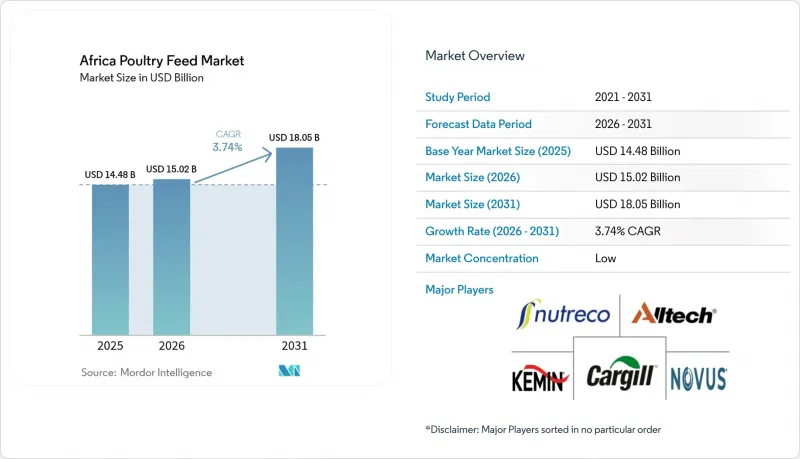
This report is Segmented by Animal Type (Broiler, Layer, Turkey, and Other Animal Types), by Ingredient Type (Cereals, Oilseed Meal, Molasses, Fish Oil and Fish Meal, Supplements, and Other Ingredient Types), by Form (Pellets, Crumble, Mash, and Other Forms), and by Geography (South Africa, Algeria, Nigeria, Ethiopia, Morocco, and Rest of Africa). The Market Forecasts are Provided in Terms of Value (USD).
Africa Poultry Feed Market Trends and Insights
Strong Demand from Quick-Service Restaurant Chicken Chains
Pan-African QSR expansion, led by KFC's more than 1,000 outlets, requires standardized broiler supply programs that lock in feed quality and volume commitments. Contract farming models incentivize mills to formulate feeds that consistently meet weight and feed-conversion targets within six-week grow-outs. QSR procurement policies increasingly specify antibiotic-free protocols, accelerating uptake of phytogenic additives that carry premium margins. The resulting predictable demand stream enables capital investment in automated pelleting lines and regional distribution hubs. Together, these factors anchor a virtuous cycle of higher throughput, lower per-unit costs, and improved profitability across the Africa poultry feed market.
Growth of Integrated Poultry Producers
Companies such as Zalar Holding and Country Bird Holdings deepen vertical integration to shield against raw-material price swings, which account for 60-70% of cost of goods sold. In-house feed mills allow synchronized formulation changes that match flock age and performance targets, supporting phase-feeding programs that reduce waste. Integrated models shorten working-capital cycles, enhance quality control, and support rapid adoption of alternative proteins like insect meal. Over time, this alignment is projected to compress cost structures across major North and Southern African producers, bolstering competitiveness.
High Volatility in Grain Import Prices
Commodity price fluctuations create significant margin pressure for feed manufacturers, particularly in markets with limited domestic grain production capacity. In 2024, maize prices in Ghana jumped 80% in eight months, forcing mills to idle 30% of capacity and prompting calls for import-license waivers. Egypt's sector likewise teetered under soaring corn and soybean costs that eroded producer margins. Currency devaluation compounds these challenges, as most African countries import significant portions of their feed ingredients in hard currencies while selling finished products in local markets.
Other drivers and restraints analyzed in the detailed report include:
- Government Subsidies for Maize and Soybean Cultivation
- Rising Adoption of Nutritionally Balanced Commercial Feed
- Disease Outbreaks Driving Temporary Demand Slumps
For complete list of drivers and restraints, kindly check the Table Of Contents.
Segment Analysis
Broiler formulations accounted for 62.25% of Africa poultry feed market share in 2025, reflecting the segment's short grow-out cycles and standardized demand profiles. The Africa poultry feed market size for turkey diets is projected to grow at a 7.30% CAGR to 2031, propelled by premium positioning and higher per-bird consumption. Broiler feed leverages economies of scale in pelleting and bulk distribution, resulting in lower unit costs compared to layer diets. Integrators align nutrient density with fast live-weight targets, reinforcing demand for energy-dense maize-soy rations.
Turkey feed, although smaller in volume, commands higher price points due to extended 28- to 32-week fattening schedules and specialized amino acid profiles. Feed manufacturers utilize differentiated additives, such as probiotic blends, to manage gut health over extended grow-out periods. While layer feed remains steady among egg enterprises, niche markets for guinea fowl and ducks spur tailored micro-batch production, preserving margins for agile, regionally focused mills.
Complete Report Scope:
- By Animal Type
- Broiler
- Layer
- Turkey
- Other Animal Types
- By Ingredient Type
- Cereals
- Oilseed Meal
- Molasses
- Fish Oil and Fish Meal
- Supplements
- Other Ingredient Types
- By Form
- Pellets
- Crumble
- Mash
- Other Forms
- By Geography
- South Africa
- Algeria
- Nigeria
- Ethiopia
- Morocco
- Rest of Africa
List of Companies Covered in this Report:
- Cargill Inc.
- Nutreco N.V. (Trouw Nutrition)
- Alltech Inc.
- Kemin Industries Inc.
- Novus International, Inc. (Mitsui & Co., Ltd. and Nippon Soda Co., Ltd.)
- BASF SE
- Seaboard Corporation
- RCL Foods Limited (Remgro Limited)
- Archer Daniels Midland Company
- Astral Foods Limited
- Zambeef Products PLC
- Evonik Industries AG
- Novafeeds (Pty) Ltd. (Quantum Foods Holdings Limited)
- De Heus Animal Nutrition Pvt. Ltd.
Additional Benefits:
- The market estimate (ME) sheet in Excel format
- 3 months of analyst support
TABLE OF CONTENTS
1 Introduction
- 1.1 Study Assumptions and Market Definition
- 1.2 Scope of the Study
2 Research Methodology
3 Executive Summary
4 Market Landscape
- 4.1 Market Overview
- 4.2 Market Drivers
- 4.2.1 Strong demand from quick-service restaurant chicken chains
- 4.2.2 Growth of integrated poultry producers
- 4.2.3 Government subsidies for maize and soybean cultivation
- 4.2.4 Rising adoption of nutritionally balanced commercial feed
- 4.2.5 Surge in insect-meal pilot projects for feed protein
- 4.2.6 African Continental Free Trade Area (AFCFTA)-driven cross-border feed logistics efficiencies
- 4.3 Market Restraints
- 4.3.1 High volatility in grain import prices
- 4.3.2 Disease outbreaks driving temporary demand slumps
- 4.3.3 Electricity shortages affecting feed-mill uptime
- 4.3.4 Limited cold-chain for vitamin premix storage
- 4.4 Regulatory Landscape
- 4.5 Technological Outlook
- 4.6 Porter's Five Forces Analysis
- 4.6.1 Bargaining Power of Suppliers
- 4.6.2 Bargaining Power of Buyers
- 4.6.3 Threat of New Entrants
- 4.6.4 Threat of Substitute Products
- 4.6.5 Intensity of Competitive Rivalry
5 Market Size and Growth Forecasts (Value)
- 5.1 By Animal Type
- 5.1.1 Broiler
- 5.1.2 Layer
- 5.1.3 Turkey
- 5.1.4 Other Animal Types
- 5.2 By Ingredient Type
- 5.2.1 Cereals
- 5.2.2 Oilseed Meal
- 5.2.3 Molasses
- 5.2.4 Fish Oil and Fish Meal
- 5.2.5 Supplements
- 5.2.6 Other Ingredient Types
- 5.3 By Form
- 5.3.1 Pellets
- 5.3.2 Crumble
- 5.3.3 Mash
- 5.3.4 Other Forms
- 5.4 By Geography
- 5.4.1 South Africa
- 5.4.2 Algeria
- 5.4.3 Nigeria
- 5.4.4 Ethiopia
- 5.4.5 Morocco
- 5.4.6 Rest of Africa
6 Competitive Landscape
- 6.1 Market Concentration
- 6.2 Strategic Moves
- 6.3 Market Share Analysis
- 6.4 Company Profiles (Includes Global Level Overview, Market Level Overview, Core Segments, Financials as Available, Strategic Information, Market Rank/Share for Key Companies, Products and Services, and Recent Developments)
- 6.4.1 Cargill Inc.
- 6.4.2 Nutreco N.V. (Trouw Nutrition)
- 6.4.3 Alltech Inc.
- 6.4.4 Kemin Industries Inc.
- 6.4.5 Novus International, Inc. (Mitsui & Co., Ltd. and Nippon Soda Co., Ltd.)
- 6.4.6 BASF SE
- 6.4.7 Seaboard Corporation
- 6.4.8 RCL Foods Limited (Remgro Limited)
- 6.4.9 Archer Daniels Midland Company
- 6.4.10 Astral Foods Limited
- 6.4.11 Zambeef Products PLC
- 6.4.12 Evonik Industries AG
- 6.4.13 Novafeeds (Pty) Ltd. (Quantum Foods Holdings Limited)
- 6.4.14 De Heus Animal Nutrition Pvt. Ltd.
7 Market Opportunities and Future Outlook

