PUBLISHER: Mordor Intelligence | PRODUCT CODE: 2113598

PUBLISHER: Mordor Intelligence | PRODUCT CODE: 2113598
Surge Arrester - Market Share Analysis, Industry Trends & Statistics, Growth Forecasts (2026 - 2031)
According to Mordor Intelligence, the surge arrester market size is expected to grow from USD 2.06 billion in 2025 to USD 2.17 billion in 2026 and is forecast to reach USD 2.8 billion by 2031 at 5.23% CAGR over 2026-2031.
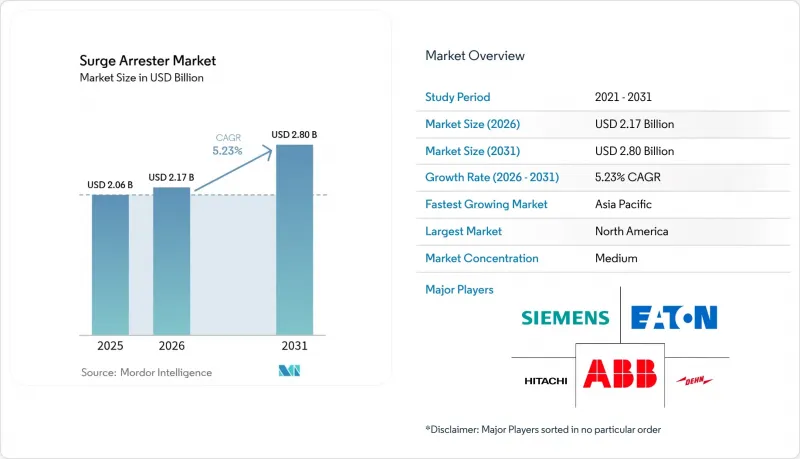
This report is Segmented by Voltage (Low Voltage, Medium Voltage, Extra- and Ultra-High Voltage, and More), Product Type (Station-Class Arresters, Line Arresters, Distribution-Class Arresters, and More), Installation Location (Substations, Transmission Lines, and More), Application (Utilities, Industrial, Commercial, and Residential), and Geography (North America, Europe, Asia-Pacific, South America, and More)
Global Surge Arrester Market Trends and Insights
Grid Modernisation Programmes in North America & EU
Utility regulators across both regions allocate multibillion-dollar budgets to harden aged grids against severe weather, elevating demand for station-class arresters with online condition sensors. Projects such as Entergy Texas's USD 335 million line-reinforcement scheme pair surge-protection upgrades with federal resilience funding, illustrating how reliability mandates translate directly into purchase orders. Predictive maintenance, powered by leakage-current analytics, now informs arrester replacement schedules, enabling utilities to avoid catastrophic failures while managing capital expenditures. At the same time, the increasing use of renewable interconnections escalates switching-surge frequency, forcing tighter coordination between arresters, breakers, and shunt reactors. As a result, the Global surge arrester market receives a pronounced boost from digital-ready hardware aligned with North American and European grid-code updates.
Utility-Scale Renewable Capacity Additions Requiring Over-Voltage Protection
Wind and solar developers specify arresters across collection systems, substations, and export cables to safeguard inverters and transformers from lightning and switching surges. Offshore wind farms pose a heightened risk; measured temporary overvoltages can reach levels that threaten cable insulation unless mitigated. Technical studies show arresters cut those overvoltages by 68.3%, with even greater reductions when paired with pre-insertion resistors, underscoring the need for coordinated protection schemes. As governments double their renewable targets to meet 2030 climate goals, medium-voltage switchgear and the associated surge-protection hardware are experiencing double-digit growth. Consequently, component suppliers scaling high-energy MOV technologies capture an additional share of the Global surge arrester market.
Volatile Prices of Metal-Oxide Varistors
Zinc oxide accounts for the majority of varistor weight, so fluctuations in mine output and tighter environmental regulations drive cost swings that squeeze margins, especially on low-voltage units sold through competitive tenders. Some OEMs redesign formulations to reduce ZnO content; however, qualification cycles are still lengthy. Short-term volatility, therefore, trims profitability, modestly slowing procurement across the Global surge arrester market.
Other drivers and restraints analyzed in the detailed report include:
- Electrification of Industrial Processes in Emerging Asia
- Rapid Build-Out of EV Fast-Charging Corridors
- Fragmented IEC & IEEE Testing Standards Across Regions
For complete list of drivers and restraints, kindly check the Table Of Contents.
Segment Analysis
Extra- and ultra-high-voltage arresters are projected to grow at the fastest rate, with a 6.74% CAGR, as interregional renewable transfers demand voltages of +-800 kV and above. Medium-voltage devices still anchor 37.52% of the Global surge arrester market in 2025, providing backbone protection for distribution feeders that serve industrial parks and dense urban loads. Complex varistor stacks and silicone housings designed for 330 kV-plus duties continue to trickle down into lower-voltage offerings, improving thermal stability across the board. China's 1,901 km +-800 kV UHVDC line underscores technical feasibility and stimulates export interest in similar corridors across South Asia and Africa.
Station-class arresters delivered 41.95% of the revenue in 2025, while line arresters advanced at a 7.18% CAGR as utilities quantified outage reductions that outweighed the installation cost. Gapless polymer-housed designs, combined with vibration-resistant clamps, speed up retrofit campaigns on existing 220 kV lines. Field data from CIGRE confirms significant lightning-outage cuts, reinforcing the adoption curve across the Global surge arrester market.
Complete Report Scope:
- By Voltage
- Low Voltage (Up to 1 kV)
- Medium Voltage (1 to 36 kV)
- High Voltage (36 to 330 kV)
- Extra and Ultra High Voltage (Over 330 kV)
- By Product Type
- Station-Class Arresters
- Distribution-Class Arresters
- Intermediate-Class Arresters
- Line Arresters
- By Installation Location
- Substations
- Transmission Lines
- Distribution Networks
- Power-Generation Facilities
- Industrial Machinery and Process Plants
- By Application
- Utilities
- Industrial
- Commercial
- Residential
- By Geography
- North America
- United States
- Canada
- Mexico
- Europe
- Germany
- United Kingdom
- France
- Italy
- Spain
- Russia
- Rest of Europe
- Asia-Pacific
- China
- India
- Japan
- South Korea
- ASEAN Countries
- Rest of Asia-Pacific
- South America
- Brazil
- Argentina
- Rest of South America
- Middle East and Africa
- Saudi Arabia
- United Arab Emirates
- South Africa
- Egypt
- Rest of Middle East and Africa
- North America
Geography Analysis
The Asia-Pacific region led with a 41.05% share of the Global surge arrester market in 2025 and is predicted to expand at a 5.82% CAGR. China's State Grid alone invested over 500 billion yuan in smart-grid rollouts during 2024, with UHV lines absorbing a sizeable arrester budget. India's electrification drives add medium-voltage demand, while Japan's long record of 66-1100 kV installations supplies application know-how.
North America registers steady gains as federal-state grid-modernization alliances release funding tranches tied to resilience metrics. Offshore-wind buildouts along the Atlantic spur marine-grade arrester purchases, and Canada's USD 1.4 trillion grid-upgrade roadmap secures long-term replacement cycles, each reinforcing North America's contribution to the Global surge arrester market.
Europe emphasizes digital monitoring and harmonized protection practices under EN 50539, and Mediterranean offshore wind cables add a challenging salt-spray environment. South America, plus the Middle East & Africa, comprise emerging pockets; mining and petrochemical projects create site-specific surges, but procurement often favors ruggedized, proven models over feature-rich units, moderating yet not negating growth within the Global surge arrester market.
- ABB Ltd.
- Siemens Energy AG
- Hitachi Energy Ltd.
- Eaton Corporation plc
- Schneider Electric SE
- Mitsubishi Electric Corp.
- CG Power & Industrial Solutions Ltd.
- General Electric Company
- Raycap Corporation SA
- Legrand SA
- Littelfuse Inc.
- Leviton Manufacturing Co. Inc.
- DEHN SE
- Phoenix Contact GmbH & Co. KG
- CITEL Electronic
- Hakel Spol s r.o.
- Bourns Inc.
- Hubbell Power Systems
- Belkin International Inc.
- Tripp Lite (by Eaton)
- Zhejiang Thor Electric Co. Ltd.
- Advanced Protection Technologies Inc.
Additional Benefits:
- The market estimate (ME) sheet in Excel format
- 3 months of analyst support
TABLE OF CONTENTS
1 Introduction
- 1.1 Study Assumptions & Market Definition
- 1.2 Scope of the Study
2 Research Methodology
3 Executive Summary
4 Market Landscape
- 4.1 Market Overview
- 4.2 Market Drivers
- 4.2.1 Grid modernisation programmes in North America & EU
- 4.2.2 Utility-scale renewable capacity additions requiring over-voltage protection
- 4.2.3 Electrification of industrial processes in emerging Asia
- 4.2.4 Rapid build-out of EV fast-charging corridors
- 4.2.5 Surge arrester retrofits in offshore wind substations
- 4.2.6 Digital twin-enabled asset-health monitoring boosting replacement demand
- 4.3 Market Restraints
- 4.3.1 Volatile prices of metal-oxide varistors
- 4.3.2 Fragmented IEC & IEEE testing standards across regions
- 4.3.3 Project delays in long-distance UHV transmission lines
- 4.3.4 Counterfeit low-cost products eroding OEM margins
- 4.4 Supply-Chain Analysis
- 4.5 Regulatory Landscape
- 4.6 Technological Outlook
- 4.7 Porter's Five Forces
- 4.7.1 Bargaining Power of Suppliers
- 4.7.2 Bargaining Power of Buyers
- 4.7.3 Threat of New Entrants
- 4.7.4 Threat of Substitutes
- 4.7.5 Intensity of Competitive Rivalry
5 Market Size & Growth Forecasts
- 5.1 By Voltage
- 5.1.1 Low Voltage (Up to 1 kV)
- 5.1.2 Medium Voltage (1 to 36 kV)
- 5.1.3 High Voltage (36 to 330 kV)
- 5.1.4 Extra and Ultra High Voltage (Over 330 kV)
- 5.2 By Product Type
- 5.2.1 Station-Class Arresters
- 5.2.2 Distribution-Class Arresters
- 5.2.3 Intermediate-Class Arresters
- 5.2.4 Line Arresters
- 5.3 By Installation Location
- 5.3.1 Substations
- 5.3.2 Transmission Lines
- 5.3.3 Distribution Networks
- 5.3.4 Power-Generation Facilities
- 5.3.5 Industrial Machinery and Process Plants
- 5.4 By Application
- 5.4.1 Utilities
- 5.4.2 Industrial
- 5.4.3 Commercial
- 5.4.4 Residential
- 5.5 By Geography
- 5.5.1 North America
- 5.5.1.1 United States
- 5.5.1.2 Canada
- 5.5.1.3 Mexico
- 5.5.2 Europe
- 5.5.2.1 Germany
- 5.5.2.2 United Kingdom
- 5.5.2.3 France
- 5.5.2.4 Italy
- 5.5.2.5 Spain
- 5.5.2.6 Russia
- 5.5.2.7 Rest of Europe
- 5.5.3 Asia-Pacific
- 5.5.3.1 China
- 5.5.3.2 India
- 5.5.3.3 Japan
- 5.5.3.4 South Korea
- 5.5.3.5 ASEAN Countries
- 5.5.3.6 Rest of Asia-Pacific
- 5.5.4 South America
- 5.5.4.1 Brazil
- 5.5.4.2 Argentina
- 5.5.4.3 Rest of South America
- 5.5.5 Middle East and Africa
- 5.5.5.1 Saudi Arabia
- 5.5.5.2 United Arab Emirates
- 5.5.5.3 South Africa
- 5.5.5.4 Egypt
- 5.5.5.5 Rest of Middle East and Africa
- 5.5.1 North America
6 Competitive Landscape
- 6.1 Market Concentration
- 6.2 Strategic Moves (M&A, Partnerships, PPAs)
- 6.3 Market Share Analysis (Market Rank/Share for key companies)
- 6.4 Company Profiles (includes Global level Overview, Market level overview, Core Segments, Financials as available, Strategic Information, Products & Services, and Recent Developments)
- 6.4.1 ABB Ltd.
- 6.4.2 Siemens Energy AG
- 6.4.3 Hitachi Energy Ltd.
- 6.4.4 Eaton Corporation plc
- 6.4.5 Schneider Electric SE
- 6.4.6 Mitsubishi Electric Corp.
- 6.4.7 CG Power & Industrial Solutions Ltd.
- 6.4.8 General Electric Company
- 6.4.9 Raycap Corporation SA
- 6.4.10 Legrand SA
- 6.4.11 Littelfuse Inc.
- 6.4.12 Leviton Manufacturing Co. Inc.
- 6.4.13 DEHN SE
- 6.4.14 Phoenix Contact GmbH & Co. KG
- 6.4.15 CITEL Electronic
- 6.4.16 Hakel Spol s r.o.
- 6.4.17 Bourns Inc.
- 6.4.18 Hubbell Power Systems
- 6.4.19 Belkin International Inc.
- 6.4.20 Tripp Lite (by Eaton)
- 6.4.21 Zhejiang Thor Electric Co. Ltd.
- 6.4.22 Advanced Protection Technologies Inc.
7 Market Opportunities & Future Outlook
- 7.1 White-Space & Unmet-Need Assessment

