PUBLISHER: Mordor Intelligence | PRODUCT CODE: 2113605

PUBLISHER: Mordor Intelligence | PRODUCT CODE: 2113605
Africa Tea - Market Share Analysis, Industry Trends & Statistics, Growth Forecasts (2026 - 2031)
According to Mordor Intelligence, Africa tea market size in 2026 is estimated at USD 4.3 billion, growing from 2025 value of USD 4.01 billion with 2031 projections showing USD 6.11 billion, growing at 7.28% CAGR over 2026-2031.
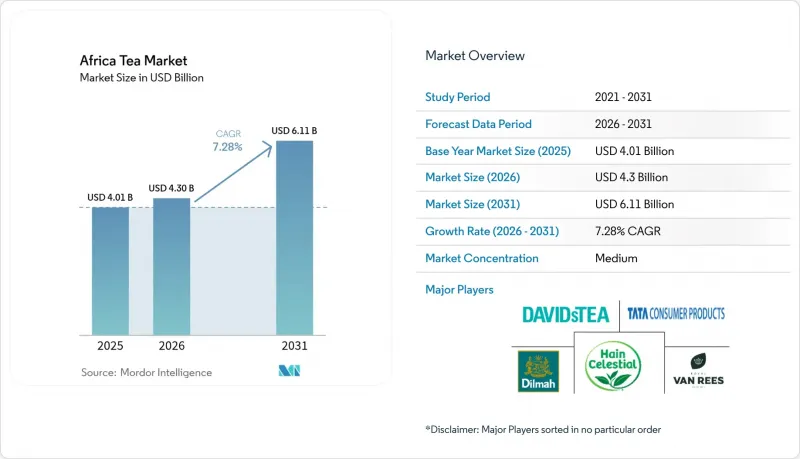
This report is Segmented by Form (Leaf Tea CTC Tea), Product Type (Black Tea Green Tea, and More), Flavor (Unflavored and Flavored), Category (Organic and Conventional), Packaging (Pouches/Bags, Boxes, and Others), Distribution Channel (Off-Trade and On-Trade), and Geography (South Africa, Egypt, Rest of Africa). The Market Forecasts are Provided in Terms of Value (USD).
Africa Tea Market Trends and Insights
Heightened Health Awareness Driving Demand for Green and Herbal Teas
Consumer health consciousness is fundamentally reshaping tea consumption patterns across Africa, with herbal and green tea segments experiencing disproportionate growth relative to traditional black tea categories. This trend manifests most prominently in urban centers where disposable income and health awareness intersect, creating premium market opportunities for functional tea products. South Africa's indigenous rooibos industry exemplifies this shift, with the EU granting Protected Designation of Origin status in 2021, enabling the country to export over 8,000 tonnes annually to 50+ countries while positioning rooibos as a premium wellness product. The health positioning extends beyond traditional antioxidant claims to include specific functional benefits, with research institutions documenting polyphenol concentration variations under different climate conditions. Egyptian consumers increasingly seek tea products with documented health benefits, driving import demand for specialty wellness teas despite the country's complex regulatory environment requiring National Food Safety Authority approval for functional food products according to U.S Commercial Service. This health-driven demand creates sustainable competitive advantages for producers who can document and market specific wellness attributes while navigating evolving regulatory frameworks.
Rising Demand for Sustainable and Ethically Sourced Products
Sustainability imperatives are reshaping supply chain structures and certification strategies across African tea markets, with traditional certification schemes facing cost-benefit recalibrations that favor locally developed frameworks. Kenya's suspension of Rainforest Alliance certification in May 2025 signals a strategic pivot toward nationally designed sustainability standards, similar to India's Trustea and Sri Lanka's Ceylon Tea schemes, reducing compliance costs while maintaining market access to key export destinations. This shift occurs as EU Deforestation Regulation compliance costs create barriers for smallholder producers, with geo-location requirements imposing approximately USD 4 per farm in administrative burden, potentially consolidating supply chains toward larger, technologically equipped producers. South Africa's rooibos industry demonstrates sustainable certification success through indigenous benefit-sharing agreements, with the Rooibos Council providing 15 million rand annually to Khoi and San communities following formal acknowledgment of traditional knowledge. The sustainability trend creates differentiation opportunities for African producers who can demonstrate environmental stewardship and social impact while managing compliance costs through regional coordination and technology adoption. Value addition initiatives, as promoted by Solidaridad Network, enable smallholder farmers to capture higher margins through local processing and branding while meeting sustainability requirements.
Strong Competition from Coffee and Other Beverages
Coffee's established market position across African urban centers creates persistent competitive pressure on tea consumption, particularly in segments where beverages compete for morning consumption occasions and cafe menu space. Egypt's beverage market demonstrates this competitive dynamic, where coffee culture and traditional beverages compete with tea for consumer preference and retail shelf space. The competitive pressure intensifies in urban areas where international coffee chains establish presence and create consumption habits that favor coffee over tea. African tea producers must differentiate through unique value propositions such as health benefits, cultural authenticity, and premium positioning rather than competing directly on caffeine content or convenience. The competition extends to functional beverage categories where energy drinks and enhanced waters target similar health-conscious consumer segments that represent growth opportunities for wellness teas. Regulatory influence from National Food Safety Authority requirements in Egypt affects how functional tea products can be positioned relative to other beverage categories.
Other drivers and restraints analyzed in the detailed report include:
- Urban Cities Expansion of Specialty Tea Cafe Chains
- Gen-Z Growing Preference for Decaffeinated and Low-Caffeine Wellness Teas
- Health Concerns Over Sugar Content in Flavored Teas
For complete list of drivers and restraints, kindly check the Table Of Contents.
Segment Analysis
CTC Tea commands 64.52% market share in 2025, reflecting established processing infrastructure and export market preferences, while Leaf Tea accelerates with 7.52% CAGR through 2031, driven by premiumization trends and specialty tea demand. The dominance of CTC processing aligns with Kenya's position as a major global supplier, where mechanized production enables cost-effective processing of high-volume exports to traditional markets including Pakistan and Egypt. However, the faster growth of Leaf Tea reflects changing consumer preferences toward premium products and single origin positioning that command higher margins. Value addition initiatives promoted by development organizations emphasize shifting from raw leaf sales to local processing and branding, enabling farmers to capture higher margins while building domestic processing capabilities.
Climate adaptation strategies increasingly influence processing choices, with leaf tea production requiring more precise timing and handling that becomes challenging under variable weather conditions documented across East African tea regions. KTDA's renewable energy initiative across 66 tea factories demonstrates infrastructure investments that support both processing forms while reducing operational costs and environmental impact. The processing form segmentation reflects broader industry tensions between volume-focused commodity production and value-added specialty positioning, with successful producers increasingly adopting dual strategies that serve both market segments through differentiated product lines and processing capabilities.
Black Tea maintains 55.76% market share in 2025, reflecting established consumption patterns and export market demand, while Herbal/Fruit Infusions surge with 8.21% CAGR, signaling consumer preference shifts toward wellness-oriented products. The stability of black tea consumption provides revenue foundation for African producers, particularly in Kenya where black tea exports reached USD 1.34 billion in 2023, representing 18.8% of total national exports. However, the accelerated growth of herbal and fruit infusions reflects health consciousness trends and premiumization opportunities that enable higher margins and differentiated positioning. South Africa's indigenous rooibos industry exemplifies successful herbal tea commercialization, with Protected Designation of Origin status enabling premium pricing and export growth to over 50 countries.
Green tea and other specialty segments benefit from health positioning and antioxidant claims, though market penetration remains limited compared to established black tea consumption patterns. The product type segmentation creates opportunities for blended products that combine traditional black tea with herbal ingredients, appealing to consumers seeking familiar flavors with enhanced wellness benefits. Climate change research indicates that secondary metabolite concentrations in tea plants respond significantly to environmental conditions, potentially affecting quality characteristics across different product types as growing conditions evolve. Regulatory considerations become important for herbal products, particularly in markets like Egypt where functional food claims require National Food Safety Authority approval and documentation of health benefits.
Complete Report Scope:
- By Form
- Leaf Tea
- CTC Tea
- By Product Type
- Black Tea
- Green Tea
- Herbal/Fruit Infusions
- Others
- By Flavour
- Unflavoured
- Flavoured
- By Category
- Organic
- Conventional
- By Packaging
- Pouches/Bags
- Boxes
- Others
- By Distribution Channel
- Off-Trade
- Supermarkets/Hypermarkets
- Convinience/Grocery Stores
- Specialty Stores
- Online Retail Stores
- Other Distribution Channels
- On-Trade
- Off-Trade
- By Geography
- South Africa
- Egypt
- Rest of the Africa
List of Companies Covered in this Report:
- Hain Celestial
- DAVIDsTEA
- Tata Consumer Products Limited
- Dilmah Ceylon Tea Company PLC
- Van Rees Group B.V.
- McLeod Russel
- JDE Peet's
- East African Tea Trade Association (EATTA)
- Kenya Tea Development Agency (KTDA)
- Chebango Tea Factory
- James Finlay Kenya
- Twinings
- Bigelow Tea
- Unilever plc
- Orientis Group (Kusmi Tea)
- Ekaterra
- Majestic Kenya Tea
- Johannesburg Tea Company
- Ahmad Tea
- Goldkili Trading
Additional Benefits:
- The market estimate (ME) sheet in Excel format
- 3 months of analyst support
TABLE OF CONTENTS
1 INTRODUCTION
- 1.1 Study Assumptions and Market Definition
- 1.2 Scope of the Study
2 RESEARCH METHODOLOGY
3 EXECUTIVE SUMMARY
4 MARKET LANDSCAPE
- 4.1 Market Overview
- 4.2 Market Drivers
- 4.2.1 Heightened Health Awareness Is Driving Up the Demand for Green and Herbal Teas
- 4.2.2 Market Growth is Bolstered by a Rising Demand for Sustainable and Ethically Sourced Products
- 4.2.3 Urban Cities Witness a Boom with the Expansion of Specialty Tea Cafe Chains
- 4.2.4 Gen-Z Shows a Growing Preference for Decaffeinated and Low-Caffeine Wellness Teas
- 4.2.5 Surging Demand for Single-Origin Tea Boosts Growth
- 4.3 Market Restraints
- 4.3.1 Strong Competition from Coffee and Other Beverages Limits Market Share
- 4.3.2 Health Concerns Over Sugar Content in Flavored Teas Hinder Demand
- 4.3.3 Climate-Induced Yield Instability Hinders Growth
- 4.3.4 Regulatory Challenges and Import/Export Barriers Disrupt Supply Chains
- 4.4 Supply Chain Analysis
- 4.5 Regualtory Landscape
- 4.6 Technological Outlook
- 4.7 Porter's Five Forces
- 4.7.1 Threat of New Entrants
- 4.7.2 Bargaining Power of Buyers
- 4.7.3 Bargaining Power of Suppliers
- 4.7.4 Threat of Substitutes
- 4.7.5 Competitive Rivalry
5 MARKET SIZE AND GROWTH FORECASTS (VALUE)
- 5.1 By Form
- 5.1.1 Leaf Tea
- 5.1.2 CTC Tea
- 5.2 By Product Type
- 5.2.1 Black Tea
- 5.2.2 Green Tea
- 5.2.3 Herbal/Fruit Infusions
- 5.2.4 Others
- 5.3 By Flavour
- 5.3.1 Unflavoured
- 5.3.2 Flavoured
- 5.4 By Category
- 5.4.1 Organic
- 5.4.2 Conventional
- 5.5 By Packaging
- 5.5.1 Pouches/Bags
- 5.5.2 Boxes
- 5.5.3 Others
- 5.6 By Distribution Channel
- 5.6.1 Off-Trade
- 5.6.1.1 Supermarkets/Hypermarkets
- 5.6.1.2 Convinience/Grocery Stores
- 5.6.1.3 Specialty Stores
- 5.6.1.4 Online Retail Stores
- 5.6.1.5 Other Distribution Channels
- 5.6.2 On-Trade
- 5.6.1 Off-Trade
- 5.7 By Geography
- 5.7.1 South Africa
- 5.7.2 Egypt
- 5.7.3 Rest of the Africa
6 COMPETITIVE LANDSCAPE
- 6.1 Market Concentration
- 6.2 Strategic Moves
- 6.3 Market Positioning
- 6.4 Company Profiles (includes Global level Overview, Market level overview, Core Segments, Financials as available, Strategic Information, Market Rank/Share for key companies, Products and Services, and Recent Developments)
- 6.4.1 Hain Celestial
- 6.4.2 DAVIDsTEA
- 6.4.3 Tata Consumer Products Limited
- 6.4.4 Dilmah Ceylon Tea Company PLC
- 6.4.5 Van Rees Group B.V.
- 6.4.6 McLeod Russel
- 6.4.7 JDE Peet's
- 6.4.8 East African Tea Trade Association (EATTA)
- 6.4.9 Kenya Tea Development Agency (KTDA)
- 6.4.10 Chebango Tea Factory
- 6.4.11 James Finlay Kenya
- 6.4.12 Twinings
- 6.4.13 Bigelow Tea
- 6.4.14 Unilever plc
- 6.4.15 Orientis Group (Kusmi Tea)
- 6.4.16 Ekaterra
- 6.4.17 Majestic Kenya Tea
- 6.4.18 Johannesburg Tea Company
- 6.4.19 Ahmad Tea
- 6.4.20 Goldkili Trading
7 MARKET OPPORTUNITIES AND FUTURE OUTLOOK

