PUBLISHER: Mordor Intelligence | PRODUCT CODE: 2113617

PUBLISHER: Mordor Intelligence | PRODUCT CODE: 2113617
China Cloud Gaming Technology - Market Share Analysis, Industry Trends & Statistics, Growth Forecasts (2026 - 2031)
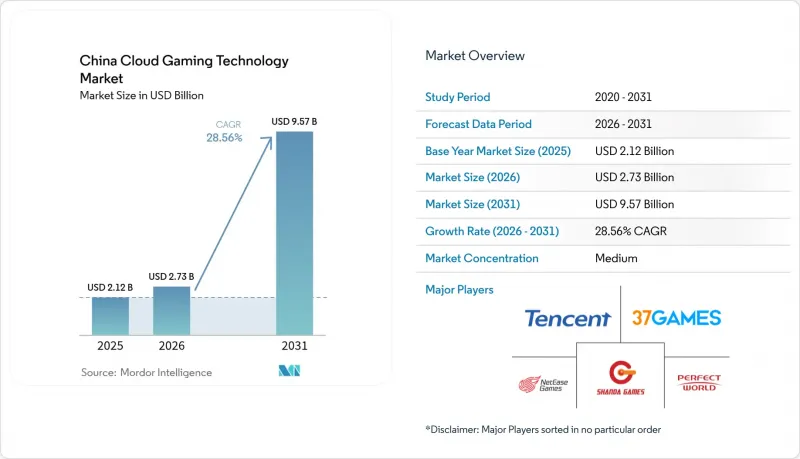
According to Mordor Intelligence, the China cloud gaming technology market size is expected to grow from USD 2.12 billion in 2025 to USD 2.73 billion in 2026 and is forecast to reach USD 9.57 billion by 2031 at 28.56% CAGR over 2026-2031.
This report is Segmented by Service Type (Pure Video Streaming, Interactive File Streaming, and Hybrid Rendering), Device (Smartphones, Tablets, and More), Business Model (Subscription (All-You-Can-Play), Time-Based Billing, Game-Specific Micro-Transaction Pass, and More), Gamer Type (Casual Gamers, Avid Gamers, and Lifestyle Gamers). The Market Forecasts are Provided in Terms of Value (USD).
China Cloud Gaming Technology Market Trends and Insights
Upgrades to 5G standalone networks and edge nodes
China Telecom devoted RMB78 billion to next-generation cloud-network infrastructure in 2024, lifting data-center and edge-node density to cut round-trip latency below 20 ms in major cities. Research from Sharif University of Technology shows that such latency levels enable a single edge server to support 23 concurrent players, improving unit economics and gameplay responsiveness. As coverage widens to Tier-2 cities, more users will experience console-grade quality on entry phones, reinforcing subscription uptake.
Carrier cloud-bundling
China Mobile integrates its Migu Cloud Gaming application with 5G data plans, leveraging a 303 million subscriber base to remove separate payment steps and app-store fees. Bundled plans reduce acquisition costs for publishers, expand cross-selling opportunities, and unlock rural demand where credit-card penetration is low. Similar offers from China Telecom and China Unicom normalise cloud gaming as a standard network feature.
Licensing quotas and censorship
The National Press and Publication Administration approved 1,400 titles during 2024, well below publisher submissions, leaving many foreign games in limbo. Platforms must embed anti-addiction systems and real-name log-ins to comply with the Protection of Minors in Cyberspace rules. Domestic studios enjoy shorter approval pathways, tilting competitive balance toward Tencent and NetEase and limiting library diversity for multinational platforms.
Other drivers and restraints analyzed in the detailed report include:
- Cloud-native re-releases of flagship AAA mobile titles
- Smart-TV OEM pre-installation of cloud gaming apps
- US GPU export controls
For complete list of drivers and restraints, kindly check the Table Of Contents.
Segment Analysis
Pure streaming held 57.85% of 2025 market share, anchoring the early China cloud gaming technology market through broad device reach. Hybrid rendering, however, is forecast to post a 32.1% CAGR to 2031 as edge nodes offload physics and input prediction tasks closer to players. This split workload cuts bandwidth needs and elevates frame stability during peak traffic windows.
Research at Sharif University confirms that edge collaboration supports 23 simultaneous users per node at <20 ms, sharpening economics for operators. As the Eastern Data Western Compute backbone brings hyperscale facilities online, providers dynamically allocate compute to hotspots, giving hybrid approaches further headroom. Interactive file streaming remains a transitional option for mid-spec devices, yet is likely to be eclipsed as telcos densify edges.
Smartphones accounted for 43.65% of the China cloud gaming technology market share in 2025, and the segment is projected to grow at a 32.6% CAGR to 2031. Handset ASPs above RMB3,000 now ship with advanced cooling and ray-tracing GPUs, making long sessions viable. Tablets attract strategy gamers seeking larger displays without sacrificing mobility, while PCs retain high-precision e-sports users.
Connected TVs and OTT boxes transform living rooms into casual gaming zones by pre-installing portals. LG-Xbox and Huawei-Peng Game collaborations illustrate the model, building recurring revenue from family plans. Dedicated cloud handhelds, such as Tencent's Sunday Dragon 3D One, demonstrate premium demand, although volumes remain niche.
Complete Report Scope:
- By Service Type
- Pure Video Streaming
- Interactive File Streaming
- Hybrid Rendering (Edge Off-load)
- By Device
- Smartphones
- Tablets
- Connected TVs and OTT Boxes
- PCs and Laptops
- Dedicated Cloud-Gaming Consoles
- Other Devices
- By Business Model
- Subscription (All-You-Can-Play)
- Time-Based Billing
- Game-Specific Micro-Transaction Pass
- B2B Whitelabel SDK / PaaS
- By Gamer Type
- Casual Gamers
- Avid Gamers
- Lifestyle Gamers
List of Companies Covered in this Report:
- Tencent Holdings Ltd.
- NetEase Inc.
- Huawei Technologies Co., Ltd. (Huawei Cloud Gaming)
- China Mobile Communications Group Co., Ltd. (Migu Cloud)
- China Telecom Co., Ltd. (Tianyi Cloud X)
- 37 Interactive Entertainment
- Perfect World Co., Ltd.
- Elex Technology Co., Ltd.
- Shanda Games Ltd.
- ByteDance
- Kuaishou Technology
- NetDragon Websoft Inc.
- Kingsoft Corporation (Kingsoft Cloud Games)
- Baidu, Inc. (Xiaodu Cloud Gaming)
- Bilibili Inc.
- iQiyi, Inc.
- Alibaba Cloud
- UgPhone
- Now.gg
Additional Benefits:
- The market estimate (ME) sheet in Excel format
- 3 months of analyst support
TABLE OF CONTENTS
1 INTRODUCTION
- 1.1 Study Assumptions and Market Definition
- 1.2 Scope of the Study
2 RESEARCH METHODOLOGY
3 EXECUTIVE SUMMARY
4 MARKET LANDSCAPE
- 4.1 Market Overview
- 4.2 Market Drivers
- 4.2.1 Upgrades to 5G SA Networks and Edge Nodes Enabling < 20 ms Latency in Tier-1 Cities
- 4.2.2 Carrier Cloud-Bundling (China Mobile - Tencent Start) Accelerating User Acquisition
- 4.2.3 Flagship AAA Mobile Titles (e.g., Genshin Impact) Re-Released in Cloud-Native Form
- 4.2.4 Smart-TV OEM Pre-Installation of Cloud-Gaming Apps Expanding Living-Room Reach
- 4.2.5 Generative-AI Content Localisation Shortening Launch Cycles for Foreign IP
- 4.3 Market Restraints
- 4.3.1 Licensing Quotas and Censorship Limiting Title Libraries
- 4.3.2 US GPU Export Controls Inflating Server-Side Capex
- 4.3.3 Consumer Price-Sensitivity vs. Data-Egress Fees Compressing Margins
- 4.4 Regulatory Outlook
- 4.5 Technological Outlook
- 4.6 Porter's Five Forces Analysis
- 4.6.1 Threat of New Entrants
- 4.6.2 Bargaining Power of Buyers/Consumers
- 4.6.3 Bargaining Power of Suppliers
- 4.6.4 Threat of Substitute Products
- 4.6.5 Intensity of Competitive Rivalry
5 MARKET SIZE AND GROWTH FORECASTS (VALUE)
- 5.1 By Service Type
- 5.1.1 Pure Video Streaming
- 5.1.2 Interactive File Streaming
- 5.1.3 Hybrid Rendering (Edge Off-load)
- 5.2 By Device
- 5.2.1 Smartphones
- 5.2.2 Tablets
- 5.2.3 Connected TVs and OTT Boxes
- 5.2.4 PCs and Laptops
- 5.2.5 Dedicated Cloud-Gaming Consoles
- 5.2.6 Other Devices
- 5.3 By Business Model
- 5.3.1 Subscription (All-You-Can-Play)
- 5.3.2 Time-Based Billing
- 5.3.3 Game-Specific Micro-Transaction Pass
- 5.3.4 B2B Whitelabel SDK / PaaS
- 5.4 By Gamer Type
- 5.4.1 Casual Gamers
- 5.4.2 Avid Gamers
- 5.4.3 Lifestyle Gamers
6 COMPETITIVE LANDSCAPE
- 6.1 Strategic Developments
- 6.2 Vendor Positioning Analysis
- 6.3 Company Profiles (includes Market level overview, Core Segments, Financials as available, Strategic Information, Products and Services, and Recent Developments)
- 6.3.1 Tencent Holdings Ltd.
- 6.3.2 NetEase Inc.
- 6.3.3 Huawei Technologies Co., Ltd. (Huawei Cloud Gaming)
- 6.3.4 China Mobile Communications Group Co., Ltd. (Migu Cloud)
- 6.3.5 China Telecom Co., Ltd. (Tianyi Cloud X)
- 6.3.6 37 Interactive Entertainment
- 6.3.7 Perfect World Co., Ltd.
- 6.3.8 Elex Technology Co., Ltd.
- 6.3.9 Shanda Games Ltd.
- 6.3.10 ByteDance
- 6.3.11 Kuaishou Technology
- 6.3.12 NetDragon Websoft Inc.
- 6.3.13 Kingsoft Corporation (Kingsoft Cloud Games)
- 6.3.14 Baidu, Inc. (Xiaodu Cloud Gaming)
- 6.3.15 Bilibili Inc.
- 6.3.16 iQiyi, Inc.
- 6.3.17 Alibaba Cloud
- 6.3.18 UgPhone
- 6.3.19 Now.gg
7 MARKET OPPORTUNITIES AND FUTURE OUTLOOK
- 7.1 White-Space and Unmet-Need Assessment

