PUBLISHER: Mordor Intelligence | PRODUCT CODE: 2114080

PUBLISHER: Mordor Intelligence | PRODUCT CODE: 2114080
Cloud Gaming - Market Share Analysis, Industry Trends & Statistics, Growth Forecasts (2026 - 2031)
According to Mordor Intelligence, the cloud gaming market size stood at USD 6.23 billion in 2026 and is projected to reach USD 21.62 billion by 2031, reflecting a robust 28.25% CAGR.
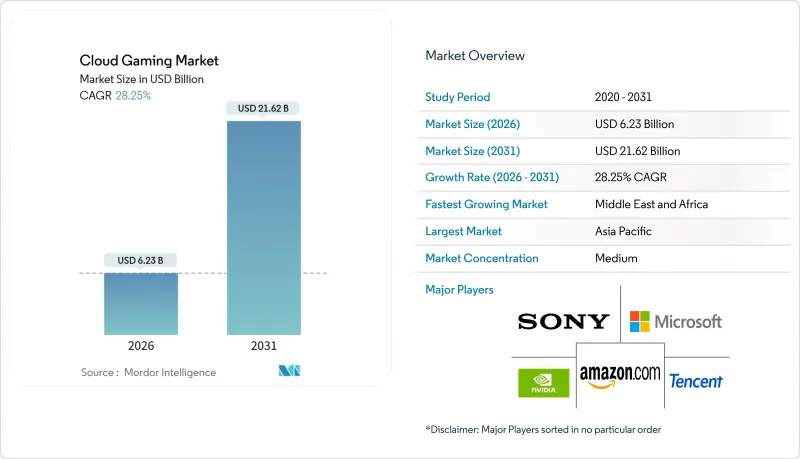
This report is Segmented by Service Type (Video Streaming and File Streaming), Device (Smartphones, Tablets, and More), Gamer Type (Casual Gamers, Avid Gamers, and Lifestyle Gamers), Business Model (Subscription-Based, Pay-As-You-Play, and Free-To-Play and Ad-Supported), and Geography (North America, Europe, Asia Pacific, South America, and More). The Market Forecasts are Provided in Terms of Value (USD).
Global Cloud Gaming Market Trends and Insights
5G and Edge Roll-outs Unlocking Low-Latency Gameplay
Multi-access edge computing nodes now place rendering servers within city limits, letting carriers deliver sub-15-millisecond round-trip times for titles such as Forza Horizon 5. Verizon's partnership with AWS Wavelength in the United States and Bridge Alliance's unified edge platform across Southeast Asia have proved that reducing backhaul hops immediately boosts session quality. GSMA Intelligence counted more than 1.2 billion 5G connections in the Asia Pacific in 2025, while Ericsson ConsumerLab reported that 68% of cloud gamers rank latency as the single most important satisfaction driver. Together, these factors convert casual mobile users into paying subscribers, particularly in bandwidth-intensive genres such as battle royales and racing simulators.
AAA Publishers Adopting Cloud-First Distribution
Publishers are launching marquee franchises simultaneously on cloud and traditional consoles to reach non-console owners. At GDC 2025, Microsoft revealed 140 million cumulative streaming hours, with over one-third of those coming from devices unable to run the content locally. Ubisoft and Tencent created a EUR 4 billion (USD 4.28 billion) subsidiary to push Assassin's Creed and Rainbow Six directly to cloud players in Asia, bypassing physical disc sales. Amazon Luna's multiyear pact with Electronic Arts places Star Wars Jedi: Survivor day-and-date inside the Prime bundle, cementing the expectation of instant access. Boston Consulting Group estimates that cloud-first launches widen the potential paying audience by 40%.
Rural Latency Bottlenecks in South America and Africa
The World Bank found that only 35% of Sub-Saharan Africa had 4G access in 2024, and that median latency exceeded 80 milliseconds, making competitive titles unplayable. GSMA data shows that 5G coverage reached just 12% of South America's population in 2025, largely confined to Sao Paulo, Buenos Aires, and Santiago. Brazil's telecom regulator recorded rural fixed-broadband speeds below 10 Mbps, further limiting service quality. Infrastructure shortfalls effectively cap the cloud gaming market in vast interior regions, delaying uptake by several years.
Other drivers and restraints analyzed in the detailed report include:
- Telco Gaming Bundles Monetizing Mobile Data Plans
- Generative-AI Compression Cutting Bandwidth Costs
- High Cloud-GPU Rental Costs Limiting Indie Platforms
For complete list of drivers and restraints, kindly check the Table Of Contents.
Segment Analysis
File streaming captured momentum after Nvidia introduced install-to-play in September 2025, blending local asset storage with remote rendering and cutting perceived input lag to under 10 milliseconds for esports titles. Although video streaming still dominated with 72.22% of revenue in 2025, performance-sensitive gamers now gravitate toward hybrid delivery, driving a 28.71% CAGR for file streaming through 2031.
Academic work in the ACM Transactions on Graphics found 60% lower bandwidth use in static environments, validating the cost-benefit. The cloud gaming market, therefore, splits between casual players who value device agnosticism and enthusiasts who prioritize responsiveness. Install-to-play also lays the groundwork for emerging mixed-reality titles that require rapid asset swapping, expanding the overall cloud gaming market size by unlocking new content formats.
Tablets are poised for a 28.61% CAGR, as Xiaomi's WinPlay engine enables ARM-based devices to run Windows and Steam apps via virtualization, closing the content gap with PCs. Logitech sold 500,000 G Cloud handhelds in 2025, signalling pent-up demand for all-day battery life and physical controls. Smartphones will continue to contribute nearly half of 2026 revenue thanks to telco bundles, but tablets combine portability with larger screens, improving immersion for live-service games.
As vendors add detachable controllers and 144 Hz displays, the cloud gaming market share held by tablets is expected to close the gap with phones. Manufacturers are segmenting aggressively from high-refresh-rate OLED handhelds to entry-level Android slates, diversifying hardware options without fragmenting cloud infrastructure.
Complete Report Scope:
- By Service Type
- Video Streaming
- File Streaming
- By Device
- Smartphones
- Tablets
- PCs and Laptops
- Other Devices
- By Gamer Type
- Casual Gamers
- Avid Gamers
- Lifestyle Gamers
- By Business Model
- Subscription-Based
- Pay-As-You-Play
- Free-to-Play and Ad-Supported
- Other Business Models
- By Geography
- North America
- United States
- Canada
- Mexico
- South America
- Brazil
- Argentina
- Rest of South America
- Europe
- Germany
- United Kingdom
- France
- Italy
- Spain
- Rest of Europe
- Asia Pacific
- China
- Japan
- South Korea
- India
- Australia
- New Zealand
- Rest of Asia Pacific
- Middle East and Africa
- United Arab Emirates
- Saudi Arabia
- South Africa
- Rest of Middle East and Africa
- North America
Geography Analysis
Asia Pacific captured 38.45% of 2025 revenue, anchored by Reliance Jio's Xbox integration and Tencent's EUR 1.16 billion (USD 1.24 billion) Ubisoft investment, which cements the region as a cloud-first hub. India alone added more than 800 million smartphones and is on track to become the largest gaming territory by 2033. China's local platforms, despite foreign licensing hurdles, generated USD 1.87 billion in revenue in 2024, illustrating domestic resilience.
The Middle East and Africa have the fastest trajectory, with a 29.35% CAGR through 2031. Saudi Arabia's USD 38 billion Savvy Games Group investment and the United Arab Emirates' push to host regional studios reduced regional dependence on imported content. MTN's Cloudplay launch and Zain KSA's bundling of GeForce NOW show that carrier-led approaches can leapfrog console scarcity. Increased data-center capacity across Gulf states has lowered latency below 30 milliseconds, a critical threshold for multiplayer shooters.
North America and Europe retain high revenue per user, with the United States and Germany acting as early adopters of premium subscriptions. Microsoft's partnership with Telcel in Mexico broadens Spanish-language catalogs, while European operators must navigate content-licensing mandates arising from the Activision Blizzard decision, which fragments libraries across borders.
- Nvidia Corporation
- Microsoft Corporation
- Sony Group Corporation
- Tencent Holdings Limited
- Amazon.com, Inc.
- Alphabet Inc. (Google)
- Ubisoft Entertainment SA
- Electronic Arts Inc.
- Ubitus K.K.
- Shadow SAS
- Blacknut SAS
- Parsec Cloud Inc. (Unity Software Inc.)
- Utomik BV
- Numecent Holdings Ltd.
- Antstream Arcade Ltd.
- Vortex Cloud Gaming (RemoteMyApp Sp. z o.o.)
- Loudplay (Azerion)
- PlayGiga S.L. (Meta Platforms Inc.)
- Boosteroid Ltd.
- My.Games Cloud (VK Company Limited)
Additional Benefits:
- The market estimate (ME) sheet in Excel format
- 3 months of analyst support
TABLE OF CONTENTS
1 INTRODUCTION
- 1.1 Study Assumptions and Market Definition
- 1.2 Scope of the Study
2 RESEARCH METHODOLOGY
3 EXECUTIVE SUMMARY
4 MARKET LANDSCAPE
- 4.1 Market Overview
- 4.2 Market Drivers
- 4.2.1 5G and Edge Roll-outs Unlocking Low-Latency Gameplay in Asia and North America
- 4.2.2 AAA Publishers Adopting Cloud-First Distribution to Expand Addressable Audience
- 4.2.3 Telco Gaming Bundles Monetizing Mobile Data Plans
- 4.2.4 Generative-AI Compression Cutting Bandwidth Costs
- 4.2.5 Growth of Cross-Platform and Device-Agnostic Gaming
- 4.2.6 Increasing Penetration of Smart TVs and Connected Devices
- 4.3 Market Restraints
- 4.3.1 Rural Latency Bottlenecks in South America and Africa
- 4.3.2 High Cloud-GPU Rental Costs Limiting Indie Platforms
- 4.3.3 Content-Licensing Barriers to Cross-Border Expansion in Europe
- 4.3.4 Data-Usage Caps and Bandwidth Restrictions
- 4.4 Impact of Macroeconomic Factors on the Market
- 4.5 Industry Value / Supply-Chain Analysis
- 4.6 Regulatory Outlook
- 4.7 Technological Outlook
- 4.8 Porter's Five Forces Analysis
- 4.8.1 Bargaining Power of Suppliers
- 4.8.2 Bargaining Power of Buyers
- 4.8.3 Threat of New Entrants
- 4.8.4 Threat of Substitute Products
- 4.8.5 Intensity of Competitive Rivalry
5 MARKET SIZE AND GROWTH FORECASTS (VALUE)
- 5.1 By Service Type
- 5.1.1 Video Streaming
- 5.1.2 File Streaming
- 5.2 By Device
- 5.2.1 Smartphones
- 5.2.2 Tablets
- 5.2.3 PCs and Laptops
- 5.2.4 Other Devices
- 5.3 By Gamer Type
- 5.3.1 Casual Gamers
- 5.3.2 Avid Gamers
- 5.3.3 Lifestyle Gamers
- 5.4 By Business Model
- 5.4.1 Subscription-Based
- 5.4.2 Pay-As-You-Play
- 5.4.3 Free-to-Play and Ad-Supported
- 5.4.4 Other Business Models
- 5.5 By Geography
- 5.5.1 North America
- 5.5.1.1 United States
- 5.5.1.2 Canada
- 5.5.1.3 Mexico
- 5.5.2 South America
- 5.5.2.1 Brazil
- 5.5.2.2 Argentina
- 5.5.2.3 Rest of South America
- 5.5.3 Europe
- 5.5.3.1 Germany
- 5.5.3.2 United Kingdom
- 5.5.3.3 France
- 5.5.3.4 Italy
- 5.5.3.5 Spain
- 5.5.3.6 Rest of Europe
- 5.5.4 Asia Pacific
- 5.5.4.1 China
- 5.5.4.2 Japan
- 5.5.4.3 South Korea
- 5.5.4.4 India
- 5.5.4.5 Australia
- 5.5.4.6 New Zealand
- 5.5.4.7 Rest of Asia Pacific
- 5.5.5 Middle East and Africa
- 5.5.5.1 United Arab Emirates
- 5.5.5.2 Saudi Arabia
- 5.5.5.3 South Africa
- 5.5.5.4 Rest of Middle East and Africa
- 5.5.1 North America
6 COMPETITIVE LANDSCAPE
- 6.1 Market Concentration
- 6.2 Strategic Moves
- 6.3 Market Share Analysis
- 6.4 Company Profiles (includes Global Level Overview, Market Level Overview, Core Segments, Financials, Strategic Information, Market Rank/Share for Key Companies, Products and Services, Recent Developments)
- 6.4.1 Nvidia Corporation
- 6.4.2 Microsoft Corporation
- 6.4.3 Sony Group Corporation
- 6.4.4 Tencent Holdings Limited
- 6.4.5 Amazon.com, Inc.
- 6.4.6 Alphabet Inc. (Google)
- 6.4.7 Ubisoft Entertainment SA
- 6.4.8 Electronic Arts Inc.
- 6.4.9 Ubitus K.K.
- 6.4.10 Shadow SAS
- 6.4.11 Blacknut SAS
- 6.4.12 Parsec Cloud Inc. (Unity Software Inc.)
- 6.4.13 Utomik BV
- 6.4.14 Numecent Holdings Ltd.
- 6.4.15 Antstream Arcade Ltd.
- 6.4.16 Vortex Cloud Gaming (RemoteMyApp Sp. z o.o.)
- 6.4.17 Loudplay (Azerion)
- 6.4.18 PlayGiga S.L. (Meta Platforms Inc.)
- 6.4.19 Boosteroid Ltd.
- 6.4.20 My.Games Cloud (VK Company Limited)
7 MARKET OPPORTUNITIES AND FUTURE OUTLOOK
- 7.1 White-Space and Unmet-Need Assessment

