PUBLISHER: Mordor Intelligence | PRODUCT CODE: 2113620

PUBLISHER: Mordor Intelligence | PRODUCT CODE: 2113620
Middle East And Africa Magnetic Resonance Imaging (MRI) - Market Share Analysis, Industry Trends & Statistics, Growth Forecasts (2026 - 2031)
According to Mordor Intelligence, the middle east and Africa MRI market size in 2026 is estimated at USD 426.33 million, growing from 2025 value of USD 405.34 million with 2031 projections showing USD 548.8 million, growing at 5.18% CAGR over 2026-2031.
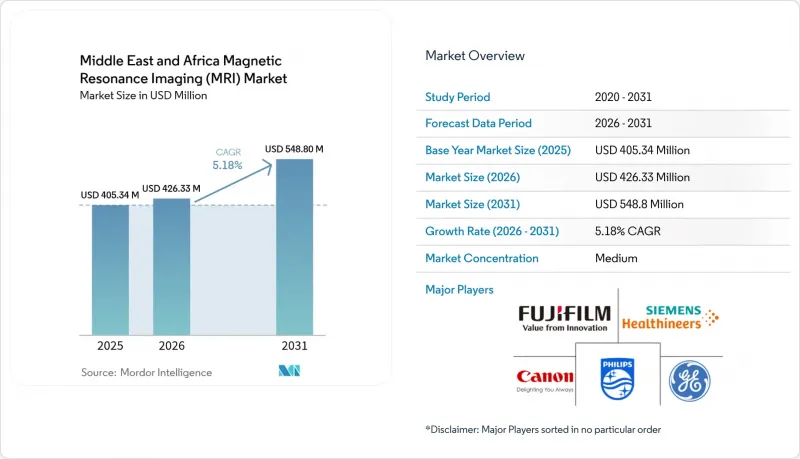
This report is Segmented by Architecture (Closed MRI Systems, Open MRI Systems), Field Strength (Low-Field < 1. 5 T, High-Field 1. 5 T, Very-High 3 T & Ultra-High >= 7 T), Application (Oncology, and More), End User (Hospitals, Diagnostic Imaging Centers, Others), and Geography (GCC, South Africa, Rest of Middle East and Africa). The Market Forecasts are Provided in Terms of Value (USD).
Middle East And Africa Magnetic Resonance Imaging (MRI) Market Trends and Insights
Growing Chronic-Disease & Aging Burden
Chronic illnesses such as diabetes, cardiovascular disease, and prostate cancer continue to climb, driving demand for stroke, cardiac, and whole-body MRI protocols across the Middle East and Africa MRI market. GCC governments finance prevention campaigns that make advanced imaging a front-line tool for population health management. Egypt's universal insurance expansion alone targets 12.8 million new beneficiaries by 2030, guaranteeing reimbursement for medically necessary scans. MRI vendors benefit from predictable throughput and the associated service revenue tied to long-term disease monitoring.
National Insurance Reforms and Screening Programs
Mandatory screening frameworks in Saudi Arabia, the UAE, and South Africa embed MRI volumes directly into reimbursement schedules, stabilizing cash flow for providers and creating scale economies for equipment suppliers. Cloud-based health-information exchanges unify scheduling, reporting, and archival, ensuring that scanners reach higher utilization thresholds. Volume-based reimbursement negotiations tighten per-scan margins yet reward manufacturers that market uptime-focused service contracts and AI engines that shorten acquisition times.
High Acquisition & Lifecycle Cost
Conventional 1.5 T installations range from USD 1-3 million plus 8-12% annual maintenance, stretching limited capital in low-income economies. Cooling, shielding, and helium demands add 30-50% to project budgets, forcing many hospitals to opt for refurbished systems or vendor-financed leasing that extends payback horizons. Helium-free magnet designs now reduce running expenses, but sticker prices remain a hurdle until bulk-purchase consortia mature.
Other drivers and restraints analyzed in the detailed report include:
- AI-Enhanced 3 T Imaging & Workflow Automation
- Rise of Portable Low-Field POC MRI Units
- Radiologist / Technologist Shortage
For complete list of drivers and restraints, kindly check the Table Of Contents.
Segment Analysis
Closed scanners generated 63.78% of 2025 revenue in the Middle East and Africa MRI market. High signal-to-noise ratio and compatibility with advanced neurological protocols sustain their primacy. Hospitals favor these systems for stroke and oncology pathways that require sub-millimeter resolution. Open designs, meanwhile, are advancing at 5.69% CAGR as claustrophobia-sensitive patient groups and interventional teams demand lateral access and comfort.
Fujifilm's 0.4 T platform couples wide bores with motion-compensated RADAR sequences, narrowing the image-quality gap to closed units and satisfying ISO 13485 compliance. Independent imaging centers leverage lower purchase prices and faster room turnover to reach breakeven sooner, pushing additional closed-to-open mix shifts in outpatient settings.
High-field 1.5 T systems accounted for 54.25% of 2025 scanner installations because they balance diagnostic versatility with manageable siting requirements. The Middle East and Africa MRI market share for ultra-high 3 T and >=7 T units is rising quickly as research hospitals and cancer centers seek superior tissue contrast. Virtually helium-free 1.5 T and 3 T magnets from Philips have already conserved 5 million L of helium worldwide.
Canon Medical's 3 T Supreme Edition integrates deep-learning reconstruction to shorten protocols and minimize operator steps. Portable low-field models below 1.5 T cater to emergency neurology and neonatal wards that lack the infrastructure for superconducting magnets. Collectively, these tiers expand the accessible customer base without cannibalizing core high-field demand.
Complete Report Scope:
- By Architecture
- Closed MRI Systems
- Open MRI Systems
- By Field Strength
- Low-Field (< 1.5 T)
- High-Field (1.5 T)
- Very-High (3 T) & Ultra-High (>= 7 T)
- By Application
- Oncology
- Neurology
- Cardiology
- Gastroenterology
- Musculoskeletal
- Other Applications
- By End User
- Hospitals
- Diagnostic Imaging Centers
- Others
- By Geography
- GCC
- South Africa
- Rest of Middle East and Africa
List of Companies Covered in this Report:
- Siemens Healthineers
- GE Healthcare
- Koninklijke Philips
- Canon
- FUJIFILM
- Esaote
- United Imaging Healthcare
- Hyperfine, Inc.
- Hitachi Ltd. (Medical)
- Fonar
- Shimadzu
- Neusoft Medical Systems
- Hologic Inc. (Breast MRI)
- Mediso
- Aurora Imaging Technology
- Time Medical Systems
- Wandong Medical
- Shenzhen Anke High-tech
- Imris Inc.
Additional Benefits:
- The market estimate (ME) sheet in Excel format
- 3 months of analyst support
TABLE OF CONTENTS
1 Introduction
- 1.1 Study Assumptions & Market Definition
- 1.2 Scope of the Study
2 Research Methodology
3 Executive Summary
4 Market Landscape
- 4.1 Market Overview
- 4.2 Market Drivers
- 4.2.1 Growing Chronic-Disease & Ageing Burden
- 4.2.2 National Insurance Reforms And Cancer/Cardiac Screening Programmes In Saudi Arabia, UAE And South Africa
- 4.2.3 Expansion Of Public-Sector Healthcare Projects
- 4.2.4 AI-Enhanced 3T Imaging & Workflow Automation
- 4.2.5 Rise Of Portable Low-Field POC MRI Units
- 4.2.6 Gulf Sovereign-Fund PPP Diagnostic Clusters
- 4.3 Market Restraints
- 4.3.1 High Acquisition & Lifecycle Cost
- 4.3.2 Radiologist / Technologist Shortage
- 4.3.3 Power-Grid & Cooling-Water Instability
- 4.3.4 Limited Reimbursement For Advanced Sequences
- 4.4 Value / Supply-Chain Analysis
- 4.5 Regulatory Landscape
- 4.6 Technological Outlook
- 4.7 Porter's Five Forces Analysis
- 4.7.1 Threat of New Entrants
- 4.7.2 Bargaining Power of Buyers/Consumers
- 4.7.3 Bargaining Power of Suppliers
- 4.7.4 Threat of Substitute Products
- 4.7.5 Intensity of Competitive Rivalry
5 Market Size & Growth Forecasts (Value, USD)
- 5.1 By Architecture
- 5.1.1 Closed MRI Systems
- 5.1.2 Open MRI Systems
- 5.2 By Field Strength
- 5.2.1 Low-Field (< 1.5 T)
- 5.2.2 High-Field (1.5 T)
- 5.2.3 Very-High (3 T) & Ultra-High (>= 7 T)
- 5.3 By Application
- 5.3.1 Oncology
- 5.3.2 Neurology
- 5.3.3 Cardiology
- 5.3.4 Gastroenterology
- 5.3.5 Musculoskeletal
- 5.3.6 Other Applications
- 5.4 By End User
- 5.4.1 Hospitals
- 5.4.2 Diagnostic Imaging Centers
- 5.4.3 Others
- 5.5 By Geography
- 5.5.1 GCC
- 5.5.2 South Africa
- 5.5.3 Rest of Middle East and Africa
6 Competitive Landscape
- 6.1 Market Concentration
- 6.2 Market Share Analysis
- 6.3 Company Profiles (includes Global level Overview, Market level overview, Core Segments, Financials as available, Strategic Information, Market Rank/Share for key companies, Products & Services, and Recent Developments)
- 6.3.1 Siemens Healthineers
- 6.3.2 GE Healthcare
- 6.3.3 Koninklijke Philips N.V.
- 6.3.4 Canon Medical Systems
- 6.3.5 Fujifilm Healthcare
- 6.3.6 Esaote SpA
- 6.3.7 United Imaging Healthcare
- 6.3.8 Hyperfine, Inc.
- 6.3.9 Hitachi Ltd. (Medical)
- 6.3.10 Fonar Corporation
- 6.3.11 Shimadzu Corporation
- 6.3.12 Neusoft Medical Systems
- 6.3.13 Hologic Inc. (Breast MRI)
- 6.3.14 Mediso Ltd.
- 6.3.15 Aurora Imaging Technology
- 6.3.16 Time Medical Systems
- 6.3.17 Wandong Medical
- 6.3.18 Shenzhen Anke High-tech
- 6.3.19 Imris Inc.
7 Market Opportunities & Future Outlook
- 7.1 White-space & Unmet-Need Assessment

