PUBLISHER: Mordor Intelligence | PRODUCT CODE: 2113776

PUBLISHER: Mordor Intelligence | PRODUCT CODE: 2113776
Asia Pacific Magnetic Resonance Imaging (MRI) - Market Share Analysis, Industry Trends & Statistics, Growth Forecasts (2026 - 2031)
According to Mordor Intelligence, the Asia Pacific magnetic resonance imaging market size is expected to grow from USD 2.29 billion in 2025 to USD 2.44 billion in 2026 and is forecast to reach USD 3.32 billion by 2031 at 6.38% CAGR over 2026-2031.
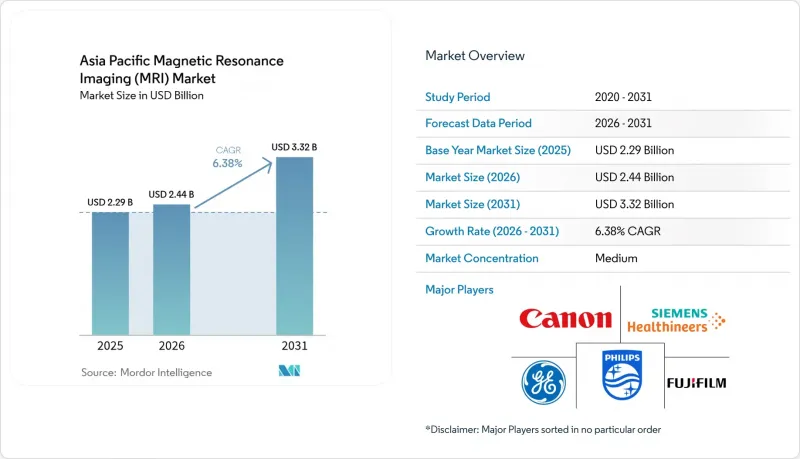
This report is Segmented by Architecture (Closed MRI Systems and Open MRI Systems), Field Strength (Low-Field <=0. 55 T, and More), Application (Neurology, Oncology, Musculoskeletal, Cardiology, Gastroenterology, Other Applications), and Country (China, Japan, India, South Korea, Australia, Rest of Asia-Pacific). The Market Forecasts are Provided in Terms of Value (USD).
Asia Pacific Magnetic Resonance Imaging (MRI) Market Trends and Insights
Increasing Burden of Chronic Diseases
Asia's rising prevalence of cardiovascular, oncologic, and neuro-degenerative disorders directly lifts annual MRI exam volumes. Diabetes-related neuropathy and stroke screening require high-resolution brain and vascular imaging more frequently than five years ago, driving procurement of both 1.5 T workhorse scanners and premium 3 T platforms. Large tertiary hospitals in China now embed MRI into standardized care pathways for oncology staging, boosting average scans per installed unit to more than 5,500 per year, compared with 4,200 in 2021. As chronic disease management shifts toward early intervention, health ministries continue to subsidize advanced imaging capacity, sustaining baseline growth for the Asia Pacific magnetic resonance imaging market.
Universal-Health-Coverage Expansion in Asian Nations
National insurance schemes such as India's Ayushman Bharat have increased covered outpatient imaging, expanding the addressable patient pool by up to 63 million lives since 2023. The immediate effect is a rise in entry-level and refurbished MRI purchases at district hospitals that previously relied on CT or patient referrals to metropolitan centers. Portable <=0.55 T systems attract administrators because they operate without shielded rooms, reducing installation cost by nearly 45% compared with conventional 1.5 T suites. Taken together, expanded coverage and cost-optimized hardware enlarge the Asia Pacific magnetic resonance imaging market.
High System Acquisition & Maintenance Costs
New 1.5 T installations carry an average ten-year total cost of ownership exceeding USD 2.8 million once facility retrofit, preventive maintenance, and software upgrades are included. Public hospitals in Indonesia and the Philippines allocate less than 6% of operating budgets to capital equipment, highlighting affordability barriers. Providers increasingly turn to subscription-based "imaging-as-a-service" models, shifting upfront investment to multiyear operating leases indexed to scan volume, a strategy pioneered by Philips and regional financing partners. Such models mitigate, but do not eliminate, cost restraints on the Asia Pacific magnetic resonance imaging market.
Other drivers and restraints analyzed in the detailed report include:
- Introduction of Hybrid MRI Systems in Emerging Markets
- AI-Enabled Accelerated Image Reconstruction Cuts Scan Time
- Helium Supply-Chain Vulnerability
For complete list of drivers and restraints, kindly check the Table Of Contents.
Segment Analysis
Open scanners delivered 8.27% CAGR between 2026 and 2031, outpacing the overall Asia Pacific magnetic resonance imaging market although closed configurations retained 55.02% share in 2025. Hospitals value the 270-degree patient access of open bores for interventional procedures and for cohorts prone to claustrophobia. Portable iterations weighing under 3 tons are now dispatched to rural clinics in Sichuan Province under provincial tele-imaging pilots, confirming that form factor flexibility converts directly into expanded patient reach. As reconstruction software compensates for lower field strength, diagnostic confidence in musculoskeletal and pediatric cases matches closed-bore benchmarks. Growth remains strongest in Southeast Asia, where outpatient imaging centers differentiate with comfort-oriented marketing.
Open architecture suppliers are layering cloud-based protocol libraries and automated positioning aids, reducing technologist learning curves. Meanwhile, closed systems continue to dominate research and high-end neurological applications because of superior gradient performance and coil ecosystem depth. Vendors have started offering hybrid service contracts allowing providers to mix open and closed units under a single uptime guarantee, a model gaining traction in Japan's private hospital groups. Consequently, both sub-segments reinforce the Asia Pacific magnetic resonance imaging market, with open systems supplying incremental volume while closed platforms preserve high-resolution leadership.
Complete Report Scope:
- By Architecture
- Closed MRI Systems
- Open MRI Systems
- By Field Strength
- Low-Field (<=0.55 T)
- Mid/High-Field (1.5 T)
- Very-High-Field (3 T)
- Ultra-High-Field (7 T +)
- By Application
- Neurology
- Oncology
- Musculoskeletal
- Cardiology
- Gastroenterology
- Other Applications
- Country
- China
- Japan
- India
- South Korea
- Australia
- Rest of Asia-Pacific
List of Companies Covered in this Report:
- Alltech Medical Systems
- Aspect Imaging
- Beijing Wandong Medical
- Bruker BioSpin
- Canon
- Esaote
- FUJIFILM
- GE Healthcare
- Hitachi Healthcare (Part of Fujifilm)
- Mindray (Shenzhen Mindray Bio-Medical)
- MR Solutions
- Neusoft Medical Systems
- Koninklijke Philips
- Shenzhen Anke High-Tech
- Shenzhen Basda Medical
- Siemens Healthineers
- SpinTech MRI
- Synaptive Medical
- Time Medical Systems
- United Imaging Healthcare
Additional Benefits:
- The market estimate (ME) sheet in Excel format
- 3 months of analyst support
TABLE OF CONTENTS
1 Introduction
- 1.1 Study Assumptions & Market Definition
- 1.2 Scope of the Study
2 Research Methodology
3 Executive Summary
4 Market Landscape
- 4.1 Market Overview
- 4.2 Market Drivers
- 4.2.1 Increasing Burden of Chronic Diseases
- 4.2.2 Universal-Health-Coverage Expansion in Asian Nations
- 4.2.3 Introduction of Hybrid MRI Systems in Emerging Markets
- 4.2.4 Rapid Growth in Ageing Population & Imaging Demand
- 4.2.5 AI-Enabled Accelerated Image-Reconstruction Cuts Scan Time
- 4.2.6 Domestic Magnet/Cryogen Manufacturing Incentives
- 4.3 Market Restraints
- 4.3.1 High System Acquisition & Maintenance Costs
- 4.3.2 Helium Supply-Chain Vulnerability
- 4.3.3 Shortage of Sub-Specialty Radiologists
- 4.3.4 Hospital CAPEX Diversion to CT & PET During Economic Slowdowns
- 4.4 Value / Supply-Chain Analysis
- 4.5 Regulatory Landscape
- 4.6 Technological Outlook
- 4.7 Porter's Five Forces
- 4.7.1 Threat of New Entrants
- 4.7.2 Bargaining Power of Buyers
- 4.7.3 Bargaining Power of Suppliers
- 4.7.4 Threat of Substitutes
- 4.7.5 Intensity of Competitive Rivalry
5 Market Size & Growth Forecasts (Value, USD)
- 5.1 By Architecture
- 5.1.1 Closed MRI Systems
- 5.1.2 Open MRI Systems
- 5.2 By Field Strength
- 5.2.1 Low-Field (<=0.55 T)
- 5.2.2 Mid/High-Field (1.5 T)
- 5.2.3 Very-High-Field (3 T)
- 5.2.4 Ultra-High-Field (7 T +)
- 5.3 By Application
- 5.3.1 Neurology
- 5.3.2 Oncology
- 5.3.3 Musculoskeletal
- 5.3.4 Cardiology
- 5.3.5 Gastroenterology
- 5.3.6 Other Applications
- 5.4 Country
- 5.4.1 China
- 5.4.2 Japan
- 5.4.3 India
- 5.4.4 South Korea
- 5.4.5 Australia
- 5.4.6 Rest of Asia-Pacific
6 Competitive Landscape
- 6.1 Market Concentration
- 6.2 Market Share Analysis
- 6.3 Company Profiles (includes Global level Overview, Market level overview, Core Segments, Financials as available, Strategic Information, Market Rank/Share for key companies, Products & Services, Recent Developments)
- 6.3.1 Alltech Medical Systems
- 6.3.2 Aspect Imaging
- 6.3.3 Beijing Wandong Medical
- 6.3.4 Bruker BioSpin
- 6.3.5 Canon Medical Systems
- 6.3.6 Esaote SpA
- 6.3.7 Fujifilm Corporation
- 6.3.8 GE Healthcare
- 6.3.9 Hitachi Healthcare (Part of Fujifilm)
- 6.3.10 Mindray (Shenzhen Mindray Bio-Medical)
- 6.3.11 MR Solutions
- 6.3.12 Neusoft Medical Systems
- 6.3.13 Koninklijke Philips NV
- 6.3.14 Shenzhen Anke High-Tech
- 6.3.15 Shenzhen Basda Medical
- 6.3.16 Siemens Healthineers
- 6.3.17 SpinTech MRI
- 6.3.18 Synaptive Medical
- 6.3.19 Time Medical Systems
- 6.3.20 United Imaging Healthcare
7 Market Opportunities & Future Outlook
- 7.1 White-space & Unmet-Need Assessment

