PUBLISHER: Mordor Intelligence | PRODUCT CODE: 2113632

PUBLISHER: Mordor Intelligence | PRODUCT CODE: 2113632
Europe Genetic Testing - Market Share Analysis, Industry Trends & Statistics, Growth Forecasts (2026 - 2031)
According to Mordor Intelligence, the Europe genetic testing market size is expected to grow from USD 6.82 billion in 2025 to USD 7.52 billion in 2026 and is forecast to reach USD 12.29 billion by 2031 at 10.31% CAGR over 2026-2031.
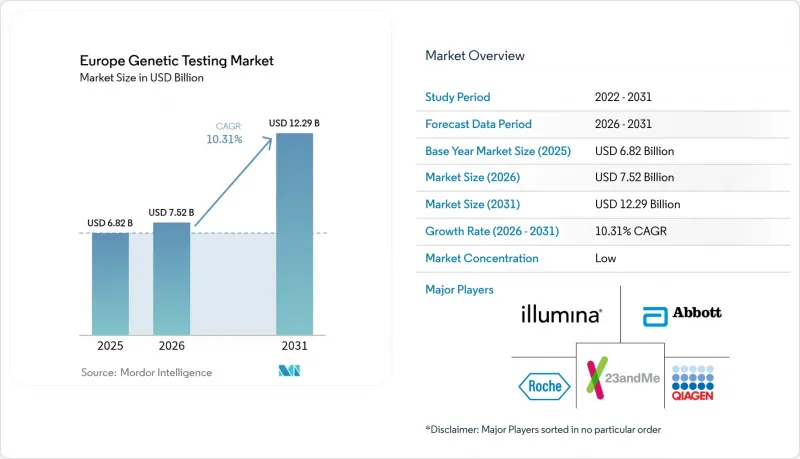
This report Segments the Industry Into by Type (Carrier Testing, Diagnostic Testing, Newborn Screening, Predictive and Presymptomatic Testing, Prenatal Testing, and More), by Disease (Alzheimer's Disease, Cancer, Cystic Fibrosis, Sickle Cell Anemia, and More), by Technology (Cytogenetic Testing, Biochemical Testing, and More), and Geography (Germany, United Kingdom, France, and More).
Europe Genetic Testing Market Trends and Insights
Growing Adoption of NGS-Based Comprehensive Panels by European Healthcare Systems
National health systems now reimburse NGS tumor and rare-disease panels, raising diagnostic yields above 40% versus 25% for sequential single-gene tests. Germany's Molecular Tumor Board network covers comprehensive genomic profiling for advanced cancers, while the UK's NHS offers free BRCA screening to Jewish women over 30, demonstrating a policy shift toward preventive genomics. Reimbursement clarity pushes laboratories to upgrade capacity, stimulate reagent demand, and invest in cloud-based bioinformatics that integrate directly with electronic clinical records. Device makers respond by launching CE-IVD marked comprehensive assays that bundle tumor mutation burden, microsatellite instability, and gene-fusion profiling in a single test run.
Expansion of Newborn and Population Genomic Screening Programs in EU States
Belgium's BabyDetect initiative screens newborns for more than 200 disorders-supported by EUR 25 million in federal funds-and delivers results within two weeks, catching treatable metabolic and immunodeficiency syndromes earlier than biochemical panels. The UK's Newborn Genomes Programme is sequencing 200,000 babies to assess actionable variants that can benefit from early interventions such as enzyme-replacement or dietary modifications. These pilots leverage Screen4Care, a EUR 15 million Horizon Europe grant, to standardize genomic data pipelines across seven member states. Data show a 35% rise in early detection of rare diseases, validating program scalability and reinforcing demand for high-throughput sequencers as well as variant-interpretation software.
Delays in Reimbursement Approvals Across National Health Insurers
Italian providers wait 18-24 months for genetic-test reimbursement decisions, triple the time required in Germany or the Netherlands, undermining equitable access and slowing revenue realization for innovators. Spain's autonomous regions each apply divergent coverage criteria, prompting laboratories to navigate 17 distinct approval pathways. The 2024 joint EU Health Technology Assessment Regulation aims to harmonize requirements, but transitional overlap with IVDR doubles dossier workload and prolongs market entry timelines for pharmacogenomics and broad tumor panels. Providers frequently rely on private payment or research grants, dampening volume growth and constraining economies of scale.
Other drivers and restraints analyzed in the detailed report include:
- Falling Sequencing Costs Due to European Infrastructure Investments
- Rising Prevalence of Hereditary Cancers Driving Demand for BRCA & Multigene Tests
- Shortage of Certified Genetic Counselors Limiting Test Uptake
For complete list of drivers and restraints, kindly check the Table Of Contents.
Segment Analysis
NGS commanded 40.62% of Europe genetic testing market share in 2025, reflecting its cost-efficient multigene capability and entrenched role in oncology and rare-disease diagnostics. PCR platforms trail yet post the segment's fastest 10.91% CAGR as hospitals deploy real-time kits for neonatal sepsis and pharmacogenomics where same-day decisions are critical.
Hospital laboratories standardize workflows around dual-platform strategies that leverage NGS for comprehensive insights and PCR for urgent triage, enabling continuity of operations during instrument maintenance windows. EU IVDR compliance favors vendors with integrated quality-management documentation, prompting smaller kit manufacturers to partner with multinational distributors. As throughput increases, reagent-rental contracts lower upfront costs, supporting wider adoption among mid-size pathology networks.
Complete Report Scope:
- By Technology (Value)
- Next-Generation Sequencing (NGS)
- Polymerase Chain Reaction (PCR)
- Microarray
- Fluorescence In Situ Hybridization (FISH)
- Sanger Sequencing
- Other Technologies
- By Application (Value)
- Cancer Diagnosis & Prognosis
- Cardiovascular Disease Diagnosis
- Neurological Disorder Diagnosis
- Ancestry & Wellness
- Other Applications
- By End User (Value)
- Hospitals & Clinics
- Diagnostic Laboratories
- Academic & Research Institutes
- Direct-to-Consumer Companies
- Other End Users
- Europe
- Germany
- United Kingdom
- France
- Italy
- Spain
- Rest of Europe
List of Companies Covered in this Report:
- 23andMe Holding Co.
- Agilent Technologies
- BGI Genomics Co., Ltd.
- Quest Diagnostics
- Centogene
- Danaher
- Dante Labs
- Eurofins
- Kaneka
- Roche
- GeneFirst Ltd.
- Genedrive plc
- Genomics England
- Guardant Health Europe
- Illumina
- Invitae
- LGC Biosearch Technologies
- Myriad Genetics
- Medicover Diagnostics
- Novogene Europe
- Oxford Nanopore Technologies plc
- QIAGEN
Additional Benefits:
- The market estimate (ME) sheet in Excel format
- 3 months of analyst support
TABLE OF CONTENTS
1 Introduction
- 1.1 Study Assumptions & Market Definition
- 1.2 Scope of the Study
2 Research Methodology
3 Executive Summary
4 Market Landscape
- 4.1 Market Overview
- 4.2 Market Drivers
- 4.2.1 Growing adoption of NGS-based comprehensive panels by European healthcare systems
- 4.2.2 Expansion of newborn and population genomic screening programs in EU states
- 4.2.3 Falling sequencing costs due to European infrastructure investments
- 4.2.4 Rising prevalence of hereditary cancers driving demand for BRCA & multigene tests
- 4.2.5 EU IVDR prompting shift to high-quality CE-IVD test kits creating replacement demand
- 4.2.6 Cross-border tele-genetics services enabling access in underserved Eastern Europe
- 4.3 Market Restraints
- 4.3.1 Delays in reimbursement approvals across national health insurers
- 4.3.2 Shortage of certified genetic counselors limiting test uptake
- 4.3.3 Data sovereignty rules complicating pan-European genomic data sharing
- 4.3.4 Scarcity of validated polygenic risk scores for non-European ancestries in Europe's migrant populations
- 4.4 Value / Supply-Chain Analysis
- 4.5 Regulatory Landscape
- 4.6 Technological Outlook
- 4.7 Porter's Five Forces
- 4.7.1 Bargaining Power of Suppliers
- 4.7.2 Bargaining Power of Buyers
- 4.7.3 Threat of New Entrants
- 4.7.4 Threat of Substitutes
- 4.7.5 Competitive Rivalry
5 Market Size & Growth Forecasts
- 5.1 By Technology (Value)
- 5.1.1 Next-Generation Sequencing (NGS)
- 5.1.2 Polymerase Chain Reaction (PCR)
- 5.1.3 Microarray
- 5.1.4 Fluorescence In Situ Hybridization (FISH)
- 5.1.5 Sanger Sequencing
- 5.1.6 Other Technologies
- 5.2 By Application (Value)
- 5.2.1 Cancer Diagnosis & Prognosis
- 5.2.2 Cardiovascular Disease Diagnosis
- 5.2.3 Neurological Disorder Diagnosis
- 5.2.4 Ancestry & Wellness
- 5.2.5 Other Applications
- 5.3 By End User (Value)
- 5.3.1 Hospitals & Clinics
- 5.3.2 Diagnostic Laboratories
- 5.3.3 Academic & Research Institutes
- 5.3.4 Direct-to-Consumer Companies
- 5.3.5 Other End Users
- 5.4 Europe
- 5.4.1 Germany
- 5.4.2 United Kingdom
- 5.4.3 France
- 5.4.4 Italy
- 5.4.5 Spain
- 5.4.6 Rest of Europe
6 Competitive Landscape
- 6.1 Market Concentration
- 6.2 Market Share Analysis
- 6.3 Company Profiles {(includes Global level Overview, Market level Overview, Core Segments, Financials as available, Strategic Information, Market Rank/Share for key companies, Products & Services, and Recent Developments)}
- 6.3.1 23andMe Holding Co.
- 6.3.2 Agilent Technologies Inc.
- 6.3.3 BGI Genomics Co., Ltd.
- 6.3.4 Quest Diagnostics
- 6.3.5 Centogene N.V.
- 6.3.6 Danaher Corporation
- 6.3.7 Dante Labs
- 6.3.8 Eurofins Scientific
- 6.3.9 Kaneka Corporation
- 6.3.10 F. Hoffmann-La Roche Ltd
- 6.3.11 GeneFirst Ltd.
- 6.3.12 Genedrive plc
- 6.3.13 Genomics England
- 6.3.14 Guardant Health Europe
- 6.3.15 Illumina Inc.
- 6.3.16 Invitae Corporation
- 6.3.17 LGC Biosearch Technologies
- 6.3.18 Myriad Genetics Inc.
- 6.3.19 Medicover Diagnostics
- 6.3.20 Novogene Europe
- 6.3.21 Oxford Nanopore Technologies plc
- 6.3.22 Qiagen N.V.
7 Market Opportunities & Future Outlook
- 7.1 White-space & unmet-need assessment

