PUBLISHER: Mordor Intelligence | PRODUCT CODE: 2114359

PUBLISHER: Mordor Intelligence | PRODUCT CODE: 2114359
Asia-Pacific Genetic Testing - Market Share Analysis, Industry Trends & Statistics, Growth Forecasts (2026 - 2031)
According to Mordor Intelligence, the Asia-Pacific genetic testing market size is expected to grow from USD 1.82 billion in 2025 to USD 1.98 billion in 2026 and is forecast to reach USD 3.01 billion by 2031 at 8.78% CAGR over 2026-2031.
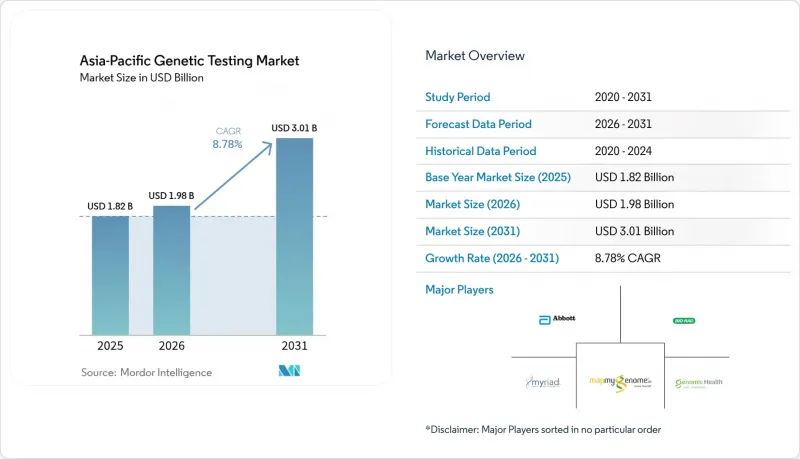
This report is Segmented by Technology (Next-Generation Sequencing, Polymerase Chain Reaction, and More), Application (Cancer Diagnosis & Prognosis, Cardiovascular Disease Diagnosis, and More), End User (Hospitals & Clinics, Diagnostic Laboratories, and More), and Geography (China, India, Japan, and More). The Market Forecasts are Provided in Terms of Value (USD).
Asia-Pacific Genetic Testing Market Trends and Insights
Expanding NGS-based Oncology & Rare-Disease Diagnostics
Liquid biopsy platforms validated in trials such as the CIRCULATE-Japan GALAXY study have shifted postoperative colorectal cancer surveillance toward circulating tumor DNA testing that predicted recurrence risk with 12-fold higher accuracy than conventional markers. National insurance in Japan now reimburses comprehensive genomic profiling, prompting neighboring regulators to re-evaluate coverage criteria. The SCRUM-Japan GOZILA project further demonstrated that liquid biopsy-guided therapies doubled median overall survival, reinforcing the clinical and economic rationale for routine genomic assays. Rare-disease programs leverage falling whole-genome prices to integrate sequencing into newborn screening agendas, especially as variant-interpretation AI tools compensate for shortages of trained genetic counselors in India and Southeast Asia. Together these shifts enlarge testing volumes and catalyze laboratory investments across primary care networks.
National Genomics Initiatives (China, India, Japan)
Government programs continue to build sovereign data assets and domestic laboratory capabilities that insulate local ecosystems from export controls and supply-chain shocks. India's Genome India Project, having sequenced 10,000 representative genomes, supplies reference alleles that improve diagnostic accuracy for South Asian populations. In China, BGI Genomics is scaling colorectal cancer screening to roughly 800,000 individuals in Harbin, demonstrating industrial capacity for population-wide interventions. Japan's nationwide whole-genome sequencing for cancer patients integrates clinical data with reimbursement, generating a feedback loop that propels adoption. These coordinated initiatives set common data standards, accelerate clinician education, and stimulate private investment in advanced sequencing hardware.
Fragmented APAC Regulatory Frameworks
Divergent approval pathways require duplicate validation even for platforms with FDA or CE clearances, extending launch timelines by up to 18 months in Japan and 12 months in South Korea. Australia mandates separate laboratory accreditation under TGA guidelines that differ from Singapore's Health Products Regulation Group, raising compliance costs for multinational laboratories. Smaller providers struggle to finance multiple dossiers, leading to country-specific monopolies that inflate test prices. Although ASEAN ministers discuss regulatory harmonization, tangible progress remains limited, prolonging market fragmentation through 2030.
Other drivers and restraints analyzed in the detailed report include:
- Declining Sequencing Costs
- Tele-genetics Adoption in Emerging APAC
- Data-Privacy & Public-Trust Concerns
For complete list of drivers and restraints, kindly check the Table Of Contents.
Segment Analysis
Next-Generation Sequencing held 37.84% of Asia-Pacific genetic testing market share in 2025 and remains the backbone for clinical oncology, while CRISPR-based enrichment is poised to grow at 8.89% CAGR through 2031 as laboratories emphasize targeted detection for liquid biopsy panels. The Asia-Pacific genetic testing market size for long-read sequencing is expanding as Genex introduced consumer PacBio Revio services priced at JPY 498,000 (USD 3,320) in 2025, demonstrating demand for structural-variant discovery beyond single nucleotide changes. Polymerase Chain Reaction retains relevance for point-of-care pathogen assays, especially in Southeast Asian clinics where instrument uptime and electricity remain constraints. Microarray platforms continue in ancestry and wellness testing, though clinical reimbursement shifts investment toward higher-resolution methods.
Laboratories are integrating artificial intelligence pipelines from firms such as GrandOmics to shorten variant-annotation cycles, improving report turnaround times from 10 days to 48 hours. Fluorescence in situ hybridization persists as a confirmatory step for chromosomal translocations in hematologic malignancies, mandated by Japanese oncology guidelines. Sanger sequencing maintains a niche for low-throughput single-gene confirmations in inherited cardiomyopathy panels, particularly when clinicians seek orthogonal validation. Collectively, the technology mix illustrates a strategic layering: comprehensive NGS for discovery, enrichment for surveillance, and legacy modalities for regulatory-driven confirmations, each reinforcing the Asia-Pacific genetic testing market as a multidimensional ecosystem.
Complete Report Scope:
- By Technology (Value)
- Next-Generation Sequencing (NGS)
- Polymerase Chain Reaction (PCR)
- Microarray
- Fluorescence In Situ Hybridization (FISH)
- Sanger Sequencing
- Other Technologies
- By Application (Value)
- Cancer Diagnosis & Prognosis
- Cardiovascular Disease Diagnosis
- Neurological Disorder Diagnosis
- Ancestry & Wellness
- Other Applications
- By End User (Value)
- Hospitals & Clinics
- Diagnostic Laboratories
- Academic & Research Institutes
- Direct-to-Consumer Companies
- Other End Users
- By country
- China
- India
- Japan
- Australia
- South Korea
- Rest of Asia-Pacific
List of Companies Covered in this Report:
- Abbott Laboratories
- Agilent Technologies
- BGI Genomics Co. Ltd.
- Danaher
- DNA Forensics Laboratory Pvt Ltd.
- Eurofins
- Roche
- Genetica DNA Laboratory Vietnam Co. Ltd.
- Illumina Biometrics Pty Ltd.
- Illumina
- Macrogen
- Mapmygenome India Ltd.
- Myriad Genetics
- Oxford Nanopore Technologies plc
- PerkinElmer
- Prenetics Global Ltd.
- QIAGEN
- Quest Diagnostics
- Strand Life Sciences Pvt Ltd.
- Telix Pharmaceuticals Ltd.
- Thermo Fisher Scientific
Additional Benefits:
- The market estimate (ME) sheet in Excel format
- 3 months of analyst support
TABLE OF CONTENTS
1 Introduction
- 1.1 Study Assumptions & Market Definition
- 1.2 Scope of the Study
2 Research Methodology
3 Executive Summary
4 Market Landscape
- 4.1 Market Overview
- 4.2 Market Drivers
- 4.2.1 Expanding NGS-based oncology & rare-disease diagnostics
- 4.2.2 National genomics initiatives (China, India, Japan)
- 4.2.3 Declining sequencing costs
- 4.2.4 Tele-genetics adoption in emerging APAC
- 4.2.5 CRO-led precision-oncology trial demand
- 4.3 Market Restraints
- 4.3.1 Fragmented APAC regulatory frameworks
- 4.3.2 Data-privacy & public-trust concerns
- 4.3.3 Limited Asian reference genomes
- 4.4 Value / Supply-Chain Analysis
- 4.5 Regulatory Landscape
- 4.6 Technological Outlook
- 4.7 Porter's Five Forces
- 4.7.1 Threat of New Entrants
- 4.7.2 Bargaining Power of Suppliers
- 4.7.3 Bargaining Power of Buyers
- 4.7.4 Threat of Substitutes
- 4.7.5 Competitive Rivalry
5 Market Size & Growth Forecasts
- 5.1 By Technology (Value)
- 5.1.1 Next-Generation Sequencing (NGS)
- 5.1.2 Polymerase Chain Reaction (PCR)
- 5.1.3 Microarray
- 5.1.4 Fluorescence In Situ Hybridization (FISH)
- 5.1.5 Sanger Sequencing
- 5.1.6 Other Technologies
- 5.2 By Application (Value)
- 5.2.1 Cancer Diagnosis & Prognosis
- 5.2.2 Cardiovascular Disease Diagnosis
- 5.2.3 Neurological Disorder Diagnosis
- 5.2.4 Ancestry & Wellness
- 5.2.5 Other Applications
- 5.3 By End User (Value)
- 5.3.1 Hospitals & Clinics
- 5.3.2 Diagnostic Laboratories
- 5.3.3 Academic & Research Institutes
- 5.3.4 Direct-to-Consumer Companies
- 5.3.5 Other End Users
- 5.4 By country
- 5.4.1 China
- 5.4.2 India
- 5.4.3 Japan
- 5.4.4 Australia
- 5.4.5 South Korea
- 5.4.6 Rest of Asia-Pacific
6 Competitive Landscape
- 6.1 Market Concentration
- 6.2 Market Share Analysis
- 6.3 Company Profiles (includes Global Overview, Market Overview, Core Segments, Financials, Strategic Information, Market Rank/Share, Products & Services, Recent Developments)
- 6.3.1 Abbott Laboratories
- 6.3.2 Agilent Technologies Inc.
- 6.3.3 BGI Genomics Co. Ltd.
- 6.3.4 Danaher Corporation (Cepheid)
- 6.3.5 DNA Forensics Laboratory Pvt Ltd.
- 6.3.6 Eurofins Scientific SE
- 6.3.7 F. Hoffmann-La Roche AG
- 6.3.8 Genetica DNA Laboratory Vietnam Co. Ltd.
- 6.3.9 Illumina Biometrics Pty Ltd.
- 6.3.10 Illumina Inc.
- 6.3.11 Macrogen Inc.
- 6.3.12 Mapmygenome India Ltd.
- 6.3.13 Myriad Genetics Inc.
- 6.3.14 Oxford Nanopore Technologies plc
- 6.3.15 PerkinElmer Inc.
- 6.3.16 Prenetics Global Ltd.
- 6.3.17 QIAGEN N.V.
- 6.3.18 Quest Diagnostics Inc.
- 6.3.19 Strand Life Sciences Pvt Ltd.
- 6.3.20 Telix Pharmaceuticals Ltd.
- 6.3.21 Thermo Fisher Scientific Inc.

