PUBLISHER: Mordor Intelligence | PRODUCT CODE: 2113664

PUBLISHER: Mordor Intelligence | PRODUCT CODE: 2113664
Italy Automotive Electro-Hydraulic Power Steering - Market Share Analysis, Industry Trends & Statistics, Growth Forecasts (2026 - 2031)
According to Mordor Intelligence, the Italy automotive electro-hydraulic power steering market size is projected to expand from USD 193.2 million in 2025 to USD 201.4 million in 2026, and to USD 247.7 million by 2031, registering a CAGR of 4.2% between 2026 and 2031.
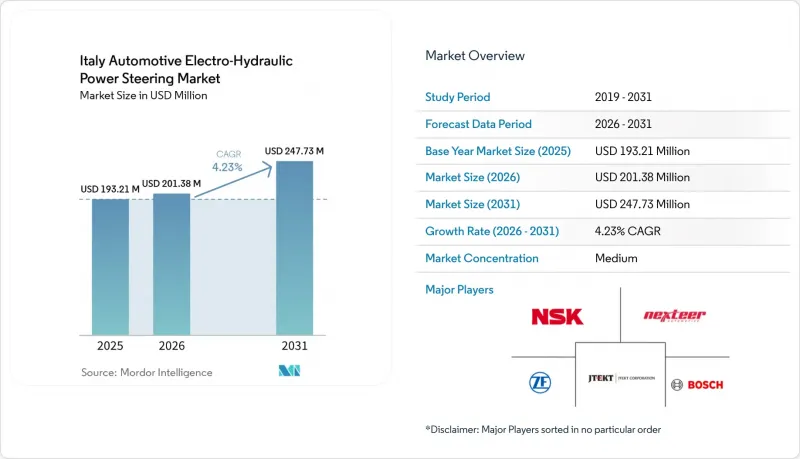
This report is Segmented by Vehicle Type (Passenger Cars, Light Commercial Vehicles, and More), Component Type (Steering Column and Rack Interface, Electric Motor, Hydraulic Pump, and More), Technology (Conventional, Advanced, Compact, and Rack-Assist EHPS), and Sales Channel (OEM Supply and Aftermarket Replacement). The Market Forecasts are in Terms of Value (USD).
Italy Automotive Electro-Hydraulic Power Steering Market Trends and Insights
EV and Hybrid Platform Compatibility
Italy's hybrid vehicle mix supports demand for the Italian electro-hydraulic power steering market. Hybrid systems can operate for extended periods without an engine-driven hydraulic pump. EHPS can provide hydraulic assist in those conditions on platforms that require higher steering loads. Hybrid-electric vehicles accounted for 44.1% of Italian new-car sales in H1 2025, establishing a large base for compatible steering fitment and future service demand. Plug-in hybrid registrations rose 86.6% in Italy in 2025 and increased 84.3% in the first half of 2026, supporting the shift toward electrified platforms . This mix makes powertrain choice more important to EHPS demand than overall new-vehicle volume alone.
Stricter CO2 and Fuel Efficiency Compliance
EU emissions regulation gives manufacturers a defined transition period to comply with fleet emissions rules. The regulation retains the carbon dioxide emissions target for passenger cars, keeping pressure on manufacturers to offer hybrid and other lower-emission powertrains. The European Commission's automotive package also maintains the long-term direction toward a substantial reduction in tailpipe emissions. Commercial vehicle operators can also assess steering efficiency when comparing operating costs.
EPS Migration in Compact Passenger Cars
Compact passenger vehicles are shifting toward column-mounted EPS. EPS is lighter, does not use hydraulic fluid, and is less costly to calibrate for lower rack-load applications. This makes EHPS less viable for the small-vehicle platforms that remain important in Italy. JTEKT introduced its Syncusteer steer-by-wire brand in 2026, indicating continued movement beyond established EPS designs in passenger vehicles. Nexteer began series production of its steer-by-wire system in April 2026 after ASIL D certification, creating another benchmark for next-generation passenger steering. The transition reduces EHPS fitment rates in city-car and subcompact vehicle lines.
Other drivers and restraints analyzed in the detailed report include:
- ADAS Ready Steering Assistance
- Fleet Renewal and Commercial Vehicle Maneuverability
- Higher System and Calibration Cost
For complete list of drivers and restraints, kindly check the Table Of Contents.
Segment Analysis
Passenger cars accounted for 62.22% of the Italian electro-hydraulic power steering market share in 2025. Their position reflects the large Italian hybrid-vehicle mix, although EPS migration limits demand in the city-car and subcompact ranges. Medium and heavy commercial vehicles, buses, and coaches benefit from fleet electrification policies and public procurement. Off-road equipment continues to require hydraulic steering under heavy loads and demanding operating conditions. A recent AGCO patent covers an electro-hydraulic steering system with a variable steering ratio for agricultural vehicles. This activity indicates that specialized equipment remains relevant to the Italian electro-hydraulic power steering market, even as passenger car applications evolve.
Light commercial vehicles are the fastest-growing vehicle type in the Italian electro-hydraulic power steering market, with a forecast CAGR of 7.42% through 2031. Fleet decarbonization funding supports electric and hybrid van platforms that require steering assistance during low engine load or electric operation. Stellantis began production of the Cargo Box BEV at its Atessa plant. Stellantis Pro One and Iveco Group also agreed to supply a range of battery-electric van models, with a commercial launch planned in the near term. Italy's incentive framework for heavier commercial vehicles reinforces demand in commercial weight classes. The Italian electro-hydraulic power steering market benefits from hydraulic assistance remaining practical for heavier van applications.
Steering column and rack interface components led with 32.51% of the Italian electro-hydraulic power steering market in 2025. These components remain the structural mounting and load-bearing base for the system. Electric motors and hydraulic pumps benefit from standardization across vehicle platform families. ECU and controller content rise as manufacturers place speed-sensitive and ADAS-compatible logic within the steering unit. Reservoirs, hoses, and related parts continue to support both original fitment and replacement demand. Bosch announced new commercial-vehicle workshop products and diagnostic solutions in 2026, reflecting continuing service support for steering systems.
Sensors and torque modules are the fastest-growing component category, with a 7.22% CAGR through 2031. Their growth reflects greater use of real-time torque feedback, variable-assist control, and interfaces for driver-assistance functions. Advanced control requirements are driving demand for electronic sensing components in both new fitment and retrofit applications. Active disturbance rejection control can improve the precision of EHPS angle tracking under dynamic loads. This supports investment in more responsive steering control systems. Higher electronic content is shifting part of the system's value from mechanical assemblies toward sensors and control functions.
Complete Report Scope:
- By Vehicle Type
- Passenger Cars
- Light Commercial Vehicles
- Medium and Heavy Commercial Vehicles
- Buses and Coaches
- Off-Road Vehicles
- Agricultural Equipment
- Construction Equipment
- Mining Equipment
- Material-Handling Equipment
- Forestry and Utility Off-Road Equipment
- Recreational Off-Road Vehicles
- By Component Type
- Steering Column and Rack Interface
- Electric Motor
- Hydraulic Pump
- Sensors and Torque Modules
- Electronic Control Unit and Controllers
- Reservoirs, Hoses, and Other Components
- By Technology
- Conventional EHPS
- Advanced EHPS
- Compact EHPS
- Rack-Assist and Pinion-Assist EHPS
- By Sales Channel
- OEM Supply
- Aftermarket Replacement
- Passenger Cars
List of Companies Covered in this Report:
- JTEKT Corporation
- Nexteer Automotive Group Limited
- Robert Bosch GmbH
- ZF Friedrichshafen AG
- NSK Ltd.
- Mando Corporation
- Hyundai Mobis Co., Ltd.
- Mitsubishi Electric Corporation
- Hitachi Astemo, Ltd.
- thyssenkrupp Presta AG
- Continental AG
- GKN Automotive Limited
- KYB Corporation
- DENSO Corporation
- Valeo SE
- Knorr-Bremse AG
- Shanghai OE Industrial Co., Ltd.
- Marelli Holdings Co., Ltd.
Additional Benefits:
- The market estimate (ME) sheet in Excel format
- 3 months of analyst support
TABLE OF CONTENTS
1 Introduction
- 1.1 Study Assumptions and Market Definition
- 1.2 Scope of the Study
2 Research Methodology
3 Executive Summary
4 Market Landscape
- 4.1 Market Overview
- 4.2 Market Drivers
- 4.2.1 EV and Hybrid Platform Compatibility
- 4.2.2 Stricter CO2 and Fuel-Efficiency Compliance
- 4.2.3 ADAS-Ready Steering Assistance
- 4.2.4 Fleet Renewal and Commercial Vehicle Maneuverability
- 4.2.5 EHPS Retrofitability Across Legacy Platforms
- 4.2.6 Regionalization of Italian Automotive Component Engineering
- 4.3 Market Restraints
- 4.3.1 EPS Migration in Compact Passenger Cars
- 4.3.2 Higher System and Calibration Cost
- 4.3.3 Italian Vehicle-Production Volatility
- 4.3.4 Limited Local Scale for High-Voltage and Software Validation
- 4.4 Value / Supply-Chain Analysis
- 4.5 Regulatory Landscape
- 4.6 Technological Outlook
- 4.7 Porter's Five Forces
- 4.7.1 Threat of New Entrants
- 4.7.2 Bargaining Power of Suppliers
- 4.7.3 Bargaining Power of Buyers
- 4.7.4 Threat of Substitutes
- 4.7.5 Competitive Rivalry
5 Market Size and Growth Forecasts (Value, USD)
- 5.1 By Vehicle Type
- 5.1.1 Passenger Cars
- 5.1.1.1 Light Commercial Vehicles
- 5.1.1.2 Medium and Heavy Commercial Vehicles
- 5.1.1.3 Buses and Coaches
- 5.1.1.4 Off-Road Vehicles
- 5.1.1.4.1 Agricultural Equipment
- 5.1.1.4.2 Construction Equipment
- 5.1.1.4.3 Mining Equipment
- 5.1.1.4.4 Material-Handling Equipment
- 5.1.1.4.5 Forestry and Utility Off-Road Equipment
- 5.1.1.4.6 Recreational Off-Road Vehicles
- 5.1.2 By Component Type
- 5.1.2.1 Steering Column and Rack Interface
- 5.1.2.2 Electric Motor
- 5.1.2.3 Hydraulic Pump
- 5.1.2.4 Sensors and Torque Modules
- 5.1.2.5 Electronic Control Unit and Controllers
- 5.1.2.6 Reservoirs, Hoses, and Other Components
- 5.1.3 By Technology
- 5.1.3.1 Conventional EHPS
- 5.1.3.2 Advanced EHPS
- 5.1.3.3 Compact EHPS
- 5.1.3.4 Rack-Assist and Pinion-Assist EHPS
- 5.1.4 By Sales Channel
- 5.1.4.1 OEM Supply
- 5.1.4.2 Aftermarket Replacement
- 5.1.1 Passenger Cars
6 Competitive Landscape
- 6.1 Market Concentration
- 6.2 Strategic Moves
- 6.3 Market Share Analysis
- 6.4 Company Profiles (Includes Global Level Overview, Market Level Overview, Core Segments, Financials as available, Strategic Information, Market Rank/Share, Products and Services, Recent Developments)
- 6.4.1 JTEKT Corporation
- 6.4.2 Nexteer Automotive Group Limited
- 6.4.3 Robert Bosch GmbH
- 6.4.4 ZF Friedrichshafen AG
- 6.4.5 NSK Ltd.
- 6.4.6 Mando Corporation
- 6.4.7 Hyundai Mobis Co., Ltd.
- 6.4.8 Mitsubishi Electric Corporation
- 6.4.9 Hitachi Astemo, Ltd.
- 6.4.10 thyssenkrupp Presta AG
- 6.4.11 Continental AG
- 6.4.12 GKN Automotive Limited
- 6.4.13 KYB Corporation
- 6.4.14 DENSO Corporation
- 6.4.15 Valeo SE
- 6.4.16 Knorr-Bremse AG
- 6.4.17 Shanghai OE Industrial Co., Ltd.
- 6.4.18 Marelli Holdings Co., Ltd.
7 Market Opportunities and Future Outlook

