PUBLISHER: Mordor Intelligence | PRODUCT CODE: 2113711

PUBLISHER: Mordor Intelligence | PRODUCT CODE: 2113711
Drilling And Completion Fluids - Market Share Analysis, Industry Trends & Statistics, Growth Forecasts (2026 - 2031)
According to Mordor Intelligence, the drilling and completion fluids market size is expected to grow from USD 10.73 billion in 2025 to USD 11.19 billion in 2026 and is forecast to reach USD 13.52 billion by 2031 at 3.85% CAGR over 2026-2031.
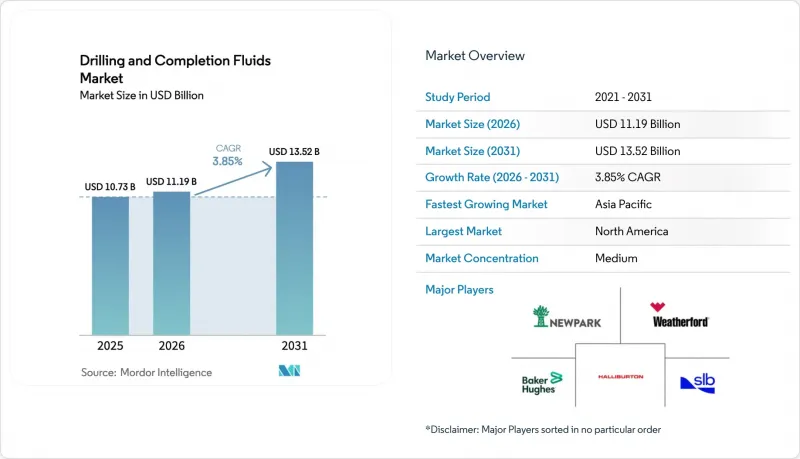
This report is Segmented by Fluid Base (Water-Based, Oil-Based, Synthetic-Based, Pneumatic, and Other Bases), Drilling Stage (Drilling Fluids and Completion and Work-Over Fluids), Well Type (Conventional and Unconventional), Application (Onshore and Offshore), and Geography (North America, Europe, Asia-Pacific, South America, and Middle East and Africa).
Global Drilling And Completion Fluids Market Trends and Insights
Deep-Water And Ultra-Deep-Water Campaigns Reshape Fluid Specifications
Deep-water wells consume 3,000-5,000 barrels of fluid each and impose HPHT conditions that demand synthetic muds blended with cesium formate brines to achieve ECDs above 18 lb/gal, as seen in Petrobras' pre-salt programs, where reservoir pressure reaches 15,000 psi. Equinor's Johan Castberg Arctic project showed synthetic systems trimmed non-productive time by 18% under discharge bans on diesel-based mud. TotalEnergies adopted internal-olefin synthetic fluids on Mero 4 to satisfy Brazilian cuttings rules while maintaining shale inhibition. These high-spec wells elevate per-well fluid value and concentrate demand in fewer, but more lucrative, offshore campaigns. Rapid rig mobilization to Namibia and Suriname is expected to reinforce this pattern through the forecast period.
Unconventional Reservoir Expansion Drives Friction-Reducer And Clay-Stabilizer Demand
Extended-reach laterals exceeding 12,000 ft in the Permian Basin rely on polyacrylamide friction reducers to cut pump pressure and torque. Argentina's Vaca Muerta uses potassium-chloride muds with encapsulating polymers that lowered wellbore-instability incidents by 22% versus bentonite systems. CNPC achieved 15% faster footage in Ordos tight sand by adding nano-silica sealants that kept fluid loss below 5 mL/30 min. These chemistry upgrades also appear in completion fluids, where viscosity breakers and surfactants improve proppant transport and recovery factors.
Oil Price Volatility Compresses Upstream Capital Allocation
Brent averaged USD 78/bbl in 2025, down from USD 84/bbl in 2024, prompting several Permian independents to park 9% of rigs and defer completions until prices exceed USD 80/bbl, as noted by ConocoPhillips in its Q3 2025 call. The IEA reported upstream capex remaining 15% below 2019 real-terms levels, with discretionary drilling projects bearing the sharpest cuts. West Africa's active rig count slipped 11% after Angolan and Nigerian programs were postponed under fiscal stress, directly trimming fluid orders. Because fluids make up only 4%-7% of well cost, they are among the first line items downgraded or canceled when operators retrench.
Other drivers and restraints analyzed in the detailed report include:
- Environmental Regulations Accelerate Synthetic And Water-Based Fluid Adoption
- Digital Optimization Platforms Enable Real-Time Fluid Adjustments
- Discharge Regulations Force Costly Fluid Substitutions
For complete list of drivers and restraints, kindly check the Table Of Contents.
Segment Analysis
Synthetic-based fluids captured a growing offshore share and are projected to register a 5.8% CAGR to 2031, outpacing the overall drilling and completion fluids market. Water-based products held 57.1% of 2025 revenue, favored in onshore shale where they undercut synthetic prices by 40%-50%. Oil-based muds are retreating as regulators tighten cuttings rules, while pneumatic fluids stay niche at <3% volume. Internal-olefin systems, such as Baker Hughes' SYN-TEQ, handled 350 °F bottom-hole temperatures in Gulf of Mexico lower tertiary wells during 2025. Emerging nano-formulations like Schlumberger's RHELIANT improved lubricity by 24% on Middle East extended-reach wells. These advances underscore how specification-driven demand is concentrating value in premium fluid categories.
Water-based technology also evolves: Halliburton's Baracarb blend attained shale inhibition parity with oil-based muds across 18% of North America's land footage while eliminating disposal fees. Cost-optimized polymer packages allow land operators to trim dilution rates without sacrificing ROP, supporting continued dominance in high-activity basins. Overall, escalating offshore HPHT projects ensure synthetic fluids remain the growth engine of the drilling and completion fluids market, even as water-based systems anchor volume and offer a sustainability narrative that resonates with regulators.
Drilling fluids retained 70.5% of 2025 demand, yet completion and work-over fluids are positioned for a faster 4.9% CAGR as reservoir contact quality eclipses pure drilling speed in operator priorities. Formate-based brines used by Occidental in Wolfcamp completions lifted initial production 11%, justifying 30%-40% higher barrel pricing. Multi-stage hydraulic fracturing intensifies density-control requirements, making premium brines and fiber-laden systems indispensable for fracture geometry management. Weatherford's Frac-Pac fluids enabled real-time fracture mapping on 230 wells in 2025, reinforcing the trend toward integrated fluid-frac workflows.
Drilling fluid innovation nevertheless continues: Newpark's Evolution biodegradable polymer system cut dilution 19% on Gulf Coast shale wells, lowering total fluid cost despite higher additive unit prices. Blurring lines between drilling and completion workflows encourages long-term, single-provider contracts that bundle both fluid phases, reinforcing the value of holistic fluid engineering throughout the well life cycle.
Complete Report Scope:
- By Fluid Base
- Water-based
- Oil-based
- Synthetic-based
- Pneumatic (air, mist, foam)
- Other Bases (ester, glycol, nano-fluids)
- By Drilling Stage
- Drilling Fluids
- Completion and Work-over Fluids
- By Well Type
- Conventional
- Unconventional
- By Application
- Onshore
- Offshore
- By Geography
- North America
- United States
- Canada
- Mexico
- Europe
- United Kingdom
- Norway
- Russia
- Ukraine
- Rest of Europe
- Asia-Pacific
- China
- India
- ASEAN Countries
- Australia
- Rest of Asia-Pacific
- South America
- Brazil
- Argentina
- Colombia
- Rest of South America
- Middle East and Africa
- Saudi Arabia
- United Arab Emirates
- Qatar
- Nigeria
- Algeria
- Rest of Middle East and Africa
- North America
Geography Analysis
North America's market size advantage is anchored in the Permian Basin, but emerging tight-oil plays in Canada and Alaska also deploy digital fluid systems to cut well costs and emissions. Asia-Pacific's localization surge signals a shift toward shorter supply chains, compelling Western service companies either to build plants or cede share. Europe's fluid demand is increasingly synthetic; 89% of 2025 Norwegian wells used water-based or synthetic formulations under stricter discharge rules. South America's pre-salt wells carry some of the highest fluid spend per hole worldwide, explaining sustained vendor investment in Brazilian blending hubs. The Middle East continues to pay premiums for HP high-H2S completion brines that preserve carbonate reservoir integrity. Africa's outlook will hinge on fiscal reforms that can reignite shelved exploration in Angola and Nigeria; without them, fluid demand risks under-performance relative to other frontier basins.
- Baker Hughes Company
- Schlumberger Limited
- Halliburton Company
- Weatherford International plc
- Newpark Resources Inc.
- TETRA Technologies Inc.
- National Oilwell Varco Inc.
- CES Energy Solutions Corp.
- Chevron Phillips Chemical Co. LLC
- M-I SWACO (SLB)
- Scomi Energy Services Bhd
- AES Drilling Fluids LLC
- Anchor Drilling Fluids USA
- Flotek Industries Inc.
- Gumpro Drilling Fluids Pvt Ltd
- Oilfield Chemical Co. Baker Petrolite
- Petrochem Performance Chemicals Ltd
- Q'Max Solutions Inc.
- IMDEX Limited (AMC Drilling Fluids)
- Valence Drilling Fluids LLC
Additional Benefits:
- The market estimate (ME) sheet in Excel format
- 3 months of analyst support
TABLE OF CONTENTS
1 Introduction
- 1.1 Study Assumptions & Market Definition
- 1.2 Scope of the Study
2 Research Methodology
3 Executive Summary
4 Market Landscape
- 4.1 Market Overview
- 4.2 Global Onshore & Offshore Active Rig Count
- 4.3 Historic & Forecast Upstream CAPEX - Onshore vs Offshore
- 4.4 Major Upcoming Upstream Projects
- 4.5 Market Drivers
- 4.5.1 Rising deep-water and ultra-deep-water drilling campaigns
- 4.5.2 Expansion of unconventional (shale & tight) reservoirs
- 4.5.3 Environmental push toward low-toxicity, water-based and synthetic fluids
- 4.5.4 Digitally enabled drilling fluid optimization & real-time rheology control
- 4.5.5 Circular-economy models for recycling and re-conditioning spent mud
- 4.5.6 National oil company (NOC) localization programs driving regional fluid manufacturing
- 4.6 Market Restraints
- 4.6.1 Volatile crude-oil price cycles delaying drilling budgets
- 4.6.2 Stringent discharge regulations on oil-based mud cuttings
- 4.6.3 Supply chain tightness of specialty polymer & barite additives
- 4.6.4 Rising adoption of managed-pressure drilling that lowers fluid volumes
- 4.7 Supply-Chain Analysis
- 4.8 Technological Outlook
- 4.9 Regulatory Landscape
- 4.10 Porter's Five Forces
- 4.10.1 Bargaining Power of Suppliers
- 4.10.2 Bargaining Power of Buyers
- 4.10.3 Threat of New Entrants
- 4.10.4 Threat of Substitutes
- 4.10.5 Competitive Rivalry
5 Market Size & Growth Forecasts
- 5.1 By Fluid Base
- 5.1.1 Water-based
- 5.1.2 Oil-based
- 5.1.3 Synthetic-based
- 5.1.4 Pneumatic (air, mist, foam)
- 5.1.5 Other Bases (ester, glycol, nano-fluids)
- 5.2 By Drilling Stage
- 5.2.1 Drilling Fluids
- 5.2.2 Completion and Work-over Fluids
- 5.3 By Well Type
- 5.3.1 Conventional
- 5.3.2 Unconventional
- 5.4 By Application
- 5.4.1 Onshore
- 5.4.2 Offshore
- 5.5 By Geography
- 5.5.1 North America
- 5.5.1.1 United States
- 5.5.1.2 Canada
- 5.5.1.3 Mexico
- 5.5.2 Europe
- 5.5.2.1 United Kingdom
- 5.5.2.2 Norway
- 5.5.2.3 Russia
- 5.5.2.4 Ukraine
- 5.5.2.5 Rest of Europe
- 5.5.3 Asia-Pacific
- 5.5.3.1 China
- 5.5.3.2 India
- 5.5.3.3 ASEAN Countries
- 5.5.3.4 Australia
- 5.5.3.5 Rest of Asia-Pacific
- 5.5.4 South America
- 5.5.4.1 Brazil
- 5.5.4.2 Argentina
- 5.5.4.3 Colombia
- 5.5.4.4 Rest of South America
- 5.5.5 Middle East and Africa
- 5.5.5.1 Saudi Arabia
- 5.5.5.2 United Arab Emirates
- 5.5.5.3 Qatar
- 5.5.5.4 Nigeria
- 5.5.5.5 Algeria
- 5.5.5.6 Rest of Middle East and Africa
- 5.5.1 North America
6 Competitive Landscape
- 6.1 Market Concentration
- 6.2 Strategic Moves (M&A, Partnerships, PPAs)
- 6.3 Market Share Analysis (Market Rank/Share for key companies)
- 6.4 Company Profiles (includes Global level Overview, Market level overview, Core Segments, Financials as available, Strategic Information, Products & Services, and Recent Developments)
- 6.4.1 Baker Hughes Company
- 6.4.2 Schlumberger Limited
- 6.4.3 Halliburton Company
- 6.4.4 Weatherford International plc
- 6.4.5 Newpark Resources Inc.
- 6.4.6 TETRA Technologies Inc.
- 6.4.7 National Oilwell Varco Inc.
- 6.4.8 CES Energy Solutions Corp.
- 6.4.9 Chevron Phillips Chemical Co. LLC
- 6.4.10 M-I SWACO (SLB)
- 6.4.11 Scomi Energy Services Bhd
- 6.4.12 AES Drilling Fluids LLC
- 6.4.13 Anchor Drilling Fluids USA
- 6.4.14 Flotek Industries Inc.
- 6.4.15 Gumpro Drilling Fluids Pvt Ltd
- 6.4.16 Oilfield Chemical Co. Baker Petrolite
- 6.4.17 Petrochem Performance Chemicals Ltd
- 6.4.18 Q'Max Solutions Inc.
- 6.4.19 IMDEX Limited (AMC Drilling Fluids)
- 6.4.20 Valence Drilling Fluids LLC
7 Market Opportunities & Future Outlook
- 7.1 White-space & Unmet-Need Assessment

