PUBLISHER: Mordor Intelligence | PRODUCT CODE: 2113721

PUBLISHER: Mordor Intelligence | PRODUCT CODE: 2113721
Italy Dental Devices - Market Share Analysis, Industry Trends & Statistics, Growth Forecasts (2026 - 2031)
According to Mordor Intelligence, the Italy dental devices market size is expected to increase from USD 354.28 million in 2025 to USD 366.95 million in 2026 and reach USD 444.91 million by 2031, growing at a CAGR of 3.93% over 2026-2031.
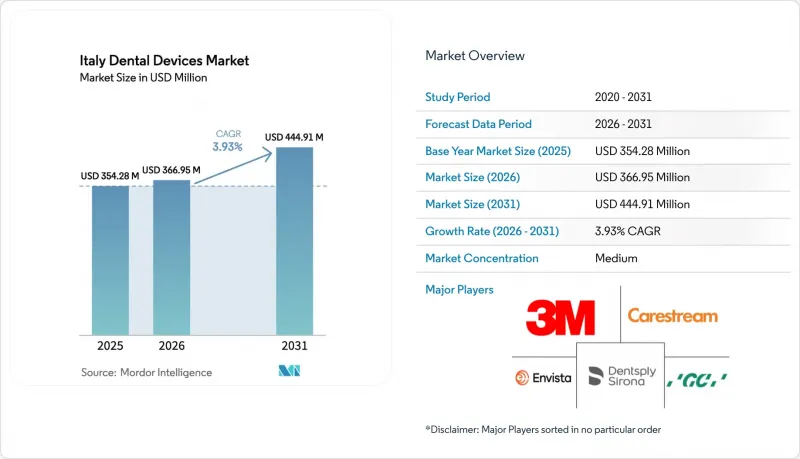
This report is Segmented by Product (Diagnostic Equipment, Therapeutic Equipment, Dental Consumables, and Other Dental Equipment), Treatment (Orthodontics, Endodontics, Periodontics, and Prosthodontics), and End User (Dental Hospitals, Dental Clinics, and Other End Users). The Market Provides the Value (in USD) for the Above-Mentioned Segments.
Italy Dental Devices Market Trends and Insights
Rising Prevalence of Dental Caries and Periodontal Diseases
Caries-free prevalence among 12-year-olds stands at only 30.45%, and 13.1% of adults suffer severe periodontitis, both rates climbing in Southern regions. Each diagnosis triggers demand for intraoral radiography, laser detection, and ultrasonic scalers, helping Diagnostics Equipment dominate 2025 revenue. ISO 13485 compliance keeps procurement focused on established multinationals.
Aging Population Driving Demand for Restorative Dentistry
The elderly share of Italy's population will rise to 34.5% by 2050, lifting demand for implants supported by CBCT imaging and zirconia prosthetics. Photogrammetry-based digitization delivers sub-50 µm accuracy, reducing fit errors and peri-implant complications. As a result, prosthodontic procedures post the fastest CAGR at 5.76%.
Inbound Dental Tourism to Specialised Italian Clinics
Although outbound flows are higher, inbound tourists seek high-end implantology priced at EUR 15,000-30,000 per case. These clinics fuel demand for CBCT, navigation systems, and 3-D-printed meshes, adding 0.3 percentage points to the CAGR of the Italian dental devices market.
Other drivers and restraints analyzed in the detailed report include:
- Growing Adoption of Digital Dentistry & CAD/CAM Systems
- High Upfront Cost of Advanced Dental Equipment
- Shortage of Skilled Dental Technicians
For complete list of drivers and restraints, kindly check the Table Of Contents.
Segment Analysis
Diagnostic equipment accounted for 39.84% of 2025 revenue, reflecting a sizable installed base of CBCT and panoramic units required for implant planning. Dental Consumables are projected to grow 4.53% annually as analog impression materials give way to scan bodies, zirconia blanks, and biocompatible resins. Guided-surgery templates fabricated via stereolithography consistently hold entry-point deviations below 1 mm, boosting implant predictability.
The Italian dental devices market, attributed to diagnostic equipment, is forecast to retain leadership through 2031, while consumables narrow the gap thanks to higher unit turnover. Compliance with EU Medical Device Regulation increases post-market obligations, consolidating share among ISO-certified suppliers.
Complete Report Scope:
- By Product
- Diagnostics Equipment
- Dental Laser
- Radiology Equipment
- Dental Chair & Equipment
- Therapeutic Equipment
- Dental Consumables
- Other Dental Equipments
- Diagnostics Equipment
- By Treatment
- Orthodontic
- Endodontic
- Periodontic
- Prosthodontic
- By End User
- Dental Hospitals
- Dental Clinics
- Academic & Research Institutes
- Other End Users
List of Companies Covered in this Report:
- 3M
- A-dec
- Acteon Group
- BEGO GmbH
- BIOLASE Inc.
- Carestream Health
- Coltene Holding
- Dentsply Sirona
- Envista
- GC Corporation
- Henry Schein
- Ivoclar Vivadent
- Midmark
- NSK Nakanishi Inc.
- Patterson Companies
- Planmeca
- Septodont
- Straumann Group
- VATECH
Additional Benefits:
- The market estimate (ME) sheet in Excel format
- 3 months of analyst support
TABLE OF CONTENTS
1 Introduction
- 1.1 Study Assumptions & Market Definition
- 1.2 Scope of the Study
2 Research Methodology
3 Executive Summary
4 Market Landscape
- 4.1 Market Overview
- 4.2 Market Drivers
- 4.2.1 Rising Prevalence of Dental Caries and Periodontal Diseases
- 4.2.2 Aging Population Driving Demand for Restorative Dentistry
- 4.2.3 Growing Adoption of Digital Dentistry & CAD/CAM Systems
- 4.2.4 Inbound Dental Tourism to Specialised Italian Clinics
- 4.2.5 Government Industry 4.0 Tax Credits for Dental 3-D Printing
- 4.2.6 Subscription-Based Aligner Therapy Via Tele-Dentistry Platforms
- 4.3 Market Restraints
- 4.3.1 High Upfront Cost of Advanced Dental Equipment
- 4.3.2 Shortage of Skilled Dental Technicians
- 4.3.3 Regional Reimbursement Fragmentation for Implants
- 4.3.4 Volatile Zirconia Supply Under EU Critical-Raw-Material Rules
- 4.4 Regulatory Landscape
- 4.5 Technological Outlook
- 4.6 Porter's Five Forces Analysis
- 4.6.1 Threat of New Entrants
- 4.6.2 Bargaining Power of Buyers
- 4.6.3 Bargaining Power of Suppliers
- 4.6.4 Threat of Substitute Products
- 4.6.5 Intensity of Competitive Rivalry
5 Market Size & Growth Forecasts
- 5.1 By Product
- 5.1.1 Diagnostics Equipment
- 5.1.1.1 Dental Laser
- 5.1.1.2 Radiology Equipment
- 5.1.1.3 Dental Chair & Equipment
- 5.1.2 Therapeutic Equipment
- 5.1.3 Dental Consumables
- 5.1.4 Other Dental Equipments
- 5.1.1 Diagnostics Equipment
- 5.2 By Treatment
- 5.2.1 Orthodontic
- 5.2.2 Endodontic
- 5.2.3 Periodontic
- 5.2.4 Prosthodontic
- 5.3 By End User
- 5.3.1 Dental Hospitals
- 5.3.2 Dental Clinics
- 5.3.3 Academic & Research Institutes
- 5.3.4 Other End Users
6 Competitive Landscape
- 6.1 Market Concentration
- 6.2 Market Share Analysis
- 6.3 Company Profiles (includes Global Level Overview, Market Level Overview, Core Segments, Financials as Available, Strategic Information, Market Rank/Share for Key Companies, Products & Services, and Recent Developments)
- 6.3.1 3M
- 6.3.2 A-dec Inc.
- 6.3.3 Acteon Group
- 6.3.4 BEGO GmbH
- 6.3.5 BIOLASE Inc.
- 6.3.6 Carestream Health Inc.
- 6.3.7 Coltene Holding AG
- 6.3.8 Dentsply Sirona
- 6.3.9 Envista Holdings (Nobel Biocare Services AG)
- 6.3.10 GC Corporation
- 6.3.11 Henry Schein Inc.
- 6.3.12 Ivoclar Vivadent
- 6.3.13 Midmark Corporation
- 6.3.14 NSK Nakanishi Inc.
- 6.3.15 Patterson Companies
- 6.3.16 Planmeca Oy
- 6.3.17 Septodont
- 6.3.18 Straumann Group
- 6.3.19 Vatech Co. Ltd
7 Market Opportunities & Future Outlook
- 7.1 White-space & Unmet-Need Assessment

