PUBLISHER: Mordor Intelligence | PRODUCT CODE: 2113738

PUBLISHER: Mordor Intelligence | PRODUCT CODE: 2113738
Africa Food Enzymes - Market Share Analysis, Industry Trends & Statistics, Growth Forecasts (2026 - 2031)
According to Mordor Intelligence, the Africa food enzymes market size is expected to grow from USD 197.37 million in 2025 to USD 208.86 million in 2026 and is forecast to reach USD 277.53 million by 2031 at 5.82% CAGR over 2026-2031.
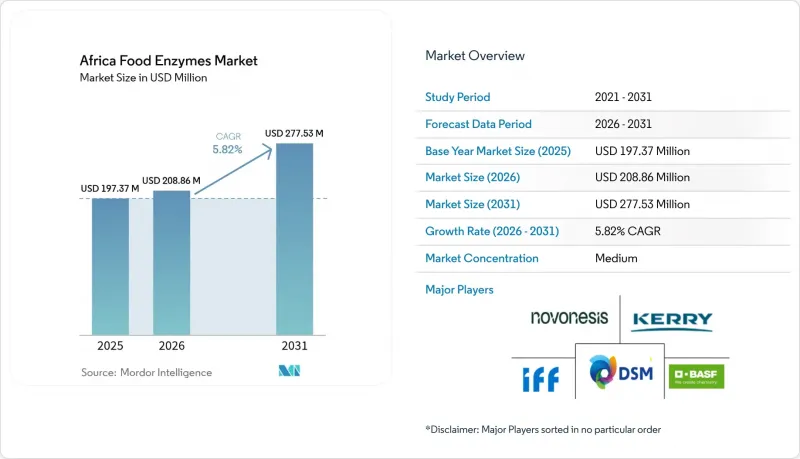
This report is Segmented by Enzyme Type (Carbohydrases, Proteases, Lipases, and Others); by Source (Microbial, Plant and More), by Application (Bakery and Confectionery, Dairy and Frozen Desserts, Meat, Poultry and Seafood Processing, and Others); and by Geography (South Africa, Nigeria, Egypt, and More). The Market Forecasts are Provided in Terms of Value (USD).
Africa Food Enzymes Market Trends and Insights
Processed-food boom in urban Africa
City dwellers in Africa are increasingly favoring packaged goods, shifting from traditional staples to items like bread, biscuits, juices, and dairy. From 2020 to 2024, as incomes rose and supermarket chains expanded, per-capita consumption of industrial bakery goods surged in Lagos and Abuja. In response to the inconsistent falling numbers in flours, industrial bakers are now turning to thermostable amylases and xylanases for smoother dough handling. The African Development Bank's Special Agro-Industrial Processing Zones program, has spurred factory expansions, adding hundreds of ovens, juice extractors, and cheese vats. Enzyme vendors are adapting by launching pilot bakeries in Lagos and Nairobi, mimicking tropical humidity for on-site optimization, a move away from less effective European protocols suited for cooler climates. These trends signal a robust growth in bakery-grade carbohydrase volume projected through 2030.
Clean-label and natural-ingredient demand
In 2025, Nigeria's regulatory body imposed a ban on azodicarbonamide and designated enzymes as the favored processing aids, especially when used in baking. Following suit, South Africa exempted deactivated enzymes from being labeled as additives. This move expanded the compliance flexibility for both dough conditioners and juice-clarification agents. In 2024, JECFA reaffirmed the acceptable daily intake levels for various carbohydrases and proteases, streamlining the import registration process. Export-driven processors in Morocco and Egypt, attuned to EU Regulation 1169/2011, have transitioned to using pectinases, moving away from chemical fining agents in juice production. Collectively, these regulatory shifts bolster the demand for microbial and plant enzymes, championing clean-label narratives devoid of E-numbers.
Fragmented food-additive regulations
Nigeria's National Biotechnology Management Agency mandates a 270-day pre-import window and requires GMO labeling. In contrast, South Africa has its own thresholds, and Egypt maintains distinct purity dossiers to regulate enzyme imports. According to UNCTAD, these non-tariff measures inflate intra-African enzyme costs, creating additional financial and logistical burdens for businesses operating in the region. Suppliers typically register only in South Africa, Nigeria, or Egypt, as these are the larger markets, leaving smaller markets underserved and reliant on gray-market channels. These channels often bypass regulatory frameworks, leading to compromised quality oversight and potential risks for end-users. Without a unified enzyme monograph adopted by regional blocs, the duplication in compliance processes will continue to hinder market growth and integration across Africa.
Other drivers and restraints analyzed in the detailed report include:
- Expansion of regional dairy capacity
- Cost-efficiency vs. chemical additives
- Cold-chain and logistics gaps
For complete list of drivers and restraints, kindly check the Table Of Contents.
Segment Analysis
In 2025, carbohydrases commanded a dominant 45.22% share of Africa's food enzymes market. This surge was largely propelled by amylases, which play a pivotal role in hydrolyzing damaged starch. These enzymes are integral, preventing staling in over 80% of industrial bread recipes. Notably, thermostable variants sourced from Bacillus licheniformis can withstand oven peaks of 90-95 °C. This resilience is crucial, given the high-heat tunnel ovens prevalent in bakeries across Johannesburg and Lagos. Meanwhile, cellulases and xylanases play a crucial role in breaking down non-starch polysaccharides. This process ensures a balanced water uptake in composite flours, especially those rich in sorghum and millet. In juice production, pectinases take center stage, boosting yields by an impressive 8-10% from mango and passion fruit pulps. Additionally, xylanases are making waves in sorghum brewing, where they effectively reduce the viscosity of the wort.
Looking ahead, lipases are projected to grow at a robust 10.49% CAGR through 2031. These enzymes are pivotal, catalyzing the release of flavors in cheese and modifying palm-kernel oil for use in ice cream. In a notable industry shift, Kenyan dairies have leveraged microbial lipases to slash cheddar maturation time from 90 days down to just 55. This halving not only accelerates production but also significantly reduces inventory overheads. Furthermore, in the realm of frozen desserts, lipase-interesterified fats are enhancing scoopability. This is particularly beneficial given the warmer freezer set points commonly found in African households. Collectively, these dynamics not only anchor carbohydrases as key revenue drivers but also spotlight lipases as the premium-growth narrative, propelling the overall expansion of Africa's food enzymes market.
Complete Report Scope:
- By Enzyme Type
- Carbohydrases
- Amylase
- Cellulase
- Pectinase
- Xylanase
- Proteases
- Lipases
- Other Specialty Enzymes
- Carbohydrases
- By Source
- Microbial
- Plant
- Animal
- Recombinant / GMO
- By Application
- Bakery and Confectionery
- Bread
- Cakes and Pastries
- Cookies and Biscuits
- Dairy and Frozen Desserts
- Meat, Poultry and Seafood Processing
- Beverages
- Juices and Nectars
- Brewing and Malting
- Fruit and Vegetable Processing
- Functional and Specialty Foods
- Bakery and Confectionery
- By Geography
- South Africa
- Nigeria
- Egypt
- Morocco
- Rest of Africa
List of Companies Covered in this Report:
- Novozymes A/S
- DSM-Firmenich
- IFF (Danisco)
- AB Enzymes GmbH
- Chr. Hansen Holding A/S
- Kerry Group PLC
- Advanced Enzyme Technologies Ltd.
- Amano Enzyme Inc.
- Sabinsa South Africa (Pty) Ltd.
- AEB Africa (Pty) Ltd.
- Megazyme Ltd.
- Zymetech
- Lesaffre (IMPROVE)
- Enzyme Supplies Ltd.
- Dyadic International
- Roquette Freres (PlantCare)
- BASF SE
- Puratos NV
- Noor Enzymes (Kenya)
- Biocatalysts Ltd.
Additional Benefits:
- The market estimate (ME) sheet in Excel format
- 3 months of analyst support
TABLE OF CONTENTS
1 INTRODUCTION
- 1.1 Study Assumptions and Market Definition
- 1.2 Scope of the Study
2 RESEARCH METHODOLOGY
3 EXECUTIVE SUMMARY
4 MARKET LANDSCAPE
- 4.1 Market Overview
- 4.2 Market Drivers
- 4.2.1 Processed-food boom in urban Africa
- 4.2.2 Clean-label and natural-ingredient demand
- 4.2.3 Expansion of regional dairy capacity
- 4.2.4 Cost-efficiency vs. chemical additives
- 4.2.5 Cassava- and sorghum-based beverage innovation
- 4.2.6 Local modular fermentation build-outs
- 4.3 Market Restraints
- 4.3.1 Fragmented food-additive regulations
- 4.3.2 Cold-chain and logistics gaps
- 4.3.3 Tariff/FX volatility on enzyme imports
- 4.3.4 Scarcity of enzymology talent
- 4.4 Supply-Chain Analysis
- 4.5 Regulatory Landscape
- 4.6 Technological Outlook
- 4.7 Porter's Five Forces
- 4.7.1 Threat of New Entrants
- 4.7.2 Bargaining Power of Buyers
- 4.7.3 Bargaining Power of Suppliers
- 4.7.4 Threat of Substitutes
- 4.7.5 Competitive Rivalry
5 MARKET SIZE AND GROWTH FORECASTS (VALUE)
- 5.1 By Enzyme Type
- 5.1.1 Carbohydrases
- 5.1.1.1 Amylase
- 5.1.1.2 Cellulase
- 5.1.1.3 Pectinase
- 5.1.1.4 Xylanase
- 5.1.2 Proteases
- 5.1.3 Lipases
- 5.1.4 Other Specialty Enzymes
- 5.1.1 Carbohydrases
- 5.2 By Source
- 5.2.1 Microbial
- 5.2.2 Plant
- 5.2.3 Animal
- 5.2.4 Recombinant / GMO
- 5.3 By Application
- 5.3.1 Bakery and Confectionery
- 5.3.1.1 Bread
- 5.3.1.2 Cakes and Pastries
- 5.3.1.3 Cookies and Biscuits
- 5.3.2 Dairy and Frozen Desserts
- 5.3.3 Meat, Poultry and Seafood Processing
- 5.3.4 Beverages
- 5.3.4.1 Juices and Nectars
- 5.3.4.2 Brewing and Malting
- 5.3.5 Fruit and Vegetable Processing
- 5.3.6 Functional and Specialty Foods
- 5.3.1 Bakery and Confectionery
- 5.4 By Geography
- 5.4.1 South Africa
- 5.4.2 Nigeria
- 5.4.3 Egypt
- 5.4.4 Morocco
- 5.4.5 Rest of Africa
6 COMPETITIVE LANDSCAPE
- 6.1 Market Concentration
- 6.2 Strategic Moves
- 6.3 Market Positioning Analysis
- 6.4 Company Profiles (includes Global level Overview, Market level overview, Core Segments, Financials as available, Strategic Information, Market Rank/Share, Products and Services, Recent Developments)
- 6.4.1 Novozymes A/S
- 6.4.2 DSM-Firmenich
- 6.4.3 IFF (Danisco)
- 6.4.4 AB Enzymes GmbH
- 6.4.5 Chr. Hansen Holding A/S
- 6.4.6 Kerry Group PLC
- 6.4.7 Advanced Enzyme Technologies Ltd.
- 6.4.8 Amano Enzyme Inc.
- 6.4.9 Sabinsa South Africa (Pty) Ltd.
- 6.4.10 AEB Africa (Pty) Ltd.
- 6.4.11 Megazyme Ltd.
- 6.4.12 Zymetech
- 6.4.13 Lesaffre (IMPROVE)
- 6.4.14 Enzyme Supplies Ltd.
- 6.4.15 Dyadic International
- 6.4.16 Roquette Freres (PlantCare)
- 6.4.17 BASF SE
- 6.4.18 Puratos NV
- 6.4.19 Noor Enzymes (Kenya)
- 6.4.20 Biocatalysts Ltd.
7 MARKET OPPORTUNITIES AND FUTURE OUTLOOK

