PUBLISHER: Mordor Intelligence | PRODUCT CODE: 2120731

PUBLISHER: Mordor Intelligence | PRODUCT CODE: 2120731
South America Food Enzymes - Market Share Analysis, Industry Trends & Statistics, Growth Forecasts (2026 - 2031)
According to Mordor Intelligence, the south american food enzymes market size is expected to grow from USD 277.65 million in 2025 to USD 297.48 million in 2026 and is forecast to reach USD 419.97 million by 2031 at 7.14% CAGR over 2026-2031.
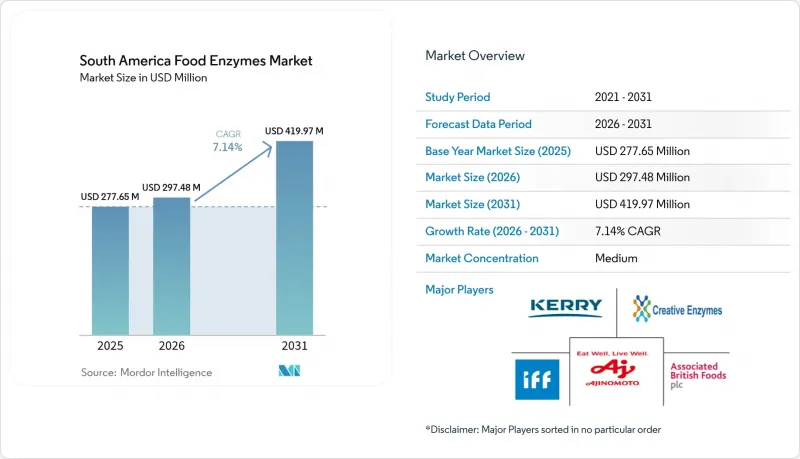
This report is Segmented by Enzyme Type (Carbohydrase, Protease, Lipase, Other Enzymes), Form (Powder and Liquid), Source (Plant, Microbial, Animal), Application (Bakery and Confectionery, Dairy and Desserts, Beverages, Meat and Meat Products, and More), and Geography (Brazil, Argentina, Colombia, Chile, Peru, Rest of South America). The Market Forecasts are Provided in Terms of Value (USD).
South America Food Enzymes Market Trends and Insights
Increasing consumption of bakery and confectionery products
Urbanization and the rise of dual-income households are boosting per-capita consumption of packaged breads, cakes, and biscuits across South America. Manufacturers are using bakery enzymes to cut dough mixing time, enhance crumb softness, and extend shelf life without synthetic emulsifiers. Amylases break down damaged starch into fermentable sugars, speeding up yeast activity and producing higher loaf volumes. Xylanases modify pentosan structure to improve dough machinability on high-speed production lines. In 2024, Brazil's bakery sector produced 7.2 million tonnes of bread, increasing by 4.1% compared to 2023, as supermarket chains expanded in-store bakeries to capture impulse purchases. Argentina's alfajor and facturas manufacturers are adopting enzyme blends to maintain texture during the country's high-humidity summer months, reducing product returns and waste. The shift toward artisanal-style breads with visible grains and seeds is prompting formulators to use cellulases and hemicellulases, which soften bran particles and prevent the "sandpaper" mouthfeel consumers reject.
Rising demand for clean-label and natural ingredients
Urban consumers are increasingly scrutinizing ingredient lists, linking chemical-sounding additives to health risks and demanding transparency from food brands. Enzymes provide a regulatory edge: as processing aids, they often escape declaration on finished-product labels under Codex and Mercosur guidelines. This loophole enables manufacturers to tout "no artificial preservatives" claims while still achieving desired functional outcomes. A 2024 survey by the Brazilian Food Industry Association revealed that 68% of consumers would pay a 15-20% premium for products labeled as natural or organic. This presents margin opportunities for brands reformulating with enzymes, steering clear of synthetic dough conditioners or flavor enhancers. Chile's updated food-labeling law, which enforces black warning octagons for high sodium, sugar, and saturated fat, is inadvertently amplifying enzyme use. Manufacturers are now using lipases to trim fat content in baked goods, ensuring mouthfeel remains intact. The clean-label movement isn't confined to retail; foodservice operators catering to schools and hospitals are also adapting. Facing procurement specs that limit E-numbers, they're increasingly turning to enzyme-assisted production.
High cost of enzyme production and formulation
Enzyme manufacturing relies on capital-intensive fermentation infrastructure, sterile production environments, and downstream purification processes, including chromatography and ultrafiltration. These requirements increase unit costs, making it difficult for small and mid-sized food processors to manage. Additionally, maintaining enzyme activity during transport from production sites to end-users requires cold-chain logistics. In regions with inconsistent refrigerated transport, such as northern Brazil and the Andean highlands, this requirement raises landed costs by 12-18%. Currency depreciation further worsens these challenges. In 2024, Brazil's real depreciated by 8.3% against the US dollar, which increased the costs of imported enzyme concentrates. This situation forces processors to either reduce margins or raise prices for retailers. Many small bakeries and dairy plants fail to optimize enzyme dosing due to a lack of expertise. This failure often leads to over-application, which reduces cost savings and can introduce off-flavors.
Other drivers and restraints analyzed in the detailed report include:
- Expansion of dairy and beverage processing industries
- Demand for lactose-free and specialty food products
- Strict regulatory approvals and compliance requirements
For complete list of drivers and restraints, kindly check the Table Of Contents.
Segment Analysis
Carbohydrases dominated the South America food enzymes market in 2025, capturing the largest share of 54.39%. This segment maintained its leading position due to its widespread use in bakery, dairy, and beverage applications, where it helps improve texture, sweetness, and overall product quality. The versatility of carbohydrases in breaking down complex carbohydrates into simpler sugars makes them highly valuable across multiple food processing industries. Their ability to enhance yield and reduce processing time further strengthens their adoption among manufacturers. Additionally, growing consumer demand for functional and nutritionally enhanced foods has reinforced the preference for carbohydrase-based solutions.
Lipase, on the other hand, emerged as the fastest-growing enzyme segment, projected to expand at a CAGR of 7.76% through 2031. This rapid growth is driven by increasing demand in dairy, bakery, and fat modification applications, where lipases help improve flavor, texture, and shelf life. The rising popularity of specialty and high-value dairy products, such as cheese and flavored spreads, has fueled lipase consumption. Technological advancements in enzyme formulation have also enhanced the efficiency and stability of lipase, encouraging wider adoption. Moreover, the growing focus on clean-label and natural processing solutions has further boosted its demand.
Powder enzymes commanded 67.38% of market share in 2025 and will grow at 7.46% CAGR through 2031, favored for their ambient-temperature stability, ease of transport, and compatibility with manual dosing systems prevalent in small bakeries and regional dairy plants. Liquid enzyme formulations are gaining share in large-scale operations where automated dosing pumps ensure precise addition rates, reducing over-application waste and improving batch-to-batch consistency. Powder enzymes offer logistical advantages in tropical climates where cold-chain infrastructure is unreliable; they can be stored at room temperature for 12-18 months without significant activity loss, whereas liquid enzymes require refrigeration at 2-8°C to prevent microbial contamination and activity degradation.
Liquid enzymes are preferred in continuous dairy processing lines where inline dosing systems inject enzymes directly into milk streams ahead of pasteurizers or cheese vats, eliminating the dust generation and dissolution time associated with powders. Large Brazilian dairy cooperatives operating ultrafiltration plants report 8-12% reductions in enzyme usage when switching from powder to liquid formats, as the latter offer higher specific activity and eliminate losses from incomplete dissolution. The liquid segment is also benefiting from enzyme producers' development of stabilized formulations that extend shelf life to 24 months under refrigeration, narrowing the convenience gap with powders.
Complete Report Scope:
- By Enzyme Type
- Carbohydrase
- Amylases
- Pectinases
- Cellulases
- Other
- Protease
- Lipase
- Other Enzymes
- Carbohydrase
- By Form
- Powder
- Liquid
- By Source
- Plant
- Microbial
- Animal
- By Application
- Bakery and Confectionery
- Dairy and Desserts
- Beverages
- Meat and Meat Products
- Soups, Sauces, and Dressings
- Other Applications
- By Geography
- Brazil
- Argentina
- Colombia
- Chile
- Peru
- Rest of South America
List of Companies Covered in this Report:
- International Flavors & Fragrances Inc.
- Kerry Group plc
- Associated British Foods plc
- Ajinomoto Co. Inc.
- DSM-Firmenich AG
- Creative Enzymes
- Novozymes A/S
- AB Enzymes GmbH
- Cargill Incorporated
- Chr. Hansen Holding A/S
- BASF SE
- Biocatalysts Ltd
- Amano Enzyme Inc.
- Advanced Enzyme Technologies Ltd
- Ingredion Incorporated
- Sunson Industry Group Co. Ltd
- Lallemand Inc.
- Enmex S.A. de C.V.
- Novus International Inc.
- Maps Enzymes Limited
Additional Benefits:
- The market estimate (ME) sheet in Excel format
- 3 months of analyst support
TABLE OF CONTENTS
1 INTRODUCTION
- 1.1 Study Assumptions and Market Definition
- 1.2 Scope of the Study
2 RESEARCH METHODOLOGY
3 EXECUTIVE SUMMARY
4 MARKET LANDSCAPE
- 4.1 Market Overview
- 4.2 Market Drivers
- 4.2.1 Increasing consumption of bakery and confectionery products
- 4.2.2 Rising demand for clean-label and natural ingredients
- 4.2.3 Expansion of dairy and beverage processing industries
- 4.2.4 Demand for lactose-free and specialty food products
- 4.2.5 Technological advancements in enzyme development
- 4.2.6 Rising adoption of enzymes for process efficiency
- 4.3 Market Restraints
- 4.3.1 High cost of enzyme production and formulation
- 4.3.2 Strict regulatory approvals and compliance requirements
- 4.3.3 Limited awareness among small-scale manufacturers
- 4.3.4 High dependency on imports for enzyme supply
- 4.4 Supply Chain Analysis
- 4.5 Regulatory Outlook
- 4.6 Porter's Five Forces
- 4.6.1 Threat of New Entrants
- 4.6.2 Bargaining Power of Buyers/Consumers
- 4.6.3 Bargaining Power of Suppliers
- 4.6.4 Threat of Substitute Products
- 4.6.5 Intensity of Competitive Rivalry
5 MARKET SIZE AND GROWTH FORECASTS (VALUE)
- 5.1 By Enzyme Type
- 5.1.1 Carbohydrase
- 5.1.1.1 Amylases
- 5.1.1.2 Pectinases
- 5.1.1.3 Cellulases
- 5.1.1.4 Other
- 5.1.2 Protease
- 5.1.3 Lipase
- 5.1.4 Other Enzymes
- 5.1.1 Carbohydrase
- 5.2 By Form
- 5.2.1 Powder
- 5.2.2 Liquid
- 5.3 By Source
- 5.3.1 Plant
- 5.3.2 Microbial
- 5.3.3 Animal
- 5.4 By Application
- 5.4.1 Bakery and Confectionery
- 5.4.2 Dairy and Desserts
- 5.4.3 Beverages
- 5.4.4 Meat and Meat Products
- 5.4.5 Soups, Sauces, and Dressings
- 5.4.6 Other Applications
- 5.5 By Geography
- 5.5.1 Brazil
- 5.5.2 Argentina
- 5.5.3 Colombia
- 5.5.4 Chile
- 5.5.5 Peru
- 5.5.6 Rest of South America
6 COMPETITIVE LANDSCAPE
- 6.1 Market Concentration
- 6.2 Strategic Moves
- 6.3 Market Ranking Analysis
- 6.4 Company Profiles (includes Global-level Overview, Market-level Overview, Core Segments, Financials (if available), Strategic Information, Market Rank/Share, Products and Services, Recent Developments)
- 6.4.1 International Flavors & Fragrances Inc.
- 6.4.2 Kerry Group plc
- 6.4.3 Associated British Foods plc
- 6.4.4 Ajinomoto Co. Inc.
- 6.4.5 DSM-Firmenich AG
- 6.4.6 Creative Enzymes
- 6.4.7 Novozymes A/S
- 6.4.8 AB Enzymes GmbH
- 6.4.9 Cargill Incorporated
- 6.4.10 Chr. Hansen Holding A/S
- 6.4.11 BASF SE
- 6.4.12 Biocatalysts Ltd
- 6.4.13 Amano Enzyme Inc.
- 6.4.14 Advanced Enzyme Technologies Ltd
- 6.4.15 Ingredion Incorporated
- 6.4.16 Sunson Industry Group Co. Ltd
- 6.4.17 Lallemand Inc.
- 6.4.18 Enmex S.A. de C.V.
- 6.4.19 Novus International Inc.
- 6.4.20 Maps Enzymes Limited
7 MARKET OPPORTUNITIES & FUTURE OUTLOOK

