PUBLISHER: Mordor Intelligence | PRODUCT CODE: 2113797

PUBLISHER: Mordor Intelligence | PRODUCT CODE: 2113797
China High-Voltage Direct Current (HVDC) Transmission Systems - Market Share Analysis, Industry Trends & Statistics, Growth Forecasts (2026 - 2031)
According to Mordor Intelligence, the China high-Voltage direct current transmission systems market size is estimated at USD 3.58 billion in 2026, and is expected to reach USD 5.67 billion by 2031, at a CAGR of 9.63% during the forecast period (2026-2031).
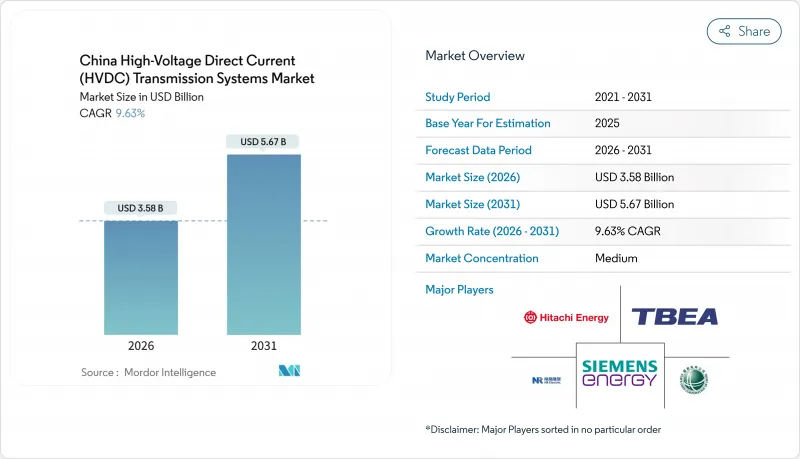
This report is Segmented by Transmission Type (Submarine, Overhead, and Underground), Component (Converter Stations, Transmission Medium, and Others), and Voltage Rating (Up To 400 KV, 401 To 800 KV, and Above 800 KV). The Market Sizes and Forecasts are Provided in Terms of Value (USD).
China High-Voltage Direct Current (HVDC) Transmission Systems Market Trends and Insights
Policy Push Under 14th Five-Year Plan
Twelve new UHV corridors received central approval, turning HVDC investment from discretionary to mandatory for provincial operators. State Grid earmarked CNY 600 billion (USD 83 billion) for grid capex in 2026, 45% of which targets HVDC converter stations and +-800 kV lines. Tariff guarantees indexed to distance allow sponsors to close 15-year policy-bank loans at 3.2% interest, widening the spread versus commercial funding and shortening breakeven timelines. The mechanism has already de-risked the Xizang-Guangdong project despite its 23-year nominal payback horizon. Renewable-integration mandates that call for 150 GW of wind and solar to flow eastward by 2030 further lock in demand for flexible VSC-HVDC topologies with black-start and frequency-support capability.
Accelerating West-to-East Renewable Power Transfer
Xinjiang recorded double-digit curtailment when the existing Hami-Chongqing link hit 85% loading. The upcoming Gansu-Zhejiang +-800 kV VSC corridor will shift 8 GW across 2,370 km and enable reverse flow during photovoltaic peaks, easing thermal limits on the AC grid. Qinghai's solar base shows why extra transfer capacity matters: by 2025, the province's peak load of 9.2 GW absorbed barely one-quarter of its installed capacity, making sub-3% HVDC losses decisive for revenue preservation. Every percentage-point loss above 3% wipes USD 28 million from annual earnings on an 8 GW line operating 6,000 full-load hours.
Very High Upfront CAPEX and Extended Payback
The Gansu-Zhejiang +-800 kV VSC project costs USD 612,500 per MW, 28% above a comparable 1,000 kV AC route. Provinces must co-fund converter stations, yet face tariff caps of CNY 0.05 per kWh that jeopardize debt coverage ratios below 1.2X. Xizang-Guangdong assumes 6,800 operating hours, but hydropower seasonality could stretch payback to 28 years if utilization falls. Each unplanned outage day erodes project NPV by USD 4.2 million, making predictive maintenance on cooling loops and DC filters central to investment returns.
Other drivers and restraints analyzed in the detailed report include:
- Surge in Large-Scale Offshore Wind HVDC Links
- Flexible VSC-HVDC Demand from Hyperscale Data Centers
- Grid-Code Complexity for Multi-Terminal HVDC Meshing
For complete list of drivers and restraints, kindly check the Table Of Contents.
Segment Analysis
Overhead corridors held 64.8% of the Chinese high-voltage direct current transmission systems market in 2025, led by projects such as the 915 km Longdong-Shandong line, whose per-kilometer cost of CNY 1.5-2 million remains 60% below submarine alternatives. Submarine links, however, are forecast to post a 12.0% CAGR to 2031 as Jiangsu and Guangdong fast-track far-from-shore wind farms that demand +-400 kV VSC technology.
The China high-voltage direct current transmission systems market size for submarine links benefits from cost savings achieved by eliminating multiple AC platforms. The Rudong project, operational since 2024, removed three intermediate stations and cut the total bill by 18%. Offshore adoption is further bolstered by domestic cable makers that offer 9-month lead times and renminbi pricing, a 4-6% cost edge over European peers. Underground HVDC remains a niche option for short urban segments where overhead routes face right-of-way hurdles, as seen in Beijing's 12 km section priced at CNY 8.2 million per km.
Complete Report Scope:
- By Transmission Type
- Submarine HVDC Transmission System
- Overhead HVDC Transmission System
- Underground HVDC Transmission System
- By Component
- Converter Stations
- Transmission Medium (Cables)
- Others (Control & Protection Systems, Reactive Power Equipment, Accessories)
- By Voltage Rating
- Up to 400 kV
- 401 to 800 kV
- Above 800 kV
List of Companies Covered in this Report:
- State Grid Corporation of China (SGCC)
- China Southern Power Grid (CSG)
- Hitachi Energy Ltd
- NR Electric Co. Ltd
- TBEA Co. Ltd
- China XD Group
- Pinggao Electric Co. Ltd
- Siemens Energy AG
- ABB Ltd
- General Electric Company
- Toshiba Corporation
- Chint Group
- Shenzhen Sieyuan Electric
- Xuji Group (NARI Technology)
- Baoding Tianwei Baobian (TWBB)
- Harbin Electric Corporation
- Furukawa Electric Co. Ltd
- Prysmian Group
- Nexans SA
- LS Cable & System
- Jiangsu Zhongtian Technology (ZTT)
- Hengtong Group
Additional Benefits:
- The market estimate (ME) sheet in Excel format
- 3 months of analyst support
TABLE OF CONTENTS
1 Introduction
- 1.1 Study Assumptions & Market Definition
- 1.2 Scope of the Study
2 Research Methodology
3 Executive Summary
4 Market Landscape
- 4.1 Market Overview
- 4.2 Market Drivers
- 4.2.1 Policy push under 14th Five-Year Plan
- 4.2.2 Accelerating West-to-East renewable power transfer
- 4.2.3 Surge in large-scale offshore wind HVDC links
- 4.2.4 Flexible VSC-HVDC demand from hyperscale data-centres
- 4.2.5 Semiconductor & EV-battery clusters' high-quality-power needs
- 4.3 Market Restraints
- 4.3.1 Very high upfront CAPEX & extended payback
- 4.3.2 Grid-code complexity for multi-terminal HVDC meshing
- 4.3.3 Domestic supply bottleneck for >= +-800 kV IGBT/thyristor valves
- 4.3.4 Environmental approvals for new corridors in ecologically sensitive provinces
- 4.4 Supply-Chain Analysis
- 4.5 Regulatory Landscape
- 4.6 Technological Outlook (UHVDC, VSC-HVDC, DC-Hub concepts)
- 4.7 Porter's Five Forces
- 4.7.1 Threat of New Entrants
- 4.7.2 Bargaining Power of Suppliers
- 4.7.3 Bargaining Power of Buyers
- 4.7.4 Threat of Substitutes (AC UHV, FACTS, Distributed Storage)
- 4.7.5 Industry Rivalry
5 Market Size & Growth Forecasts
- 5.1 By Transmission Type
- 5.1.1 Submarine HVDC Transmission System
- 5.1.2 Overhead HVDC Transmission System
- 5.1.3 Underground HVDC Transmission System
- 5.2 By Component
- 5.2.1 Converter Stations
- 5.2.2 Transmission Medium (Cables)
- 5.2.3 Others (Control & Protection Systems, Reactive Power Equipment, Accessories)
- 5.3 By Voltage Rating
- 5.3.1 Up to 400 kV
- 5.3.2 401 to 800 kV
- 5.3.3 Above 800 kV
6 Competitive Landscape
- 6.1 Market Concentration
- 6.2 Strategic Moves (M&A, Partnerships, PPAs)
- 6.3 Market Share Analysis (Market Rank/Share for key companies)
- 6.4 Company Profiles (includes Global level Overview, Market level overview, Core Segments, Financials as available, Strategic Information, Products & Services, and Recent Developments)
- 6.4.1 State Grid Corporation of China (SGCC)
- 6.4.2 China Southern Power Grid (CSG)
- 6.4.3 Hitachi Energy Ltd
- 6.4.4 NR Electric Co. Ltd
- 6.4.5 TBEA Co. Ltd
- 6.4.6 China XD Group
- 6.4.7 Pinggao Electric Co. Ltd
- 6.4.8 Siemens Energy AG
- 6.4.9 ABB Ltd
- 6.4.10 General Electric Company
- 6.4.11 Toshiba Corporation
- 6.4.12 Chint Group
- 6.4.13 Shenzhen Sieyuan Electric
- 6.4.14 Xuji Group (NARI Technology)
- 6.4.15 Baoding Tianwei Baobian (TWBB)
- 6.4.16 Harbin Electric Corporation
- 6.4.17 Furukawa Electric Co. Ltd
- 6.4.18 Prysmian Group
- 6.4.19 Nexans SA
- 6.4.20 LS Cable & System
- 6.4.21 Jiangsu Zhongtian Technology (ZTT)
- 6.4.22 Hengtong Group
7 Market Opportunities & Future Outlook
- 7.1 White-space & Unmet-need Assessment

