PUBLISHER: Mordor Intelligence | PRODUCT CODE: 2113809

PUBLISHER: Mordor Intelligence | PRODUCT CODE: 2113809
Thermal Energy Storage - Market Share Analysis, Industry Trends & Statistics, Growth Forecasts (2026 - 2031)
According to Mordor Intelligence, thermal energy storage market size in 2026 is estimated at USD 8.04 billion, growing from 2025 value of USD 7.44 billion with 2031 projections showing USD 11.87 billion, growing at 8.1% CAGR over 2026-2031.
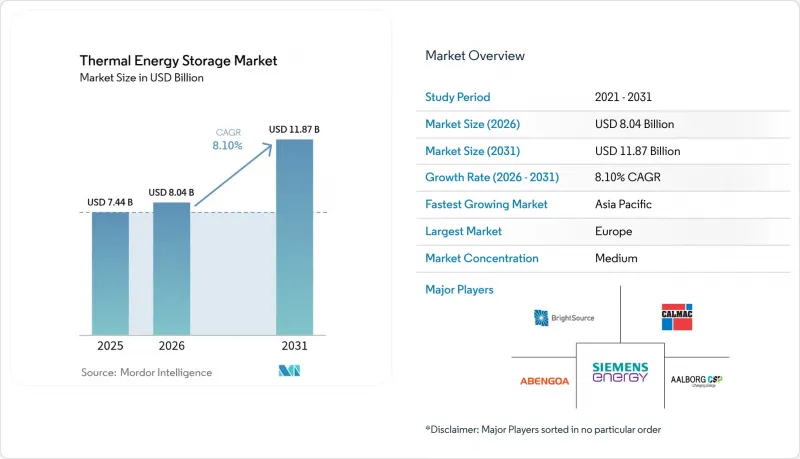
This report is Segmented by Storage Material (Molten Salt, Phase-Change Materials, and More), Technology (Sensible Heat Storage, Thermochemical Heat Storage, and More), Application (Power Generation, Industrial Process Heat, and More), End-User (Utilities, Commercial and Industrial, and Residential), and Geography (North America, Europe, Asia-Pacific, South America, and Middle East and Africa).
Global Thermal Energy Storage Market Trends and Insights
Rapid Build-Out of CSP Plants Integrating >=8-Hour Molten-Salt TES
Mandatory eight-hour storage rules in China's 4.8 GW CSP program and India's 5 GW pipeline have turned molten-salt tanks into standard equipment for dispatchable solar power. Lenders now treat the storage block as a revenue enhancer because it enables capacity-market earnings and reduces curtailment risk. Achieving levelized costs that rival gas-fired peakers has unlocked new sovereign-backed auctions across MENA. EPC firms are standardizing dual-tank designs, lowering balance-of-plant costs by 12% since 2024, further strengthening the bankability of large-scale thermal energy storage market projects. Pipeline visibility beyond 2027 fosters domestic salt and alloy supply chains in China and India, de-risking raw-material access.
Mandatory Renewable Capacity Auctions Bundling TES Adders
California's Clean Power 2030 framework and the EU's Building Performance Directive 2024/1275 require new renewable assets, including long-duration storage, awarding higher auction points to TES-equipped bids. These rules erase the prior split between generation and storage procurement, enabling unified project finance that favors thermal solutions once discharge windows exceed 6 hours. In Australia, renewable-energy zones grant grid-connection priority to thermal-storage projects that provide inertia and voltage support, trimming interconnection queuing delays by a year on average. The policy shift noticeably increases the thermal energy storage market's addressable capacity in utility solicitations announced for 2026 and beyond.
High Capex of Large-Scale Molten-Salt Tanks
Utility-scale molten-salt fields cost USD 15-25 per kWh, largely driven by stainless-steel containment and corrosion-resistant salt blends. Limited operating history keeps debt providers cautious, pushing projects toward higher-priced equity that inflates hurdle rates. The U.S. Department of Energy's USD 305 million loan guarantee for a 2025 deployment signals rising public-sector confidence but has yet to materially compress financing spreads. OEMs are exploring prefabricated tank modules and low-chrome alloys that could shave 20% off capex by 2027, yet short-term economics remain a headwind for some thermal energy storage market bids.
Other drivers and restraints analyzed in the detailed report include:
- Expansion of Fourth-Generation District Heating & Cooling Grids
- Industrial Waste-Heat Recovery Mandates
- Competition from Low-Cost Li-ion and Flow Batteries
For complete list of drivers and restraints, kindly check the Table Of Contents.
Segment Analysis
Market leaders continued to favor molten salt, which retained 45.40% revenue in 2025, yet phase-change materials (PCM) are projected to capture an outsized share of new installations by growing at 15.6% CAGR. Compact PCMs lower installation footprint by up to 40%, easing siting inside commercial facilities and pushing incremental penetration in the thermal energy storage market. Solid media such as sand or concrete advance quickly: Finland's 1 MW/100 MWh sand battery demonstrated 44% power-conversion efficiency, validating multi-day storage at sub-USD 10 per kWh. PCMs handle cooling loads effectively, especially in ice-based systems for commercial buildings. Meanwhile, solid media's ability to sustain >1,000 °C unlocks direct industrial process-heat delivery without costly heat exchangers. As module suppliers scale production, unit costs are forecast to converge with molten salt by 2027, strengthening competitive parity across storage materials inside the thermal energy storage market.
Second-generation molten-salt recipes now tolerate 565 °C, allowing hybrid salt-plus-particle systems to edge closer to thermo-chemical densities. Suppliers are bundling salt supply contracts with recycled nitrate feedstocks, mitigating price volatility that previously discouraged offtakers. Regulatory preference for low-toxicity materials, especially in Europe, keeps water-based PCMs relevant for HVAC peak-shaving even though their energy density lags other chemistries. Overall, customer selection is becoming application-driven: PCMs for space-cooling peaks, molten salt for CSP baseload, and sand for extreme-temperature industrial furnaces, widening option sets within the thermal energy storage market.
Sensible-heat technologies-water pits, molten-salt tanks, refractory bricks-retained 73.20% of 2025 revenue owing to proven performance and straightforward O&M. Yet thermochemical systems are forecast to register an 17.1% CAGR to 2031, the fastest within the thermal energy storage market, because they deliver three-fold higher volumetric density and negligible self-discharge. Pilot units based on salt-hydrate cycles now exceed 1 MWh, and metal-oxide redox loops are nearing 100-hour discharge tests. Contrastingly, latent-heat solutions using bio-based PCMs bridge the complexity gap by offering energy densities double those of sensible heat without active chemical reactors.
Research at Kaunas University of Technology showed soil-embedded thermochemical capsules that retrofit beneath existing buildings, eliminating separate tank infrastructure and cutting installed costs. The integration of AI-based control software optimizes charging when renewable curtailment surges, enhancing revenue stacking from energy-arbitrage plus heat-offtake contracts. As thermochemical vendors achieve >=95% round-trip efficiency in targeted temperature bands, EPC firms are beginning to quote turnkey pricing for 5-10 MWh blocks, reinforcing commercialization prospects and expanding the thermal energy storage industry footprint.
Complete Report Scope:
- By Storage Material
- Molten Salt
- Water/Hot-Water
- Ice/Chilled-Water
- Phase-Change Materials (PCM)
- Solid Media (Concrete, Sand, Brick)
- Others
- By Technology
- Sensible Heat Storage
- Latent Heat Storage
- Thermochemical Heat Storage
- By Application
- Power Generation (CSP, Grid-integrated)
- District Heating
- Industrial Process Heat
- Building HVAC Cooling
- Other Niche (Peak-shaving, Military, etc.)
- By End-User
- Utilities
- Commercial and Industrial
- Residential
- By Geography
- North America
- United States
- Canada
- Mexico
- Europe
- Germany
- United Kingdom
- France
- Italy
- Russia
- Rest of Europe
- Asia-Pacific
- China
- India
- Japan
- South Korea
- ASEAN Countries
- Rest of Asia-Pacific
- South America
- Brazil
- Argentina
- Rest of South America
- Middle East and Africa
- Saudi Arabia
- United Arab Emirates
- South Africa
- Egypt
- Rest of Middle East and Africa
- North America
Geography Analysis
Europe controlled 34.60% of global revenue in 2025 by exploiting mature district-energy systems, stringent carbon policies, and generous heat-network grants. Germany's EUR 3 billion (USD 3.3 billion) modernization fund accelerates pit-thermal-storage adoption, while Denmark's target for 50% district-heating coverage by 2030 implies multi-gigawatt-hour seasonal reservoirs. Scandinavia's seasonal mismatch between abundant summer solar and winter heat loads makes TES indispensable, pushing network operators to procure modular sand or water-pit systems. Building-performance mandates now label long-duration heat storage as critical infrastructure, mainstreaming procurement processes and expanding the thermal energy storage market across municipal utilities.
Asia-Pacific is the fastest-growing region with a 13.4% CAGR to 2031, buoyed by China's 30 GW storage target and India's CSP mandates that require eight-hour TES. Domestic supply chains in China reduce molten-salt tank costs by 18% compared with imported systems, sharpening price competitiveness in the thermal energy storage market. Australia's renewable-energy zones award expedited grid interconnection to projects bundling TES, and pilot approvals for firebrick batteries in industrial mines add proof points. Japan and South Korea focus on high-temperature waste-heat capture in steel and petrochemical complexes, leveraging favorable depreciation schemes to replace imported LNG with stored solar or grid electricity.
North America benefits from the Inflation Reduction Act, which provides a 30% investment-tax credit for qualified thermal storage. California's Clean Power 2030 plan mandates TES in new utility solar solicitations, and New York's building decarbonization codes push high-density storage for space-heating retrofits. The U.S. Department of Energy's USD 305 million loan guarantee to a large-scale project signaled federal support that eases lender risk perceptions. Industrial off-takers such as data-center operators trial sand batteries to recycle server waste heat into facility heating, illustrating a demand-side driver that complements utility procurements and broadens the thermal energy storage market addressable base.
- Aalborg CSP A/S
- Abengoa SA (ENGIE CSP)
- BrightSource Energy Inc.
- Siemens Energy AG
- CALMAC Corp.
- EVAPCO Inc.
- SaltX Technology Holding AB
- Trane Technologies plc
- Rondo Energy
- Antora Energy
- Brenmiller Energy
- Hyme Energy
- Energy Nest (Aker Solutions)
- Malta Inc.
- Terrafore Technologies LLC
- Vantaa Energy Ltd.
- SR Energy
- Baltimore Aircoil Company (BAC)
- Burns & McDonnell
- Ice Energy
- Additional validated firms
Additional Benefits:
- The market estimate (ME) sheet in Excel format
- 3 months of analyst support
TABLE OF CONTENTS
1 Introduction
- 1.1 Study Assumptions & Market Definition
- 1.2 Scope of the Study
2 Research Methodology
3 Executive Summary
4 Market Landscape
- 4.1 Market Overview
- 4.2 Market Drivers
- 4.2.1 Rapid build-out of CSP plants integrating over 8-h molten-salt TES
- 4.2.2 Mandatory renewable capacity auctions bundling TES adders
- 4.2.3 Expansion of fourth-generation district heating & cooling grids
- 4.2.4 Industrial waste-heat recovery mandates
- 4.2.5 Coupling long-duration TES with green-hydrogen electrolyzers
- 4.2.6 Super-hot-sand "thermal batteries" targeting Below US$10 /kWh LCoS
- 4.3 Market Restraints
- 4.3.1 High capex of large-scale molten-salt tanks
- 4.3.2 Competition from low-cost Li-ion and flow batteries
- 4.3.3 Absence of bankable revenue stacks for behind-the-meter TES
- 4.3.4 Supply-chain bottlenecks for high-purity phase-change materials
- 4.4 Supply-Chain Analysis
- 4.5 Regulatory Landscape
- 4.6 Technological Outlook
- 4.7 Porter's Five Forces
- 4.7.1 Bargaining Power of Suppliers
- 4.7.2 Bargaining Power of Buyers
- 4.7.3 Threat of New Entrants
- 4.7.4 Threat of Substitutes
- 4.7.5 Intensity of Competitive Rivalry
5 Market Size & Growth Forecasts
- 5.1 By Storage Material
- 5.1.1 Molten Salt
- 5.1.2 Water/Hot-Water
- 5.1.3 Ice/Chilled-Water
- 5.1.4 Phase-Change Materials (PCM)
- 5.1.5 Solid Media (Concrete, Sand, Brick)
- 5.1.6 Others
- 5.2 By Technology
- 5.2.1 Sensible Heat Storage
- 5.2.2 Latent Heat Storage
- 5.2.3 Thermochemical Heat Storage
- 5.3 By Application
- 5.3.1 Power Generation (CSP, Grid-integrated)
- 5.3.2 District Heating
- 5.3.3 Industrial Process Heat
- 5.3.4 Building HVAC Cooling
- 5.3.5 Other Niche (Peak-shaving, Military, etc.)
- 5.4 By End-User
- 5.4.1 Utilities
- 5.4.2 Commercial and Industrial
- 5.4.3 Residential
- 5.5 By Geography
- 5.5.1 North America
- 5.5.1.1 United States
- 5.5.1.2 Canada
- 5.5.1.3 Mexico
- 5.5.2 Europe
- 5.5.2.1 Germany
- 5.5.2.2 United Kingdom
- 5.5.2.3 France
- 5.5.2.4 Italy
- 5.5.2.5 Russia
- 5.5.2.6 Rest of Europe
- 5.5.3 Asia-Pacific
- 5.5.3.1 China
- 5.5.3.2 India
- 5.5.3.3 Japan
- 5.5.3.4 South Korea
- 5.5.3.5 ASEAN Countries
- 5.5.3.6 Rest of Asia-Pacific
- 5.5.4 South America
- 5.5.4.1 Brazil
- 5.5.4.2 Argentina
- 5.5.4.3 Rest of South America
- 5.5.5 Middle East and Africa
- 5.5.5.1 Saudi Arabia
- 5.5.5.2 United Arab Emirates
- 5.5.5.3 South Africa
- 5.5.5.4 Egypt
- 5.5.5.5 Rest of Middle East and Africa
- 5.5.1 North America
6 Competitive Landscape
- 6.1 Market Concentration
- 6.2 Strategic Moves (M&A, Partnerships, PPAs)
- 6.3 Market Share Analysis (Market Rank/Share for key companies)
- 6.4 Company Profiles (includes Global level Overview, Market level overview, Core Segments, Financials as available, Strategic Information, Products & Services, and Recent Developments)
- 6.4.1 Aalborg CSP A/S
- 6.4.2 Abengoa SA (ENGIE CSP)
- 6.4.3 BrightSource Energy Inc.
- 6.4.4 Siemens Energy AG
- 6.4.5 CALMAC Corp.
- 6.4.6 EVAPCO Inc.
- 6.4.7 SaltX Technology Holding AB
- 6.4.8 Trane Technologies plc
- 6.4.9 Rondo Energy
- 6.4.10 Antora Energy
- 6.4.11 Brenmiller Energy
- 6.4.12 Hyme Energy
- 6.4.13 Energy Nest (Aker Solutions)
- 6.4.14 Malta Inc.
- 6.4.15 Terrafore Technologies LLC
- 6.4.16 Vantaa Energy Ltd.
- 6.4.17 SR Energy
- 6.4.18 Baltimore Aircoil Company (BAC)
- 6.4.19 Burns & McDonnell
- 6.4.20 Ice Energy
- 6.4.21 Additional validated firms
7 Market Opportunities & Future Outlook
- 7.1 White-space & Unmet-need Assessment

