PUBLISHER: Mordor Intelligence | PRODUCT CODE: 2113816

PUBLISHER: Mordor Intelligence | PRODUCT CODE: 2113816
High-end Inertial Systems - Market Share Analysis, Industry Trends & Statistics, Growth Forecasts (2026 - 2031)
According to Mordor Intelligence, the high-end inertial systems market size is expected to grow from USD 5.18 billion in 2025 to USD 5.5 billion in 2026 and is forecast to reach USD 7.4 billion by 2031 at 6.13% CAGR over 2026-2031.
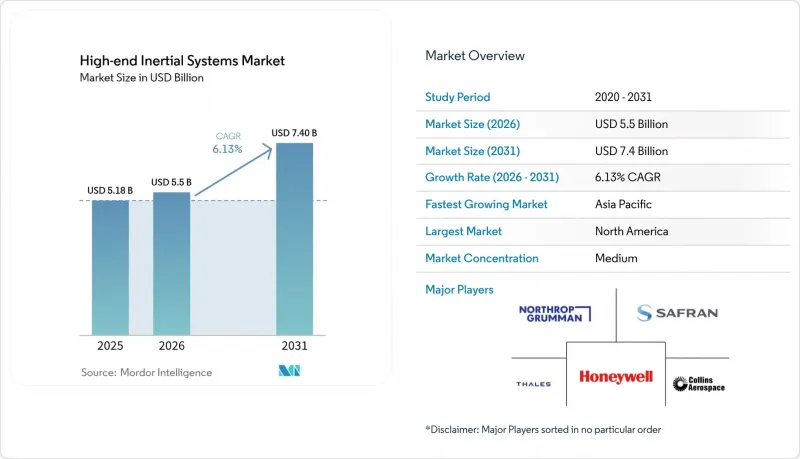
This report is Segmented by Type (Inertial Measurement Units, Inertial Navigation Systems, and More), Component (Sensors, Processors, Software and Algorithms, and More), End-User Industry (Defense and Aerospace, Industrial, Marine and Sub-Sea, and More), Navigation Grade (Strategic Grade, Navigation Grade, and More), and Geography. The Market Forecasts are Provided in Terms of Value (USD).
Global High-end Inertial Systems Market Trends and Insights
Proliferation of UAVs And Autonomous Vehicles
Rising UAV fleet sizes and autonomous-system deployments compel operators to adopt tactical-grade IMUs that minimize drift below 1°/h, allowing missions to continue during GPS jamming. U.S. Special Operations Command forecast procurement of more than 1,200 Group-3 UAVs between 2024 and 2029, embedding a steady base of high-rate IMU demand. In mining and agriculture, visual-inertial odometry integrates IMU outputs with stereo-camera feeds, reducing cumulative position error to under 0.5% of the distance traveled while keeping the unit price below USD 5,000. Local processing of fused data eliminates latency associated with cloud offloading, prompting sensor makers to co-develop on-board Kalman filters that satisfy safety-critical response requirements. This momentum supports the broader penetration of high-end inertial systems in the civilian sector without diluting the strategic-grade backlog.
Defense Modernization Budgets For Inertial Navigation
Pentagon allocations rose in fiscal 2024, exemplified by a USD 99 million award to Honeywell for the Distributed Anti-Jam GPS System that pairs tactical-grade IMUs with anti-jam receivers. Similar upgrade cycles in European navies are replacing 1990s-era fiber-optic gyros with newer tactical-grade INS, cutting per-unit costs by roughly 30% and extending platform life. The U.S. Army's Mounted Assured Positioning, Navigation and Timing architecture blends LN-251 fiber-optic gyros with encrypted GPS to harden vehicles against electronic attack, solidifying recurring revenue for Tier-1 primes but raising certification barriers for entrants. These contracts anchor the high-end inertial systems market even when commercial demand fluctuates.
High Initial Procurement And Calibration Costs
Strategic-grade inertial navigation systems priced above USD 500,000 require six-axis thermal calibration, which can add 20% to the purchase cost and extend lead times by more than 18 months. Tactical-grade IMUs still require factory cycles spanning 72 hours, pushing smaller industrial buyers to postpone adoption in favor of GNSS-only modules under USD 1,000. Leasing and calibration-as-a-service schemes remain immature, forcing end users to amortize capital expenses over decade-long refresh cycles that exceed consumer-hardware timelines, constraining near-term penetration of the high-end inertial systems market.
Other drivers and restraints analyzed in the detailed report include:
- Advancements In MEMS Manufacturing Reducing SWaP
- Increasing Demand For GNSS-Denied Navigation In Aerospace
- Complex System Integration Challenges In Multi-Sensor Fusion
For complete list of drivers and restraints, kindly check the Table Of Contents.
Segment Analysis
Inertial measurement units contributed 37.85% of 2025 revenue, underscoring their centrality to the high-end inertial systems market size for multi-domain navigation platforms. Their modular architecture pairs tri-axis accelerometers and gyroscopes with external processors, allowing OEMs to tailor performance-to-cost ratios across aerospace and industrial robots. Attitude and heading reference systems are set to clock an 8.28% CAGR, mainly because offshore-wind installation vessels demand heading accuracy within 0.5°, where integrated magnetometers outperform standalone IMUs. This performance uptick underlines how incremental sensor fusion is driving segment substitution rather than pure additive spend.
IMUs benefit from broader design-win opportunities in UAVs and missiles; yet AHRS gains traction in marine and mining equipment seeking plug-and-play pitch-roll solutions. Fiber-optic or MEMS gyros, when combined with fluxgate or solid-state compasses, enable AHRS to replace more expensive INS units on price-sensitive platforms. Quantum-interferometry prototypes, such as Northrop Grumman's LR-500, which achieved 0.001°/h bias stability in 2024, remain in laboratories; however, miniaturization roadmaps suggest disruptive competition within the high-end inertial systems market before 2030.
Sensor hardware accounted for 42.15% of component revenue in 2025, reflecting the capital-intensive nature of clean-room MEMS wafering and fiber-coil winding, which influences the cost structure across the high-end inertial systems market share. However, software and algorithms are expected to record an 8.37% CAGR as customers pay licensing fees for adaptive Kalman-filter libraries and AI-enhanced error modeling. Vendors increasingly bundle middleware with hardware to secure pull-through revenue and lock customers into their calibration frameworks.
Processors, typically ARM Cortex-M7 or DSP cores, account for roughly 9% of the bill-of-materials value but ensure deterministic loop times of less than 1 ms, which is necessary for suppressing IMU shot noise. Mechanical frames made of titanium or carbon fiber stave off vibration-induced errors, which are critical for military and offshore applications. Meanwhile, power-supply modules designed for 9-36 V rails broaden cross-platform integration, helping to expand the total addressable spend within the high-end inertial systems market.
Complete Report Scope:
- By Type
- Inertial Measurement Units
- Inertial Navigation Systems
- Accelerometers
- Gyroscopes
- Attitude and Heading Reference Systems
- Others
- By Component
- Sensors
- Processors (DSP and Micro-controllers)
- Software and Algorithms
- Mechanical Frames
- Power Supplies
- Others
- By End-user Industry
- Defense and Aerospace
- Industrial
- Marine and Sub-sea
- Mining and Drilling
- Automotive
- Other End-user Industries
- By Navigation Grade
- Strategic Grade
- Navigation Grade
- Tactical Grade
- Industrial Grade
- By Geography
- North America
- United States
- Canada
- Mexico
- South America
- Brazil
- Argentina
- Rest of South America
- Europe
- Germany
- United Kingdom
- France
- Italy
- Spain
- Russia
- Rest of Europe
- Asia Pacific
- China
- Japan
- India
- South Korea
- Australia
- Rest of Asia Pacific
- Middle East and Africa
- Middle East
- Saudi Arabia
- United Arab Emirates
- Turkey
- Rest of Middle East
- Africa
- South Africa
- Nigeria
- Egypt
- Rest of Africa
- Middle East
- North America
Geography Analysis
North America generated 37.65% of 2025 revenue as Pentagon funding of USD 1.2 billion flowed into inertial upgrades across air, land, and sea platforms. Honeywell's Clearwater and Northrop Grumman's Woodland Hills plants dominate strategic-grade output, with Canadian Arctic programs spurring demand for -55 °C-rated IMUs. Mexico's Queretaro cluster assembles tactical-grade sensors that qualify for USMCA duty benefits yet remain subject to ITAR re-export rules, illustrating the interdependence of supply chains within the high-end inertial systems market.
Asia Pacific is predicted to log an 8.21% CAGR through 2031, propelled by BeiDou-denied backup systems, Japanese destroyer retrofits worth over USD 100 million, and India's Make-in-India defense offsets. Hanwha's domestic IMU for the K2 tank and Australian mining fleets, which utilize more than 2,000 IMUs annually, reflect the regional appetite for both strategic resilience and industrial automation. Taiwan and South Korea's semiconductor fabs offer MEMS volume capacity, positioning the region to capture a larger share of sensor hardware as unit shipments rise.
Europe, the Middle East, and Africa supply the remainder of the high-end inertial systems market. European offshore wind projects, such as Orsted's Hornsea 2, employ fiber-optic gyros for dynamic positioning, sustaining a high-margin marine niche. Middle Eastern demand centers around UCAV tactical-grade imports, while South African underground platinum mining highlights industrial-grade opportunities in GNSS-denied environments. The region also faces supply-chain constraints for optical fiber produced in Germany and France, which could potentially lengthen lead times for fiber-optic units.
- Honeywell International Inc.
- Northrop Grumman Corporation
- Safran S.A.
- Thales S.A.
- Collins Aerospace (Raytheon Technologies Corp.)
- Bosch Sensortec GmbH
- Analog Devices Inc.
- Moog Inc.
- ON Semiconductor Corp.
- VectorNav Technologies LLC
- STMicroelectronics N.V.
- KVH Industries Inc.
- Silicon Sensing Systems Ltd.
- Exail Group (formerly iXblue SAS)
- Trimble Inc.
- Colibrys (Safran Sensors and Electronics) SA
- TDK InvenSense Inc.
- Teledyne Technologies Inc.
- Systron Donner Inertial (EMCORE Corp.)
- Epson ToyoCom Corp.
Additional Benefits:
- The market estimate (ME) sheet in Excel format
- 3 months of analyst support
TABLE OF CONTENTS
1 INTRODUCTION
- 1.1 Study Assumptions and Market Definition
- 1.2 Scope of the Study
2 RESEARCH METHODOLOGY
3 EXECUTIVE SUMMARY
4 MARKET LANDSCAPE
- 4.1 Market Overview
- 4.2 Impact of Macroeconomic Factors
- 4.3 Market Drivers
- 4.3.1 Proliferation of UAVs and autonomous vehicles
- 4.3.2 Defense modernization budgets for inertial navigation
- 4.3.3 Advancements in MEMS manufacturing reducing SWaP
- 4.3.4 Increasing demand for GNSS-denied navigation in aerospace
- 4.3.5 Emergence of quantum-enhanced inertial sensors
- 4.3.6 Integration with fiber-optic gyros in offshore wind installation vessels
- 4.4 Market Restraints
- 4.4.1 High initial procurement and calibration costs
- 4.4.2 Complex system integration challenges in multi-sensor fusion
- 4.4.3 Supply-chain vulnerabilities for specialty inertial-grade quartz and optical fibers
- 4.4.4 Regulatory export controls limiting high-performance IMU shipments
- 4.5 Industry Value Chain Analysis
- 4.6 Regulatory Landscape
- 4.7 Technological Outlook
- 4.8 Porter's Five Forces Analysis
- 4.8.1 Bargaining Power of Suppliers
- 4.8.2 Bargaining Power of Consumers
- 4.8.3 Threat of New Entrants
- 4.8.4 Threat of Substitute Products
- 4.8.5 Intensity of Competitive Rivalry
5 MARKET SIZE AND GROWTH FORECASTS (VALUE)
- 5.1 By Type
- 5.1.1 Inertial Measurement Units
- 5.1.2 Inertial Navigation Systems
- 5.1.3 Accelerometers
- 5.1.4 Gyroscopes
- 5.1.5 Attitude and Heading Reference Systems
- 5.1.6 Others
- 5.2 By Component
- 5.2.1 Sensors
- 5.2.2 Processors (DSP and Micro-controllers)
- 5.2.3 Software and Algorithms
- 5.2.4 Mechanical Frames
- 5.2.5 Power Supplies
- 5.2.6 Others
- 5.3 By End-user Industry
- 5.3.1 Defense and Aerospace
- 5.3.2 Industrial
- 5.3.3 Marine and Sub-sea
- 5.3.4 Mining and Drilling
- 5.3.5 Automotive
- 5.3.6 Other End-user Industries
- 5.4 By Navigation Grade
- 5.4.1 Strategic Grade
- 5.4.2 Navigation Grade
- 5.4.3 Tactical Grade
- 5.4.4 Industrial Grade
- 5.5 By Geography
- 5.5.1 North America
- 5.5.1.1 United States
- 5.5.1.2 Canada
- 5.5.1.3 Mexico
- 5.5.2 South America
- 5.5.2.1 Brazil
- 5.5.2.2 Argentina
- 5.5.2.3 Rest of South America
- 5.5.3 Europe
- 5.5.3.1 Germany
- 5.5.3.2 United Kingdom
- 5.5.3.3 France
- 5.5.3.4 Italy
- 5.5.3.5 Spain
- 5.5.3.6 Russia
- 5.5.3.7 Rest of Europe
- 5.5.4 Asia Pacific
- 5.5.4.1 China
- 5.5.4.2 Japan
- 5.5.4.3 India
- 5.5.4.4 South Korea
- 5.5.4.5 Australia
- 5.5.4.6 Rest of Asia Pacific
- 5.5.5 Middle East and Africa
- 5.5.5.1 Middle East
- 5.5.5.1.1 Saudi Arabia
- 5.5.5.1.2 United Arab Emirates
- 5.5.5.1.3 Turkey
- 5.5.5.1.4 Rest of Middle East
- 5.5.5.2 Africa
- 5.5.5.2.1 South Africa
- 5.5.5.2.2 Nigeria
- 5.5.5.2.3 Egypt
- 5.5.5.2.4 Rest of Africa
- 5.5.5.1 Middle East
- 5.5.1 North America
6 COMPETITIVE LANDSCAPE
- 6.1 Market Concentration
- 6.2 Strategic Moves
- 6.3 Market Share Analysis
- 6.4 Company Profiles (includes Global level overview, Market level overview, Core Segments, Financials as available, Strategic Information, Market Rank/Share, Products and Services, Recent Developments)
- 6.4.1 Honeywell International Inc.
- 6.4.2 Northrop Grumman Corporation
- 6.4.3 Safran S.A.
- 6.4.4 Thales S.A.
- 6.4.5 Collins Aerospace (Raytheon Technologies Corp.)
- 6.4.6 Bosch Sensortec GmbH
- 6.4.7 Analog Devices Inc.
- 6.4.8 Moog Inc.
- 6.4.9 ON Semiconductor Corp.
- 6.4.10 VectorNav Technologies LLC
- 6.4.11 STMicroelectronics N.V.
- 6.4.12 KVH Industries Inc.
- 6.4.13 Silicon Sensing Systems Ltd.
- 6.4.14 Exail Group (formerly iXblue SAS)
- 6.4.15 Trimble Inc.
- 6.4.16 Colibrys (Safran Sensors and Electronics) SA
- 6.4.17 TDK InvenSense Inc.
- 6.4.18 Teledyne Technologies Inc.
- 6.4.19 Systron Donner Inertial (EMCORE Corp.)
- 6.4.20 Epson ToyoCom Corp.
7 MARKET OPPORTUNITIES AND FUTURE OUTLOOK
- 7.1 White-space and Unmet-Need Assessment

