PUBLISHER: Mordor Intelligence | PRODUCT CODE: 2155000

PUBLISHER: Mordor Intelligence | PRODUCT CODE: 2155000
South America Inertial Systems - Market Share Analysis, Industry Trends & Statistics, Growth Forecasts (2026 - 2031)
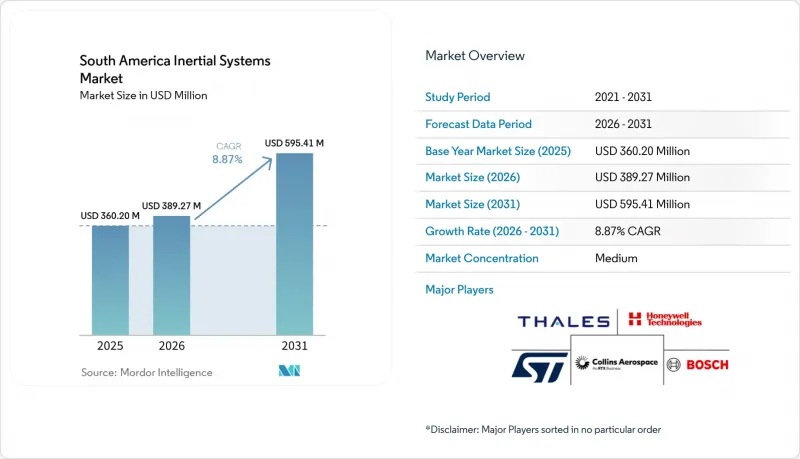
According to Mordor Intelligence, the South America inertial systems market size is expected to increase from USD 360.20 million in 2025 to USD 389.27 million in 2026 and reach USD 595.41 million by 2031, growing at a CAGR of 8.87% over 2026-2031.
South America Inertial Systems Market Trends and Insights
Defense and Aerospace Platform Modernization
Platform modernization in Brazil, Argentina, and Colombia supports sustained demand within the South America inertial systems market. Brazil's Tamandare-class frigate program covers 4 vessels scheduled for delivery through 2029, and its first frigate entered service with an integrated navigation and bridge system in February 2026. Each vessel requires navigation integration at the platform level, which supports demand for inertial equipment during installation, qualification, and service. Argentina's F-16 modernization program introduces embedded GPS and inertial navigation requirements that are consistent with NATO-aligned avionics standards. The concurrent modernization of fighter aircraft, frigates, and helicopters gives suppliers several long-duration program opportunities instead of a single procurement cycle. This mix also supports replacement demand after the original platform deliveries are complete.
Expansion of UAV, UGV, and UUV Deployment
The expansion of unmanned air, ground, and subsea systems increases demand for compact sensors that can withstand shock and operate with calibrated performance profiles. The South America inertial systems market benefits because unmanned platforms use inertial inputs for stabilization, guidance, attitude reference, and position estimation. Brazil conducted the first confirmed flight of the Albatroz Vortex jet-powered UAV in January 2026 under a cooperation arrangement involving the Ministry of Defense and the Air Force. Argentina publicly demonstrated a UGV with a gyrostabilized weapon turret and first-person-view drone deployment capability in May 2026. These programs show that regional procurement is extending beyond conventional crewed platforms into several unmanned domains. Their requirements favor smaller and more cost-efficient systems while maintaining reliable field performance.
Import Dependence for High-Grade Inertial Components
South America has limited domestic capacity for accelerometers and gyroscopes that meet navigation-grade and strategic-grade accuracy requirements. The South America inertial systems market, therefore, relies on a concentrated group of internationally qualified manufacturers for military aircraft, ship navigation, and precision-guided weapons. Export controls can restrict the availability of these products and complicate delivery planning for regional programs. The International Traffic in Arms Regulations establish controls for defense articles and related technical data, which can affect cross-border supply arrangements. Import dependence also raises local procurement costs when contracts are denominated in foreign currencies. Brazil's work on a domestic SNI-GNSS system points to a longer-term effort to develop local capability, but high-grade component demand remains externally sourced in the near term.
Other drivers and restraints analyzed in the detailed report include:
- GNSS-Denied Navigation and Anti-Jam Requirements
- Oil, Gas, and Mining Automation
- Long Qualification and Certification Cycles
For complete list of drivers and restraints, kindly check the Table Of Contents.
Segment Analysis
IMUs held 33.81% of the South America inertial systems market share in 2025 and are projected to expand at a 10.13% CAGR between 2026 and 2031. This position reflects their use in navigation, stabilization, and guided-weapon guidance across defense and civil applications. Brazil's serial production of the MANSUP anti-ship missile and MAX 1.2 AC anti-tank missile at SIATT's Cacapava facility supports demand for guidance subsystems. SIATT expanded its production capability through a new 6,000 m2 facility in Sao Jose dos Campos in September 2025, with research laboratories and lines for MANSUP, MAX 1.2 AC, and SisGAAz systems. IMUs also serve offshore energy, UAV, space-launch, and industrial navigation functions. Their use across several platforms makes the component less dependent on any one procurement program.
Accelerometers and gyroscopes provide the basic sensing inputs used in IMUs and more complex inertial assemblies. Their demand is linked to the production rate of IMUs and inertial navigation systems rather than to a single end use. Magnetometers retain a focused role in heading-reference applications across maritime and mining operations. AHRS equipment has gained support in offshore oil and gas work, as shown by Exail's contract for 30 Quadrans AHRS units for Petrobras-operated FPSOs. Inclinometers and navigation computers add revenue through autonomous and remotely operated industrial systems. The component mix gives the South America inertial systems industry exposure to high-precision defense programs and larger-volume commercial uses. Local integration requirements can favor suppliers that combine sensor capability with engineering support.
Complete Report Scope:
- By Component
- Accelerometers
- Gyroscopes
- Inertial Measurement Units (IMUs)
- Magnetometers
- Attitude Heading and Reference Systems
- Other Components
- By Technology
- MEMS
- Fiber-Optic Gyro
- Ring Laser Gyro
- Vibrating Gyro
- Hemispherical Resonator Gyro
- Mechanical Inertial Navigational Systems
- By Applications
- Aerospace and Defense
- Energy and Infrastructure
- Consumer Electronics
- Industrial
- Automotive
- Medical
- Land and Transportation
- Other Applications
- By Country
- Brazil
- Argentina
- Colombia
- Rest of South America
List of Companies Covered in this Report:
- Honeywell International Inc.
- Collins Aerospace
- Safran Electronics & Defense
- Thales Group
- Northrop Grumman Corporation
- STMicroelectronics N.V.
- Analog Devices, Inc.
- Robert Bosch GmbH
- TDK Corporation
- Murata Manufacturing Co., Ltd.
- KVH Industries, Inc.
- EMCORE Corporation
- Teledyne Technologies Incorporated
- Trimble Inc.
- VectorNav Technologies, LLC
- Exail Technologies
- Kearfott Corporation
- Silicon Sensing Systems Limited
- AEL Sistemas S.A.
- Embraer S.A.
- SIATT Sistemas de Defesa Ltda.
- INVAP S.E.
- HORUSEYE TECH Systems Engineering
Additional Benefits:
- The market estimate (ME) sheet in Excel format
- 3 months of analyst support
TABLE OF CONTENTS
1 INTRODUCTION
- 1.1 Study Assumptions and Market Definition
- 1.2 Scope of the Study
2 RESEARCH METHODOLOGY
3 EXECUTIVE SUMMARY
4 MARKET LANDSCAPE
- 4.1 Market Overview
- 4.2 Market Drivers
- 4.2.1 Defense and Aerospace Platform Modernization
- 4.2.2 Expansion of UAV, UGV and UUV Deployment
- 4.2.3 MEMS Miniaturization and Lower System Cost
- 4.2.4 GNSS-Denied Navigation and Anti-Jam Requirements
- 4.2.5 South American Oil, Gas and Mining Automation
- 4.2.6 Localized Defense-Electronics Integration in Brazil
- 4.3 Market Restraints
- 4.3.1 Import Dependence for High-Grade Inertial Components
- 4.3.2 Long Qualification and Certification Cycles
- 4.3.3 Integration, Calibration and Drift-Compensation Complexity
- 4.3.4 Currency Volatility and Uneven Defense Procurement
- 4.4 Industry Value Chain Analysis
- 4.5 Regulatory Landscape
- 4.6 Technological Outlook
- 4.7 Porter's Five Forces Analysis
- 4.7.1 Threat of New Entrants
- 4.7.2 Bargaining Power of Suppliers
- 4.7.3 Bargaining Power of Buyers
- 4.7.4 Threat of Substitutes
- 4.7.5 Competitive Rivalry
- 4.8 Impact of Macroeconomic Factors on the Market
5 MARKET SIZE AND GROWTH FORECASTS (VALUE)
- 5.1 By Component
- 5.1.1 Accelerometers
- 5.1.2 Gyroscopes
- 5.1.3 Inertial Measurement Units (IMUs)
- 5.1.4 Magnetometers
- 5.1.5 Attitude Heading and Reference Systems
- 5.1.6 Other Components
- 5.2 By Technology
- 5.2.1 MEMS
- 5.2.2 Fiber-Optic Gyro
- 5.2.3 Ring Laser Gyro
- 5.2.4 Vibrating Gyro
- 5.2.5 Hemispherical Resonator Gyro
- 5.2.6 Mechanical Inertial Navigational Systems
- 5.3 By Applications
- 5.3.1 Aerospace and Defense
- 5.3.2 Energy and Infrastructure
- 5.3.3 Consumer Electronics
- 5.3.4 Industrial
- 5.3.5 Automotive
- 5.3.6 Medical
- 5.3.7 Land and Transportation
- 5.3.8 Other Applications
- 5.4 By Country
- 5.4.1 Brazil
- 5.4.2 Argentina
- 5.4.3 Colombia
- 5.4.4 Rest of South America
6 COMPETITIVE LANDSCAPE
- 6.1 Market Concentration
- 6.2 Strategic Moves
- 6.3 Market Share Analysis
- 6.4 Company Profiles (includes Global Level Overview, Market Level Overview, Core Segments, Financials as available, Strategic Information, Market Rank/Share, Products and Services, Recent Developments)
- 6.4.1 Honeywell International Inc.
- 6.4.2 Collins Aerospace
- 6.4.3 Safran Electronics & Defense
- 6.4.4 Thales Group
- 6.4.5 Northrop Grumman Corporation
- 6.4.6 STMicroelectronics N.V.
- 6.4.7 Analog Devices, Inc.
- 6.4.8 Robert Bosch GmbH
- 6.4.9 TDK Corporation
- 6.4.10 Murata Manufacturing Co., Ltd.
- 6.4.11 KVH Industries, Inc.
- 6.4.12 EMCORE Corporation
- 6.4.13 Teledyne Technologies Incorporated
- 6.4.14 Trimble Inc.
- 6.4.15 VectorNav Technologies, LLC
- 6.4.16 Exail Technologies
- 6.4.17 Kearfott Corporation
- 6.4.18 Silicon Sensing Systems Limited
- 6.4.19 AEL Sistemas S.A.
- 6.4.20 Embraer S.A.
- 6.4.21 SIATT Sistemas de Defesa Ltda.
- 6.4.22 INVAP S.E.
- 6.4.23 HORUSEYE TECH Systems Engineering
7 MARKET OPPORTUNITIES AND FUTURE OUTLOOK
- 7.1 White-Space and Unmet-Need Assessment

