PUBLISHER: Mordor Intelligence | PRODUCT CODE: 2113824

PUBLISHER: Mordor Intelligence | PRODUCT CODE: 2113824
Business Intelligence (BI) - Market Share Analysis, Industry Trends & Statistics, Growth Forecasts (2026 - 2031)
According to Mordor Intelligence, the business intelligence (BI) market size reached USD 41.16 billion in 2026 and is projected to climb to USD 62.38 billion by 2031, registering an 8.67% CAGR.
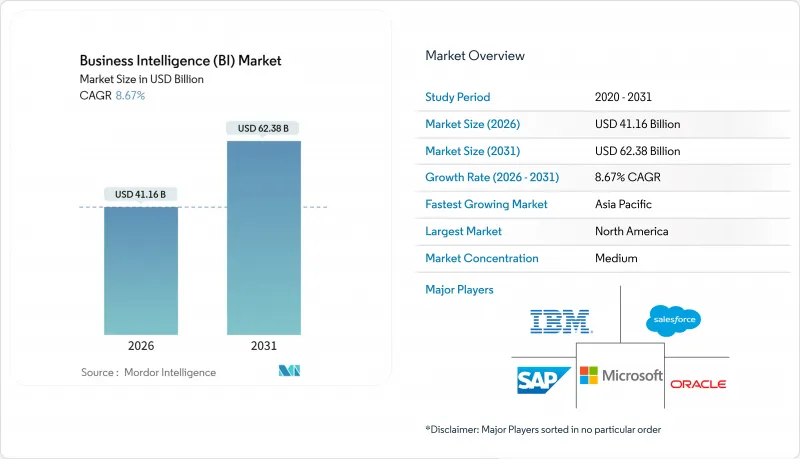
This report is Segmented by Component (Software and Platform, and Services), Deployment (On-Premise, and Cloud), Business Model (Subscription / SaaS License, Perpetual License, and More), End-User Industry (BFSI, IT and Telecommunication, and More), and Geography. The Market Forecasts are Provided in Terms of Value (USD).
Global Business Intelligence (BI) Market Trends and Insights
Cloud-first analytics adoption
Enterprises continue to migrate analytic workloads into managed cloud ecosystems because pay-per-second pricing matches spending to actual consumption. Serverless warehouses such as Amazon Redshift Serverless auto-scale to meet thousands of concurrent queries, letting teams finish pilot dashboards in weeks rather than the multi-year timelines once associated with on-premise builds. Google BigQuery's streaming inserts and Gemini AI integration allow business users to issue natural-language questions that the platform translates into SQL, widening participation beyond specialized analysts. Microsoft Power BI paired with Fabric can refresh visuals whenever new data lands, eliminating nightly batch windows. Financial-services firms maintain hybrid patterns, keeping regulated records on-premise while exploratory models move to the cloud, a deployment style referenced in U.S. supervisory guidance.
Explosion of Semi-Structured IoT Data
Industrial sensors, vehicle telematics, and smart-city networks push daily payloads of JSON, Avro, and Parquet files that traditional relational databases cannot absorb efficiently. Columnar lakehouse engines use schema-on-read to query raw device messages alongside transactional data, enabling predictive maintenance that cuts unplanned downtime by 20-30% in manufacturing trials. Peer-reviewed benchmarks show GPU-accelerated SQL engines delivering 8-60X speed-ups versus CPU systems on TPC-H workloads, reducing end-user wait times to sub-second levels. Snowflake's VARIANT data type and Databricks Delta Lake illustrate unified storage that hosts structured orders and raw telemetry in a single environment. As 5G coverage expands, edge gateways forward aggregated sensor snapshots to cloud object stores, keeping bandwidth costs manageable while still enabling near-real-time analytics.
Shortage of Data-Literate Workforce
Accenture's 2025 survey shows only 21% of employees possess functional data skills, leaving 87% of enterprises struggling to fill analyst roles. The World Economic Forum ranks data analysis among the top five future skills through 2030, yet academic programs are not producing graduates fast enough to meet demand. Rising salaries divert budgets away from platform investments into compensation, sometimes delaying new deployments. Low-code tools help but cannot replace human judgment when reconciling conflicting sources or addressing sampling bias. Companies respond with internal academies and certification stipends, yet ramp-up timelines remain lengthy, extending the adoption curve in the Business Intelligence (BI) market.
Other drivers and restraints analyzed in the detailed report include:
- Mainstream Embedded BI in SaaS Apps
- Data Clean-Room Partnerships
- Up-Front Integration Cost for Legacy Systems
For complete list of drivers and restraints, kindly check the Table Of Contents.
Segment Analysis
Services revenue expanded at a 9.23% CAGR, outpacing the Business Intelligence (BI) market because companies enlist domain experts to design semantic models, optimize query logic, and train citizen analysts. Software and platforms retained 68.73% 2025 revenue as license subscriptions remain foundational, particularly for organizations standardizing on a single visualization layer. Systems integrators differentiate by guaranteeing service-level objectives such as sub-second dashboard latency or 99.9% refresh reliability, monetizing outcome-based contracts rather than billable hours. Managed-service bundles that wrap licenses, cloud infrastructure, and ongoing optimization into usage-based payments reduce capital strain for mid-market buyers, aligning with broader IT shifts toward operating-expense models.
Platform vendors counter competitive pressure by embedding AI copilots that auto-generate visuals and DAX formulas, lowering external consulting needs. Hyperscaler convergence accelerates, as Oracle Autonomous Database and SAP Analytics Cloud combine storage, transformation, and presentation layers to lock in enterprise data estates. Services providers respond by specializing in cross-platform governance, helping multinational clients reconcile multiple BI stacks acquired through mergers. As the Business Intelligence (BI) market size rises, specialist boutiques emerge around vertical use cases such as pharmacovigilance signal detection and retail demand sensing, sustaining a vibrant advisor ecosystem despite platform simplification trends.
The cloud segment accounted for 65.87% of 2025 revenue and is advancing at a 9.54% CAGR through 2031. The cloud implementations segment dominates the market because variable compute and serverless warehousing eliminate idle capacity costs while auto-scaling meets unpredictable analytical surges. Continuous ingestion pipelines feed near-real-time dashboards for e-commerce flash-sale monitoring, a capability historically out of reach for on-premise appliances. Nations such as India and Indonesia require local data processing, prompting hyperscalers to launch in-country regions that meet sovereignty mandates and support further growth of the Business Intelligence (BI) market.
On-premises clusters persist in hospitals and banks that cannot move patient records or credit data off-site due to regulatory constraints, resulting in hybrid architectures where sensitive workloads remain on-premises while customer experience experimentation occurs in the cloud. Multi-cloud strategies spread risk across Amazon Web Services, Microsoft Azure, and Google Cloud Platform but incur egress charges that sometimes eclipse compute costs, prompting interest in zero-egress object stores such as Cloudflare R2. Vendors now integrate cost-optimizer dashboards that model query-level spend, helping finance teams predict invoices and avoid sticker shock.
Complete Report Scope:
- By Component
- Software and Platform
- Services
- By Deployment
- On-Premise
- Cloud
- By End-User Industry
- BFSI
- IT and Telecommunication
- Retail and e-Commerce
- Healthcare
- Manufacturing
- Government and Public Sector
- By Business Model
- Subscription / SaaS License
- Perpetual License
- Freemium / Usage-Based
- Managed Service / BI-as-a-Service
- By Geography
- North America
- United States
- Canada
- Mexico
- South America
- Brazil
- Argentina
- Rest of South America
- Europe
- United Kingdom
- Germany
- France
- Italy
- Spain
- Russia
- Rest of Europe
- Asia-Pacific
- China
- Japan
- India
- South Korea
- Australia and New Zealand
- Southeast Asia
- Rest of Asia-Pacific
- Middle East and Africa
- Middle East
- Saudi Arabia
- United Arab Emirates
- Turkey
- Rest of Middle East
- Africa
- South Africa
- Nigeria
- Kenya
- Rest of Africa
- Middle East
- North America
Geography Analysis
North America captured 39.85% of 2025 revenue thanks to concentrated hyperscaler data centers that keep dashboard round-trip latency below 10 milliseconds. Mature venture-capital ecosystems fund start-ups offering specialized AI copilots that broaden Business Intelligence (BI) market adoption beyond trained analysts. Only 21% of workers hold analytical competency, limiting platform utilization despite abundant technology. Multi-cloud egress charges occasionally surpass compute spend for data-intensive workloads, forcing architectural redesign to co-locate processing and storage.
Asia-Pacific is forecast to log a 10.12% CAGR to 2031 as China targets a 60% digital-economy contribution to GDP by 2025, spurring domestic BI platform investment. India's Digital India program expands broadband and subsidizes cloud adoption, creating greenfield demand for localized analytics solutions. The Association of Southeast Asian Nations projects its digital economy will reach USD 1 trillion by 2030, with e-commerce and fintech sectors spearheading analytics spend. However, divergent privacy frameworks across China, India, and Southeast Asia require region-specific data residencies, inflating vendor compliance costs.
Europe grows steadily as enterprises embed privacy-by-design analytics to satisfy the General Data Protection Regulation, which levied EUR 1.6 billion in fines during 2023. South America witnesses upticks in Brazil and Argentina as firms digitize operations, but currency volatility slows mega-projects. The Middle East and Africa plant early seeds via smart-city programs in the United Arab Emirates and Saudi Arabia, yet infrastructure gaps and skills shortages constrain near-term scale, making partnerships with regional integrators essential.
- Microsoft Corporation
- SAP SE
- Oracle Corporation
- International Business Machines Corporation
- SAS Institute Inc.
- Salesforce Inc.
- Amazon Web Services Inc.
- Google LLC
- QlikTech International AB
- MicroStrategy Incorporated
- Domo Inc.
- TIBCO Software Inc.
- Infor Inc.
- Zoho Corporation Pvt. Ltd.
- Teradata Corporation
- Alteryx Inc.
- Sisense Inc.
- ThoughtSpot Inc.
- Yellowfin International Pty Ltd.
- GoodData Corporation
Additional Benefits:
- The market estimate (ME) sheet in Excel format
- 3 months of analyst support
TABLE OF CONTENTS
1 INTRODUCTION
- 1.1 Study Assumptions and Market Definition
- 1.2 Scope of the Study
2 RESEARCH METHODOLOGY
3 EXECUTIVE SUMMARY
4 MARKET LANDSCAPE
- 4.1 Market Overview
- 4.2 Market Drivers
- 4.2.1 Cloud-First Analytics Adoption
- 4.2.2 Explosion of Semi-Structured IoT Data
- 4.2.3 Mainstream Embedded BI in SaaS Business Apps
- 4.2.4 Data Clean-Room Partnerships in Privacy-First Advertising
- 4.2.5 GPU-Accelerated Query Engines Lowering TCO
- 4.2.6 Rise of Analytics-as-Code and GitOps Practices
- 4.3 Market Restraints
- 4.3.1 Shortage of Data-Literate Workforce
- 4.3.2 Up-Front Integration Cost for Legacy Core Systems
- 4.3.3 Escalating Egress Fees in Multi-Cloud BI Architectures
- 4.3.4 Data-Sovereignty Clampdowns in Emerging Digital-Trade Rules
- 4.4 Industry Supply-Chain Analysis
- 4.5 Regulatory Landscape
- 4.6 Technological Outlook
- 4.7 Impact of Macroeconomic Factors on the Market
- 4.8 Porter's Five Forces Analysis
- 4.8.1 Bargaining Power of Suppliers
- 4.8.2 Bargaining Power of Buyers and Consumers
- 4.8.3 Threat of New Entrants
- 4.8.4 Threat of Substitute Products
- 4.8.5 Intensity of Competitive Rivalry
5 MARKET SIZE AND GROWTH FORECASTS (VALUE)
- 5.1 By Component
- 5.1.1 Software and Platform
- 5.1.2 Services
- 5.2 By Deployment
- 5.2.1 On-Premise
- 5.2.2 Cloud
- 5.3 By End-User Industry
- 5.3.1 BFSI
- 5.3.2 IT and Telecommunication
- 5.3.3 Retail and e-Commerce
- 5.3.4 Healthcare
- 5.3.5 Manufacturing
- 5.3.6 Government and Public Sector
- 5.4 By Business Model
- 5.4.1 Subscription / SaaS License
- 5.4.2 Perpetual License
- 5.4.3 Freemium / Usage-Based
- 5.4.4 Managed Service / BI-as-a-Service
- 5.5 By Geography
- 5.5.1 North America
- 5.5.1.1 United States
- 5.5.1.2 Canada
- 5.5.1.3 Mexico
- 5.5.2 South America
- 5.5.2.1 Brazil
- 5.5.2.2 Argentina
- 5.5.2.3 Rest of South America
- 5.5.3 Europe
- 5.5.3.1 United Kingdom
- 5.5.3.2 Germany
- 5.5.3.3 France
- 5.5.3.4 Italy
- 5.5.3.5 Spain
- 5.5.3.6 Russia
- 5.5.3.7 Rest of Europe
- 5.5.4 Asia-Pacific
- 5.5.4.1 China
- 5.5.4.2 Japan
- 5.5.4.3 India
- 5.5.4.4 South Korea
- 5.5.4.5 Australia and New Zealand
- 5.5.4.6 Southeast Asia
- 5.5.4.7 Rest of Asia-Pacific
- 5.5.5 Middle East and Africa
- 5.5.5.1 Middle East
- 5.5.5.1.1 Saudi Arabia
- 5.5.5.1.2 United Arab Emirates
- 5.5.5.1.3 Turkey
- 5.5.5.1.4 Rest of Middle East
- 5.5.5.2 Africa
- 5.5.5.2.1 South Africa
- 5.5.5.2.2 Nigeria
- 5.5.5.2.3 Kenya
- 5.5.5.2.4 Rest of Africa
- 5.5.5.1 Middle East
- 5.5.1 North America
6 COMPETITIVE LANDSCAPE
- 6.1 Market Concentration
- 6.2 Strategic Moves
- 6.3 Market Share Analysis
- 6.4 Company Profiles (includes Global-Level Overview, Market-Level Overview, Core Segments, Financials as Available, Strategic Information, Market Rank/Share for Key Companies, Products and Services, and Recent Developments)
- 6.4.1 Microsoft Corporation
- 6.4.2 SAP SE
- 6.4.3 Oracle Corporation
- 6.4.4 International Business Machines Corporation
- 6.4.5 SAS Institute Inc.
- 6.4.6 Salesforce Inc.
- 6.4.7 Amazon Web Services Inc.
- 6.4.8 Google LLC
- 6.4.9 QlikTech International AB
- 6.4.10 MicroStrategy Incorporated
- 6.4.11 Domo Inc.
- 6.4.12 TIBCO Software Inc.
- 6.4.13 Infor Inc.
- 6.4.14 Zoho Corporation Pvt. Ltd.
- 6.4.15 Teradata Corporation
- 6.4.16 Alteryx Inc.
- 6.4.17 Sisense Inc.
- 6.4.18 ThoughtSpot Inc.
- 6.4.19 Yellowfin International Pty Ltd.
- 6.4.20 GoodData Corporation
7 MARKET OPPORTUNITIES AND FUTURE OUTLOOK
- 7.1 White-Space and Unmet-Need Assessment

