PUBLISHER: Mordor Intelligence | PRODUCT CODE: 2124455

PUBLISHER: Mordor Intelligence | PRODUCT CODE: 2124455
United Kingdom Business Intelligence - Market Share Analysis, Industry Trends & Statistics, Growth Forecasts (2026 - 2031)
According to Mordor Intelligence, the United Kingdom business intelligence market size is expected to grow from USD 1.18 billion in 2025 to USD 1.33 billion in 2026 and is forecast to reach USD 2.23 billion by 2031 at 10.89% CAGR over 2026-2031.
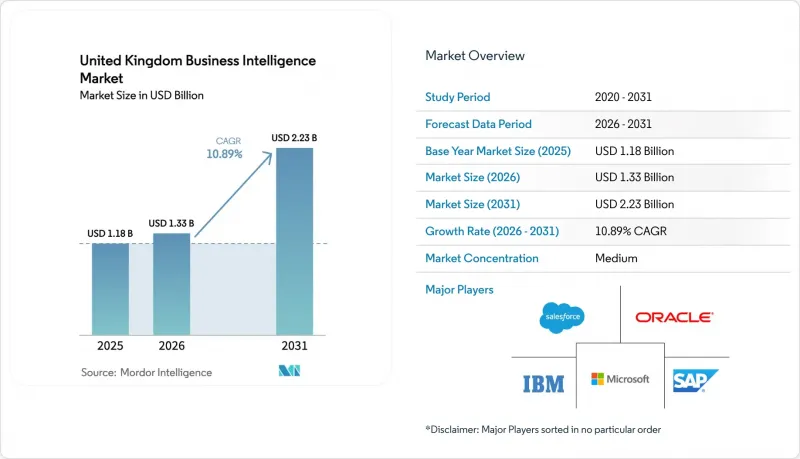
This report is Segmented by Component (Software, and Services), Deployment Mode (On-Premise, Cloud, and Hybrid), Organization Size (SMEs, and Large Enterprises), Functionality (Reporting, Data Mining, Performance Management, and Dashboard), End-User Vertical (BFSI, IT and Telecom, Retail, Manufacturing, and More), and Geography. The Market Forecasts are in Provided in Terms of Value (USD).
United Kingdom Business Intelligence Market Trends and Insights
Cloud-first Policy Among UK SMEs
Small and medium enterprises comprise 99.9% of UK businesses and are pivoting to software-as-a-service analytics that avoid upfront capital expenditure. Adoption among these firms rose 34% between 2024 and 2025 according to HM Revenue and Customs, placing business intelligence behind only email and accounting workloads in popularity. Consumption-based pricing aligns operating costs with revenue cycles, while government grants lower entry barriers. Vendors are now shipping industry templates that cut implementation times from months to weeks. Despite the momentum, 42% of SMEs still flag data-sovereignty and vendor lock-in as obstacles, prompting hybrid architectures that keep sensitive ledgers on-premises.
Generative-AI-Augmented Analytics Platforms
Natural-language interfaces powered by large language models are democratizing analytics access. Microsoft Copilot for Power BI and Salesforce Einstein GPT for Tableau both debuted in 2025, letting finance or marketing teams generate dashboards through plain-English prompts. Early pilots reduced dashboard-creation time by 60% yet raised governance challenges when hallucinated insights surfaced. The Information Commissioner's Office issued guidance in September 2025 reminding enterprises that accountability remains with data controllers, spurring demand for explainability features and audit trails.
Shortage of Advanced Analytics Talent
Tech Nation tallied a deficit of 178,000 technology professionals in 2025, a gap that directly constrains business intelligence rollouts. Large firms often backfill with consultancies, but mid-market companies lack comparable budgets. While universities expand data-science cohorts, graduates frequently gravitate to higher-paying technology roles or emigrate. The Apprenticeship Levy redirects 0.5% of large-company payrolls into training, yet employers argue that six-month boot camps create mid-level technicians rather than strategists capable of framing business questions.
Other drivers and restraints analyzed in the detailed report include:
- Proliferation of IoT-enabled Data Streams
- Need for Real-time Decision Intelligence in Finance
- Data-Residency and Sovereignty Concerns Post-Brexit
For complete list of drivers and restraints, kindly check the Table Of Contents.
Segment Analysis
Spending on software commanded a 72.00% share of the United Kingdom business intelligence market in 2025, underscoring the entrenched position of platforms such as Power BI, SAP Analytics Cloud, and Tableau. Implementation projects, however, are growing more intricate as enterprises migrate aging reporting suites to the cloud and embed AI models into dashboards. System integrators now oversee data-quality remediation, user-acceptance testing, and multi-cloud governance that can span 18 months and exceed GBP 5 million (USD 6.3 million).
Service revenue is consequently rising at a 15.20% annual clip. Vendors package licenses with pre-configured dashboards, training, and managed data pipelines, compressing deployment cycles for SMEs. Consulting firms also market analytics-as-a-service subscriptions that give clients fractional access to data scientists and DevOps engineers. The result is a virtuous loop: rising technical complexity fuels demand for expertise, and that expertise amplifies the value derived from software investments, thereby enlarging overall United Kingdom business intelligence market / UK BI market revenue.
Cloud deployments captured 64.00% of the United Kingdom business intelligence market share in 2025, validating the government's Cloud First policy that requires public bodies to favor hosted solutions. The appeal is clear: automatic upgrades, usage-based billing, and global access for hybrid workforces. Even risk-averse banks are adopting cloud sandboxes for development and test workloads while keeping sensitive ledgers on-premises.
The United Kingdom business intelligence market size attributable to cloud is projected to expand at a 17.80% CAGR, aided by sovereign-cloud regions operated by hyperscalers under British legal jurisdiction. Manufacturers and healthcare systems increasingly adopt hybrid patterns, retaining latency-sensitive data locally and bursting analytical workloads to the public cloud for scale. On-premises deployments in the UK business intelligence (BI) market will persist in pockets with extreme residency or air-gap mandates, yet hybrid architectures that balance control and elasticity are becoming the default.
Complete Report Scope:
- By Component
- Software
- Services
- By Deployment Mode
- On-premises
- Cloud
- Hybrid
- By Organization Size
- Small and Medium Enterprises
- Large Enterprises
- By End-user Vertical
- Banking, Financial Services and Insurance
- Information Technology and Telecom
- Retail and Consumer Goods
- Manufacturing and Logistics
- Healthcare and Life Sciences
- Other End-user Verticals
List of Companies Covered in this Report:
- Microsoft Corporation
- SAP SE
- Salesforce Inc. (Tableau)
- IBM Corporation
- SAS Institute Inc.
- Oracle Corporation
- Tibco Software Inc.
- QlikTech International AB
- MicroStrategy Incorporated
- Google LLC (Looker)
- Zoho Corporation Pvt. Ltd.
- Sisense Inc.
- Domo Inc.
- Board International SA
- Yellowfin International Pty Ltd
- ThoughtSpot Inc.
- Pyramid Analytics BV
- Infor Inc.
- Information Builders Inc.
Additional Benefits:
- The market estimate (ME) sheet in Excel format
- 3 months of analyst support
TABLE OF CONTENTS
1 INTRODUCTION
- 1.1 Study Assumptions and Market Definition
- 1.2 Scope of the Study
2 RESEARCH METHODOLOGY
3 EXECUTIVE SUMMARY
4 MARKET LANDSCAPE
- 4.1 Market Overview
- 4.2 Market Drivers
- 4.2.1 Proliferation of IoT-enabled Data Streams
- 4.2.2 Cloud-first Policy Among UK SMEs
- 4.2.3 Need for Real-time Decision Intelligence in Finance
- 4.2.4 Government Smart-City Initiatives Driving BI Demand
- 4.2.5 Rise of Embedded BI in Operational Apps
- 4.2.6 Generative-AI Augmented Analytics Platforms
- 4.3 Market Restraints
- 4.3.1 Shortage of Advanced Analytics Talent
- 4.3.2 Data-Residency and Sovereignty Concerns Post-Brexit
- 4.3.3 High Cost of Modern Data Platforms for SMEs
- 4.3.4 Legacy IT Integration Complexities
- 4.4 Industry Value Chain Analysis
- 4.5 Regulatory Landscape
- 4.6 Technological Outlook
- 4.7 Porter's Five Forces Analysis
- 4.7.1 Bargaining Power of Suppliers
- 4.7.2 Bargaining Power of Buyers
- 4.7.3 Threat of New Entrants
- 4.7.4 Threat of Substitutes
- 4.7.5 Intensity of Competitive Rivalry
5 MARKET SIZE AND GROWTH FORECASTS (VALUE, 2025 BASE YEAR)
- 5.1 By Component
- 5.1.1 Software
- 5.1.2 Services
- 5.2 By Deployment Mode
- 5.2.1 On-premises
- 5.2.2 Cloud
- 5.2.3 Hybrid
- 5.3 By Organization Size
- 5.3.1 Small and Medium Enterprises
- 5.3.2 Large Enterprises
- 5.4 By End-user Vertical
- 5.4.1 Banking, Financial Services and Insurance
- 5.4.2 Information Technology and Telecom
- 5.4.3 Retail and Consumer Goods
- 5.4.4 Manufacturing and Logistics
- 5.4.5 Healthcare and Life Sciences
- 5.4.6 Other End-user Verticals
6 COMPETITIVE LANDSCAPE
- 6.1 Market Concentration
- 6.2 Strategic Moves
- 6.3 Market Share Analysis
- 6.4 Company Profiles (includes Global Level Overview, Market Level Overview, Core Segments, Financials as available, Strategic Information, Market Rank/Share, Products and Services, Recent Developments)
- 6.4.1 Microsoft Corporation
- 6.4.2 SAP SE
- 6.4.3 Salesforce Inc. (Tableau)
- 6.4.4 IBM Corporation
- 6.4.5 SAS Institute Inc.
- 6.4.6 Oracle Corporation
- 6.4.7 Tibco Software Inc.
- 6.4.8 QlikTech International AB
- 6.4.9 MicroStrategy Incorporated
- 6.4.10 Google LLC (Looker)
- 6.4.11 Zoho Corporation Pvt. Ltd.
- 6.4.12 Sisense Inc.
- 6.4.13 Domo Inc.
- 6.4.14 Board International SA
- 6.4.15 Yellowfin International Pty Ltd
- 6.4.16 ThoughtSpot Inc.
- 6.4.17 Pyramid Analytics BV
- 6.4.18 Infor Inc.
- 6.4.19 Information Builders Inc.
7 MARKET OPPORTUNITIES AND FUTURE OUTLOOK
- 7.1 White-Space and Unmet-Need Assessment

