PUBLISHER: Mordor Intelligence | PRODUCT CODE: 2113829

PUBLISHER: Mordor Intelligence | PRODUCT CODE: 2113829
Europe Laundry Appliances - Market Share Analysis, Industry Trends & Statistics, Growth Forecasts (2026 - 2031)
According to Mordor Intelligence, the European laundry appliance market size is expected to grow from USD 16.83 billion in 2025 to USD 17.21 billion in 2026 and is forecast to reach USD 19.21 billion by 2031 at 2.23% CAGR over 2026-2031.
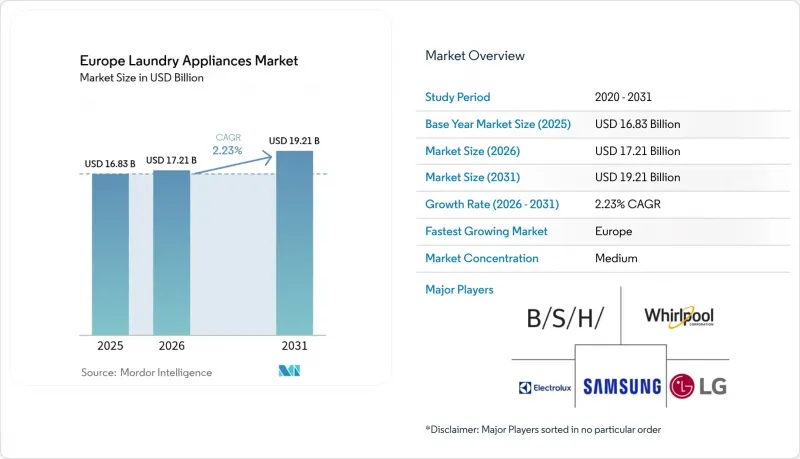
This report is Segmented by Product Type (Stand-Alone Washing Machines, Stand-Alone Drying Machines/Dryers, Combined Washer-Dryers), Loading Type (Front-Load, Top-Load), Capacity (Below 6 Kg, 6-8 Kg, Above 8 Kg), Usage (Residential, Commercial), Distribution Channel (B2B/Direct, B2C/Retail), and Geography (UK, Germany, and Other). The Market Forecasts are Provided in Terms of Value (USD).
Europe Laundry Appliances Market Trends and Insights
Rising Penetration of Smart, IoT-Enabled Laundry Appliances
Connected washers and dryers are moving from optional extras to baseline expectations as households prioritize live energy monitoring and predictive maintenance. BSH invested EUR 850 (USD 885.32) million in 2024 R&D, channeling a sizable portion into digital platforms that unite appliances with voice assistants and utility dashboards. The latest EU label embeds QR codes linking to the EPREL database, giving buyers transparent efficiency metrics that bolster adoption in the Europe laundry appliance market. Northern countries, where electricity prices are high, lead uptake because real-time usage data translates directly into lower monthly bills. Commercial laundromats follow suit, installing sensor-rich equipment that trims downtime and introduces consumers to app-controlled cycles during public usage. As the installed base of smart machines grows, manufacturers launch subscription software and detergent services, creating recurring revenue layers that buffer cyclical hardware sales. The feedback loop reinforces premium positioning and cements digital ecosystems as a central battleground for share gains.
Energy-Efficiency Regulations Spurring Replacement Demand
The July 2025 tumble-dryer rule eliminates the crowded A+++-to-D scale, replacing it with a simple A-to-G ladder and effectively restricting future sales to heat-pump models. Policymakers forecast 15 TWh savings and a 1.7 million tCO2e cut by 2040, numbers retailers promote to position upgrades as financially prudent. Parallel Ecodesign rules introduce digital product passports, forcing brands to publish durability metrics that reward engineering rigor and expose corner-cutting competitors. German research reveals buyers now rank lifecycle footprint ahead of sticker price, an attitudinal shift that directly benefits high-efficiency SKUs. As a result, the Europe laundry appliance market sees a two-tier structure: premium classes command margin headroom, while bare-minimum compliant models confront commoditization. This regulatory squeeze triggers early retirements of aging units, giving OEMs a predictable baseline of replacement demand even when broader consumer sentiment cools.
Price Sensitivity Amid Inflationary Pressures
Although euro-area inflation has receded from its 2023 peak, it remains above pre-pandemic norms, suppressing household confidence and stretching appliance replacement cycles. APPLiA warns that simultaneous increases in regulatory compliance and input costs narrow manufacturer margins, forcing tough trade-offs between specification depth and shelf pricing. Entry-level and mid-tier segments show pronounced price elasticity, prompting many buyers to defer upgrades unless energy bills escalate sharply. Retailers respond by extending 0% financing, yet higher interest rates diminish the appeal of long repayment plans. OEMs turn to value engineering-streamlining chassis parts, localizing supply chains-to protect headline prices while meeting Class A energy thresholds. Promotions cluster around events like Black Friday, demonstrating that bargain hunting shapes purchase timing in the Europe laundry appliance market.
Other drivers and restraints analyzed in the detailed report include:
- Growing Multi-Family Housing Driving Compact Appliance Sales
- Premiumization Trend Among Urban Households
- Mature Replacement Market Saturation in Western Europe
For complete list of drivers and restraints, kindly check the Table Of Contents.
Segment Analysis
Stand-alone washers controlled 71.55% of 2025 shipments, a testament to habit-entrenched purchasing where separate machines still symbolize reliability and throughput. The Europe laundry appliance market size for these models is forecast to rise modestly, signaling maturity yet durability. Combined washer-dryers, enjoying a 6.97% CAGR, owe momentum to shrinking apartment footprints and improved heat-pump drying that remedies historic energy concerns. Korean brands pushing 25 kg drums inside standard frames illustrate how engineering solves capacity constraints without enlarging cabinets. Premium cues such as allergen-neutralizing steam and AI load sensing entice households that equate multifunctionality with value. OEM roadmaps therefore converge: integrate identical smart modules across stand-alone and combo lines to blunt development cost inflation while meeting tightening EU standards.
Regulatory shifts further tilt the playing field; the July 2025 rule effectively bans non-heat-pump dryers, blurring technology distinctions between combo units and traditional stand-alone dryers. Retailers already spotlight energy-class symbols next to combination machines, easing consumer anxiety about operating costs and reinforcing the premium narrative. Commercial users, especially boutique hotels, increasingly adopt combo units to reduce back-of-house floor space, signaling crossover appeal beyond residential niches. Early evidence shows combo machines achieving comparable service lifespans, once considered a weak point, addressing prior concerns over dual-function wear. Investors note that higher average selling prices help recoup incremental R&D spending within three years, a metric supportive of continued portfolio expansion. The Europe laundry appliance market thus witnesses category convergence accelerated by policy, technology, and real-estate trends
Front-load machines posted a 89.80% share in 2025 because European kitchens and utility rooms favor under-counter installation and stacked dryer configurations. The loading design uses gravity for tumble action, allowing lower water volumes and gentler fabric agitation, attributes that translate into Class A energy and water scores. OEMs refine spin algorithms and drum patterns to push residual moisture below statutory thresholds, trimming dryer cycle lengths. Consumers reward these gains with higher Net Promoter Scores, reinforced by marketing that links front-loaders to lower wardrobe replacement costs. Top-loaders persist mainly in rural installations or retrofit situations where plumbing aligns better with vertical orientation. Yet even in those niches, energy labels erode top-loader appeal, making widespread comeback unlikely in the Europe laundry appliance market.
Manufacturers continue to tweak magnetic door seals, counterbalancing higher spin speeds with vibration dampers that safeguard apartment block tranquility. Smart apps now offer tailored programs-wool, baby clothes, or sportswear-leveraging drum reversals unique to horizontal axes. Service data reveal declining warranty claims as brushless motors replace carbon-brush predecessors, indicating the maturation of front-load architectures. Marketing focuses on sanitary steam options that meet post-pandemic hygiene expectations, adding perceived-value layers that justify marginal price bumps. With capacity growth migrating to larger drums rather than alternate loading styles, front-load dominance appears structurally sound. Consequently, front-load innovation remains a priority funding line in every major R&D budget within the Europe laundry appliance market.
Complete Report Scope:
- By Product Type
- Stand-alone Washing Machines
- Stand-alone Drying Machines / Dryers
- Combined Washer-Dryers
- By Loading Type
- Front-Load
- Top-Load
- By Capacity
- Below 6 Kg
- 6 - 8 Kg
- Above 8 Kg
- By Usage
- Residential
- Commercial (laundromats, hospitals, hotels, hostels, etc.)
- By Distribution Channel
- B2B / Direct from Manufacturers
- B2C / Retail Consumers
- By Geography
- United Kingdom
- Germany
- France
- Spain
- Italy
- BENELUX (Belgium, Netherlands, Luxembourg)
- NORDICS (Denmark, Finland, Iceland, Norway, Sweden)
List of Companies Covered in this Report:
- BSH Hausgerate GmbH (Bosch, Siemens)
- Electrolux AB
- Whirlpool Corporation
- LG Electronics Inc.
- Samsung Electronics Co., Ltd.
- Miele & Cie. KG
- Arcelik A.S. (Beko, Grundig)
- Haier Smart Home Co., Ltd. (Candy, Hoover)
- Hisense Europe (Gorenje, Asko)
- Panasonic Corporation
- SMEG S.p.A.
- Vestel White Goods Inc.
- Alliance Laundry Systems LLC
- Indesit Company SpA (Whirlpool)
- Zanussi (Electrolux)
- Fagor Industrial S. Coop.
- ASKO Appliances (Hisense)
- Hoover Europe (Haier)
- Candy Hoover Group S.r.l. (Haier)
- Groupe SEB (Brandt)
Additional Benefits:
- The market estimate (ME) sheet in Excel format
- 3 months of analyst support
TABLE OF CONTENTS
1 Introduction
- 1.1 Study Assumptions & Market Definition
- 1.2 Scope of the Study
2 Research Methodology
3 Executive Summary
4 Market Landscape
- 4.1 Market Overview
- 4.2 Market Drivers
- 4.2.1 Rising penetration of smart, IoT-enabled laundry appliances
- 4.2.2 Energy-efficiency regulations spurring replacement demand
- 4.2.3 Growing multi-family housing driving compact appliance sales
- 4.2.4 Premiumisation trend among urban households
- 4.2.5 Circular-economy leasing models by OEMs (under-reported)
- 4.2.6 Water-scarcity mitigation technologies (under-reported)
- 4.3 Market Restraints
- 4.3.1 Price sensitivity amid inflationary pressures
- 4.3.2 Mature replacement market saturation in Western Europe
- 4.3.3 Grid-capacity constraints slowing adoption of heat-pump dryers (under-reported)
- 4.3.4 Right-to-repair legislation impacting new unit sales (under-reported)
- 4.4 Value / Supply-Chain Analysis
- 4.5 Regulatory Landscape
- 4.6 Technological Outlook
- 4.7 Porter's Five Forces
- 4.7.1 Threat of New Entrants
- 4.7.2 Bargaining Power of Buyers
- 4.7.3 Bargaining Power of Suppliers
- 4.7.4 Threat of Substitutes
- 4.7.5 Competitive Rivalry
5 Market Size & Growth Forecasts
- 5.1 By Product Type
- 5.1.1 Stand-alone Washing Machines
- 5.1.2 Stand-alone Drying Machines / Dryers
- 5.1.3 Combined Washer-Dryers
- 5.2 By Loading Type
- 5.2.1 Front-Load
- 5.2.2 Top-Load
- 5.3 By Capacity
- 5.3.1 Below 6 Kg
- 5.3.2 6 - 8 Kg
- 5.3.3 Above 8 Kg
- 5.4 By Usage
- 5.4.1 Residential
- 5.4.2 Commercial (laundromats, hospitals, hotels, hostels, etc.)
- 5.5 By Distribution Channel
- 5.5.1 B2B / Direct from Manufacturers
- 5.5.2 B2C / Retail Consumers
- 5.6 By Geography
- 5.6.1 United Kingdom
- 5.6.2 Germany
- 5.6.3 France
- 5.6.4 Spain
- 5.6.5 Italy
- 5.6.6 BENELUX (Belgium, Netherlands, Luxembourg)
- 5.6.7 NORDICS (Denmark, Finland, Iceland, Norway, Sweden)
6 Competitive Landscape
- 6.1 Market Concentration
- 6.2 Strategic Moves
- 6.3 Market Share Analysis
- 6.4 Company Profiles (includes Global level Overview, Market level overview, Core Segments, Financials as available, Strategic Information, Market Rank/Share for key companies, Products & Services, and Recent Developments)
- 6.4.1 BSH Hausgerate GmbH (Bosch, Siemens)
- 6.4.2 Electrolux AB
- 6.4.3 Whirlpool Corporation
- 6.4.4 LG Electronics Inc.
- 6.4.5 Samsung Electronics Co., Ltd.
- 6.4.6 Miele & Cie. KG
- 6.4.7 Arcelik A.S. (Beko, Grundig)
- 6.4.8 Haier Smart Home Co., Ltd. (Candy, Hoover)
- 6.4.9 Hisense Europe (Gorenje, Asko)
- 6.4.10 Panasonic Corporation
- 6.4.11 SMEG S.p.A.
- 6.4.12 Vestel White Goods Inc.
- 6.4.13 Alliance Laundry Systems LLC
- 6.4.14 Indesit Company SpA (Whirlpool)
- 6.4.15 Zanussi (Electrolux)
- 6.4.16 Fagor Industrial S. Coop.
- 6.4.17 ASKO Appliances (Hisense)
- 6.4.18 Hoover Europe (Haier)
- 6.4.19 Candy Hoover Group S.r.l. (Haier)
- 6.4.20 Groupe SEB (Brandt)
7 Market Opportunities & Future Outlook
- 7.1 Shift toward subscription-based "Laundry-as-a-Service" models for urban millennials
- 7.2 Adoption of heat-pump condenser dryers in energy-retrofit programs across EU-27

