PUBLISHER: Mordor Intelligence | PRODUCT CODE: 2113838

PUBLISHER: Mordor Intelligence | PRODUCT CODE: 2113838
Big Data In Oil And Gas Exploration And Production - Market Share Analysis, Industry Trends & Statistics, Growth Forecasts (2026 - 2031)
According to Mordor Intelligence, big data in oil and gas exploration and production market size market size in 2026 is estimated at USD 23.15 billion, growing from 2025 value of USD 20.25 billion with 2031 projections showing USD 45.15 billion, growing at 14.3% CAGR over 2026-2031.
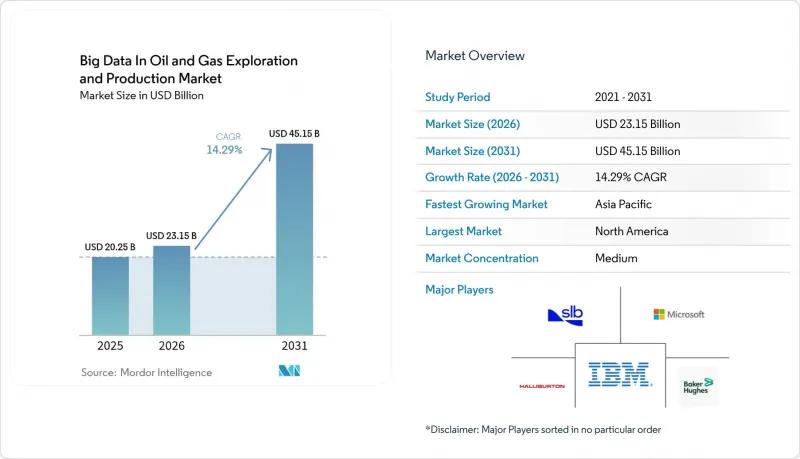
This report is Segmented by Component (Hardware, Software, and Services), Deployment Mode (On-Premise, Cloud, and Hybrid/Edge-Enabled), Data Type (Structured, Unstructured, and Semi-structured/Streaming), Application (Reservoir Management and EOR, Drilling and Well Planning, Predictive Maintenance, and More), and Geography (North America, Europe, Asia-Pacific, and More).
Global Big Data In Oil And Gas Exploration And Production Market Trends and Insights
Explosion of High-Frequency E&P Sensor Data
Modern rigs now carry more than 40,000 sensors that stream over 2 TB per well each day. Edge devices filter this torrent locally and then relay curated sets to cloud clusters for further processing. Real-time optimisation cuts non-productive time by up to 15% while raising wellbore placement accuracy. The International Energy Agency expects AI-linked industrial electricity demand to reach 1,500 TWh by 2030, underscoring the compute load behind these analytics . Operators already use multi-sensor correlation to predict equipment faults 72 hours ahead, lowering unplanned downtime by 25%.
Cost-Pressure Led Demand for Production Optimization
Low-margin environments prompt producers to extract every last drop from existing wells. ExxonMobil's automated gas-lift system delivered a 2.2% production uplift across 1,300 wells and trimmed USD 50 million in yearly costs . Machine-learning models review historical production, reservoir pressure, and ESP performance to identify underperforming assets. Vital Energy reported 2-4% lift-pump gains by continuously adjusting motor speed against downhole conditions. Baker Hughes' InjectRT software predicts chemical-injection needs with 90% accuracy, preventing overdosing and scale build-up.
Cyber-security & IP-Protection Concerns
More than half of the top oil and gas firms reported data breaches in 2024, with 69% scoring D or below on external security ratings. The blending of OT and IT networks opens fresh attack surfaces. Operators hesitate to move proprietary subsurface data-often worth billions-to public clouds despite the use of its strong encryption. Regulatory mosaics add extra hurdles; some jurisdictions insist seismic data stay within national borders. Together these issues slow universal adoption of shared analytics platforms.
Other drivers and restraints analyzed in the detailed report include:
- Cloud Migration of Subsurface Data Workloads
- Industry Adoption of OSDU Open Data Standard
- Legacy IT & Data-Silo Complexity
For complete list of drivers and restraints, kindly check the Table Of Contents.
Segment Analysis
Software contributed the largest 37.95% share of 2025 revenue, and it is forecast to grow at a 15.62% CAGR, underscoring that algorithm sophistication, not hardware count, drives the competitive edge in the Big Data market for oil and gas exploration & production. Providers bundle seismic interpretation, reservoir modelling, and predictive maintenance within cohesive suites that shorten time-to-value. Managed-service providers complement these offerings by deploying data scientists into field teams to operationalise models quickly.
Hardware retains relevance for high-performance computing and ruggedized edge gateways, yet cloud elasticity removes the need for constant capital expenditure (capex) refresh. Services-ranging from data integration to change-management training-help operators overcome legacy IT friction. As software matures, value migrates toward packaged use cases, such as automated gas-lift tuning or ESP failure prediction, that deliver measurable production gains within weeks.
On-premise estates still held a 41.90% share in 2025, reflecting perceived security benefits and regulatory mandates for local data storage. Even so, cloud workloads are growing at an 18.15% CAGR, the fastest of any deployment category within the big data market in oil and gas exploration & production. Hybrid architectures dominate: sensitive data sits inside operator firewalls while heavyweight simulations burst to cloud GPU clusters.
Edge computing provides the final layer, executing AI at the wellhead where milliseconds matter. This tiered model trims latency, controls bandwidth costs, and supports autonomous operations in remote basins. Vendors now offer pre-validated blueprints that streamline hybrid deployment, making the transition easier for conservative operators.
Complete Report Scope:
- By Component
- Hardware
- Software
- Services
- By Deployment Mode
- On-premise
- Cloud
- Hybrid/Edge-Enabled
- By Data Type
- Structured
- Unstructured
- Semi-structured/Streaming
- By Application
- Exploration and Seismic Imaging
- Drilling and Well Planning
- Production and Lift Optimization
- Reservoir Management and EOR
- Predictive Maintenance
- HSE and Emissions Monitoring
- Supply-Chain and Logistics
- Geography
- North America
- United States
- Canada
- Mexico
- Europe
- Germany
- United Kingdom
- France
- Italy
- NORDIC Countries
- Russia
- Rest of Europe
- Asia-Pacific
- China
- India
- Japan
- South Korea
- ASEAN Countries
- Rest of Asia-Pacific
- South America
- Brazil
- Argentina
- Colombia
- Rest of South America
- Middle East and Africa
- Saudi Arabia
- United Arab Emirates
- Qatar
- Nigeria
- South Africa
- Egypt
- Rest of Middle East and Africa
- North America
Geography Analysis
North America generated 37.25% of 2025 revenue, powered by shale players that pioneered horizontal drilling and data-rich completions. The region continues to scale automated gas-lift control and ESP analytics that deliver tangible cost savings. Government support for data-sharing consortia further expands the accessibility of subsurface libraries.
The Asia-Pacific region is the fastest-growing geography, projected to grow at an 18.42% CAGR through 2031. National oil companies in China and India are investing capital in AI-enabled exploration to enhance domestic supply security. Joint research programs between academia and industry accelerate the localization of algorithms for complex geology found in the South China Sea and Indian basins.
The Middle East leverages massive field datasets-Saudi Aramco alone stores 1,500 PB-to run AI models that optimise injection patterns across giant reservoirs. Europe focuses on emissions analytics to meet strict ESG rules, while South America adopts cloud platforms to overcome limited in-house computing capabilities. Collectively, these trends ensure the Big Data in oil and gas exploration & production market remains global in scope, yet locally nuanced in execution.
- IBM
- Schlumberger
- Halliburton
- Baker Hughes
- Microsoft
- AWS
- Google Cloud
- Oracle
- Accenture
- Palantir
- Cognite
- AspenTech
- GE Vernova
- Hitachi Vantara
- SAP SE
- Teradata
- Dell Technologies
- Spotfire/TIBCO
- C3 AI
- Emerson
- Pason Systems
Additional Benefits:
- The market estimate (ME) sheet in Excel format
- 3 months of analyst support
TABLE OF CONTENTS
1 Introduction
- 1.1 Study Assumptions & Market Definition
- 1.2 Scope of the Study
2 Research Methodology
3 Executive Summary
4 Market Landscape
- 4.1 Market Overview
- 4.2 Market Drivers
- 4.2.1 Explosion of high-frequency E&P sensor data
- 4.2.2 Cost-pressure led demand for production optimization
- 4.2.3 Cloud migration of subsurface data workloads
- 4.2.4 Industry adoption of OSDU open data standard
- 4.2.5 Edge / fog analytics at remote wellheads
- 4.2.6 ESG-driven methane-leak analytics mandates
- 4.3 Market Restraints
- 4.3.1 Cyber-security & IP-protection concerns
- 4.3.2 Legacy IT & data-silo complexity
- 4.3.3 Shortage of domain data-science talent
- 4.3.4 Regulatory-driven investment uncertainty
- 4.4 Supply-Chain Analysis
- 4.5 Regulatory Landscape
- 4.6 Technological Outlook
- 4.7 Porter's Five Forces
- 4.7.1 Bargaining Power of Suppliers
- 4.7.2 Bargaining Power of Buyers
- 4.7.3 Threat of New Entrants
- 4.7.4 Threat of Substitutes
- 4.7.5 Intensity of Rivalry
5 Market Size & Growth Forecasts
- 5.1 By Component
- 5.1.1 Hardware
- 5.1.2 Software
- 5.1.3 Services
- 5.2 By Deployment Mode
- 5.2.1 On-premise
- 5.2.2 Cloud
- 5.2.3 Hybrid/Edge-Enabled
- 5.3 By Data Type
- 5.3.1 Structured
- 5.3.2 Unstructured
- 5.3.3 Semi-structured/Streaming
- 5.4 By Application
- 5.4.1 Exploration and Seismic Imaging
- 5.4.2 Drilling and Well Planning
- 5.4.3 Production and Lift Optimization
- 5.4.4 Reservoir Management and EOR
- 5.4.5 Predictive Maintenance
- 5.4.6 HSE and Emissions Monitoring
- 5.4.7 Supply-Chain and Logistics
- 5.5 Geography
- 5.5.1 North America
- 5.5.1.1 United States
- 5.5.1.2 Canada
- 5.5.1.3 Mexico
- 5.5.2 Europe
- 5.5.2.1 Germany
- 5.5.2.2 United Kingdom
- 5.5.2.3 France
- 5.5.2.4 Italy
- 5.5.2.5 NORDIC Countries
- 5.5.2.6 Russia
- 5.5.2.7 Rest of Europe
- 5.5.3 Asia-Pacific
- 5.5.3.1 China
- 5.5.3.2 India
- 5.5.3.3 Japan
- 5.5.3.4 South Korea
- 5.5.3.5 ASEAN Countries
- 5.5.3.6 Rest of Asia-Pacific
- 5.5.4 South America
- 5.5.4.1 Brazil
- 5.5.4.2 Argentina
- 5.5.4.3 Colombia
- 5.5.4.4 Rest of South America
- 5.5.5 Middle East and Africa
- 5.5.5.1 Saudi Arabia
- 5.5.5.2 United Arab Emirates
- 5.5.5.3 Qatar
- 5.5.5.4 Nigeria
- 5.5.5.5 South Africa
- 5.5.5.6 Egypt
- 5.5.5.7 Rest of Middle East and Africa
- 5.5.1 North America
6 Competitive Landscape
- 6.1 Market Concentration
- 6.2 Strategic Moves (M&A, Partnerships, PPAs)
- 6.3 Market Share Analysis (Market Rank/Share for key companies)
- 6.4 Company Profiles (includes Global level Overview, Market level overview, Core Segments, Financials as available, Strategic Information, Products & Services, and Recent Developments)
- 6.4.1 IBM
- 6.4.2 Schlumberger
- 6.4.3 Halliburton
- 6.4.4 Baker Hughes
- 6.4.5 Microsoft
- 6.4.6 AWS
- 6.4.7 Google Cloud
- 6.4.8 Oracle
- 6.4.9 Accenture
- 6.4.10 Palantir
- 6.4.11 Cognite
- 6.4.12 AspenTech
- 6.4.13 GE Vernova
- 6.4.14 Hitachi Vantara
- 6.4.15 SAP SE
- 6.4.16 Teradata
- 6.4.17 Dell Technologies
- 6.4.18 Spotfire/TIBCO
- 6.4.19 C3 AI
- 6.4.20 Emerson
- 6.4.21 Pason Systems
7 Market Opportunities & Future Outlook
- 7.1 White-space & Unmet-Need Assessment

