PUBLISHER: Mordor Intelligence | PRODUCT CODE: 2113864

PUBLISHER: Mordor Intelligence | PRODUCT CODE: 2113864
North America Ophthalmic Drugs And Devices - Market Share Analysis, Industry Trends & Statistics, Growth Forecasts (2026 - 2031)
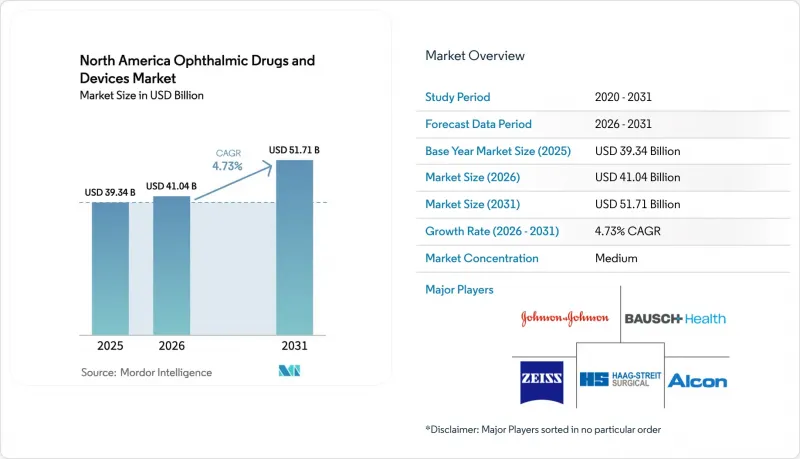
According to Mordor Intelligence, the North America ophthalmic drugs and devices market size is expected to grow from USD 39.34 billion in 2025 to USD 41.04 billion in 2026 and is forecast to reach USD 51.71 billion by 2031 at 4.73% CAGR over 2026-2031.
This report is Segmented by Product Type (Diagnostic & Monitoring Devices, Surgical Devices, Vision Care Products, Drug Class), Application (Cataract, Glaucoma, Refractive Errors, Retinal Disorders, Dry-Eye & Ocular Surface), End User (Hospitals & Eye Clinics, Ascs, and More), and Geography (United States, Canada, Mexico). Market Forecasts are Provided in Terms of Value (USD).
North America Ophthalmic Drugs And Devices Market Trends and Insights
Aging Population and Cataract-Glaucoma Burden
By 2030, the 65-plus population in North America will total 83 million, representing a 35% jump from 2020 and accounting for 92% of age-related macular degeneration cases and 78% of primary open-angle glaucoma cases. Cataract prevalence among Americans older than 75 climbed to 68% in 2024, up from 61% five years earlier, reflecting longer life expectancy and higher diabetes incidence. Canada's National Institute on Ageing projects that seniors will make up one-quarter of the population by 2030, a shift already stretching cataract wait-lists that average 6.2 months in Ontario and British Columbia. Mexico's aging curve lags but accelerates after 2028, prompting cross-border demand for U.S. procedures as the 60-plus cohort grows at 4.1% annually. This demographic momentum sustains steady cataract and glaucoma procedure pipelines that, in turn, support equipment upgrades and sustained drug dispensing.
Technological Advances in Minimally Invasive Surgery
Femtosecond laser-assisted cataract surgery penetrated 38% of U.S. premium cases in 2025 because blade-free capsulotomies cut posterior capsule rupture risk to 0.14% versus 0.92% for manual techniques. The iStent Infinite, cleared in 2024, places three micro-bypass stents through one injector and achieved an 18 mmHg mean intraocular pressure drop at 12 months in the APEX study. Lensar's ALLY system overlays augmented-reality guidance on real-time OCT and was adopted by 127 U.S. ASCs in ten months. Canada reimburses FLACS only with premium IOLs, so 62% of 2025 cases were private-pay.
High Cost of Advanced Devices & Limited Procedure Reimbursement
A fully equipped ophthalmic ASC requires USD 1.2-2.5 million for a femtosecond laser, swept-source OCT, phaco system, and microscope, making entry into the market tough for independents. Alcon's Centurion system is listed at USD 135,000 in 2025, whereas J&J's Catalys laser costs USD 650,000 or USD 9,500 monthly under a seven-year lease. Independent ASCs doing fewer than 800 cataract cases a year face payback periods of more than 4 years. Canadian capital budgets fell 8% in real terms from 2020-2024, forcing hospitals to stretch equipment cycles to 15 years. Mexico's clinics pay 12-18% import tariffs on U.S. devices, raising landed costs outside major metros.
Other drivers and restraints analyzed in the detailed report include:
- AI Powered Diagnostic Imaging Adoption
- Outpatient ASC Procedure Growth
- Stringent FDA Approval Timelines
For complete list of drivers and restraints, kindly check the Table Of Contents.
Segment Analysis
Diagnostics commanded 51.12% of 2025 revenue as swept-source OCT, fundus cameras and rebound tonometers became standard equipment in 92% of new office installations. The drug class will grow at 6.33% through 2031, overtaking hardware, as anti-VEGF biosimilars and novel dry-eye agents expand therapeutic volumes. Surgical devices grew 4.1% in 2024-2025 as premium toric and EDOF lenses lifted procedure revenue despite saturated monofocal demand. Vision care products face refractive-surgery headwinds, yet gain from myopia-control offerings aimed at children.
Swept-source OCT platforms such as Zeiss Cirrus 6000 displaced time-domain systems largely because 1050 nm wavelengths penetrate dense cataracts and capture 100,000 A-scans per second, a leap that enables widefield angiography. Fundus cameras integrating AI diabetic retinopathy software reached 41% of U.S. primary care deployments by mid-2025. Intraocular lens innovation is anchored by light-adjustable materials; RxSight's LAL secured 12% of U.S. premium placements in 2025.
Complete Report Scope:
- By Product Type
- Diagnostic & Monitoring Devices
- Optical Coherence Tomography Scanners
- Fundus Cameras
- Tonometers
- Other Diagnostic Devices
- Surgical Devices
- Intra-ocular Lenses
- Ophthalmic Lasers
- Phacoemulsification Systems
- Other Surgical Devices
- Vision Care Products
- Drug Class
- Anti-VEGF Agents
- Anti-inflammatory/Ocular NSAIDs
- Glaucoma Therapeutics (Prostaglandin Analogues, B-Blockers, Others)
- Anti-infectives
- Dry-Eye Therapies
- Diagnostic & Monitoring Devices
- By Application
- Cataract
- Glaucoma
- Refractive Errors
- Retinal Disorders
- Dry-Eye & Ocular Surface
- By End User
- Hospitals & Eye Clinics
- Ambulatory Surgery Centers (ASCs)
- Specialty Ophthalmic Centers
- By Country
- United States
- Canada
- Mexico
List of Companies Covered in this Report:
- Alcon
- Bausch Health
- BVI Medical
- Canon
- Carl Zeiss
- The Cooper Companies
- EssilorLuxottica
- Glaukos Corp.
- HOYA
- HAAG-Streit
- Iridex
- Johnson & Johnson
- Lensar Inc.
- Lumenis
- Nidek
- Optovue (a Zeiss company)
- RxSight Inc.
- Santen Pharmaceutical
- STAAR Surgical
- Topcon
- Ziemer Group
Additional Benefits:
- The market estimate (ME) sheet in Excel format
- 3 months of analyst support
TABLE OF CONTENTS
1 Introduction
- 1.1 Study Assumptions & Market Definition
- 1.2 Scope of the Study
2 Research Methodology
3 Executive Summary
4 Market Landscape
- 4.1 Market Overview
- 4.2 Market Drivers
- 4.2.1 Aging Population & Cataract-Glaucoma Burden
- 4.2.2 Technological Advances in Minimally Invasive Surgery
- 4.2.3 AI-Powered Diagnostic Imaging Adoption
- 4.2.4 Outpatient ASC Procedure Growth
- 4.2.5 VC Funding in Ophthalmic Robotics & Digital Platforms
- 4.2.6 Smart Drug-Delivery Implants Creating Combo Solutions
- 4.3 Market Restraints
- 4.3.1 High Capital Cost of Advanced Equipment
- 4.3.2 Stringent FDA Approval Timelines
- 4.3.3 Shortage of Skilled Ophthalmic Technicians
- 4.3.4 Sustainability Push Against Single-Use Devices
- 4.4 Regulatory Landscape
- 4.5 Technological Outlook
- 4.6 Porter's Five Forces Analysis
- 4.6.1 Threat of New Entrants
- 4.6.2 Bargaining Power of Buyers
- 4.6.3 Bargaining Power of Suppliers
- 4.6.4 Threat of Substitute Products
- 4.6.5 Intensity of Competitive Rivalry
5 Market Size & Growth Forecasts
- 5.1 By Product Type
- 5.1.1 Diagnostic & Monitoring Devices
- 5.1.1.1 Optical Coherence Tomography Scanners
- 5.1.1.2 Fundus Cameras
- 5.1.1.3 Tonometers
- 5.1.1.4 Other Diagnostic Devices
- 5.1.2 Surgical Devices
- 5.1.2.1 Intra-ocular Lenses
- 5.1.2.2 Ophthalmic Lasers
- 5.1.2.3 Phacoemulsification Systems
- 5.1.2.4 Other Surgical Devices
- 5.1.3 Vision Care Products
- 5.1.4 Drug Class
- 5.1.4.1 Anti-VEGF Agents
- 5.1.4.2 Anti-inflammatory/Ocular NSAIDs
- 5.1.4.3 Glaucoma Therapeutics (Prostaglandin Analogues, B-Blockers, Others)
- 5.1.4.4 Anti-infectives
- 5.1.4.5 Dry-Eye Therapies
- 5.1.1 Diagnostic & Monitoring Devices
- 5.2 By Application
- 5.2.1 Cataract
- 5.2.2 Glaucoma
- 5.2.3 Refractive Errors
- 5.2.4 Retinal Disorders
- 5.2.5 Dry-Eye & Ocular Surface
- 5.3 By End User
- 5.3.1 Hospitals & Eye Clinics
- 5.3.2 Ambulatory Surgery Centers (ASCs)
- 5.3.3 Specialty Ophthalmic Centers
- 5.4 By Country
- 5.4.1 United States
- 5.4.2 Canada
- 5.4.3 Mexico
6 Competitive Landscape
- 6.1 Market Concentration
- 6.2 Market Share Analysis
- 6.3 Company Profiles (includes Global Level Overview, Market Level Overview, Core Segments, Financials as Available, Strategic Information, Market Rank/Share for Key Companies, Products & Services, and Recent Developments)
- 6.3.1 Alcon Inc.
- 6.3.2 Bausch Health Companies Inc. (Bausch + Lomb)
- 6.3.3 BVI Medical
- 6.3.4 Canon Medical Systems
- 6.3.5 Carl Zeiss Meditec AG
- 6.3.6 CooperVision
- 6.3.7 EssilorLuxottica
- 6.3.8 Glaukos Corp.
- 6.3.9 HOYA Corporation
- 6.3.10 Haag-Streit Group
- 6.3.11 IRIDEX Corp.
- 6.3.12 Johnson & Johnson
- 6.3.13 Lensar Inc.
- 6.3.14 Lumenis Ltd.
- 6.3.15 NIDEK Co., Ltd.
- 6.3.16 Optovue (a Zeiss company)
- 6.3.17 RxSight Inc.
- 6.3.18 Santen Pharmaceutical
- 6.3.19 STAAR Surgical
- 6.3.20 Topcon Corporation
- 6.3.21 Ziemer Ophthalmic Systems
7 Market Opportunities & Future Outlook
- 7.1 White-space & Unmet-Need Assessment

