PUBLISHER: Mordor Intelligence | PRODUCT CODE: 2113874

PUBLISHER: Mordor Intelligence | PRODUCT CODE: 2113874
Smart Pills Diagnostics - Market Share Analysis, Industry Trends & Statistics, Growth Forecasts (2026 - 2031)
According to Mordor Intelligence, the smart pills diagnostics market size is expected to grow from USD 1.21 billion in 2025 to USD 1.34 billion in 2026 and is forecast to reach USD 2.19 billion by 2031 at 10.38% CAGR over 2026-2031.
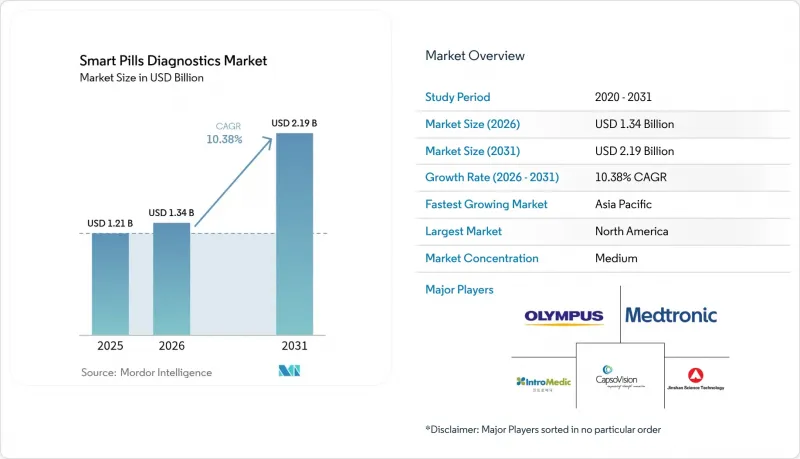
This report is Segmented by Indication (GI Bleeding, Crohn's Disease, Small-Bowel Tumors, Celiac Disease, Other GI Diagnoses), Component (Capsule Endoscope, Imaging Software & Workstations, Data Recorder & Receivers, Other Accessories), End User (Hospitals, Diagnostic Imaging Centers, and More), and Geography (North America and More). The Market Forecasts are Provided in Terms of Value (USD).
Global Smart Pills Diagnostics Market Trends and Insights
Rising Prevalence of Gastrointestinal Disorders
Inflammatory bowel disease now affects 3.1 million U.S. adults, with global incidence climbing 2%-3% annually as diet, urbanization, and enhanced diagnostic awareness shift disease patterns.Persistent conditions such as Crohn's disease and ulcerative colitis require repeated mucosal assessments, making capsule imaging a recurring revenue stream. Early detection of small-bowel tumors through capsule visualization reduces the need for exploratory surgery and accelerates oncologic intervention. The doubling of celiac disease prevalence over two decades further boosts demand for second-line capsule imaging when biopsy results are inconclusive. These epidemiologic trends align most strongly with aging, higher-BMI populations in North America and Europe. The World Health Organization estimates that non-communicable digestive disorders will claim 15% of global disability-adjusted life years by 2030, reinforcing the strategic value of early, noninvasive diagnostics.
Demand for Minimally Invasive Diagnostic Modalities
Patient preference for sedation-free, same-day discharge procedures is reshaping GI workflows. Capsule endoscopy eliminates bowel insufflation and anesthesia risks, aligning with value-based care incentives. A 2024 study in Gastrointestinal Endoscopy reported that 78% of patients preferred capsules when clinically appropriate, citing comfort and convenience. Ambulatory surgery centers offer capsule imaging 30%-50% below hospital prices, accelerating uptake among self-pay and high-deductible patients. CMS broadened capsule coverage in 2024 for suspected small-bowel bleeding, easing prior authorization and spurring immediate demand. Pilot programs in Australia and Canada mirror these U.S. shifts, signaling international momentum.
High Upfront Device & Reader Costs
Capital requirements of USD 40,000-80,000 for recorders and workstations hinder adoption in community facilities, while single-use capsules priced at USD 500-2,000 strain budgets where reimbursement is partial or absent. A 2024 survey of Indian GI practices found 62% citing equipment cost as the top barrier to offering capsule studies, despite strong clinical demand. Pay-per-use and leasing models are emerging but depend on robust credit infrastructure seldom present in low-income regions, sustaining a cost headwind through the near term.
Other drivers and restraints analyzed in the detailed report include:
- Favorable Reimbursement for Capsule Endoscopy in OECD Markets
- Rapid CMOS Sensor and AI Image-Analysis Advances
- Uneven Reimbursement in Emerging Economies
For complete list of drivers and restraints, kindly check the Table Of Contents.
Segment Analysis
Crohn's disease leads with a 12.88% CAGR to 2031 as biologic therapy monitoring requires serial mucosal imaging. Gastrointestinal bleeding maintained 39.10% of smart pills diagnostics market share in 2025 thanks to its acute presentation and limited alternative diagnostics. Small-bowel tumors benefit from full intestinal visualization unavailable in traditional scopes, while celiac disease remains a stable, secondary niche. A 2024 Lancet study found capsule imaging altered management in 42% of Crohn's patients, accelerating biologic initiation and lowering hospitalization rates. Regulatory fast-track pathways for indication-specific capsules shorten development cycles, enabling manufacturers to target these high-growth chronic indications.
Complete Report Scope:
- By Indication
- Gastrointestinal Bleeding
- Crohn's Disease
- Small-Bowel Tumors
- Celiac Disease
- Other GI Diagnoses
- By Component
- Capsule Endoscope
- Imaging Software & Workstations
- Data Recorder & Receivers
- Other Accessories
- By End User
- Hospitals
- Diagnostic Imaging Centers
- Ambulatory Surgery Centers
- Research Institutes
- By Geography
- North America
- United States
- Canada
- Mexico
- Europe
- Germany
- United Kingdom
- France
- Italy
- Spain
- Rest of Europe
- Asia-Pacific
- China
- Japan
- India
- Australia
- South Korea
- Rest of Asia-Pacific
- Middle East & Africa
- GCC
- South Africa
- Rest of Middle East & Africa
- South America
- Brazil
- Argentina
- Rest of South America
- North America
Geography Analysis
North America held 40.85% of 2025 revenue, supported by Medicare reimbursement and a dense network of inflammatory bowel disease centers. FDA pediatric clearance of CapsoCam Plus in 2025 further widens the addressable base. Canada pilots capsule imaging for iron-deficiency anemia, cutting colonoscopy waits, whereas Mexico's private sector drives urban uptake amid public-budget limits.
Asia-Pacific is projected to expand at a 12.31% CAGR, the fastest globally, propelled by streamlined approvals in China, Japan, and India. Japan's 12% reimbursement boost in 2024 underscores its emphasis on early detection, while India's shortened approval timelines encourage both domestic and foreign entrants. Australia and South Korea extend coverage for broader indications, bolstering tertiary-care adoption.
Europe, the Middle East & Africa, and South America grow more steadily. Germany funds capsule imaging with no copay for documented small-bowel pathology, while the U.K. reimburses GBP 450 per procedure but faces staffing constraints. Gulf states adopt rapidly via medical tourism channels. South Africa and Brazil remain constrained by partial or absent reimbursement, tempering near-term volume gains.
- Ankon Medical Technologies
- Atmo Biosciences Ltd.
- BodyCap Medical
- CapsoVision
- Check-Cap Ltd.
- etectRx
- HQ
- IntroMedic Co., Ltd.
- Jinshan Science & Technology Co., Ltd.
- Koninklijke Philips
- Medtronic
- Motilis Medica SA
- Olympus
- Otsuka
- Ovesco Endoscopy
- PENTAX Medical (HOYA Corporation)
- PillSense Ltd.
- RF System Lab
Additional Benefits:
- The market estimate (ME) sheet in Excel format
- 3 months of analyst support
TABLE OF CONTENTS
1 Introduction
- 1.1 Study Assumptions & Market Definition
- 1.2 Scope of the Study
2 Research Methodology
3 Executive Summary
4 Market Landscape
- 4.1 Market Overview
- 4.2 Market Drivers
- 4.2.1 Rising Prevalence of Gastrointestinal (GI) Disorders
- 4.2.2 Demand For Minimally-Invasive Diagnostic Modalities
- 4.2.3 Favorable Reimbursement For Capsule Endoscopy in OECD Markets
- 4.2.4 Rapid CMOs Sensor & AI Image-Analysis Advances
- 4.2.5 Integration Of Gas-Sensing Capsules For Microbiome Diagnostics
- 4.2.6 Space-Flight R&D Spin-Offs Enabling Ultra-Low-Power Telemetry
- 4.3 Market Restraints
- 4.3.1 High Upfront Device & Reader Costs
- 4.3.2 Uneven Reimbursement In Emerging Economies
- 4.3.3 Patient Reluctance to Swallow Electronic Devices
- 4.3.4 Electromagnetic Interference Concerns in Pacemaker Patients
- 4.4 Value/ Supply Chain Analysis
- 4.5 Regulatory Landscape
- 4.6 Technological Outlook
- 4.7 Porter's Five Forces Analysis
- 4.7.1 Threat of New Entrants
- 4.7.2 Threat of Substitutes
- 4.7.3 Bargaining Power of Buyers
- 4.7.4 Bargaining Power of Suppliers
- 4.7.5 Competitive Rivalry
5 Market Size & Growth Forecasts (Value, USD)
- 5.1 By Indication
- 5.1.1 Gastrointestinal Bleeding
- 5.1.2 Crohn's Disease
- 5.1.3 Small-Bowel Tumors
- 5.1.4 Celiac Disease
- 5.1.5 Other GI Diagnoses
- 5.2 By Component
- 5.2.1 Capsule Endoscope
- 5.2.2 Imaging Software & Workstations
- 5.2.3 Data Recorder & Receivers
- 5.2.4 Other Accessories
- 5.3 By End User
- 5.3.1 Hospitals
- 5.3.2 Diagnostic Imaging Centers
- 5.3.3 Ambulatory Surgery Centers
- 5.3.4 Research Institutes
- 5.4 By Geography
- 5.4.1 North America
- 5.4.1.1 United States
- 5.4.1.2 Canada
- 5.4.1.3 Mexico
- 5.4.2 Europe
- 5.4.2.1 Germany
- 5.4.2.2 United Kingdom
- 5.4.2.3 France
- 5.4.2.4 Italy
- 5.4.2.5 Spain
- 5.4.2.6 Rest of Europe
- 5.4.3 Asia-Pacific
- 5.4.3.1 China
- 5.4.3.2 Japan
- 5.4.3.3 India
- 5.4.3.4 Australia
- 5.4.3.5 South Korea
- 5.4.3.6 Rest of Asia-Pacific
- 5.4.4 Middle East & Africa
- 5.4.4.1 GCC
- 5.4.4.2 South Africa
- 5.4.4.3 Rest of Middle East & Africa
- 5.4.5 South America
- 5.4.5.1 Brazil
- 5.4.5.2 Argentina
- 5.4.5.3 Rest of South America
- 5.4.1 North America
6 Competitive Landscape
- 6.1 Market Concentration
- 6.2 Market Share Analysis
- 6.3 Company Profiles (includes Global level Overview, Market-level Overview, Core Segments, Financials, Strategic Info, Market Rank/Share, Products & Services, Recent Developments)
- 6.3.1 Ankon Medical Technologies
- 6.3.2 Atmo Biosciences Ltd.
- 6.3.3 BodyCap Medical
- 6.3.4 CapsoVision Inc.
- 6.3.5 Check-Cap Ltd.
- 6.3.6 etectRx Inc.
- 6.3.7 HQ Inc.
- 6.3.8 IntroMedic Co., Ltd.
- 6.3.9 Jinshan Science & Technology Co., Ltd.
- 6.3.10 Koninklijke Philips N.V.
- 6.3.11 Medtronic plc
- 6.3.12 Motilis Medica SA
- 6.3.13 Olympus Corporation
- 6.3.14 Otsuka Pharmaceutical Co., Ltd.
- 6.3.15 Ovesco Endoscopy AG
- 6.3.16 PENTAX Medical (HOYA Corporation)
- 6.3.17 PillSense Ltd.
- 6.3.18 RF System Lab
7 Market Opportunities & Future Outlook
- 7.1 White-space & Unmet-Need Assessment

